|
|



|
|
|


6000-series Gallery 21
|
|
|
|
|
6000-series Gallery 21
 |
cta6021_19540825.jpg (212k) First-generation 6000-series car 6021 is assigned to the Douglas-Loop service in this August 25, 1954 view at Paulina Junction, and is displaying a Train Identification Coil on the front corner of the train under the motorcab. The Train Identification Coil, or "identra coil", was an electronic device carried by the lead car of a train for automatic operation at an interlocked junction, to detect the type (route) of train approaching and set the switches automatically, negating the need to staff a tower at that location to sort trains. They were first used for Douglas trains at Paulina Junction in 1954, and later at Loomis Junction starting in 1958. The train also carries a sign on its front chains identifying it as stopping at Wood Street station--amidst a series of changes to economize and speed up Douglas service in 1951, several stations were closed while a few others, like Wood, became "partial service stations", which were unstaffed and served only by a limited number of trains that also skipped the adjacent stop (in the case of Wood, 18th station). Wood closed in 1957. (Photo courtesy of the Krambles-Peterson Archive) |
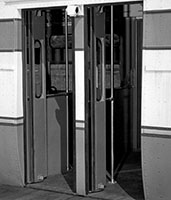 |
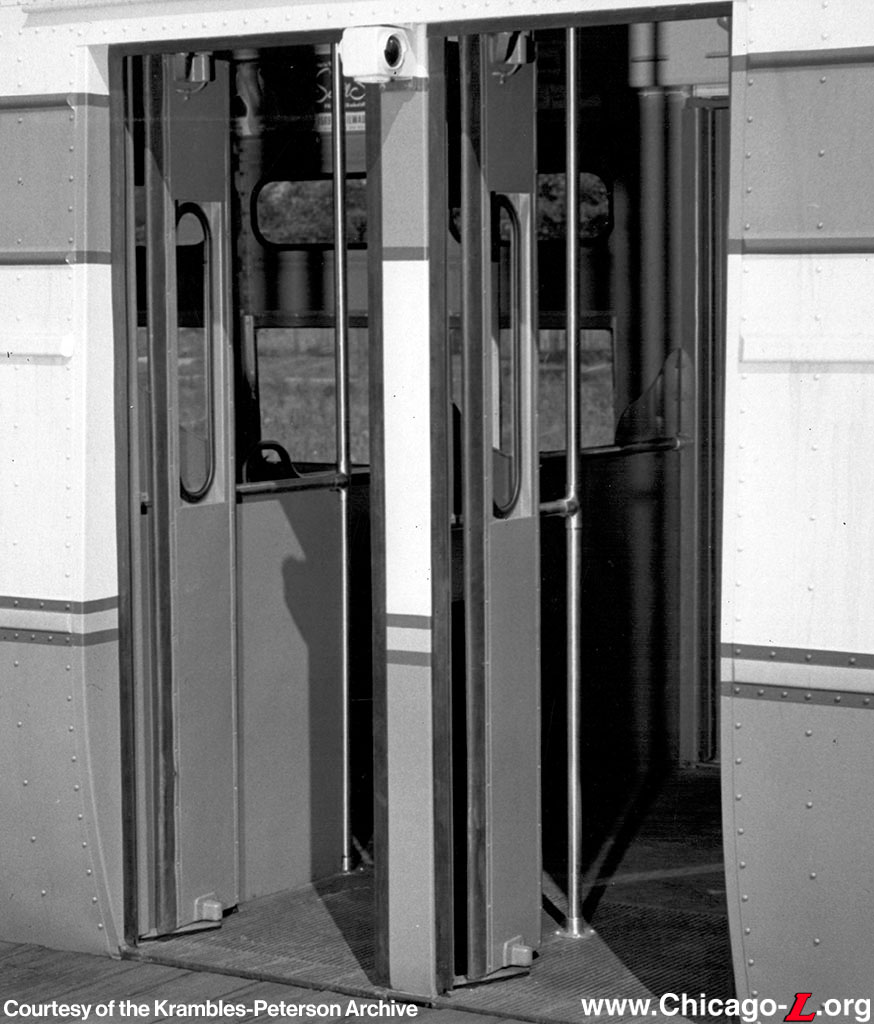
cta6001-02_19500800_sidedoor.jpg (175k) A set of sidedoors on a "flat door six" -- in this case, the first cars of the series, 6001-6002 -- are seen at Logan Square in August 1950. Although the sides of the carbody are curved (more precisely, they have a "fishbelly" profile), the door panels are flat, requiring a jamb be to designed into the recessed doorway to properly frame the doors. This door design was only used on the first 200 6000-series cars. Also note the original door open/cut-out indicator light location, as a projecting module between the doorsets. Having this housing project out from the carside ended up having issues, including damage caused by the automatic car washer at Howard, resulting in CTA changing the location/mounting arrangements for this to a carside-mounted indicator. (Photo courtesy of the Krambles-Peterson Archive) |
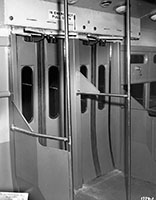 |
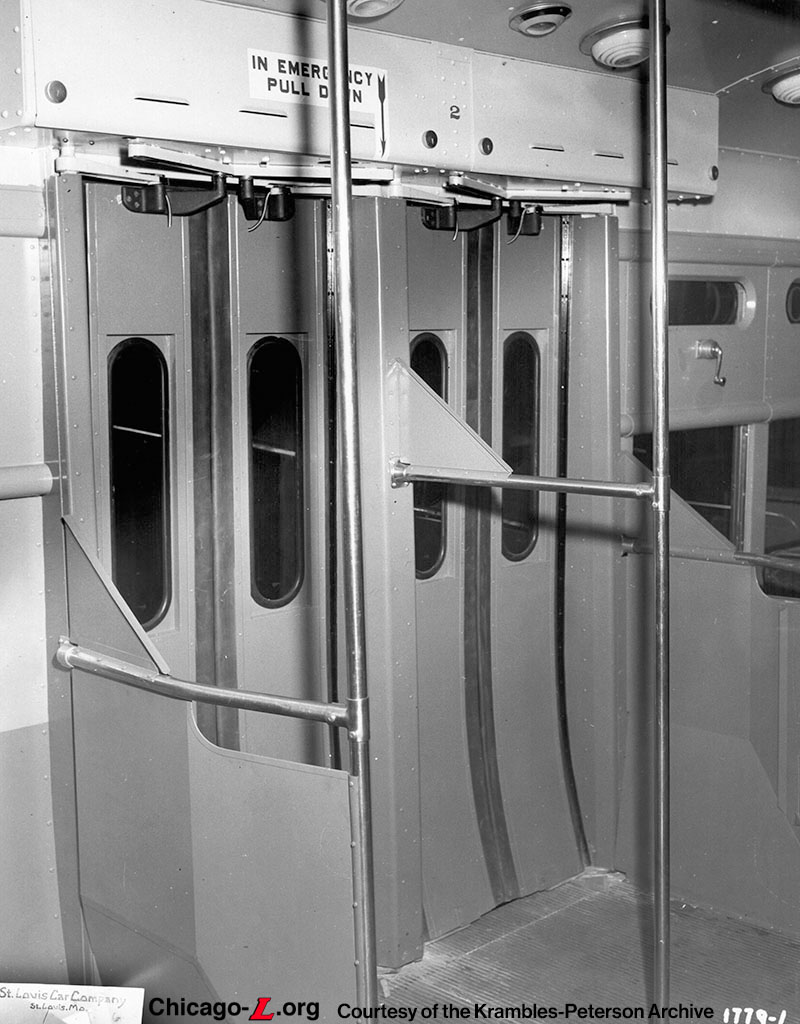
cta6220_19540000_int_sidedoor.jpg (177k) Starting with car 6201 and maintained through the rest of the series (as well as their single-car cousins, the 1-50 series), the sidedoors on the 6000s were redesigned to be curved, following the shape of the rest of the carbody, as seen here on car 6220 still at the builder, St. Louis Car Company, in 1954. This both eliminated the need for the recess in the carbody for the doors and created a more streamlined appearance for the cars' exteriors. (Photo courtesy of the Krambles-Peterson Archive) |
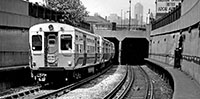 |
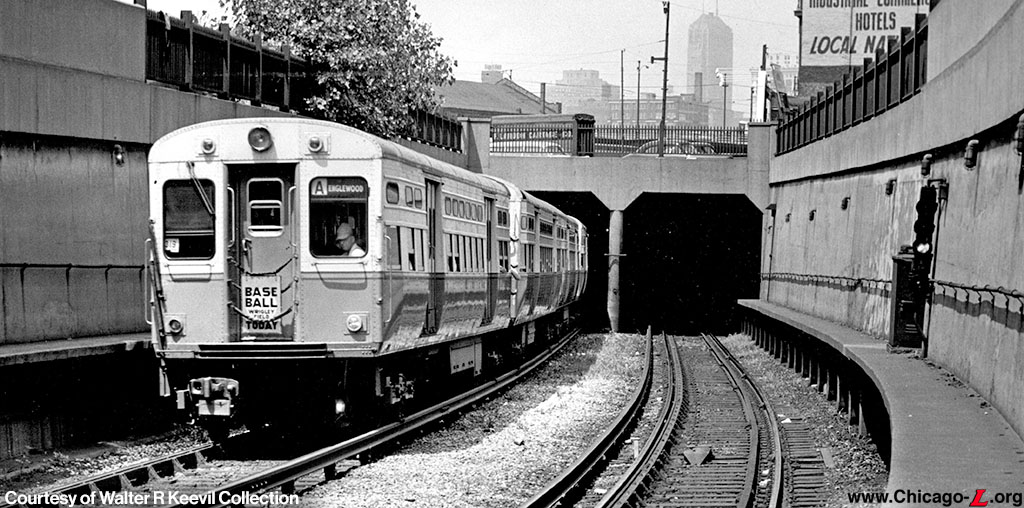
cta6134_19540000.jpg (192k) Car 6134 leads a southbound train out of the State Street Subway at the 13th Street Portal on its way to Englewood. Although taken in July 1954, this view of the shows the standard signal and trip installation location adopted with the opening of the subway in 1943. On Track A (normal northbound) to the right of the 6134, you can see a signal displaying a stop aspect, with its associated trip (between the third rail and the running rail) in the "up" position. The US&S air trip mechanism is located between the guard rails of this track. (Photo courtesy of the Walter R. Keevil Collection) |
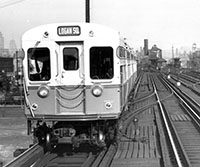 |
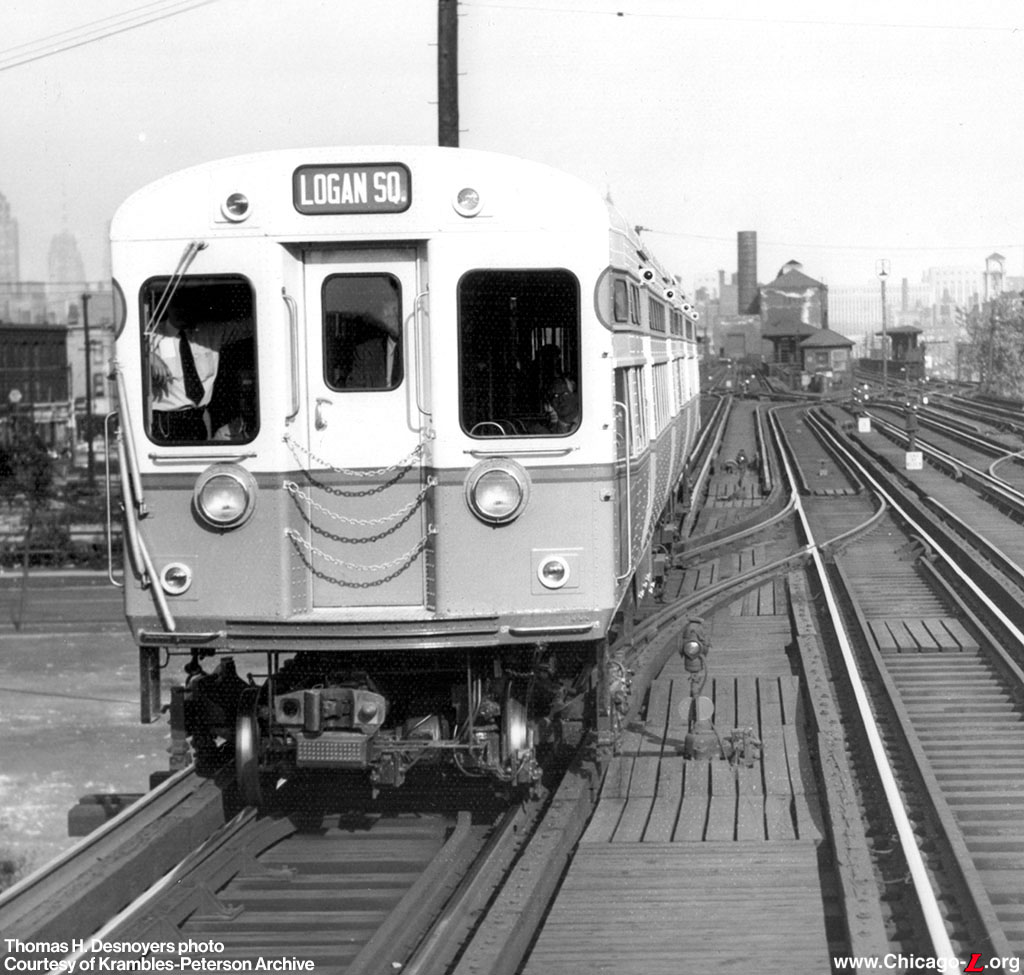
cta6001_19500917.jpg (211k) This striking image of the brand-new 6001-02 was taken from the north platform at the Marshfield station on the "Met Mainline" on September 17, 1950. The cars display the original arrangement of the center trip, using steel piping to create a framework from which to suspend the center trip -- it's visible immediately to the right and slightly below the coupler in this view. The side trip can be seen ahead of the right-hand running wheel. A later change order would move the center trip to a truck-mounted design. (Photo by Tom Desnoyers, courtesy of the Krambles-Peterson Archive) |
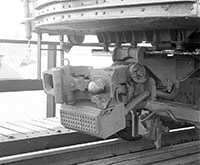 |
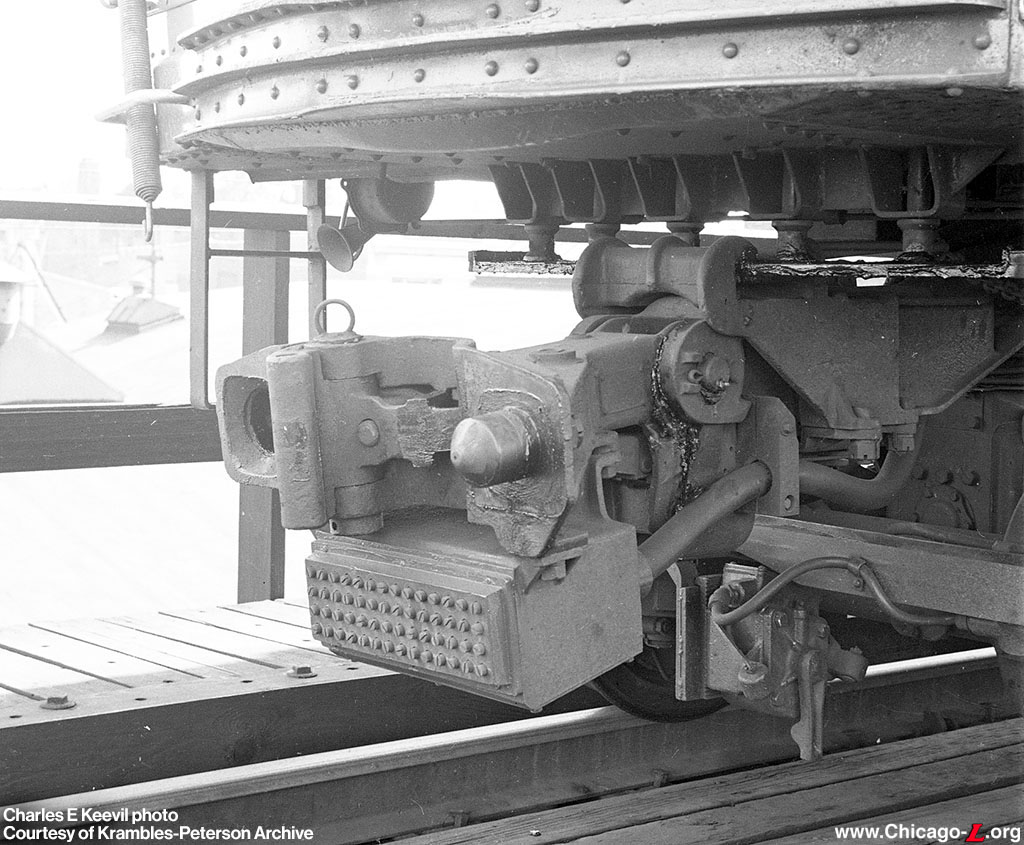
cta6034_19510906_coupler+trip_detail.jpg (231k) Modification of the 6000-series cars built with the original carbody-mounted center trip is shown in this view of car 6034, taken on September 6, 1951. The relocated center trip equipment can be seen to right and below the coupler in this view. Your eyes don't deceive you! The coupler on the 6034 is drooping a touch. This was due to damage sustained in a collision. You can also see further evidence of damage along the ribs of this car's anticlimber. (Photo by Charles E. Keevil, courtesy of the Krambles-Peterson Archive) |
|
|
|