|
|



|
|
|


.
Marker Lights
|
|
|
|
|
.
Marker Lights
For passengers, the most typical method of identifying trains and their routes is a roller curtain or run board displaying the destination or route. But for towerman, supervisors, and other operating employees (not to mention savvy riders), there's another way: marker lights.
Markers are sets of lights on the front of "L" cars that indicate what route the train is running. There are two sets of lights (one on the right side of the car, one on the left), each having four colors: red, green, yellow (amber), and white. Different combinations of these colors indicate different routes.
|
Marker Light History/Operation | Marker Route Identification
|
Marker Light History/Operation
|
Northwestern
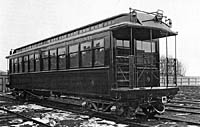
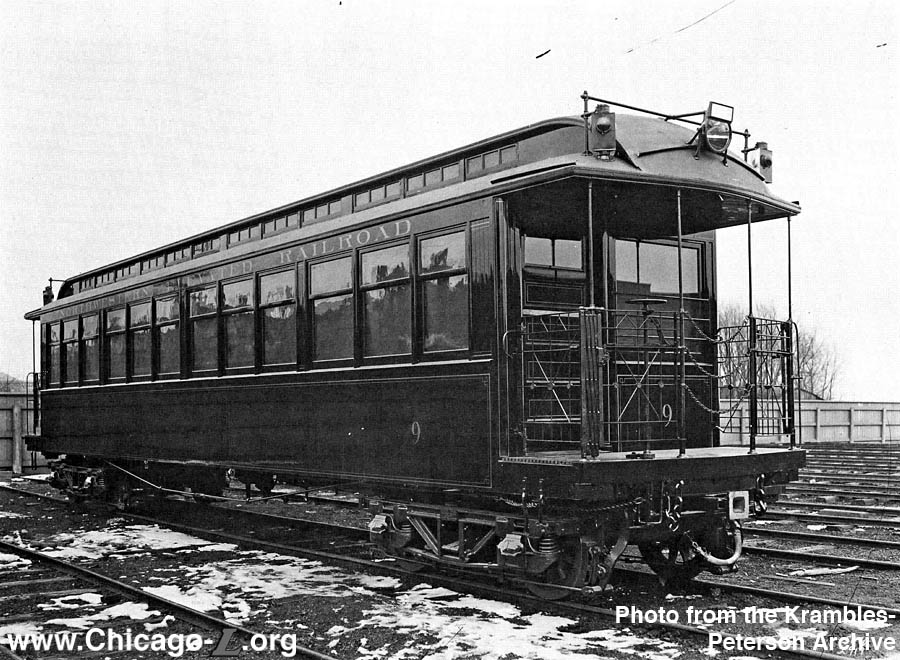
Elevated car 9 (top) shows the typical
marker-headlight arrangement for "railroad roof"
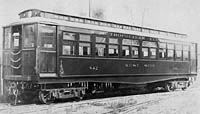
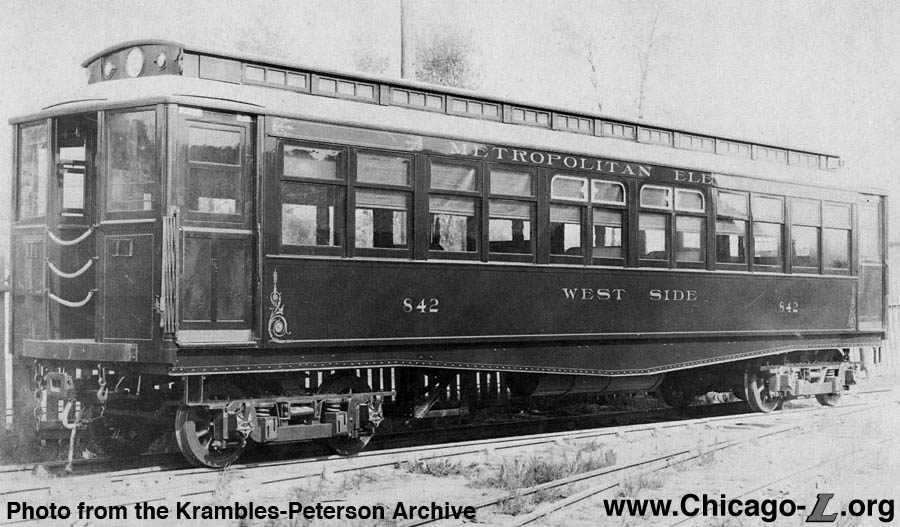
cars while Metropolitan Elevated car 842 (above)
shows how the markers and headlight were integrated
into the squared end of the clerestory on "monitor
roof" cars. For a larger view of NWERR car 9, click
here.
For a larger view of Met car 842, click
here.
(Photos courtesy of the Krambles-Peterson
Archive) The first company that seems to have used marker lights was the Metropolitan West Side Elevated, whose motor cars and controller trailers were equipped with them from the beginning. The Metropolitan had a myriad of different car designs, compounded by the free hand that shopmen apparently had in rebuilding damaged cars, but as far as roof design goes there were two main types. Nearly all of the Met's trailers and control trailers, as well as some motor cars had traditional "railroad" type roofs, a two-level roof with small windows in a clerestory that provided light and ventilation and whose ends curved down, tapering and blending into the lower part of the roof. Meanwhile, a good portion of the Met's motor cars (as well as the 2250-67 series trailers) had "monitor" roofs: a roof topped with a clerestory with square ends, looking perhaps like a coffin or box sitting on top of the roof. The railroad roof motors and control trailers had an elaborate set of hardware on the ends of the roofs that included marker lights and a headlight. The markers were four-sided lanterns, each side with a colored lens, that were mounted to the lower part of the roof, one on each side of the clerestory. A headlight was mounted in the front center of the roof on the sloping part of the clerestory. A horizontal bar ran between the tops of the two marker lights and connected to the headlight in between. The marker lanterns could spin on their mounting, allowing whichever colored lens needed to be used to be spun into the front position. The monitor roof cars, on the other hand, had their headlight and markers built into the squared end of the upper part of the roof. A single headlight was in the middle, while one marker lens was on either side. The color of the light behind the lens must have been changeable from inside the cars. Following the electrification of the first two "L" lines -- the Lake Street in 1895-96 and the South Side in 1897-98 -- the converted motor cars were given marker lights. By this time, their lines had some varying types of runs and were mingling with the other companies' trains on the loop so this type of identification became necessary for towermen. Both companies' fleets consisted entirely of railroad roof cars and a setup similar to the Met's was installed on the Lake Street's motorcars. The South Side's motorcars got the marker lanterns on each side of the clerestory but lacked a headlight or horizontal connecting bar. The South Side's lanterns, which also seemed to be smaller and have fewer lenses than the other companies' cars, were mounted on an L-shaped pipe that went directly into the side of the sloping end of the roof clerestory. The Northwestern Elevated was the last company on the scene and had the same marker-headlight arrangement as the Lake Street and Met railroad-roof cars, though in a slightly different assembly. The Northwestern's roof equipment was further complicated by the later addition of destination sign boxes in front of the roof headlight. These complex entanglements of roof equipment seem to have only lasted a few decades at most. In practice, they were probably overly complicated and a headache to maintain. The roof marker lanterns seem to have last only as late as the 1910s or 1920s. They were replaced by simple brackets on the corner posts of the cars on which colored rectangular marker paddles (for daytime use) or lanterns with colored lenses (for nighttime or poor weather use) could be mounted. This became the system standard and were also used on both the Baldie and Plushie 4000-series cars.
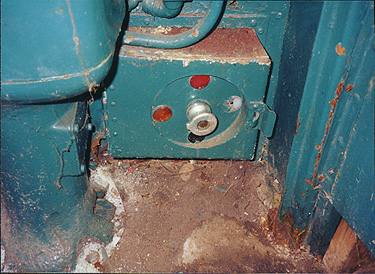
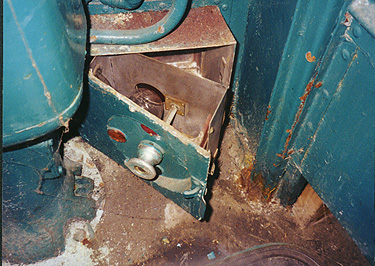
The 6000-series and 1-50 series cars used the same type of markers. They were located in the same places in the car body and controlled identically to the 5000-series markers. The motorman set up the cab at the beginning of each run, so he was responsible for turning the color knob to the correct combination for the lower marker lights, and switching off the two red upper marker lights which indicated the rear of a train. The motorman was also responsible for turning the headlight on. If the train entered a terminal where the crew had to "swap ends" (instead of running around a loop-track in the yard), the motorman would usually turn off the headlight, turn on the upper red marker lights, and operate the knob(s) so both lower marker lights displayed red, while closing up the cab. Note, however, that it was officially the conductor's responsibility to insure the four marker lights at the rear of the train displayed red, and that the headlight was off. If a supervisor or "spotter" turned in a crew for improper lights at the rear of the train, the conductor had better not have said "But I thought my motorman had set them!" or he would have been in a lot of trouble! The opposite was true of the front of the train - that was the responsibility of the motorman. The 4000-series cars did not originally have electric markers, but the CTA retrofitted the cars with marker light units in 1953. The markers were put in two vertical oblong boxes on either side of the front door, below the end windows. Each box had four lenses, one of each light color. This represented a change in design from the 5000-, 6000- and 1-50 series markers, which had a single lens for all four lights. At the same time, the 4000s were given a single sealed-beam headlight on the roof, above the front door. To set the markers on the 4000s, there was a box mounted on the front wall of the cab, with two five-position rotating-switch knobs. (The fifth position was OFF.) On the 4000s, the same rules of responsibility for setting and checking lights at either end of the train held as on the 6000s. The High-Performance Family of cars, starting with the 2000-series, continued the concept of separate lenses for each marker color, but now had the lights molded into the end cap of the car. The eight lights were set along the top of the front above the end windows, four on each side of the destination sign. They were, from left to right, RED, AMBER, GREEN, LUNAR WHITE, <the destination sign>, LUNAR WHITE, GREEN, AMBER, RED. This design has been maintained through to the current 3200-series cars. The only exception were the 2200-series cars. These units still had the lights in two four-light sets on either side of the destination sign, but because the end windows extended nearly to the roof line of the car, the lights were actually mounted inside the car, against the window glass. In the High-Performance cars, the knobs that controlled the markers also automatically set the destination sign to the corresponding reading. Another innovation of the High-Performance Family was in the headlights. Starting here, the sealed-beam headlights and sealed-beam taillights became separate units, mounted next to each other on the front of each married-pair car. Previous to this, the taillights were formed by using the two red marker lights on the rear of the train. |
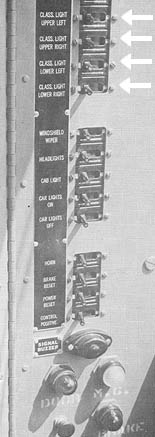
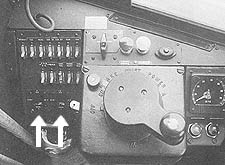
Above Right: The
control panel of a 2000-series car. The color of the marker
lights were controlled by the dials pointed to by the white
arrows. Each dial controlled one set of markers. These dials
are used on all High-Performance cars.
(CTA Photo) Left: The cab switch
panel in the early 6000-series cab. They changed very little
from this builder's view. The white arrows at the top point
to the four switches that turned the marker lights on and
off. The color had to be changed
manually. (Photo from the
Krambles-Peterson Archive)
As described above, the combination of two different colored lights indicates what route and/or class an "L" train is. The combinations have changed over time as new routes and stopping patterns have come and gone.
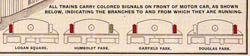
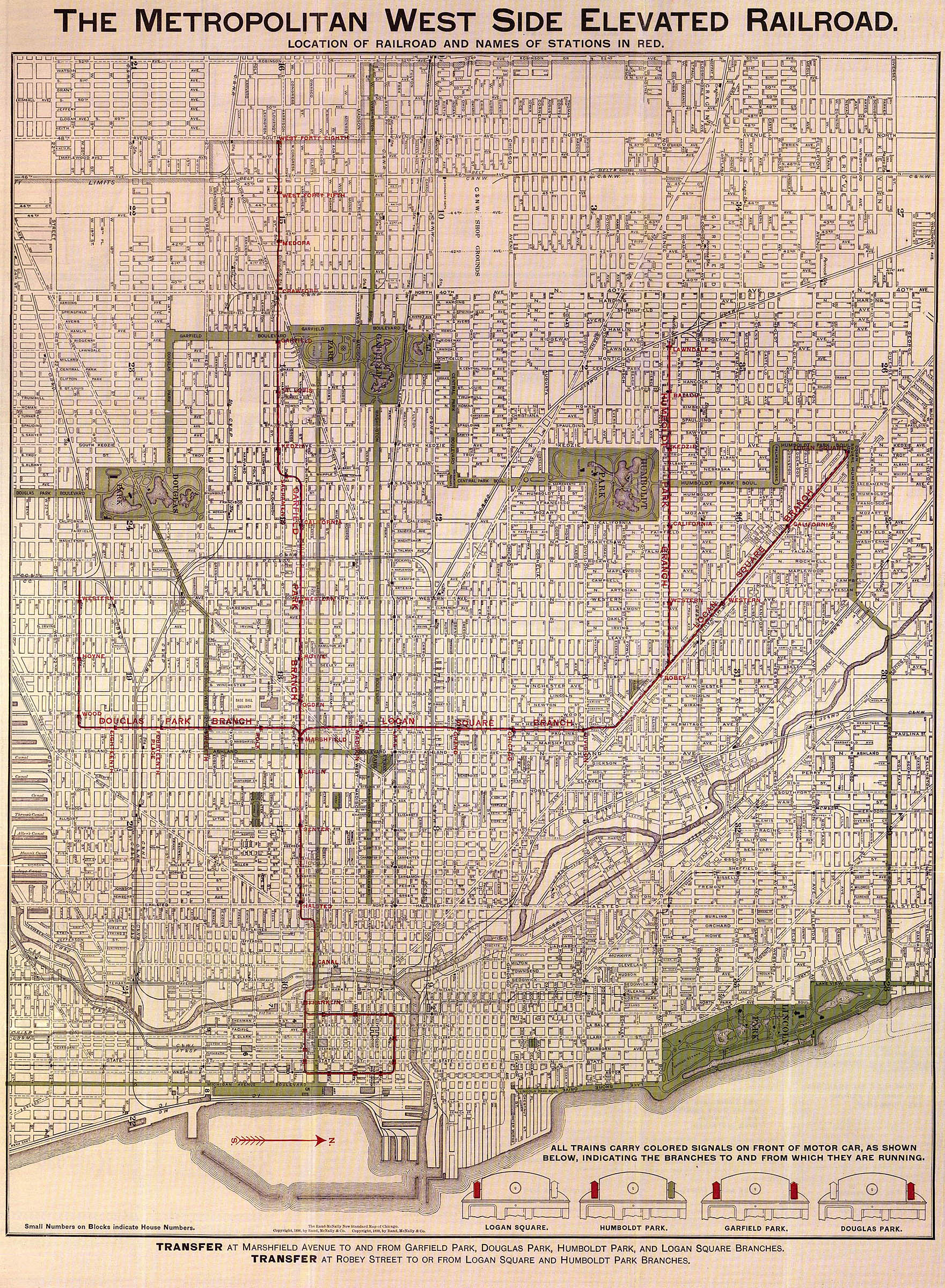
Excerpt from the Metropolitan "L"'s 1898 public route map, showing the different marker combinations their trains carried. For a larger view of the whole map, click here. |
Although the three original "L" companies -- the South Side, the Lake Street, and the Metropolitan West Side -- each had different patterns of service they operated on their own lines, it was less important for most to need to need to differentiate the trains clearly for towermen before they were all connected via the Loop elevated. The exception was the Metropolitan, which from the beginning had planned and operated a system that consisted of several branches, necessitating an easy way for the towermen to identify the trains from a distance and sort them efficiently. Interestingly, the Met even published their marker light system on their public maps (seen at right), allowing the passengers to take advantage of being able to identify the trains from a distance as well.
When the Loop was competed in 1897 and trains from different companies began intermingling, it became more important for each company to have a system of markers that would identify the trains for the towerman at each junction on and off the Loop. The Met continued to use their system, while the South Side and Lake Street companies initially just had one set of marker indications each. Red, white and green were the only colors used initially, and for many decades thereafter. The Union Elevated Railroad's 1898 Rule Book listed these as the marker combinations in use:

|
Lake Street |

|
South Side |

|
Metropolitan Garfield Park |
|
|
Metropolitan Humboldt Park |
|
|
Metropolitan Logan Square |
|
|
Metropolitan Douglas Park |
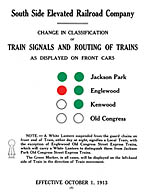
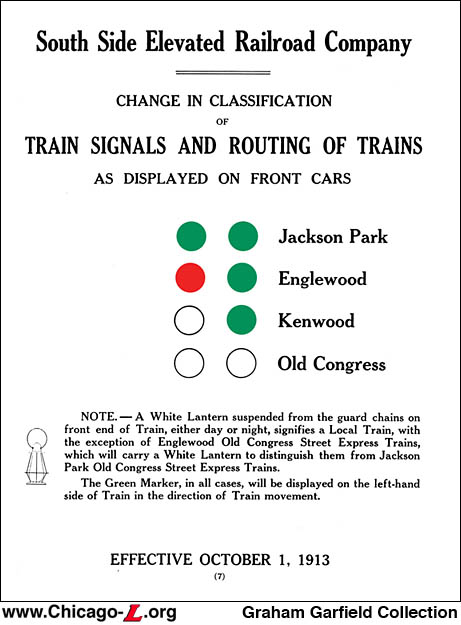
Sheet describing the marker lights of the South Side lines from Instructions for Trainmen in Connection with Through Routing, published in 1913 for employees. For a larger view, click here.(Graham Garfield Collection) |
As the South Side Elevated began to built branches, served both the Loop and their old, original "stub terminal" outside the Loop, and added an express track along part of their line, the need for a more complex system of marker indications was needed for their trains. The South Side used green-green for Jackson Park-Loop express trains, red-green for Englewood-Loop express trains, white-green for Kenwood runs, and white-white for any trains going into the Old Congress stub terminal. Any of these markers combined with a white lantern indicated a local train except for those going to Old Congress: here, the white lantern indicated an Englewood-Old Congress train (as opposed to a Jackson Park-Old Congress train). Stock Yards shuttle trains may not have needed markers, since they rarely ventured beyond their own line and separate pocket at Indiana station, but the Stock Yards-Jackson Park trains run in the mornings and evenings until 1949 was well-known among railfans and towermen for carrying blue plate markers, the only known "L" service to use marker colors other than red, green, or white (and later yellow) to indicate routing.
The Rules and Regulations of the Northwestern Elevated Railroad Company employee manual of 1900, meanwhile, stated that two red markers and a headlight indicated an express train while local trains carried a white marker on the right and a green marker on the left. Additional marker readings were added after the North Water Terminal, Ravenswood branch, and Evanston extension entered service. For instance, southbound trains terminated at North Water carried two yellow markers in addition to signs reading "N. WATER ST." on the sides of the cars.
By the 1920s, with four major divisions (the four original companies) and most of those with several branches, stub terminals just outside downtown, and various operating patterns, a more complex system of marker indications had developed. According to a memo from the Chicago Rapid Transit Company (CRT) Office of Superintendent of Shops and Equipment, dated July 1, 1927, concerning getting more marker paddles fabricated and painted, this was the system of marker indications in use at that time:
Metropolitan Division |
|
|
|
Logan Square |
|
|
Humboldt Park |
|
|
Garfield Park |
|
|
Douglas Park |
|
|
Wells Street |
North Side Division |
|
|
|
Evanston |
|
|
Wilson Avenue |
|
|
Ravenswood |
|
|
North Water Street |
South Side Division |
|
|
|
Jackson Park |
|
|
Englewood |
| |
Kenwood |
| |
Old Congress |
Lake Street Division |
|
| |
Forest Park Express |
| |
Forest Park Local |
| |
Austin Ave Local |
| |
Hamlin Ave Local |
| |
Market Street |
The CRT's Rules and Regulations book of 1942 stated, as rule #77, that "the required set of signal lights, markers and a destination sign will be supplied for each train. The Conductor will be held strictly responsible for this equipment and for its return to the place provided for it, when it is no longer needed..." Furthermore, rule #79 stated, "Motormen and Conductors must see that markers, destination sign and headlights, when needed, are displayed on the front end of trains before leaving yards or terminals. Under no circumstances will markers be changed while trains are in motion..."
Opening of the State St Subway: 1943-1947
When the State Street Subway, Chicago's first subway, opened in 1943, there were significant changes to North and South side trains. Generally speaking, express trains were routed into the subway, while locals continued to use the Loop elevated. Jackson Park-Evanston/Howard and Englewood/Normal Park-Ravenswood trains were rerouted to the new subway, while Kenwood-Wilson trains and Wilson-Loop trains remained on the elevated.
With these changes to routes came several changes to markers. Some changes were general, concerning how they were displayed. A supplement to the CRT rule book, General Order No. 196: Operation of Clybourn-Divison-State Street Subway, Subway Route 1, stated in rule 39:
39. Marker Lights and Tail Lights. All trains routed via Subway Route 1 must display lighted Marker Lights and lighted Tail Lights from terminal to terminal at all hours of the day and night.
So, rather than using paddles during the day and lighted lanterns at night for markers as trains typically did at the time, subway trains always had to use lighted lanterns for markers at all times to assure visibility of the markers in the subway.
Another general change was to the arrangement -- rather than just a pair of markers, one on each side of the train front, some routes would also now use stacked markers, with two markers on one side of a train's front, stacked one above the either (with either none on the other side, or in a few cases one marker on the other side, meaning there were three markers total -- two stacked on one side and one on the other). This did two things: First, it created several additional potential marker light combinations to provide more unique readings for the new routings being introduced. It also created a new marker configuration that made it possible to differentiate a subway train from and elevated train at a glance: subway trains would use stacked markers on the right (non-motorcab) side of the train front end.
A poster titled, "Present Train Markers & Proposed Markers for Subway Operation," depicted the front ends of a 4000-series train with different markers for different routes/destinations, divided by trains via the elevated and trains via subway. The poster was likely from 1942 or early 1943 (given that the new subway routings are "proposed", i.e. the subway was not open and routings potentially not finalized yet), and perhaps for posting in trainrooms and/or interlocking towers for reference. In any case, it listed marker light combinations for North-South trains as they existed just before the subway opened, as well as new, proposed readings for after the subway opened:
Trains via Elevated |
|
|
|
Howard St |

|
First Howard St Stub |
|
|
Howard St Stub |
|
|
Ravenswood Stub |
|
|
Wilson Ave |
|
|
Ravenswood |
|
|
Jackson Park |
|
|
Englewood-Normal Park |
| |
Kenwood |
|
|
AM Loyola to Grand Ave, then change tor regular markers |
|
|
PM Loyola |
|
|
Shoppers Special |
|
|
Englewood Stub |
|
|
Jackson Park Stub |
Trains via Subway |
|
|
|
Howard St |
|
|
Wilson Ave |
|
|
Ravenswood |
|
|
Jackson Park |
|
|
Englewood-Normal Park |
|
|
Kenwood |
|
|
PM Loyola |
|
|
Shoppers Special |
The entries from the poster that mention "Stub" are somewhat confusing, since there is no Howard St Stub, Englewood Stub, etc. What these most likely refer to are North Water Stub and Old Congress Stub, and trains that operate to/from them (i.e. the "Englewood Stub" train refers to a train that operates between the Old Congress Stub and Englewood); so the Howard St and Ravenswood "stub" trains listed ran to/from North Water, and the Englewood and Jackson Park "stub" trains ran to/from Old Congress. This makes sense, as, except for the Ravenswood Stub train listed, the markers shown for those trains correspond to the markers known to have been used for North Water and Old Congress trains earlier in the CRT era; why they are listed this way on the poster is unclear.
It is also worth noting that some of the train types listed may not have actually existed, at least after the subway opened. For instance, Wilson Ave and Kenwood trains via subway are listed, but no such trains are known to have actually operated, at least in regular scheduled service. Similarly, markers are listed for routes via elevated that would be diverted into the subway and no longer operate via the elevated. There are two likely reasons for this. Recalling that the poster is titled, "Present Train Markers & Proposed Markers for Subway Operation" (emphasis added), the poster lists routings that existed at the time it was issued (presumably before the subway opened) but would not necessarily exist afterward; similarly, the subway routes and markers listed are proposed, suggesting they are not final. So two likely scenarios are: 1) the routings had not been finalized at the time the poster was issued, so markers were developed for all possible combinations so that training could begin while the route structure was finalized; or 2) routes and markers are listed that existed at the time (pre-subway opening) for reference even if they might not continue to be scheduled routings later and markers were developed for any service being routed into the subway or not, both "just in case" any route changes were made later the markers for them already existed and were published.
Presumably, markers for West Side (Lake Street Division and Metropolitan Division) trains did not change at this time, since the opening of the subway did not effect those routes.
Early CTA Era Markers: 1947-1969
Soon after CTA took over, they began to reorganize "L" service and streamline routes, as well as implement A/B skip-stop service to speed trains and provide some form of express service even on 2-track lines. On April 5, 1948, Lake Street service was fully revised with mid-route turnbacks eliminated, all trains operating from Forest Park to the Loop, 10 low-use stations closed, and A/B service implemented. On July 31, 1949 , CTA instituted its massive North-South service revision, simplifying services into the North-South Route (Howard-Englewood and Howard-Jackson Park), Ravenswood Route, and Evanston Route, reducing all other South Side branches (Kenwood, Stock Yards and Normal Park) to shuttle services, closing 23 low-use stations, and implementing A/B skip-stop service on the North-South and Ravenswood routes. By this point, so many services had been changed that a significant revamp of the marker light system was needed.
Below is a chart, approximating a CTA document dated December 12, 1949, showing the marker combinations from that period. Markers for the new services on the revamped North-South, Ravenswood and Evanston routes are provided, as well as for the streamlined Lake Street services, although it is interesting to note that the Lake "A", "B" and "all-stop" services reused some of the markers from the pre-CTA Lake Street services. West Side Met Division services are shown and actually largely keep their pre-CTA markers, although CTA includes several variants to these services and provides markers for them. There's also information on CNS&M and CA&E trains. (Thanks to Phil O'Keefe for supplying this document.)
|
||||||||||||||||||||||||||||||||||||||||||||||||||||||||||||||||||||||||||||||||||||||||||||||||||||||
|
ALL A
& B ROUTES: MEANING
OF SYMBOLS: .SEO
X-4692 |
||||||||||||||||||||||||||||||||||||||||||||||||||||||||||||||||||||||||||||||||||||||||||||||||||||||
One notable change is the elimination of the stacked markers for subway trains introduced in 1943 and turning out to be short-lived. It is likely that with the streamlining and simplifying of North-South routes and subway services, and fewer route variants as a result, the additional marker combinations created by having both stacked and non-stacked markers was no longer needed, and CTA could simplify things by retiring their use.
The only cars with electric markers in 1949 were the four 5000-series units; the first of the 720 6000-series cars (also with electric markers) would be delivered next year and the retrofitting of the 4000s with electric markers was still several years away. At the beginning of the CTA era, most cars used colored paddles by day for markers and lanterns at night and on subway trains. It would be a decade into CTA assuming operation, in 1957, before the last of the cars without electric markers were retired.
Another thing to note about the above marker list is the absence of a yellow (amber) marker. It was not incorporated into the "L"'s route identification system until April 18, 1954, when a new classification light system using amber color for first time came into use. By then, a larger number of cars (namely the 6000s, 1-50s and retrofitted 4000s) had the amber setting.
The next set of changes to the marker system occurred a couple years later in 1951, when a series of changes occurred to West Side "L" service. First, on February 25, Logan Square trains were rerouted into the new Milwaukee-Dearborn Subway; Humboldt Park trains were truncated into a shuttle terminating at a special platform on the branch that connected to main line trains at Damen. Milwaukee Route trains bewteen Logan Square and downtown did not use any markers (they were left dark/turned off), as they were effectively isolated to their own line that did not interact with any other services and had no interlocking towers except at the terminal. Exceptions were trains that were to lay up on the stub tracks west of Congress Street Terminal (LaSalle), which would turn on a green marker on motorman's side at Jackson before passing LaSalle Tower, and unscheduled extras drags used white / white markers. Humboldt trains used no markers, since they were confined to the branch.
The next change to West Side service occurred on December 9, 1951, when service on the Garfield Park and Douglas Park branches was revised. Several low-ridership stations were closed and A/B skip-stop service was implemented on both lines. The Westchester branch was closed and Garfield service truncated to Desplaines. (A few months later, on February 3, 1952, Douglas service was also cut back from Oak Park to 54th; this was originally to have occurred on December 9, 1951 as well, but was temporarily delayed by a court injunction.) The implementation of A/B skip-stop service on Garfield Park and Douglas Park meant different markers were needed for each stopping pattern. By the end of 1951, these markers had been implemented on West Side trains (thanks to Andre Kristopans and Art Peterson for providing some of this information):
Milwaukee service |
|
 |
Logan Square (markers off/dark, not used) |
|
|
Congress St Terminal lay-ups (set leaving Jackson southbound) |
|
|
Extras and Lay-ups running lite |
Garfield Park service |
|
|
|
Garfield Park "A" and All-stop |
|
|
Garfield Park "B" |
Douglas Park service |
|
|
|
Douglas Park "A" and All-stop |
|
|
Douglas Park "B" |
It is interesting to note that under this scheme, Douglas Park trains ceased using the white / red markers they had used since the Met began service in the 1890s, using the inverse (previously used for Logan Square trains) instead for "A" and local (all-stop) trains and a variant of it for "B" trains.
Service changes on the West Side lines continued into the 1950s. In September 1953, Garfield Park trains are rerouted onto a temporary street level operation over a 2-1/2 mile zone between Sacramento and Aberdeen, enabling construction of the Congress (Eisenhower) Expressway. At that point, A/B skip-stop service was discontinued on the Garfield line. On April 4, 1954, Douglas trains were rerouted to the Loop via the Paulina Connector (former Logan Square line) and the Lake Street route to allow further construction on the Congress Line and the Congress Expressway.
With all these changes, the marker lights for the rapid transit system were changed again in April 1954. New marker aspect combinations were implemented not just for the changes on the West Side, but systemwide, with nearly every service's markers changing. A bulletin from the Office of Superintendent of Transportation dated April 15, 1954 established that, "effective at 12:01 AM, Sunday, April 18, 1954, the Marker Aspects for trains on the Rapid Transit Division will be as follows" (thanks to Walter Keevil for providing this document):
North Side - South Side Trains |
|
|
|
Evanston - Loop |
|
|
Evanston Shuttles |

|
Howard-Englewood "A" and All-stop |
|
|
Howard-Jackson Park "B" and All-stop |
|
|
Ravenswood "A" and All-stop |
| |
Ravenswood "B" |
| |
Kenwood |
| |
Stock Yards |
| |
Extras and Lay-ups running light |
West Side Trains |
|
| |
Garfield |
| |
Douglas "A" and All-Stop |
| |
Douglas "B" |
| |
Logan |
| |
Lake "A" and All-stop |
| |
Lake "B" |
| |
Extras and Lay-ups running lite |
It was in the system of markers implemented here that many classification light combinations that would be retained for decades were introduced, such as those for North-South Route (Howard-Englewood and Howard-Jackson Park), Ravenswood and Evanston services. Amber (yellow) markers were implemented for the first time, with a sufficient number of trains now being equipped with electric markers that included an amber setting to make this possible. Douglas trains resumed using the "classic" white / red markers used since the Met days, for "A" and All-stop trains, albeit only for a few more years.
By this time, a sizable number of railcars in service were PCC cars with four marker light positions -- two at the top corners of the car and two at the bottom corners of the car. (The only other cars in service at the time with electric markers, the retrofit 4000-series cars, had two marker positions, on the right and left sides of the end door; later cars delivered would similarly have only two marker positions, at the top right and top left of the cars' front end.) Because of this, the 1954 bulletin noted, "On cars equipped with high and low markers, the high markers will be used with low headlights and the low markers will be used with high headlights. Tail-lights will be two Red lights, or four Red lights if the car is equipped with four." In this case, the "red lights" referenced to be used as taillights were the markers; "L" cars would not be built with dedicated taillights until the 2000-series in 1964 onward.)
The opening of the Congress Line, and creation of the new West-Northwest Route through-service, in 1958 was the impetus for the next update of the marker light system. The aspect combinations generally remained unchanged from the 1954 bulletin, the only changes being the creation of the new Milwaukee-Congress and Milwaukee-Douglas aspects (and discontinuance of the Garfield-Loop and Douglas-Loop indications), and addition of markers for the Ravenswood Shuttle (which used the red / red combination used for other shuttle services in the CTA era). The chart below is an approximate reproduction of a pamphlet issued by the CTA Training & Accident Prevention Department circa 1958 for motorman, towermen, and supervisors. (Thanks to retired CTA employee Peter Christy [Badge #23234] for supplying this document.)
|
||||||||||||||||||||||||||||||||||||||||||
While it appears that there might be room for confusion because certain combinations are used more than once (e.g., both the Howard-Jackson Park "B" and Douglas-Milwaukee "B" use the green / green combination) and there are theoretically enough possible combinations to prevent the need for duplication, those routes with duplicate light combinations from the North-South and West-Northwest routes never used the same tracks, and never pass the same towers, so there would be no chance for confusion.
Note that the card refers to settings for North Shore Line interurban trains. Not only did the North Shore Line use the CTA "L" tracks to reach the Loop and Roosevelt Road until it discontinued service in 1963, but starting in 1942, "L" crewmen operated the North Shore trains between Howard or Linden and the Loop. (This resulted because because on January 31, 1942, North Shore trainmen ceased to be members of the Amalgamated Association of Street, Electric Railway and Motor Coach Employees and thus CRT employees [who were still members] refused to handle the trains. Starting February 18, 1942, an agreement was struck that "L" crews would operate the trains south of Linden for Shore Line trains and Howard for Skokie Valley trains. This arrangement ended July 1, 1953 for Shore Line Route trains and February 1, 1954 for Skokie Valley trains.) Thus, not only did towermen and supervisors need to know NSL marker combinations until 1963, but for a time, so did motormen.
It might also seem confusing that some trains used the red-red marker combination for route identification, the same combination used for the tail lights at the rear of the train. Might a towerman be unsure whether such a train was coming or going? Not so! First, the headlight would be illuminated on the front of the train, identifying the front from the rear. Additionally, on the rear of the train, there would be four Red markers (2 lower and 2 up higher) and of course, no headlight showing. (On the 5000-, 6000- and 1-50 series cars, the four reds were made up of the four marker lights at each corner of the car's front. On later cars, two of the four red lights were the markers along the top; the bottom two were the separate taillights.)
(A quick note on headlights: It was considered a serious no-no to leave a headlight burning at the rear of a train. Although it seems unlikely that anyone got time off without pay for that infraction, if you were turned in several times for doing so you might have to take a "retraining" ride with a Supervisor, and it would be on you permanent record.)
The next major change to occur to the "L" system that influenced the marker light arrangements was the opening of the Dan Ryan line on September 28, 1969. Dan Ryan service was through-routed with Lake service via the Loop elevated, creating the new West-South Route (Lake-Dan Ryan). While the Lake route's markers could have been retained to use on the new through-route, instead CTA instituted new markers for the route. The next day, a Loop Shuttle service began operating provide circulation around the Loop to compensate for the loss of Lake trains circling the Loop. The next year, on February 1, 1970, West-Northwest Route Milwaukee service was extended beyond Logan Square to Jefferson Park, using the median strip of the Kennedy Expressway. However, no marker changes were needed for that change.
The following markers were in use effective September 1969:
| FRONT MARKER LIGHTS | |
|
|
Extras and Lay-ups - all branches |
|
|
Shuttle trains - all branches |
North-South Trains |
|
|
|
Howard-Englewood "A" and All-stop |
|
|
Howard-Jackson Park "B" and All-stop |
| Ravenswood Trains | |
|
|
Ravenswood "A" and All-stop |
| |
Ravenswood "B" |
| Evanston Trains | |
| |
Evanston Express - 4000-series |
| |
Evanston Express - 5-50 series |
Skokie Trains |
|
| |
Skokie Swift |
| West-South Trains | |
|
|
Lake-Dan Ryan "A" and All-stop |
|
|
Lake-Dan Ryan"B" |
| West-Northwest Trains | |
|
|
Congress-Milwaukee "A" and All-stop |
|
|
Douglas-Milwaukee "B" and All-stop |
| . TAIL LIGHTS |
|
| |
4000-series cars |
| |
All other series, except Skokie Swift |
| |
Skokie Swift |
The establishment of Lake-Dan Ryan "A" and all-stop using yellow / yellow markers and "B" trains using green / green firmly established a system started in 1958 that these two marker aspects were the "standard" readings for "A" and "B" trains on the trunk-line through-routes. While it might seem unnecessary to reuse the same readings on three routes, practically speaking the three services were physically separated (in two different subways and the third on the Loop elevated) and did not mingle, so there was little chance for confusion in service. (The rare exception would be if the State Street Subway were to close and North-South trains were rerouted "over the top" (i.e. via the elevated) through downtown, in which case they would intermingle with West-South trains on the Loop. In these rare cases, since it would either be planned or due to an emergency, extra supervision would be on hand to manage service issues.)
The shuttle trains of "all branches" referenced on the marker light reference card referred to, at the time, the Evanston Shuttle (Linden-Howard) run at all times outside of rush hours, the Ravenswood Shuttle (Kimball-Belmont) operated nights and Sundays, and the Loop Shuttle (which made a continuous circuit around the Inner Loop track for aid in passenger circulation). Ridership on the Loop Shuttle was not strong, resulting in dwindling service hours until it was finally discontinued altogether on September 30, 1977. Given the four colors in two positions available the all the resulting potential aspect options this presented, it is interesting that CTA chose to use four red markers for shuttle trains, as this was the same aspects used for tail lights on non-4000-series cars at the time. The addition of the headlight on the front end of these trains differentiated the front from the rear end, but it is still a notable choice.
Most services used two markers, either on railcars that only had two sets of markers (older, retrofit 4000-series cars, as well as the then-new 2000- and 2200-series cars) or on cars that had four (PCC 6000-series, 5-50 series and 51-54 series cars), with the other two markers left dark on the latter car types on these routes. But some routes, as noted above, used all four markers to create additional aspect options. However, these were only possible on routes that used PCC cars. In 1969 and into the 1970s, Ravenswood, Skokie and Evanston were indeed largely or entirely (depending on the route) operated with PCCs, though Evanston and Ravenswood still used some of the last remaining 4000-series cars in service until their final retirement in November 1973, hence the notations where markers would differ betweens 4000s and other cars on these routes. Later updates of the marker reference materials after 1973 omitted these references, since the 4000s were no longer an issue.
These marker lights remained largely unchanged for the next 20 years. In April 1974, there was a small change where Evanston and Ravenswood shuttle trains changed from four red markers to two reds on top and yellow / red on the bottom. By 1988, the shuttle service markers had returned to four red markers. These were the markers on March 8, 1988:
| FRONT MARKER LIGHTS | |
|
|
Extras and Lay-ups - all branches |
|
|
Shuttle trains - all branches |
North-South Trains |
|
|
|
Howard-Englewood "A" and All-stop |
|
|
Howard-Jackson Park "B" and All-stop |
| Ravenswood Trains | |
|
|
Ravenswood "A" and All-stop |
| |
Ravenswood "B" |
| Evanston Trains | |
| |
Evanston Express 6000-series |
| |
Evanston Express 2000- and 2600-series |
Skokie Trains |
|
| |
Skokie Swift |
| West-South Trains | |
|
|
Lake-Dan Ryan "A" and All-stop |
|
|
Lake-Dan Ryan"B" |
| West-Northwest Trains | |
|
|
Congress-Milwaukee "A" and All-stop |
|
|
Douglas-Milwaukee "B" and All-stop |
| . TAIL LIGHTS |
|
| |
All other series, except Skokie Swift |
| |
Skokie Swift |
While the marker aspects stayed largely the same for over 20 years beginning in 1969, in the 1990s enough changes occurred to service patterns, plus the retirement of most of the PCC cars, that a change to the markers was needed. The realignment of the Red and Green lines in 1993, the end of A/B skip-stop service in 1995, and other alterations brought enough changes that it was eventually required to rework the Route Identification Markers. Beginning in 1993, the marker combinations were reconfigured as seen below. The chart is an approximate reproduction of a pamphlet issued by the CTA Training & Instruction Department:
|
......
.......cta 183.20 (07/93) Training & Instruction |
||||||||||||||||||||||||||||||||||||||||||||||||||||||||||||||||||||
When the CTA introduced terminal-specific destination signs in 1996-97, the marker lights generally stayed the same, and were associated with generally the same routes and destinations as in 1993. The main difference was that on the Green and Blue lines, which had branches, the terminal shared by trains serving both branches (Harlem and O'Hare, respectively) and the (what would have formerly been) the "A" terminal (Ashland/63rd and Forest Park) shared the same marker lights, with only trains going to the "B" terminal (Cottage Grove and 54th/Cermak, respectively) having different markers. Previously, the "B" trains (or, post A/B skip-stop service, any train serving those branches) displayed the alternate markers in both directions. The change was due to the marker light setting being associated with specific destination sign readings, not a service pattern per se, and since trains departing either branch heading, say, to O'Hare would use the same destination sign setting they would display the same markers, regardless of which terminal the train was actually departing from. Additional short-turn destination sign readings were also added at this time, and most of these also had their own unique marker lights aspects, adding some additional combinations to the mix.
These are the marker light indications used between approximately 1996 and 2008, and the destination sign readings they were associated with:
|
Red Line |
|
Yellow Line |
||
|
|
Howard, 95/Dan Ryan |
|
Skokie, Howard |
|
|
|
Wilson, Roosevelt |
|||
|
.. |
Purple Line |
|||
|
Green Line |
|
Loop, Linden |
||
|
|
Harlem/Lake, Ashland/63 |
|
Howard |
|
|
|
East 63rd |
|||
|
|
Loop |
Blue Line |
||
|
.. |
|
O'Hare, Forest Park |
||
|
Brown Line |
|
54/Cermak |
||
|
|
Kimball, Loop |
|
UIC-Halsted, Rosemont, Belmont*, Jefferson Park* |
|
|
. |
Belmont |
|
||
|
.. |
Extra Readings |
|||
|
Orange Line |
|
Express, Not in service |
||
|
|
Midway, Loop |
|
CTA logo reading |
|
|
|
Ford City |
|||
| * There were no destination signs for Jefferson Park or Belmont Blue Line short-turns at this time, but trains that ended their trips at these stations used white-white markers according to some sources. What signs were displayed is not clear. | ||||
In mid-2002, to help customers with hearing impairments identify trains that are given mid-line express runs, the marker lights for the "Express" reading were modified to be flashing white-white, rather than a steady white-white. This, along with the flashing red light inside the car next to the destination sign, helped differentiate these trains from Purple Line and out of service trains. This modification is also designed to help towermen differentiate these trains. When the white-white marker lights are flashing there is a noticeable clicking noise coming from the motorman's control panel, much like the sound of a turn signal on a car. The marker light modification to display flashing white-white markers began the weekend of May 18-19, 2002 on the Purple Line-assigned 2400-series cars at Linden and Howard Shops.
In spring 2006, Blue Line cars were equipped with new roller curtains with additional readings for the Pink Line, which began service on June 25, 2006. The first generation of roller curtains containing the Pink Link readings were only installed on cars assigns to O'Hare, Forest Park, and 54th terminals. For the Pink Line, white-red was chosen for the markers for two reasons: First, white and red pigments combine to make pink. Second, back in the days of the Metropolitan West Side "L", the markers for Douglas branch trips was white-red, the use of the markers for trips on that branch had historical precedent.
The curtains also had an additional interesting reading: a Green Line "58th" reading, in green text on a white background, apparently for a possible short-turn operation at the then-abandoned 58th station. Because this reading was never used in revenue service, it is not clear what the marker combination for it was, although green-white or white-green seems likely.
All of the other readings remained the same for the time being. The "54/Cermak" Blue Line reading was retained because initially there were still O'Hare-54th trips during the weekday morning and evening rush periods.
Pink Line |
|
|
|
54/Cermak, Loop |
The Green Line "58th" reading was short-lived, as the following year all cars received new roller curtains, and the "58th" reading disappeared.
In late April 2007, railcars began to be equipped with the new roller curtains. There were three versions of the roller curtain, with several readings appearing on more than one curtain type. The Red Line's primary readings -- "Howard" and "95th" (shortened from the previous "95/Dan Ryan" verbiage) -- were on all three. The idea was to equip some cars on each line with two or even three of the curtains so provide a level of flexibility if cars needed to be transferred between lines.
In addition to the changes intended to promote flexibility of car assignments, the curtains' graphics were updated to accommodate new train routings and short-turns. They were also designed to include readings for projected future services, like the proposed Airport Express service. At the same time, some marker lights were changed. Transition to the new roller curtains and marker lights was completed by fall 2008.
These are the marker light indications used beginning in 2007 through the present, and the destination sign readings they were associated with:
Red Line |
Yellow Line |
|||
|
|
Howard, 95th |
|
Skokie, Howard |
|
|
|
Roosevelt |
|||
.. |
Purple Line |
|||
Green Line |
|
Loop, Linden |
||
|
|
Harlem, Ashland/63 |
|
Howard |
|
|
|
Cottage Grove |
|||
Blue Line |
||||
.Brown Line |
|
O'Hare, Forest Park |
||
|
|
Kimball, Loop |
|
54/Cermak* |
|
| .
|
Belmont |
|
Rosemont, Jefferson Park, UIC |
|
Orange Line |
Pink Line |
|||
|
|
Midway, Loop |
|
54/Cermak, Loop |
|
Airport Express* |
Extra Readings |
|||
|
|
O'Hare, Downtown, Midway |
(flashing) |
Express |
|
|
|
Out of Service |
|||
| * These readings are not used in regular revenue service. | ||||
At 2am on Sunday, May 19, 2013, the Dan Ryan branch of the Red Line was closed for renovation as part of the Red Line South Reconstruction Project. During that time, Red Line trains shared the South Side elevated with the Green Line trains. Red Line trains were routed to and from the South Side elevated via the old 13th Street subway incline located between 13th Interlocking in the subway and 17th Junction on the elevated. Red Line trains ran between Howard and Ashland/63rd, while Green Line trains continued running between Harlem and Cottage Grove (but discontinued service to Ashland/63rd). Some Green Line trains from Harlem were also short-turned at Roosevelt in the morning rush and around the Outer Loop in the evening rush due to limited capacity on the South Side elevated for both Red and Green line trains.
New roller curtains were only made up for the Red Line, which placed a new red "Ashland/63" reading were the red "Roosevelt" reading had been. The red 'Roosevelt" reading was changed to the yellow-yellow marker combination (although it was also left as the "95th" markers, since during the project both destination signs would not be used at the same time). The red "95th" and green "Ashland/63" readings stayed on the curtains but were not used. The new green "Roosevelt" and "Loop" (the latter returning after a six year absence) only existed as digital readings on the new 5000-series cars, while the Red Line trains short-turned at Roosevelt in the morning rush period also had to use 5000-series equipment to use the digital reading on those cars since that slot on the mylar roller curtains was now taken up by the red "Ashland/63" reading.
These marker light readings were added to all 5000-series cars, while the yellow-green "Ashland/63rd" reading was added only to those older cars (mostly just 2600-series cars) that received the roller curtains to operate that service:
Red Line |
Green Line |
|||
|
|
Howard, 95th, Roosevelt |
|
Harlem, Ashland/63, Roosevelt |
|
|
|
Ashland/63 |
|
Cottage Grove |
|
|
|
Loop |
|||
This continued until the work was completed and the Dan Ryan branch was reopened on October 20, 2013.
The Red Line Ashland/63rd reading and markers came back into use for two periods due to the $280 million 95th Terminal Improvement Project to expand and greatly improve the 95th/Dan Ryan Red Line station -- as construction continued on the new terminal, including foundations and structural steel work next to the tracks, track alignment work, and platform construction, CTA needed to close both the east and west platform tracks (at separate times), severely constraining capacity during rush and requiring a reduction in the number of trains in and out of the station. Select Red Line trains were diverted to/from Ashland/63rd during weekday rush periods; during most times, normal service via the Dan Ryan branch continued. The Red Line Ashland/63rd service was operated between April 3 and November 22, 2017, and again between July 30 and late 2018.
|
|
|
Thanks to retired CTA employee Peter Christy [Badge #23234], Phil O'Keefe, and Roy Benedict for supplying additional information for this page.