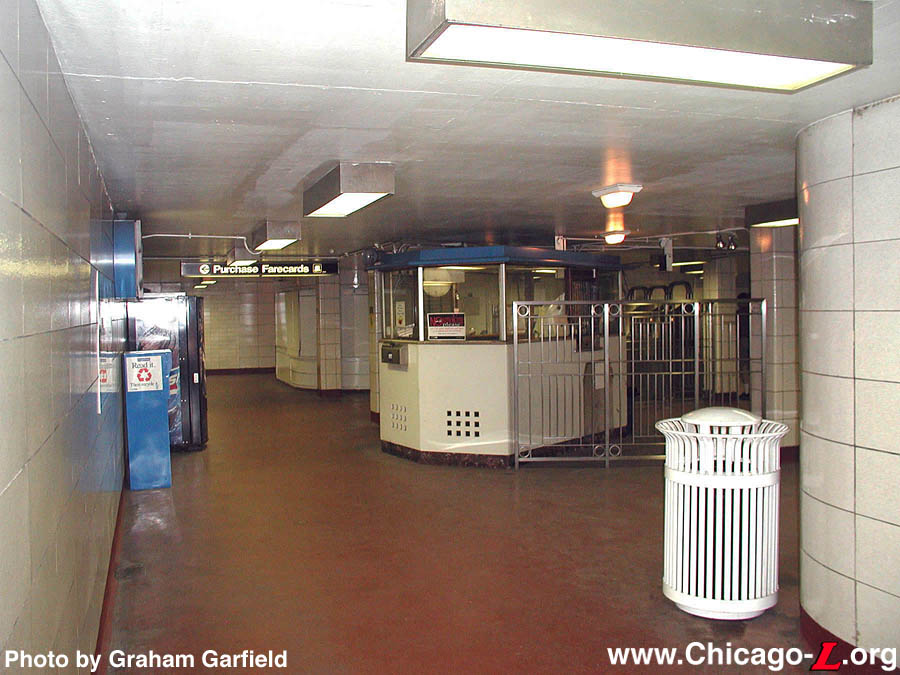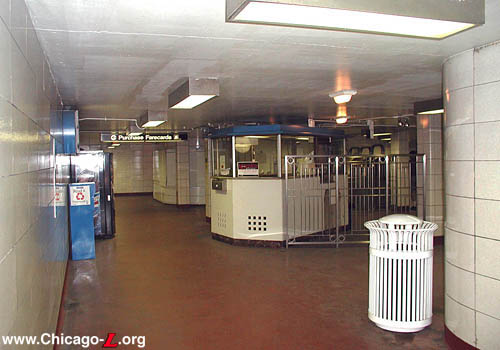
The Clark-LaSalle mezzanine
of the LaSalle/Congress subway station, looking south in
July 2001. Unlike all other subway stations, the agent's
booth isn't centered, but rather is turned toward the north
entrance. This may have been because the bulk of people
using the station were expected to come from the LaSalle
Street Rock Island station to the north of the subway
station. For a larger view, click here.
(Photo by Graham
Garfield)
|
LaSalle
(140W/500S)
LaSalle Street and
Ida B. Wells Drive, Loop
Service
Notes:

|
Blue Line:
Milwaukee-Dearborn Subway
|

|
Transfer to
Metra: Rock Island District
|

|
Owl
Service
|
Quick Facts:
Address: 150 W. Ida B. Wells
Drive
Established: February 25, 1951
Original Line: Milwaukee-Dearborn Subway
Previous Names: Congress Terminal
(appeared on maps
only)
|
Skip-Stop Type:
|

|
Station
|
Rebuilt: n/a
Status: In Use
History:
LaSalle is typical of stations on the Dearborn
and State Street
subways. The architecture of the station was streamlined Art Moderne
with some Art Deco elements, simple and austere compared to earlier
subways in New York, London, Paris or other systems but very much in
the style and fashion of the period in which it was designed. At
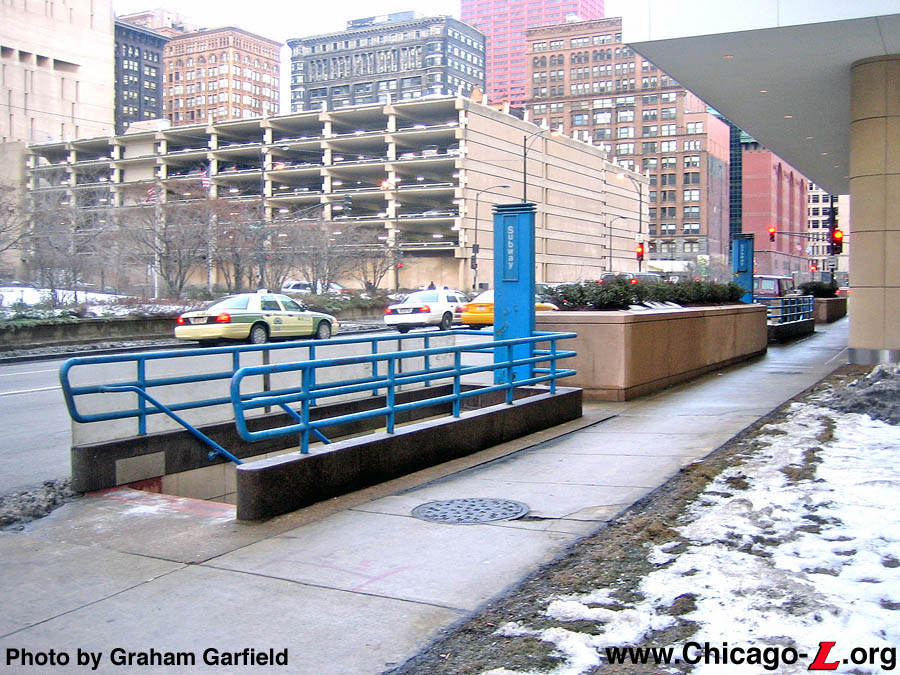
street-level, the four entrances located on Congress between Clark
and LaSalle were very simple, consisting of stairs down from the
sidewalk surrounded by simple tubular railings with a smooth
identification pylon at the back with Deco rings around the top. The
fare controls were at a lower mezzanine level beneath Congress
Parkway. The station mezzanines had broadly curving walls clad in
off-white glazed ceramic tile, which served to both reinforce the
Moderne, streamlined architectural style employed in the Initial
System of Subways station as well as to direct passenger flow through
subtle design cues.
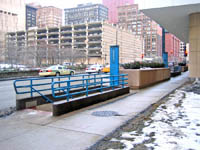
LaSalle was one of the last Initial System of Subways stations with its original Art Deco entrance pylons and railings. Moreover, in their later years, the two on the south side of Congress Parkway had the advertising and sign boxes that were attached to their pylons circa the 1970s removed, revealing the original designs (save for the newer "subway" graphic inserts). They are seen here looking west on February 19, 2007. For a larger view, click here. (Photo by Graham Garfield)
|
The interior had smooth concrete floors and ceilings, red for the
former and a neutral color for the latter. The fare control booth had
an angled Deco design and were made of stone walls with a small
ventilation grate near the bottom and glass windows on all four
sides, allowing for maximum visibility of the mezzanine for the
station agents. It is interesting to note that rather than being
centered and aligned along the centerline of the mezzanine, the booth
in the LaSalle mezzanine is actually angled to the north, perhaps
arranged to serve heavy traffic that was expected from LaSalle Street
Station to the north. Turnstiles were steel, with some angled toward
the entrances and a number of self-serve coin-operated models for
efficient traffic circulation. The mezzanine also had several
amenities for the use of passengers, such as public phones, lockers,
restrooms, and concessions.
A dual set of escalators lead down from the mezzanine to the
platform, augmented by a set of stairs which wrapped around behind
the escalators and connected to the platform east of the
escalators.
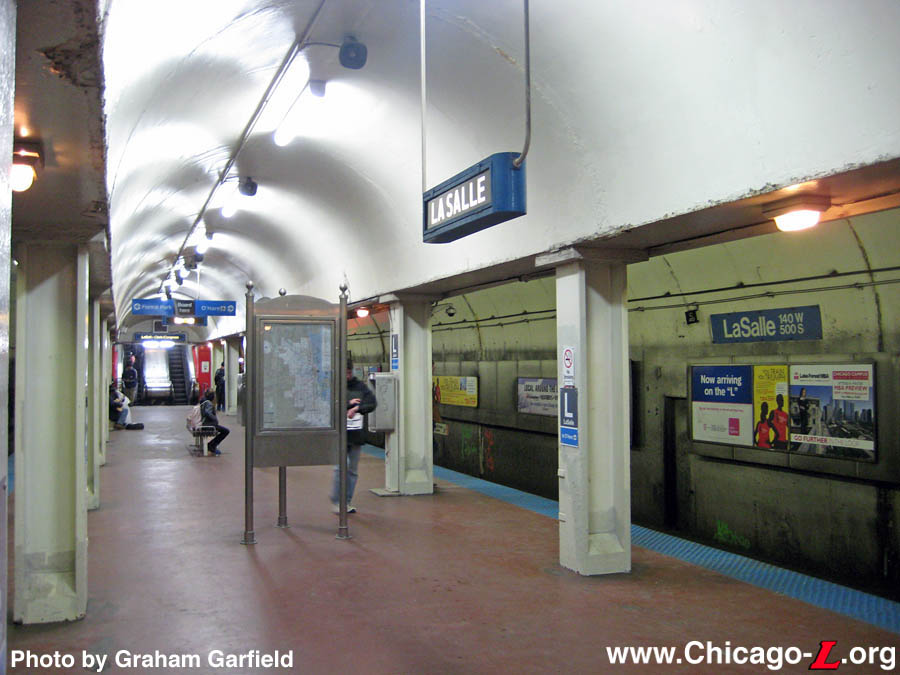
The island platform had red no-slip concrete floors, curved,
barrel-vaulted concrete ceilings and a row of I-beam steel columns
along each platform edge. Unlike some of the more ornate subways in
other cities, the walls along side the tracks in the stations were
left as unfinished concrete rather than tiled. To aid in station
identification, each station had a color scheme that was used in the
accents like tile borders, platform column color, and signage
lettering and background. The colors blue, red, green, and brown were
rotated in sequence beginning up at Division
& Milwaukee. LaSalle's accent color was red. A
specially-designed Futura typeface was used throughout the subway on
metal, tile, and backlit glass signs. Fluorescent lights and
illuminated station signs hanging from the ceilings finished the
decoration.
Though much of the structural work of the Dearborn
Subway was concurrent with that of State
Street's (which was begun in 1938 and opened in 1943),
construction on the Dearborn
line was suspended in 1941 due to wartime materials shortages. Even
after the war was over, it was another several years before work was
resumed. Finally, the Milwaukee-Dearborn
Subway was completed and opened on February 25, 1951, eight years
after the State
Street tube was inaugurated. This is when LaSalle station
opened.
Even then, it was only open at the north end. When the subway
opened, LaSalle served temporarily as the south terminus of the line,
with cars forced to turn around at a diamond crossover east of the
station. This lasted for seven years until the completion of the
Congress Line in
1958, after which cars were through-routed from the subway via a
connection east of Halsted in the median of the Congress (now
Eisenhower) Expressway.
Because this station was originally the terminal of the Milwaukee-Dearborn
Subway, the scale of some of the station's facilities are
slightly enlarged (compared to other stations outside the Loop) to
handle the large traffic loads that were expected. The station has
a wide platform and the two escalators from the platform to the
mezzanine, one for each direction, were unusual for the Initial
System of Subway stations (even the Loop stations had only one
escalator per mezzanine). The mezzanine is also somewhat enlarged, as are
the restrooms (no longer open to the public). When LaSalle served as the terminal, it was often referred to as "Congress Street Terminal" or just "Congress", both on maps and in at least some porcelain-steel signage in the station (the signage inlaid in the glazed block walls around the stairs and escalators at platform level always carried its original, intended name, "LaSalle/Congress"). After the subway was extended farther west and it came a through station, signage and maps all uniformly referred to the station was "LaSalle" or "LaSalle/Congress".
The LaSalle subway station was intended to serve several nearby
mainline rail terminals, including Grand Central Station (now
demolished) and LaSalle Street Station.
When LaSalle station first opened in 1951, only three of the four planned stairways between the Clark-LaSalle mezzanine and street-level opened -- the stairs at the northeast corner of the mezzanine (northwest corner of Clark and Congress), southeast corner of the mezzanine (southwest corner of Clark and Congress) and southwest corner of the mezzanine (southeast corner of LaSalle and Congress). The planned forth stairway at the northwest corner of the mezzanine (northeast corner of Clark and Congress) did not begin construction until late summer 1956. Installation of this stairway could not be made at the time the subway opened because the Western Union building occupied the site. When Congress Street was widened to become a parkway to feed the Congress Street Expressway to the west, a portion of the Western Union building was sliced off and the way was cleared for the new entrance. This fourth stairway opened February 21, 1957; it is the closest stairway to both the LaSalle/Van Buren "L" station and to the Rock Island's LaSalle Street Station. The cost of the stairway's construction borne by the City of Chicago.
The station has changed
little since its construction, even hanging on to its original 1950s
illuminated hanging station signs, which have graphics that are replicas of the original designs.
Recent Developments
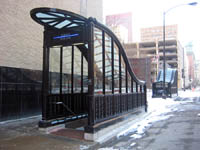
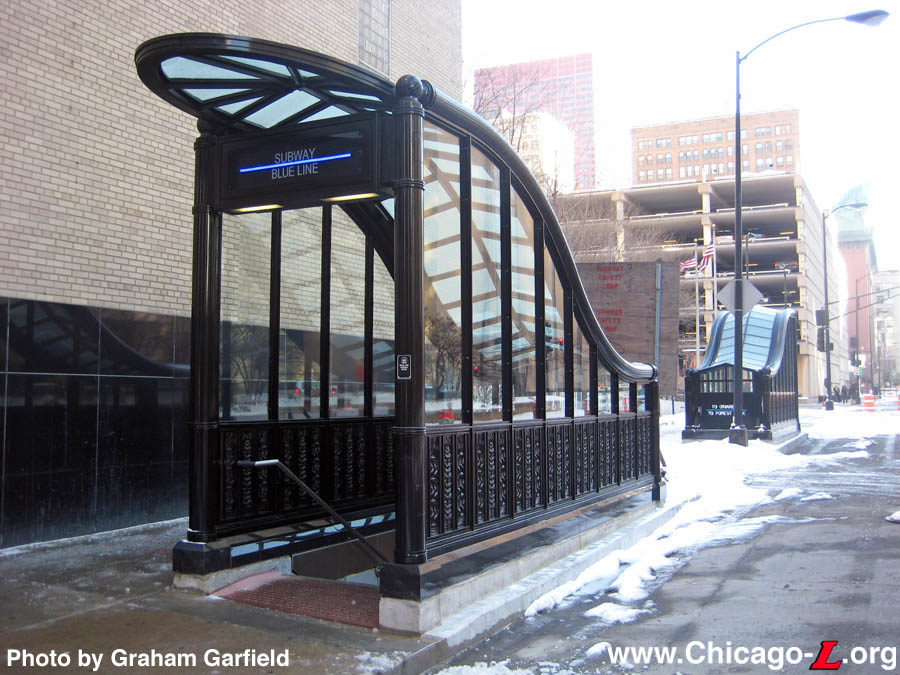
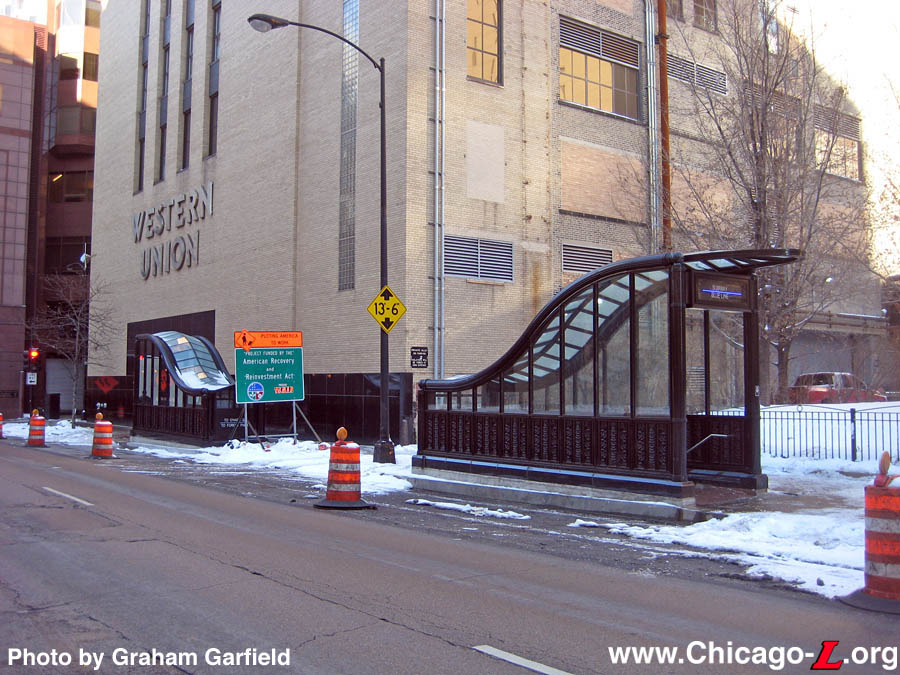
In late 2010, the original 1950s street-level entrance railings were replaced with new entrance kiosks as part of the City's Congress Parkway Streetscape project. The kiosks -- the northwest entrance seen here looking east on December 27, 2010 -- follow a neo-Art Nouveau design CDOT has used elsewhere on the subway. For a larger view, click here. (Photo by Graham Garfield)
|
Beginning Saturday, June 10 and Sunday, June 11, 2001, six
downtown area "L" and subway stations and seven station entrances
that were Part-Time Stations -- closed late at night or on weekends
-- were returned to being open at all hours that trains are in
service. Starting at 0600 hours on Saturday, June 10, 2001,
LaSalle/Congress returned to being in service 24/7.
In November 2005, CTA forces built a series of cinder block walls in the station mezzanine
which had the effect of walling off the mezzanine's northwest
quadrant, which had previously been open unused space. The new
enclosed space used by
CTA personnel and
equipment.
LaSalle was one of the last Initial System of Subways stations with its original Art Deco street-level entrance pylons and railings. Moreover, in their later years, the two on the south side of Congress Parkway had the advertising and sign boxes that were attached to their pylons circa the 1970s removed, revealing the original designs (save for the newer KDR-era graphic inserts). The original entrance railings and pylons were removed and replaced in late 2010 as part of a larger project to improve the environment along Congress Parkway. The Congress Parkway Streetscape Project, managed by the Chicago Department of Transportation (CDOT), stretches from Michigan Avenue to Wells Street and is intended to make Congress both better looking, as one of the main gateways into downtown, and safer for both pedestrians and cars. The $16.9 million project includes improvements such as interconnecting signal timings, wider sidewalks, pedestrian refuge areas, new trees and planters, and decorative lighting. Although the overall project was not scheduled scheduled to be completed until fall of 2011, one of the first elements improved were the entrances to the LaSalle/Congress subway station.
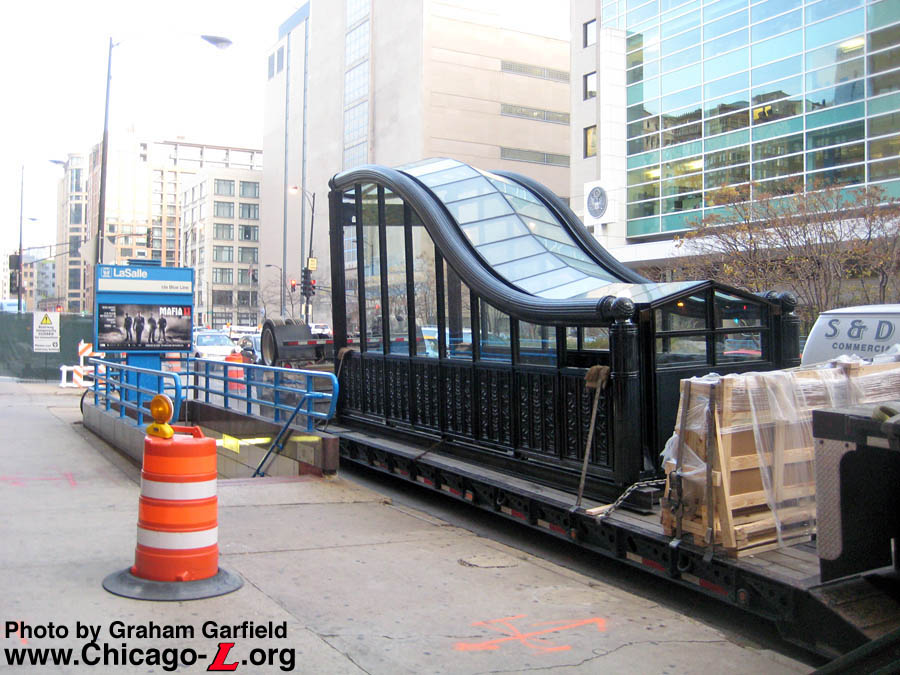
The four entrances were renovated two at a time, with two entrances closed for improvement while the other two remained open. The northeast and southwest entrances were renovated first, then the northwest and southeast stairways. The old entrance railings and pylons were removed and a foundation prepared for the new kiosk structure. The kiosks were fabricated off-site and moved in whole on the beds of trailer trucks, then lowered into place. The new entrance kiosks use a design CDOT has used at other subway stations they've renovated downtown, such as Jackson/Dearborn. What is interesting, however, is that the fully-enclosed kiosks that were used at LaSalle have previously only been used to enclose escalators, while stairways have traditionally used a more open design without a canopy covering the entire kiosk. Here, all four stairways have enclosed kiosks with full canopies, which afford better protection from the elements in inclement weather. The kiosks are designed in a neo-Art Nouveau style, with a cast metal structure and compound-curve canopy with a curved eave overhanging the front opening of the kiosk. The canopy and upper portions of the side and back walls are glass, while the bottom portions of the walls are metal panels cast with a decorative floral motif. Other decorative embellishments, as well as the overall shape of the kiosks, also evoke the organic character of the Art Nouveau style, albeit with a modern execution (most starkly embodied in the kiosks' all-black coloring). The improvements were confined to street-level, with no renovation work done to the mezzanine, the stairways themselves below the sidewalk threshold, or other parts of the station.
In 2018-19, Congress Parkway between Columbus Drive in Grant Park and its transition into the Eisenhower Expressway west of Franklin Street was renamed Ida B. Wells Drive. On July 25, 2018, the Chicago City Council voted to rename the stretch of Congress for Ida Wells, for the civil rights icon, journalist, NAACP founding member, anti-lynching crusader, and suffragist. Street signs were changed, and the name was added or changed in digital mapping databases and apps in late 2018 and early 2019. On February 11, 2019, the name change was finalized and made official with a renaming ceremony in the Winter Garden of the Harold Washington Library.
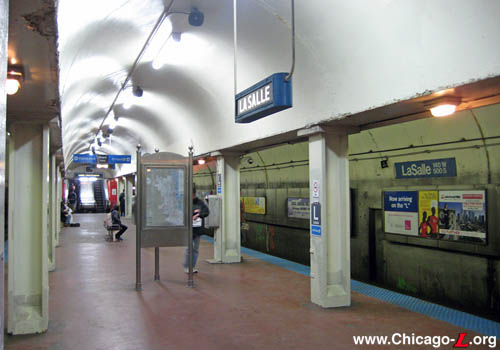
The LaSalle/Congress
platform, looking east on March 5, 2010. LaSalle was originally
the subway terminal, which accounts for the slightly
enlarged facilities. The vintage hanging illuminated sign has graphics that duplicate the original 1951 design. For a larger view, click
here.
(Photo by Graham
Garfield)
|

|
lasalle-congress01.jpg
(108k)
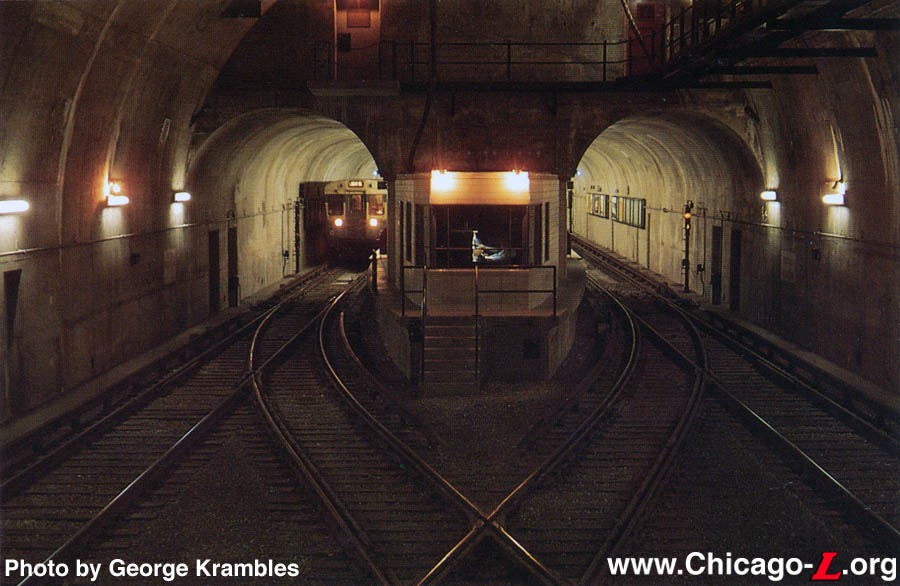
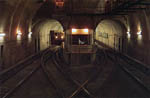
A Logan Square train stops at the LaSalle station
just two months after it opened, looking west from the
LaSalle interlocking just east of the station in April,
1951. LaSalle was the end of the line until 1958 when the
connecting Congress Line was completed, so trains turned
through the diamond crossover to make the trip back to Logan Square.
(Photo by George Krambles)
|
|
lasalle-congress02.jpg
(114k)
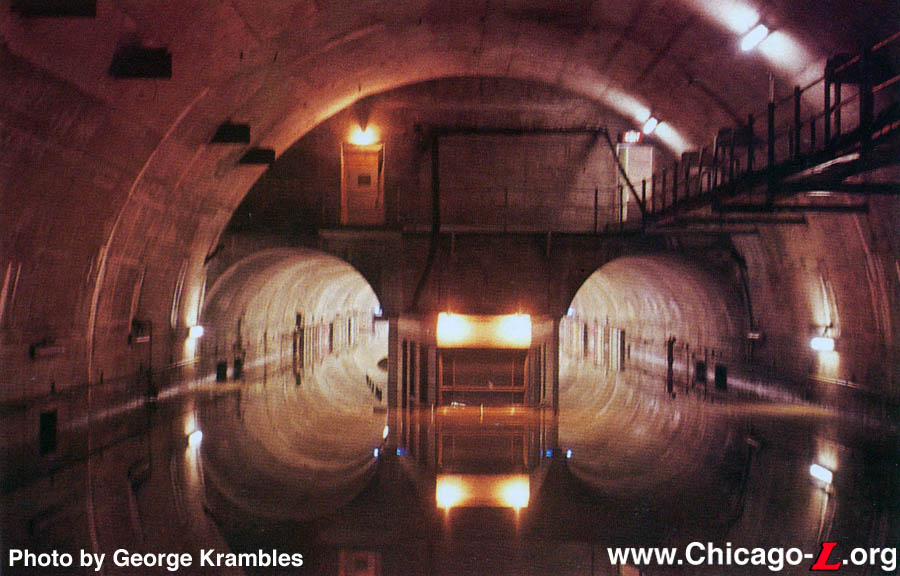
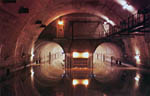
On July 13, 1957, a severe storm struck and
Chicago, but the drainage system of neither the new Congress
Expressway or the rapid transit line in its median were not
yet operational. Connecting to this line just east of
Halsted, a torrent of water rushed into the tunnels of the Dearborn Subway, settling at Jackson station. LaSalle was
water-logged until days later when cleanup was completed. This view looks west on July 14, 1957. (Photo by George Krambles)
|
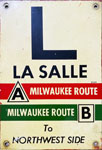 |
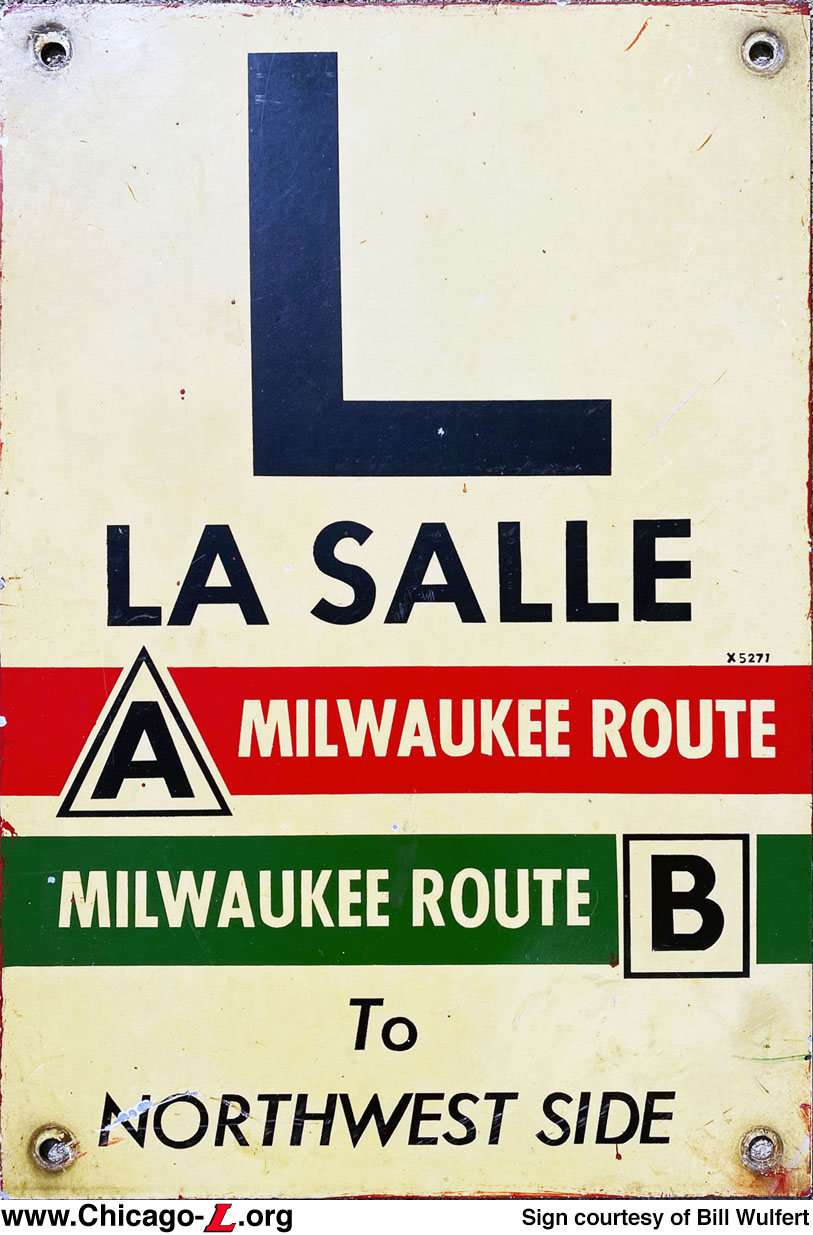
lasalle-congress-P-8_50sSignNB.jpg (224k)
This "symbol sign", as CTA calls them, from the northbound side of LaSalle/Congress island platform is of a type implemented beginning in the mid-1950s. The artwork for this sign from the CTA Staff Engineer's Office is dated September 6, 1956. Temporary cardboard versions were installed at the station on June 10, 1958, shortly before the Congress Line opened, and replaced by permanent signs on September 8, 1958, a few months after the Congress Line opened. The design of this sign, for the northbound direction toward Logan Square and the Northwest Side, is typical of this type: large first letter of the station name with the full name under it; the skip-stop letters on color-coded bands (red was used for 'A' stations and green used for 'B' stations on through-routed services; at A/B stations, the word "STATION" in the band was replaced with the name of the route/service) in the middle; and the destination at the bottom (on most designs, this was accompanied by an arrow pointing in the direction of travel [possibly omitted here because these were posted in both sides of platform columns, which would have required two variants with arrows in each direction to point the same way when back-to-back] and the cardinal direction of travel [perhaps here felt to be redundant with "Northwest Side" as the destination].) (Sign courtesy of Bill Wulfert) |
|
lasalle-congress03.jpg
(81k)
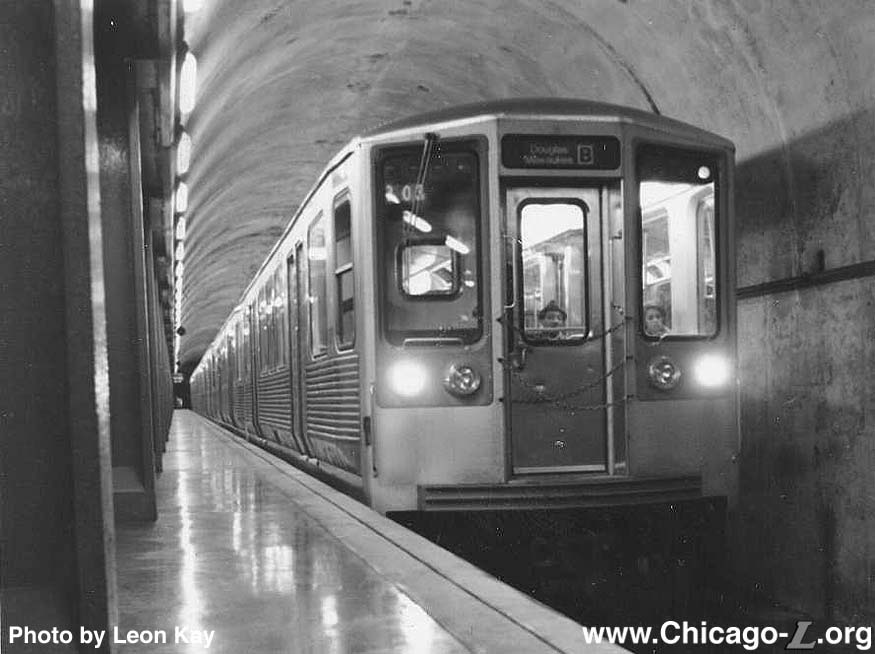
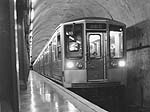
A 2200-series
Milwaukee-Douglas B train stops at LaSalle in
1974. (Photo by Leon Kay)
|
 |
lasalle-congress05.jpg (115k)
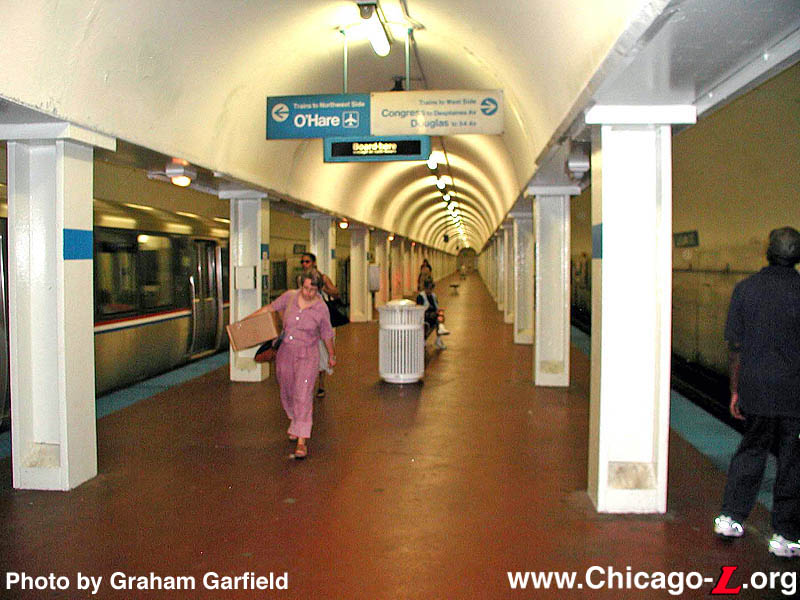
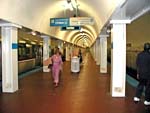
The LaSalle/Congress platform, looking west in July 2001. (Photo by Graham Garfield) |
 |
lasalle-congress06.jpg (106k)
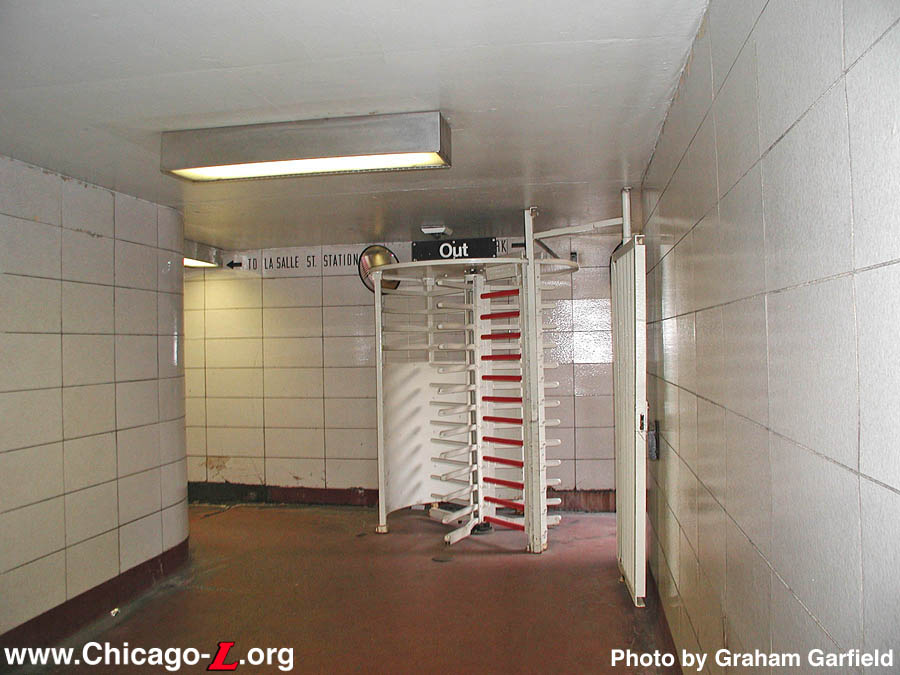
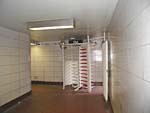
This exit rotogate is situated at the north end of the LaSalle station mezzanine, seen looking north on October 26, 2003. The rotogate was installed on July 27, 1993, along with one at Chicago/Milwaukee, to provide exiting at all times during a period when LaSalle and Chicago were part-time stations closed nights, weekends, and holidays. Thus, when the rest of the station was closed to entering traffic by closing the gates located at the mid-level landing of the northwest, southwest and southeast street-to-mezzanine stairs, and to the right of the rotogate, a customer who errantly found themselves on the platform at LaSalle could still get out of the station. Once LaSalle resumed being open 24/7 in 2001 the rotogate became superfluous, but has never been removed. Note the signage inlaid in the glazed brick wall, including a wayfinding sign pointing to LaSalle Street Station. (Photo by Graham Garfield) |
|
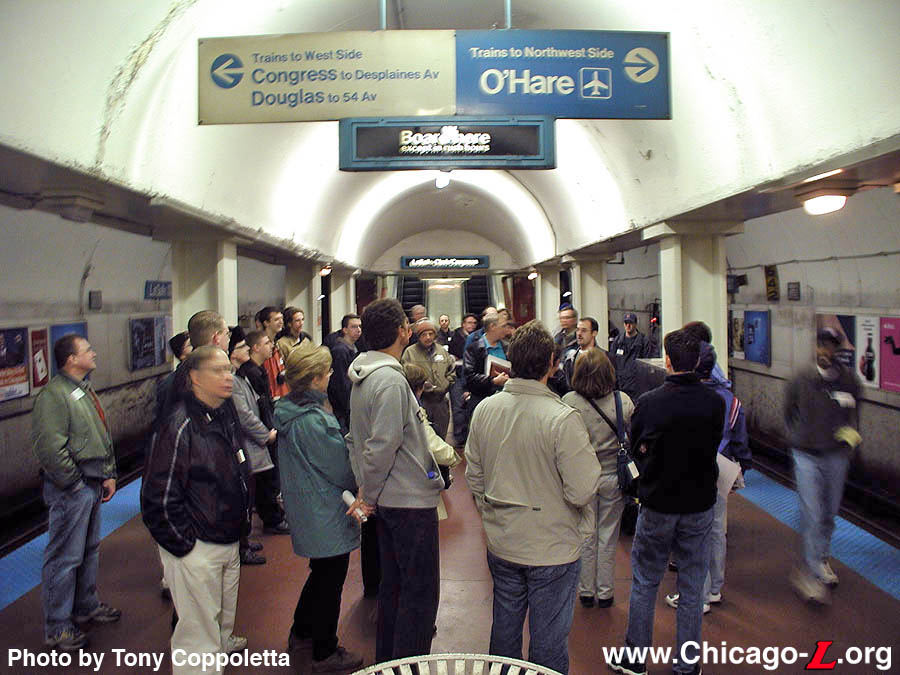
tour03@LaSalle01.jpg
(143k)
Before the charter train comes to pick them up for the
5th Annual Historic "L" Station
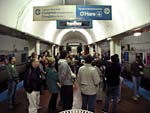
Tour, tour participants are given an introductory
lecture on the platform at LaSalle/Congress
covering the history of the subways and the design of
LaSalle station on
October 26, 2003. (Photo by Tony
Coppoletta)
|
|
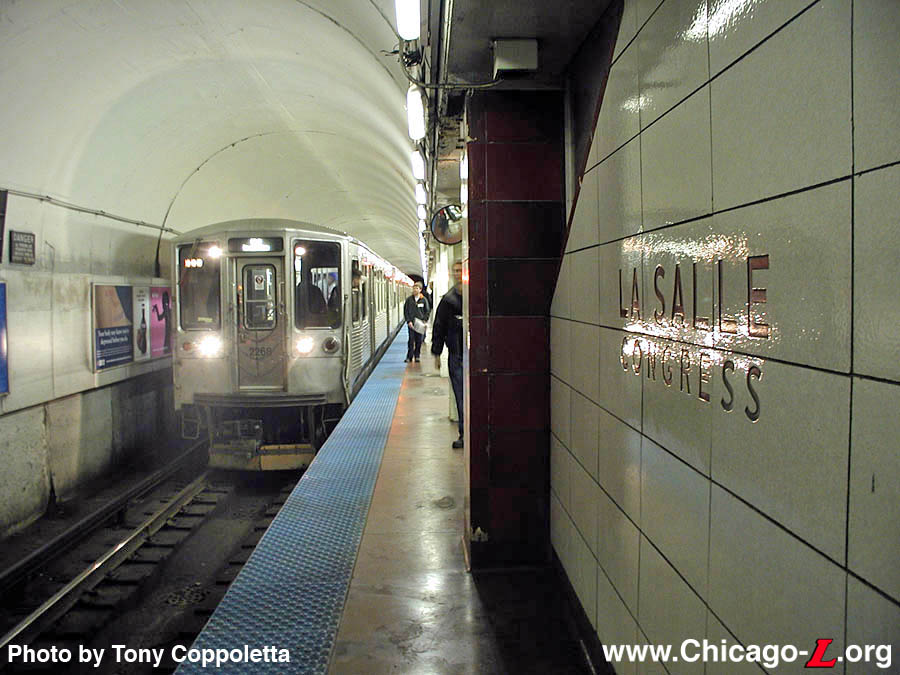
tour03@LaSalle02.jpg
(132k)
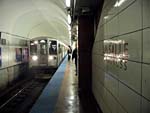
The tour's charter train of 2200-series
cars -- the oldest on the
CTA -- has arrived
and tour participants are about to board for the 5th
Annual Historic "L" Station Tour on October 26, 2003.
The 1951-vintage subway station's inlaid tile station
signage is reflecting the headlights of the 1969 Budd-built
rail car on its glazed surface. (Photo by
Tony Coppoletta)
|
 |
lasalle-congress07.jpg (104k)
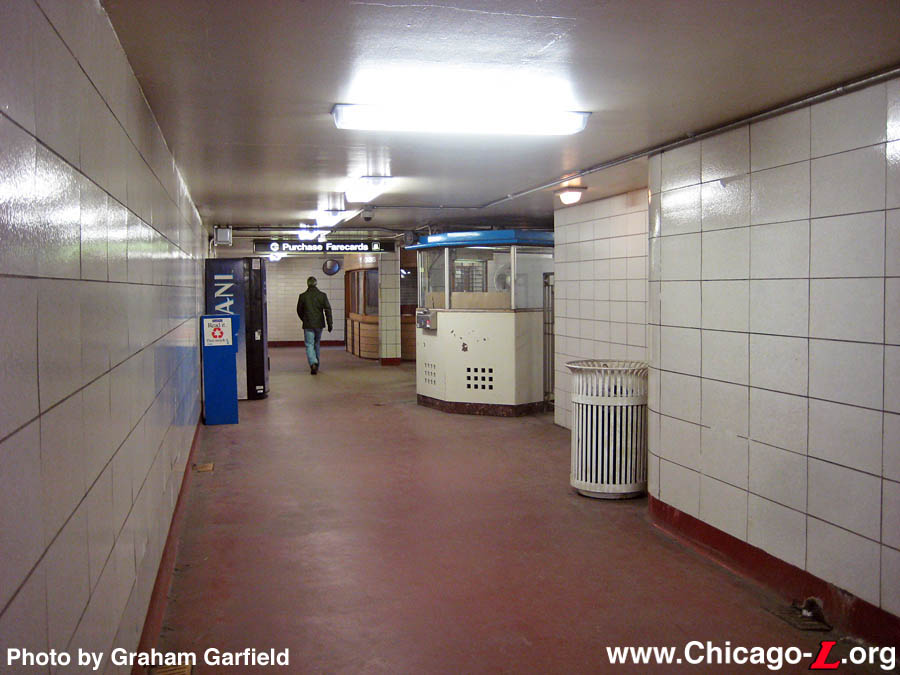
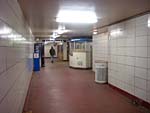
The LaSalle station mezzanine is seen looking south toward the Customer Assistant booth and fare control area from the corridor leading from the north stairs to street level on March 5, 2010. Compared to the image at the top of the page, note that a wall has been constructed on the right, creating a new room for CTA equipment. The lighting has also been improved within a year or so or when the photo was taken. (Photo by Graham Garfield) |
 |
lasalle-congress08.jpg (125k)
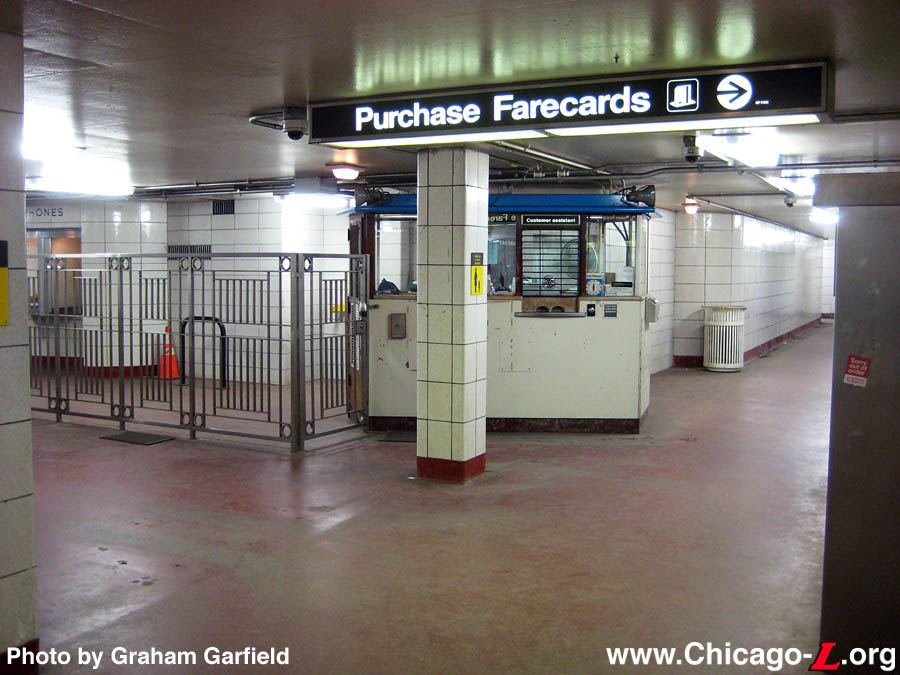
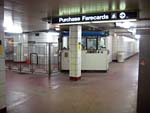
Looking north in the unpaid area on March 5, 2010, the LaSalle/Congress mezzanine is little changed from when it opened over 60 years earlier. The original off-white glazed brick walls and columns, Deco ticket agent's booth (now used by Customer Assistants), and red "no-slip" concrete floors are all still present. Only new fare control equipment and signage betray the passage of time. (Photo by Graham Garfield) |
 |
lasalle-congress11.jpg (151k)
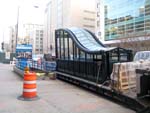
When new street-level entrance kiosks were installed in late 2010, they were fabricated off-site and delivered to the station fully assembled on the flatbed's of "low-boy" tractor trailer trucks. This view, of a new kiosk next to the original, soon-to-be-replaced northwest entrance railing, looks east on November 19, 2010. (Photo by Graham Garfield) |
 |
lasalle-congress13.jpg (164k)
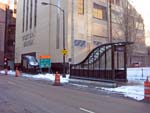
The new neo-Art Nouveau station entrance kiosks at LaSalle on the north side of Congress Parkway are seen looking northwest on December 27, 2010. Two identical kiosks are located across the street, on the south side of Congress Parkway. (Photo by Graham Garfield) |

- LaSalle_Blue_next.wav
(130k): "LaSalle is next. Doors open on the left at LaSalle."
(Sound courtesy of Tony Coppoletta)
.
- LaSalle_Blue.wav
(38k): "This is LaSalle"
(Sound courtesy of Tony Coppoletta)