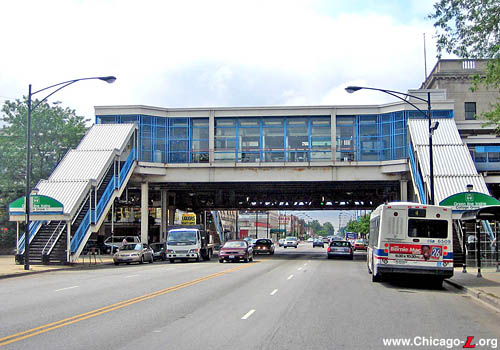
The Cottage Grove station is
seen looking south on July 17, 2006 at the fare control
facility over the street. The station's boxy shape, angled
sections, use of steel and glass, and vivid, contrasting
colors give it an almost postmodern look. The choice of blue
was probably make because at the time of its construction,
Olympic Blue was the CTA's official color for signage and
other public information elements. Note the Nova bus
operating on the #4 Cottage Grove route dropping off
passengers. For a larger view, click here.
(Photo by Graham
Garfield)
|
Cottage Grove
(800E/6300S)
Cottage Grove Avenue and
63rd Street, Woodlawn
Service
Notes:

|
Green Line: East
63rd branch
|

|
Accessible
Station
|
Quick Facts:
Address: 800 E. 63rd
Street
Established: April 23, 1893
Original Line: South Side Rapid Transit
Previous Names: Cottage Grove-East 63rd
(1996-c.2008, on system maps)
|
Skip-Stop Type:
|

|
Station
|
Rebuilt: 1989-91
Status: In Use
History:
This station was built in 1892-93 when the South Side Rapid
Transit Company extended its line from 39th
Street to Jackson Park to serve the World's Columbian Exposition.
Cottage Grove was originally one of five stations on the Jackson
Park branch; the others were Stony
Island (aka Jackson Park), Dorchester,
University and King
Drive.
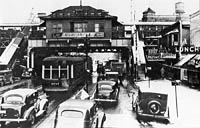
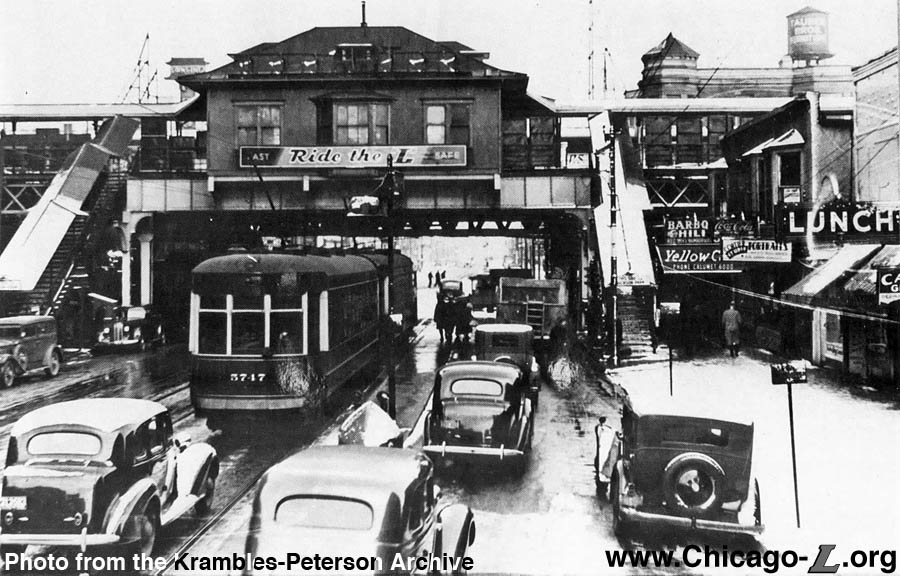
The original Cottage Grove
station in the 1930s. The sign on the front of the station
house reads: "Fast, Safe, Ride the 'L'." For a larger view,
click here.
(Photo from the Krambles-Peterson
Archive)
|
The station had two platform-level station houses, one in each
direction of travel. There was no connection between the two sides by
mezzanine or platform, so each station house handled passengers only
for one direction of travel. Cottage Grove's station houses were
executed in sheet metal, with generally classical ornamentation, a
bay window on the front elevations over the street, and hipped roofs.
Since a number of stations on the South Side Rapid Transit
constructed at the same time, such as Garfield
Blvd, were designed by architect Myron H. Church, it seems
possible that this structure was also of his design. The station
houses had more elaborate treatment of the windows and bay in older
architectural drawings, so its simple, restrained look later might
indicate that it was later remodeled and simplified. The station
house interiors were clad in pressed metal and wood trim, with wooden
agent's booths and coal stoves for heat. Most of the Jackson
Park branch stations over 63rd Street had "turtleback" arched
platform canopies, but Cottage Grove seems to have differed (and its
station houses differed) in having peaked roof canopies over its side
platforms.
The World's Columbian Exposition of 1893, held in neighboring
Jackson Park, brought 20,000 new residents and entrepreneurs to
Woodlawn, the neighborhood in which Cottage Grove station is
centrally located, resulting in the construction of large apartments
and tourist hotels. After the fair closed, Woodlawn remained a
popular destination thanks to the Washington Park's amusement parks,
racetrack, and beer gardens and the specialty shops along 63rd
Street. By the 1920s, Woodlawn had become one of Chicago's premier
retail and entertainment centers, due in large part to popular
theaters like the Tivoli, dance halls and cabarets such as the
Trianon Ballroom, close proximity to dense concentrations of
affordable housing, and the community's convenient transportation
connections. Cottage Grove station was at the center of this popular
business and recreational district.
During the Depression, the community became distressed and the
mass migrations from the southern United States during World War II
for jobs in the defense industry reinforced a demographic
transformation already underway in Woodlawn. After the war, 63rd
Street's businesses began to close and in 1946 the Chicago Plan
Commission designated Woodlawn eligible as a conservation area. By
1960 Woodlawn had deteriorating, crowded housing and few commercial
attractions to support its population, which was by that time 89
percent African-American.
In 1970, Cottage Grove became one of a few stations that were designated as
allowing inbound boarding only. (A similar arrangement was put in
place at the same time at King Drive
and University on the Jackson
Park branch, and Isabella on the
Evanston Line.) The
agents booth and fare controls on the outbound side were abandoned
and removed, respectively, and high-barrier rotogates were installed
so that people could exit here, but not enter from the unpaid area.
Relatively few people were boarding the "L" to travel eastbound from
here and the few who needed to head that way could take the #63 63rd
bus, so the elimination of agents here allowed for an economy for the
CTA.
On March 4, 1982, service on the Jackson
Park branch was suspended south of 61st
Street due to structural defects found in the Dorchester bridge
over the Illinois Central Railroad. The Chicago Department of
Transportation come up with a number of responses, which included
cutting service to Dorchester on the west side of the IC tracks,
abandoning the Jackson
Park branch altogether and replacing the IC bridge and restoring
service to the Stony Island terminal,
the latter of which then-Mayor Jane Byrne supported. On December 12, 1982,
service was restored as far as University
station and the defective bridge was later demolished. As part of the
reopening of the branch, Mayor Byrne announced a four-point
program that included working closely with the Woodlawn community and
The Woodlawn Organization (TWO) to promote economic development along
East 63rd Street. The plan pledged $56 million for modernizing the
branch and the three reopened stations and to build a new Jackson
Park branch terminal at Dorchester,
providing direct access to the Illinois Central commuter line and a
new CTA bus terminal.
Station Reconstruction
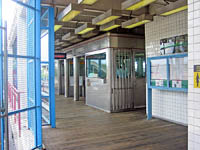
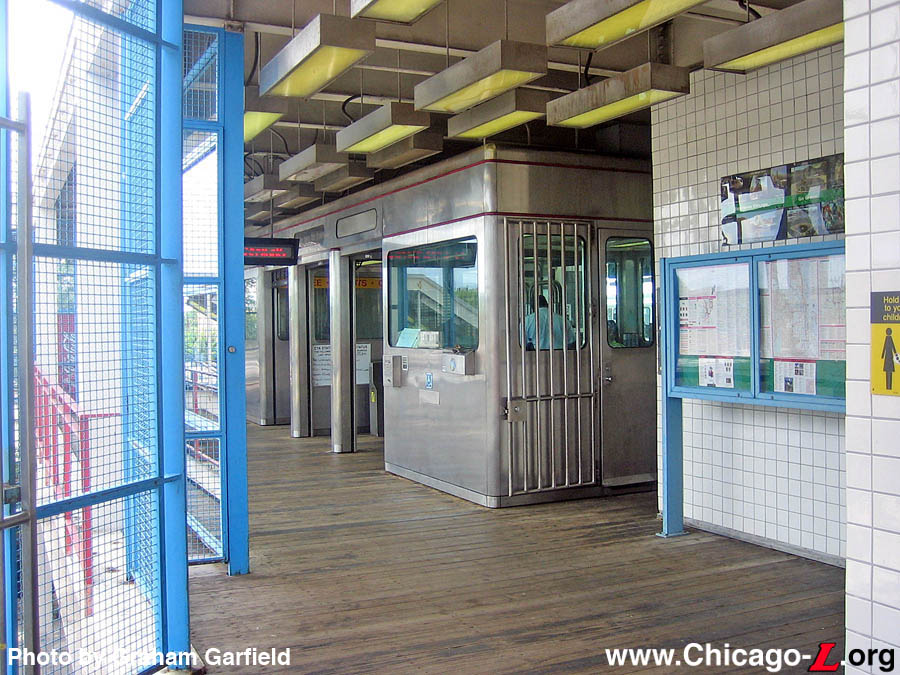
The fare control area of the
Cottage Grove station is seen looking southeast on July 18,
2006 from the northwest stairs from the street. The
stainless steel agent's booth and fare controls, with its
rounded corners and red stripes, is similar to in style to
other stations designed in the 1980s. For a larger view,
click here.
(Photo by Graham
Garfield)
|
In 1989, station rehabilitation was initiated, resulting in its
demolition and replacement with a new facility. Extra-wide stairs led
from both sides of Cottage Grove, north of 63rd Street, to the
platform-level fare control area, enclosed by a steel framed, modern
station house with glass curtain walls. An elevator provides access
for the mobility-limited. The agent's booths and fare controls were
stainless steel, with rounded corners and openings, similar in style
to those designed in the 1980s for several "L" stations such as
O'Hare and others on the O'Hare Extension, as well as the Clark/Lake
entrance in the 203 N. LaSalle building. A full-width canopy
stretches across both side platforms, with an opening down the middle
over the former location of a center track.
Cottage Grove continued
to be an inbound-only boarding station and the new facility was
built with this in mind. Fare controls are only provided on the
inbound side. On the outbound platform, only high-barrier rotogates
are provided to allow exiting; there is no way to access this
platform from the unpaid area or street. Another elevator and two stairs
provided egress to the street from the outbound platform.
On January 21, 1991, the station was reopened after a $4.9
million reconstruction. The project was managed by the Chicago Department of Public
Works and then-CTA Chairman
Clark Burrus said the "upgrading of the Cottage Grove station was
done to meet the expected growing needs of the community. A new
terminal is planned for the Jackson
Park branch at Dorchester, 800 feet
east of the present University station,
now the terminal." The loss of this station and the ones at King
Drive and University leave none of
the Jackson Park
branch's original 1893 stations in place.
Conversion to the Terminal
The new Cottage Grove station was open just three years before the
Green Line -- the
realignment of the Jackson
Park and Englewood
branches with the Lake
branch, effective in 1993 -- closed for rehabilitation in 1994.
The station reopened in 1996 when the Jackson
Park branch was reactivated after a general renovation of the
Green Line, although
little was done to Cottage Grove since it had so recently been
rebuilt. However, a different type of change was in store: the old
University station had been torn down
during the rehab project and the new Dorchester
terminal was not yet finished. More importantly, there was now some
doubt as to whether the extension to Dorchester
would be completed at all, as some elements in Woodlawn were lobbying
to remove the "L" structure from over 63rd Street. So when the
Green Line reopened in
1996, it was only as far as this station, making Cottage Grove the
temporary terminal. Owing to the uncertainty of where the branch
would go, the terminal was termed "East 63rd" (which would remain
accurate where ever the terminal station actually was), although all
station signage was left reading "Cottage Grove". Circa 2009, signage on the system, such as rail system maps and directional signs, began to remove the "East 63rd" name from references to the station, although the branch itself is still referred to as the "East 63rd branch".
In late 1997, the decision was reached: the new elevated structure
and partially-built Dorchester terminal
were dismantled, making Cottage Grove the new permanent terminus of the East
63rd branch. The structure was cut back to the station, meaning no
tail track was available east of the station for turning trains (this
has to be done at a diamond crossover west of the platforms). A
platform was built at the end of the elevated structure, across the
former location of the tracks to connect the north and south
platforms at their east ends. Although the north (former inbound)
platform is primarily used for boarding and alighting trains, since
this is where the fare controls are, this allows the former outbound
platform on the south to also be used for boarding or alighting as needed. With no
terminal offices, trainroom, or reporting location left at 61st
Street (where they had been before the 1993 route realignment), a
small trainroom was also added at the east end of the structure, on
the walkway connecting the platforms, so that trainmen would have
someplace to go between their trips.
Although the platforms were both rebuilt in 1991 to accommodate 8-car trains per CTA standards (long enough to berth the train, plus extra room at each end for a safety margin), when the East 63rd branch was cut back to Cottage Grove in 1996 it was cut back too far into the platform area to allow an 8-car train to berth. Rather than the bumping post being placed beyond the east end of the platforms, it was placed just west of the ends of the platforms, within the platform area (which allowed a walkway to the built across the end of the tracks connecting the two platforms at their east ends to permit free passage between the two). When further accounting for the distance back from the bumping post that the fixed track trip (to engage the brakes of any train that did not stop before reaching the end of the track and bumping post) and wayside signals had to be placed to ensure braking distance in an emergency, there was no longer sufficient room on the remainder of the platform to allow an 8-car train to fully berth with all doors on the platform, let alone the additional stretch of platform that was typically provided for a safety margin in berthing. As a result, service on the East 63rd branch was restricted to 6-car trains ever since the Green Line reopened post-rehab in 1996. Although this did not technically prevent trains scheduled to travel between Harlem and Ashland/63rd from being 8-cars long, it made such an arrangement problematic because, should a delay or other operational situation require scheduled trips to be switched between the terminals, it might result in an 8-car train being sent to a terminal that could not accommodate it (or, to prevent this, severely limit the options of supervisory or management personnel in trying to restore service or deal with such disruptions).
In August 2015, work began to extend the north pocket platform (former northbound platform) approximately 36 feet in order to allow 8-car trains to fully berth in the station on Track 2 (north pocket track). The work, which began on Tuesday, August 11, 2015 and lasted about two weeks, actually bridged the west end of the north platform with another existing platform to the west, on which a relay house and tower for the interlocking sat. However, the section of platform with the relay house is not part of the extended passenger platform; the new end railing is at the west end of the platform extension, and passengers are prohibited from the area with the signal house.
Because the north platform was extended before the south platform was, 8-car trains are restricted to only berthing on the north platform, restricting the flexibility of operations at the Cottage Grove terminal.
Small Business/DBE Contractors Provide Station Improvements
In 2018, CTA made improvements at four Green Line stations -- 51st, Halsted, Cottage Grove and Kedzie -- benefitting Chicago's South and West side communities with improved transit facilities and new opportunities for small local business owners.
A variety of subcontractors completed the work on these four stations, some of which graduated from CTA's 2017 Green Line Small Business Initiative. Through this unique program, small businesses and disadvantage business enterprises (DBEs) from Chicago's South and West sides were provided training and assistance in order to help them compete for business opportunities on CTA projects.
The contract for improvement work on the 51st, Halsted, Cottage Grove and Kedzie Green Line stations was awarded to F.H. Paschen. Paschen then hired a number of subcontractors to meet the project's DBE goals, as well as some of the participants of the Green Line Small Business Initiative.
The DBE participation for each station included 35% at 51st Station, 40% at Cottage Grove, 40% at Halsted and 35% at Kedzie. Companies that worked on the Green Line stations included The Giant Painter, which painted the Kedzie and Halsted stations; R.E.A. Masonry, LLC, which worked on Halsted; Synergy Development, which provided their services at Cottage Grove and Halsted; Bartech Group, which worked at Kedzie and Halsted; and Alpha Phase, which worked on the 51st station.
Of the 24 small and local businesses that participated in the Green Line Small Business Initiative, four received DBE certification as a result of the program and six firms were able to secure improvement work on the four Green Line stations listed above, as well as the Garfield station.
Each of the four Green Line stations received the following improvements, which have significantly improved the safety of the stations and has extended the useful life of various station components:
- Replacement of existing light fixtures with LED
- Cleaning and polishing of all stainless steel surfaces
- Painting of the stairwells and stair structures
- Exit stairs repaired for increased customer safety
- Adding ADA-compliant hand rails
- Adding new stainless steel and glass storefront doors with frames
- Power washing the interior and exterior walls, glass and steel facade
- Adding new backlit station Identifier, entrance and elevator signage
- Sealing roof to wall connections
On December 28, 2018, Mayor Rahm Emanuel and CTA President Dorval R. Carter, Jr. announced the completion of the improvements made at the four Green Line stations.
The cost of improvements to all four stations was $12 million, funded by 2017 CTA bonds.
Planned "Gateway" Station Renovation
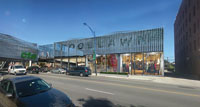
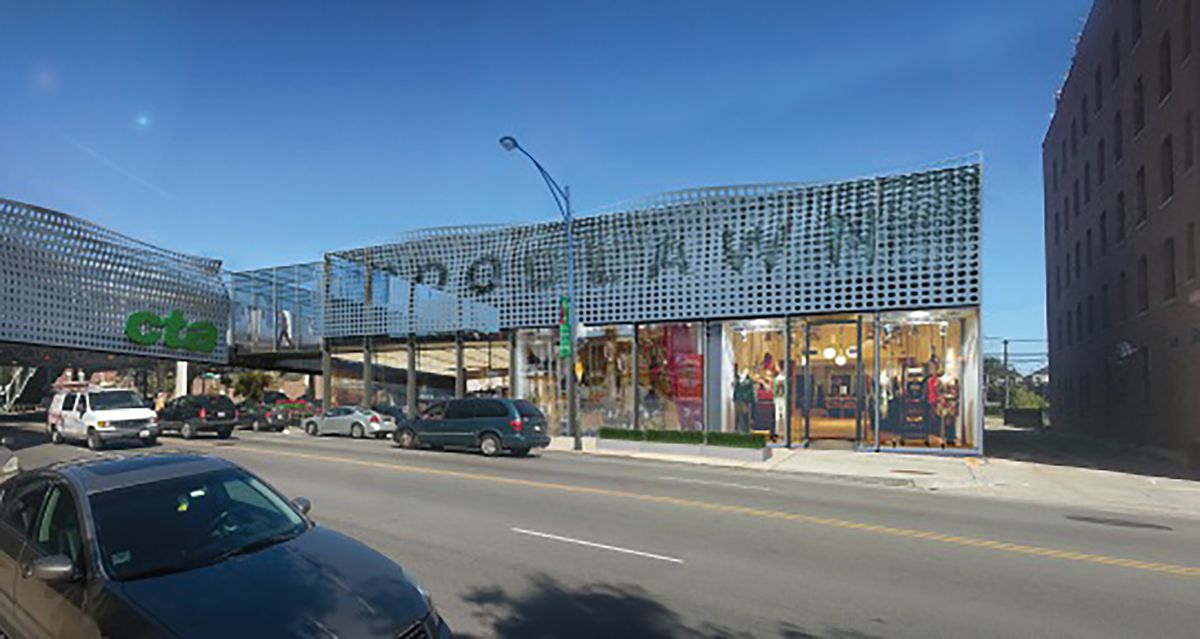
A conceptual artist's rendering conveys the type and scale of improvements that may be included in the planned "gateway" renovation project at Cottage Grove. For a larger view,
click here. (Image courtesy of CTA) |
In April 2017, the CTA and the city announced plans to renovate the Cottage Grove Green Line station, though details, including the cost and when construction would begin, were still in flux at the time.
The project was intended to promote the station as a "gateway" to the community -- the same idea behind renovations at the Belmont Blue Line and the Garfield Green Line stations. The Cottage Grove station is at the heart of Woodlawn, the South Side community undergoing a revival. The station is just minutes from the future home of the Obama Presidential Center.
Improvement options being considered for the station included new canopies, lighting and reconfigured stairs, as well as a sign to identify the Woodlawn community. One idea for the station is to use lighting to accentuate the architectural beauty of the steel "L" structure, the CTA said. Also being considered is a perforated steel screen with the word "Woodlawn" along the top of nearby commercial buildings, and to reconfigure the stairs so they would run east and west, instead of north and south, and incorporate them into some commercial buildings. The CTA and the Chicago Department of Transportation were working on developing the project's full scope and estimated budget.1
By fall 2020, although the precise scope and detailed designs appeared to still be in development, the plans now included a new station house with pedestrian bridge to a new commercial building on the southeast corner of 63rd and Cottage Grove to be built by the nonprofit Preservation of Affordable Housing (POAH). POAH plans to begin construction on their building by 2022 and finish the building in 2023.2 It is not clear if the new station house is to be part of the new POAH building, or a separate facility.

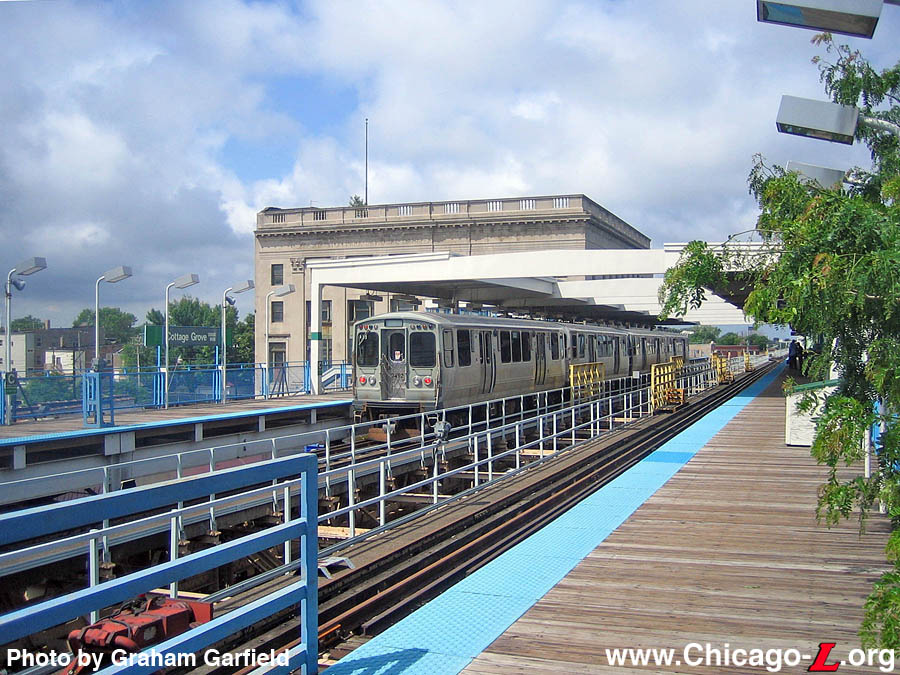
The Cottage Grove station is
seen looking west from the east end of the former inbound
(north) platform on July 17, 2006. Originally designed as a
through-station, a walkway now connects the two platforms
just to the left out of frame. The four-car train of 2400s
is there to serve as an extra set of equipment for the
terminal, in case of a train arriving back late or to
replace defective equipment. The yellow stands on the
catwalk assist switchmen in cutting cars of train consists.
For a larger view, click here.
(Photo by Graham
Garfield)
|

|
cottagegrove-tivoli.jpg
(124k)
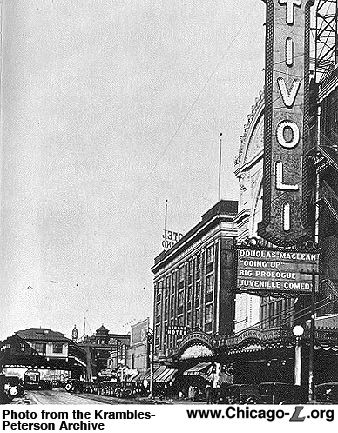
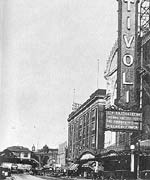
Looking north on Cottage Grove in 1924. Located in the
western part of Woodlawn, this was one of the major business
centers of the South Side. The Tivoli, with over 4000 seats,
was one of the largest early movie palaces.
(Photo from the Krambles-Peterson
Archive)
|
|
cottagegrove01.jpg
(132k)
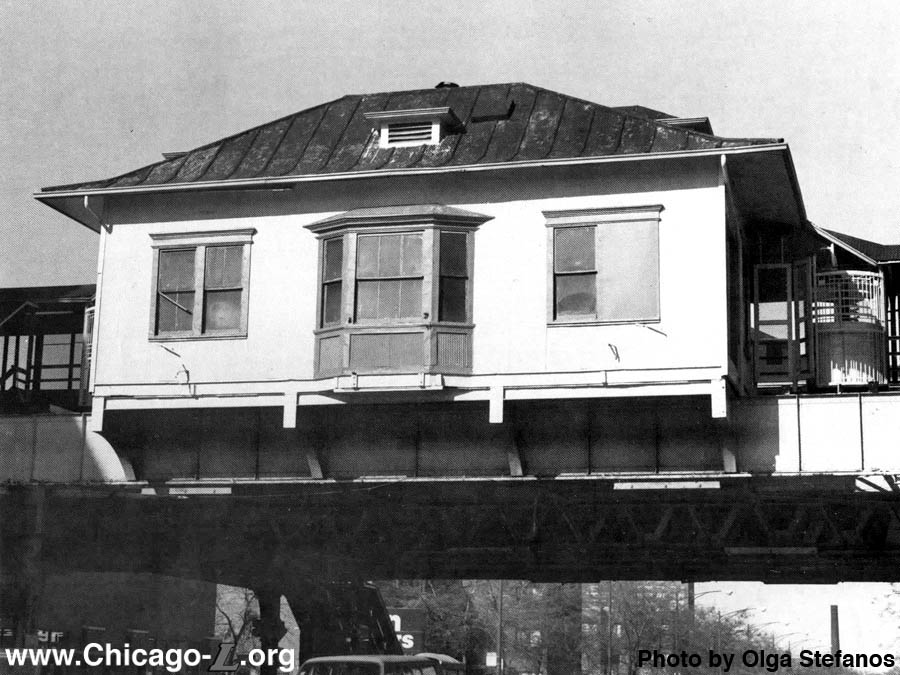
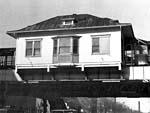
The Cottage Grove elevated station, a classical sheet metal
and wood structure, seen in 1985. By this time, the station
had undergone several changes, including removal of some
ornamental details and the covering of some of the exterior
windows. (Photo by Olga Stefanos)
|
|
cottagegrove04.jpg
(81k)
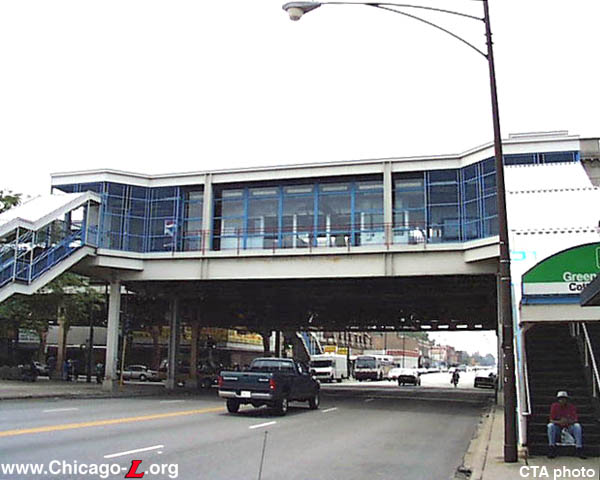
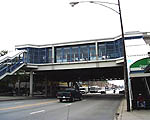
The Cottage Grove inbound station house, looking
south in 1999. Very similar to the new King
Drive station, these two are the only "L" stations to
use this particular modern design.
(Photo from the Chicago Transit
Authority Collection)
|

|
cottagegrove05.jpg
(62k)
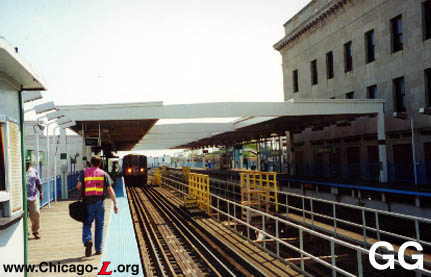
The platforms at Cottage Grove, looking
east in Summer 2000. The full-width canopy is open down the
center, where there are no trains or platforms to cover.
Designed as a through station with dual platforms (though
outbound boarding was never intended here), it has now
become the terminal of the branch.
(Photo by Graham Garfield)
|

|
cottagegrove06.jpg
(181k)
The fare control area at Cottage Grove station,
looking northwest on December 14, 2002 from the paid area.
Even though the station has two side platforms with no
common mezzanine, it only has fare controls on the north
platform. It was originally designed as a mid-line station
with inbound-only boarding permitted, so no fare controls
were needed on the south platforms. Today, with the station
functioning as a terminal, the one fare array serves both
platform. The elf, a
CTA employee, is
there for the annual Holiday Train, which was on layover at
the station. (Photo
by Graham Garfield)
|
|
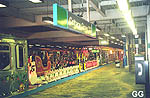
cottagegrove-HolidayTrain.jpg
(70k)
The CTA's Holiday Train visits the Green Line on December
16, 2000, looking east on the outbound platform at Cottage
Grove. The Holiday Train consists of a CTA flat
car decorated with a Santa sleigh, elf workshop, and copious
amounts of lights, between sets of decorated rehabbed
2600-series
cars. (Photo by
Graham Garfield)
|


- announce2.wav
(77K): A Green Line operator gives the standard safety
announcement at the beginning of the run at Cottage Grove, then
announces the next stop, King
Drive.
Notes:
1. Wisniewski, Mary. "CTA, city plan renovation of Cottage Grove Green Line station," Chicago Tribune,
April 24, 2017.
2. Gettinger, Aaron. "Plan for $60 million renovation of Cottage Grove 'L' station includes link to new POAH building," Hyde Park Herald,
October 23, 2020.