|
|



|
|
|

5000-series Cars (2009)
|
|
|
|
|
5000-series Cars (2009)

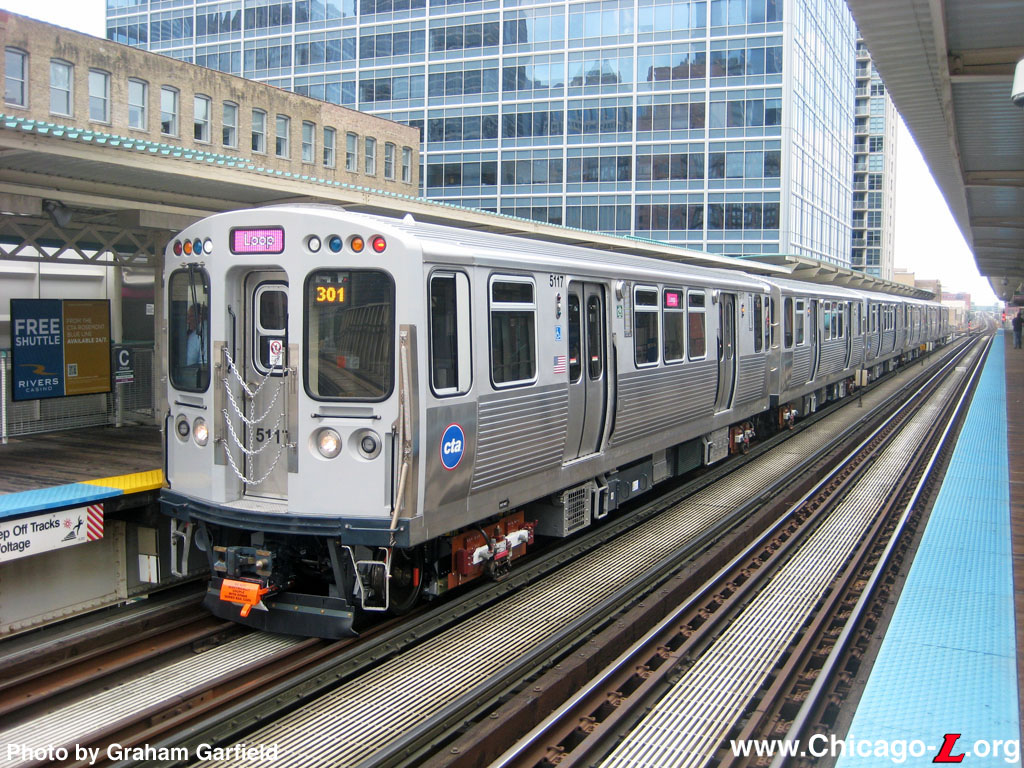
The 5000-series CTA railcars have an exterior very similar to the 3200-series cars. Differences include some minor changes in the window arrangement near the sidedoors and the use of LED destination signs. Car 5117 is seen at the head end of a 6-car Pink Line train at Clinton on July 18, 2012. Car 5117 was one of the first cars delivered with color LED exterior destination signs. For a larger view, click here. (Photo by Graham Garfield) |
Specifications:
Built by: Bombardier Transit Corporation
Year: 2009 (5001-5012), 2011-2015 (5013-5714)
Length: 48'-0"
Width at Floor: 8'-8"
Width at Windows: 9'-4"
Height over Roof: 12'-0"
Trucks: Bombardier
Truck centers: 33' 8"
Truck wheelbase: 6' 6"
Coupler: #1 end / #2 end: Form 5 / tubular
Wheel diameter: 28"
Seats: 38
Weight (w/o passengers): 57,000 lbs
Motors per car: 4 TM11-1FP @ 131hp
Balancing speed: 70 mph
Governed speed: 55 mph +
+ The propulsion package, while capable of higher speeds, is limited by the logic of the car controls and the external signal system.
.
History:
By the early 2000s, the CTA's oldest cars (the 2200-series) were more than 30 years old, and its next oldest series (the 2400-series) wasn't much younger. CTA's most recent purchase of new rail cars was in the 1990s when 3200-series cars were purchased for the opening of the Orange Line, and to replace older cars on the Brown and Yellow lines. The need to continue renewing the railcar fleet, along with the eventual need for an expanded fleet for 8-car Brown Line service and various planned extensions necessitated a new railcar order.
Development
The new series of cars was originally going to be essentially the same as the 3200-series with a few upgrades. The "3500-series", as they were dubbed, were to be unpainted metal with corrugated side panels on the exterior and feature full-width motor cabs, air-conditioning, upholstered seat inserts in a fiberglass seat shell, and sliding side doors. New features were to include a video surveillance system (prototypes of which were retrofitted and tested on some 3200-series units), protective film on windows to deter graffiti vandalism, improved destination signs, use of 2x2 seating throughout the car (discontinuing the use of single seats started in the 3200s), and the use of AV signs inside in concert with the pre-recorded announcements to alert riders to station stops and other information.
The Chicago Transit Authority issued a Request for Proposals (RFP) for the manufacture and delivery of the 3500-series on April 17, 2002. The request advertised for a contract to manufacture up to 406 cars, with options to build up to 300 additional cars. In late December 2002 the bid requisition was "canceled in its entirety."
In May 2003, the CTA publicly announced that their plans to purchase new rail cars using alternating current (AC) technology, which is increasingly used in transit system traction. This represented a substantial change from the previous 3500-series designs, which had called for another order of DC-propulsion units.
The decision to transition the fleet to AC traction was based on both passenger comfort and cost savings. AC cars have practical benefits for riders. AC train motor systems produce smoother acceleration and braking. Trains also use AC power more efficiently, lowering operating and maintenance costs, and there is less wear and tear on the rails and cars because of the way the power is supplied. Through power regeneration, AC propulsion also offers some power savings. Some of the power used to accelerate the train can be recovered and put back into the third rail when stopping the train. This provides additional power to accelerate other trains and reduces the total amount of energy required to run the system. On trains using DC propulsion systems, the braking energy is dissipated as heat.
The third rail remains 600v DC and the DC-to-AC conversion happens onboard the cars. However, this still means that there will be a long period during which CTA will operate a mixed fleet of AC and DC equipment because the conversion will take decades, the amount of time needed to replace the agency's entire fleet of railcars. A line, theoretically, will be able run with both AC and DC equipment during the conversion period, but not in mixed train consists.
As the High-Performance 2000-series represented a clean break with the PCC 6000s, the new AC cars represent the beginning of a new family of cars that are incompatible with the current High-Performance Family cars. The AC cars keep the same coupler (the Ohio Brass Form 5), so the ACs and DCs can be mechanically coupled, but they will not be able to be electrically coupled.
The new railcars were internally referred to variously as "1000-series" and "8000-series" before CTA announced them as being officially termed the "5000-series". The choice to number the cars in the 5000-series is interesting, considering that a previous set of cars bore that series designation. Reuse of car numbers is not a new concept for the "L", however, as most of the High-Performance Family cars numbered 2001-3458 reused car numbers previously used by Lake Street and Metropolitan Division wooden "L" cars.
Car Design and Acquisition
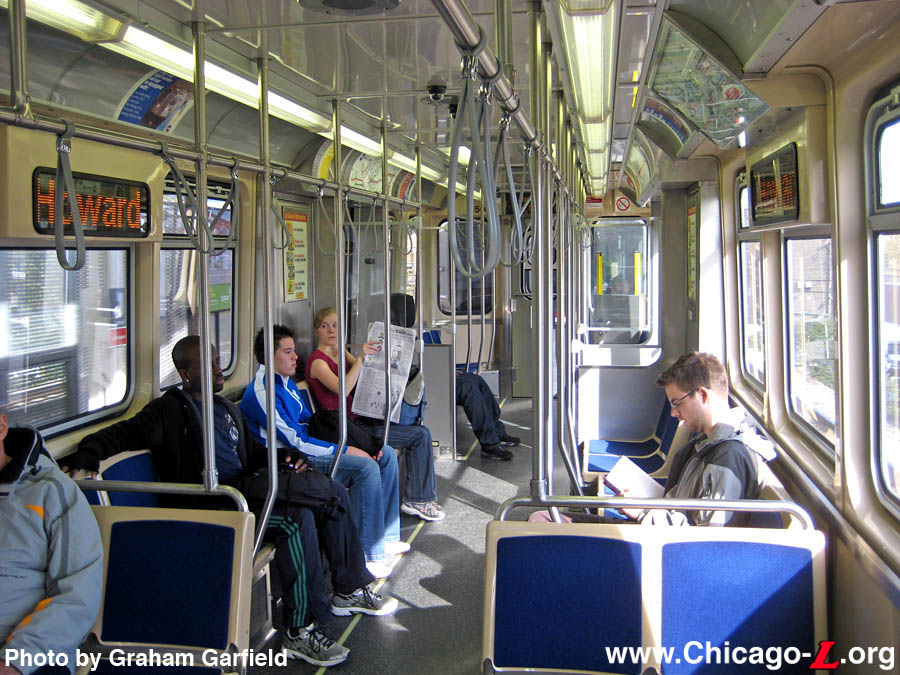
In this view of car 5009's interior on April 19, 2010, note the 5000-series' use of longitudinal seats, overhead stanchions with straps, LED destination signs, and flooring with glow-in-the-dark striping. For a larger view, click here. (Photo by Graham Garfield) |
Aesthetically speaking, the 5000-series railcars are similar to the 3200-series cars. Their exteriors maintain the unpainted stainless steel car sides with fluting below the window line and molded fiberglass end caps. However, the cars have many new features.
Aside from the use of AC propulsion, perhaps the most obvious change in the 5000-series railcars is the use of longitudinal aisle-facing seating. With the new seating configuration, the CTA says they can accommodate more customers per rail car and provide a more comfortable trip. The longitudinal seating configuration adds six-inches to the narrowest portion of the aisle, providing more space for standing customers. Vertical and horizontal stanchions with hanging straps in the center of the car also provide additional support for standees. Customers carrying backpacks, packages, luggage, strollers and bikes have more room to maneuver. Additionally, the new configuration allows for one more wheelchair position (two per car) than the current configuration (one per car). The cars have 40 seats, one more than the CTA's newest units, the 3200-series. Urban railways in several major cities, such as New York, Boston, London, Paris and Tokyo, also use aisle-facing seating. In 2004, the CTA tested the concept on a pair of 3200-series cars, unit 3407-08, by temporarily converting the cars to longitudinal seating, running them on all routes except the Yellow Line, and collecting feedback. (Read more about the experimental seating cars here.)
The seating configuration proved controversial among riders, however, with mixed reactions from passengers. The belief that the aisle-facing configuration provided more capacity was not entirely borne out, although the reasons for this appear to be partly physical constraints and partly rider behavioral patterns that resulted in space not being fully utilized. A study titled "Is This Seat Taken?", conducted by two CTA planning and market research employees and published by the Washington-based research and policy group Transportation Research Board in early 2015, looked at the issue and found that many of the stated goals from when the cars were designed in early/mid-2000s did not come to fruition. The study found that many passengers will decline to use an empty seat between two seated passengers on the aisle-facing seats, because riders would be uncomfortably squeezed shoulder to shoulder and thigh to thigh, in part due to the width of the scoop seats. The study also found no evidence that the more standing room available on the 5000-series cars increased car capacity, stating, "the wider aisle in [the 5000-series] layout was compromised by the varied leg lengths of the seated customers and therefore created spots in which no one chose to stand."
Other features of the cars include:
The CTA issued a RFP for the manufacture of the new 5000-series AC-propulsion rail cars on January 28, 2005. The RFP called for a base order of 206 rail cars with additional options that could bring the total purchase to 706 cars. The total with all options would represent the largest single railcar procurement in CTA history, topping the 600 2600-series railcars delivered in 1981-87.
According to an October 10, 2005 Crain's Chicago Business article, three companies submitted proposals by the September 15, 2005 deadline: Alstom Transportation Inc., an American subsidiary of French firm Alstom S.A.; Bombardier Inc., the Montreal-based aircraft and railcar manufacturer; and Kawasaki Rail Car Inc., a subsidiary of Japanese company Kawasaki Heavy Industries Ltd. According to Crain's, the three manufacturers all retained local consultants, many former CTA and city staff and officials, to help them hone their pitches and navigate the Chicago political waters.
On May 10, 2006, the Chicago Transit Board approved a contract for the manufacture and purchase of 406 new rail cars -- the base order and first option in the RFP. The total contract with all options is not to exceed $933 million; however, CTA currently has funding for the base order of 206 and an additional option in the contract for 200 rail cars for a total of $577 million. CTA is using capital funding from the Federal Transit Administration Formula Funds-5309, and funds from the Illinois Department of Transportation. When approving the contract, the CTA said they may have to issue $50 million in bonds to complete the purchase unless additional capital funds were provided.
Through a competitive RFP process, CTA selected Bombardier Transit Corporation located in Bensalem, Pennsylvania for the contract. Its project history includes the first North American order for high-speed trains from Amtrak; commuter cars for the Long Island Railroad and Metro-North Railroad, and rapid transit cars for the New York City Transit Authority. In the U.S., Bombardier Transportation is also the leader in automated people mover systems which currently operate in 10 airports across the country.
The base order and first option will provide enough cars replace the Budd 2200-series cars delivered in 1969-70 and the Boeing-Vertol 2400-series cars delivered in 1976-78, plus some additional cars to increase the fleet size to meet growing ridership and operate 8-car trains on the Brown Line.
CTA received 10 prototype cars in advance of the full production order. The prototype cars will get at least nine months of testing -- in Chicago's snowy winter and humid summer -- before other new cars are delivered by Bombardier. Construction will go forward at a slow pace during the testing period. Production of the remainder of the base order of 206 was expected to begin in 2010 with delivery beginning in 2011, with the first option of 200 additional rail cars following that. Under the contract with Bombardier, CTA was able to exercise other options, originally for an additional 216 rail cars and another 84 rail cars for airport service, as funding became available.
The CTA issued a Notice to Proceed to Bombardier at the end of July 2006 to begin assembly of the cars. The contract called for delivery of the 10 prototype cars within 30 months after official Notice to Proceed is given by the CTA, although due to various issues they were actually delivered some months after that period.
The Chicago Transit Board granted permission on October 11, 2006 to issue up to $275 million in revenue bonds to help pay for new rail cars and buses and to continue capital improvement projects.
On January 23, 2008, the Chicago Transit Board approved a change order to the contract with Bombardier, incorporating technology enhancements to improve some of the previously planned features of the rail cars. Adding wireless connectivity to the electronic systems provided for the following additional features:
In addition to the technological upgrades, the change also included a new specification for the seat insert fabric, which was upgraded to an anti-stain/anti-microbial fabric newly available in the industry.
The adjustments made to the existing $577 million contract total $26.6 million, bringing the grand total for the base order of 206 rail cars and option 1 for 200 additional rail cars to $603.6 million.
Besides these changes, the CTA also asked the manufacturer to perform an industrial design assessment to determine what additional enhancements could be made to improve the functionality and appearance of the rail cars without affecting the production and delivery schedule. Features such as seat design, flat panel information screens, windscreen and lighting design were all evaluated and additional costs estimated for consideration. Proposed designed were prepared and shown at a CTA Board meeting; however, the changes were not pursued and the prototypes and production cars were delivered as originally specified.
On February 10, 2010, the Chicago Transit Board approved an ordinance providing authorization to issue revenue bonds that will allow the agency to purchase the 406 rail cars contained in the base order and option 1 of CTA's contract with Bombardier. When the procurement began in 2006, CTA programmed the issuance of bonds as part of its capital spending. The amount for the bonds is not to exceed $550 million. The total cost of the rail cars is $674 million. The bonds, which were to be bid in early March 2010, are backed by federal funds and sales taxes.
In mid-July 2011, the CTA exercised the remaining two options for additional cars in their contract with Bombardier for additional cars, adding another 300 railcars to the order and bringing the total number of 5000s on order to 706. The 300 cars will cost about $331 million, bringing the total value of the contract to $1.37 billion. On October 13, 2011, the CTA board approved a financing strategy to acquire the last 300 cars. CTA will sell up to $625 million in bonds to pay for the cars, interest costs and associated charges. The CTA elected to sell bonds to finance the remaining cars rather than use other grants to take advantage of the unusually low interest rate available at the time, freeing up the grant funds for other badly needed capital projects. The cost of each 5000-series railcar comes out to $1.4 million, according to CTA chief financial officer Karen Walker. By comparison, the cost to overhauling existing CTA railcar averages $1.2 million per car, she said.
On February 13, 2013, the Chicago Transit Board approved a contract amendment to increase the total order of the 5000-series to 714 cars, as well as to change the lighting in the cars to LEDs. To cover the costs of those improvements, CTA applied a spare parts credit and agreed to make an accelerated payment to Bombardier. After ordering too many spare parts for the 5000-series rail cars under the 2006 contract, the CTA subsequently reduced the spare parts procurement, earning a monetary credit. Acquiring an additional eight rail cars, bringing the total order to 714 from 706, will allow the CTA to have additional cars to more quickly replace aging rail cars. CTA advanced Bombardier an accelerated payment of $61 million and applied a spare parts credit of $15 million in return for the LED lights and the eight rail cars, which are being bought for about $300,000 less per car than those under the original contract -- the CTA will pay $1,034,831 for each of the eight extra cars, whereas the per-car cost was $1,336,596 in the initial order.
Prototype Units -- Cars 5001-5012 -- Testing and Acceptance
Per the contract, the 10 prototype 5000-series cars were built for CTA, but Bombardier actually built 12 prototypes total. Cars 5003-5012 were delivered to CTA per contract, while Bombardier kept the other two, 5001-02, for testing and other purposes.
The 5000-series cars were assembled and track tested at Bombardier's plant in Plattsburgh, NY. With car shells assembled in La Pocatiere, Quebec, near Montreal, from parts fabricated there and in Sahagun, Mexico, the shells were trucked to Plattsburgh, the site of Bombardier's assembly and testing facility. Once assembled and placed on trucks, the cars were moved by the Canadian Pacific railroad approximately two miles to a test facility and test track. A full schedule of tests, both in the shop and on the track, were performed. Power was first applied to the first set of cars, 5001-02, and system static testing was begun.
Upon completion, the prototype car shells underwent water testing followed by the installation of under-car and interior wiring and equipment and interior fixtures including floors, seats, lights, and the motorcab. The side and end doors and some wire harnesses were installed in La Pocatiere during shell assembly and other wire harnesses were installed in Mexico during underframe assembly.
Prototype cars 5009-10 received a special promotional exterior graphic scheme for the prototypes' introduction to the press and public. No other cars received this scheme. Car 5010 is seen at Howard on April 19, 2010. For a larger view, click here. (Photo by Graham Garfield) |
The first prototype cars delivered to CTA was unit 5011-12 on September 24, 2009. This was followed by the delivery of cars 5007-08 on October 21, 2009, cars 5003-04 on November 3, 2009, and cars 5005-06 on November 18, 2009. Delivery of the ten prototype 5000-series cars was completed with the arrival of cars 5009-10 at Skokie Shops at approximately 3:30pm on November 23, 2009. Ironically, the very first set of cars, unit 5001-02, were retained by Bombardier at their Plattsburgh, NY assembly and testing facility.
CTA began testing the first cars received, 5011-12, before any of the other cars arrived. These two cars were tested as a two-car train beginning October 6, 2009 on Track 1, the southbound Purple Line Express track, between Howard and Wilson middays when no revenue service was scheduled. The cars operated in non-revenue service, without passengers, bi-directionally on Track 1, testing the propulsion, braking, Global Positioning, leveling, public address, and other systems, as well as clearances. The cars carried a compliment of CTA and Bombardier engineers, as well as Rail Operations instructors and other personnel, to conduct tests, monitor and troubleshoot issues, and analyze the results.
The 5000s first operated south of Wilson on November 4, 2009, when a four-car train consisting of cars 5007-08 and 5011-12 continued testing in non-revenue service between Linden and 95th. During testing, the train simulated in-service operation by making all station stops but opening the doors on whatever side of the train was opposite the platform so as not to confuse or pick up customers. One car would also be loaded with sandbags to simulate the weight of a passenger load. Non-revenue testing continued for several months and on all the "L" lines. The four-car test train of 5007-08 and 5011-12 made its first test trip on the Orange, Brown and Green lines on November 5, and on the Blue and Pink lines on November 6, 2009.
Crew familiarization training began on December 10, 2009, using cars 5009-10. The training train originated from and laid up to Skokie Yard. Training concentrated on the operators assigned to the Red Line, since this was where the cars were first run in revenue service.
After several months of testing in non-revenue service, CTA's first new rapid transit cars in more than 15 years entered revenue service on April 19, 2010, under rush hour conditions on the Red Line. The consist of the first train of the new cars in revenue service was 5010-5009-5011-5012-5006-5005-5004-5003. Cars 5001-5002 remained at Bombardier and 5007-5008 were at Skokie Shops. A minor glitch occurred immediately on the cars' maiden voyage. The train was loaded and ready to go at 95th/Dan Ryan at 7:30 a.m., but the brakes refused to release on car 5011, the third car of the eight-car train. CTA and Bombardier personnel troubleshot the problem and, after a 10-minute delay, the new train was underway.
Following four weeks of passenger service testing on the Red Line, the 5000-series prototype cars moved to the Green Line over the weekend of May 15-16 and went into service there beginning Monday, May 17. The first trip on the Green Line Monday morning was Run 605, leaving Harlem/Lake at 6:20am. Train operated as a 6-car consist on the Green Line, compared with its 8-car operation on the Red Line.
The CTA temporarily removed the 5000-series prototype rail cars from service on Thursday, May 20, 2010 so that engineers could install and test a modification to the braking system. Bombardier had been working on a modification that would improve the operation of the brakes. Although the test trains did not experienced any failure, under certain conditions a component was found to be affected. Vibrations were affecting a component in the braking system, CTA engineers found. According to the Chicago Tribune, the vibrations could possibly cause the "slack adjuster'' in the brake to loosen and result in a loss of braking friction during extended use. The slack adjuster makes accommodations for the amount of wear on the brake pads over time. The retrofit was performed at Skokie Shops, and once the adjustment was made the rail cars were tested out-of-service beginning in June before resuming testing again on the Green Line on Monday, July 12, 2010.
The cars continued in Green Line service until Saturday, July 31, 2010, after which they were transferred to the Blue Line. The prototype railcars began in-service testing on the Blue Line beginning Monday, August 2 and were removed from the line in mid-October. After briefly returning to Skokie Shops for additional adjustments and testing, the prototype cars were transferred to the Orange Line and began a testing period on that route on Monday, October 25. After a month of testing between Midway and the Loop, the 5000-series prototype railcars began in-service testing on the Brown Line effective at the start of service on Tuesday, November 23. After a month-long testing period on the Brown Line, the cars moved to the Pink Line for another month of in-service testing. The cars' test service on the Pink Line began with the start of service on Monday, December 27, 2010 and ended the weekend of January 15-16, 2011. The 5000-series prototype rail cars began in-service testing on the Yellow and Purple lines beginning at the start of service on Monday, January 17. Because eight of the 10 prototype cars were typically used in-service testing at any given time on the other lines, but the Purple and Yellow lines are restricted to trains no longer and six and two cars, respectively, the cars were tested simultaneously on the two lines by splitting the cars between them. Typically, a 6-car train operated on the Purple Line, while a 2-car train operated on the Yellow Line, leaving the other two cars as spares or for other testing, training, or other purposes as needed. Testing on the Purple and Yellow lines finished on February 12.
After having completed testing on all eight "L" lines, the cars entered the last stage of their in-service testing. Entering service Monday morning, February 14, 2011, the cars went back to the Red Line -- the first line on which they were tested in revenue service for two noncontiguous periods -- because it is the rail system's busiest line and the CTA wanted to test the cars during winter conditions under heavy ridership. After about a month and a half on the Red Line -- which included a period during which they received more system tweaks and upgrades and were run in nonrevenue testing -- the cars moved to Purple Line on Monday, April 4, 2011 for additional in-service testing.
On May 27, 2011, the revenue service test period for the prototype 5000-series railcars came to a successful completion when CTA accepted Bombardier's solutions to the last technical issues that had arisen during the testing, and CTA gave Bombardier permission to begin delivery of production cars.
The delivery of cars began with 5001-5002, the remaining two prototype cars that has been kept at Bombardier's plant in Plattsburgh, NY to develop the revised cab arrangement and secondary structure designs that were then incorporated in all cars. 5001-02 arrived at Skokie Shops on June 4, 2011 and, although built as prototypes, in a sense became the first production cars since they incorporated all the changes included in the production cars.
The other prototype cars, 5003-5012, remained in revenue service on the Purple Line in order to complete testing of new software that had been recently installed. On Friday, June 10, 2011, the cars were removed from service and transferred to Skokie Shops where they were stored before being returned to Bombardier for retrofitting to production configuration. The first two cars to return to Bombardier were 5011-12 which left Skokie Shops the morning of July 7, 2011.
Production Units -- Cars 5013-5714 -- Construction and Delivery
Once the CTA completed testing of the 10 prototype units, with a satisfactory outcome of the testing regiment, the CTA authorized Bombardier to proceed with final assembly and delivery of the production units.
The CTA initially planned to exercise the base order and option 1 of their contract with Bombardier, which would provide for the delivery of another 396 railcars for, along with the 10 prototypes, a total of 406 cars. In mid-July 2011, the CTA exercised the remaining two options for additional cars in their contract with Bombardier for additional cars, adding another 300 railcars to the order and bringing the total number of 5000s on order to 706. In February 2013, the CTA increased the order by eight cars through a contract amendment, bringing the total number of cars to 714. Following the prototype cars, these remaining units will be numbered 5013 through 5714.
The first production cars to arrive at Skokie Shops were 5013-5014 on Saturday, June 11, 2011, where they were held until unloaded and mated on Monday, June 13, 2011. Subsequent cars did not arrived in numerical order since Bombardier had been building cars since mid-2010 and had a back log of cars that must receive all the late retrofits and software upgrades developed during the prototype revenue service testing. Thus, the next cars delivered were 5021-5022 on June 30, 2011, and 5019-5020 on July 21, 2011. Cars continued to arrive, out of numerical order, thereafter.
In Service, Modifications, and Fleet Replacement, Expansion
CTA's plan is not to replace aging "L" cars one-for-one with the new 5000-series cars being delivered by Bombardier, but rather to replace the two oldest car series while growing the size of the fleet. CTA President Forrest Claypool said on July 8, 2011, that he intends to increase the rapid transit fleet from 1,190 cars to approximately 1,400, referring to the 406 cars ordered under the initial base and first option orders.
The plan remains to replace CTA's two oldest series of "L" cars: the Budd-built 2200-series, which has been in service since 1969- 70, and the Boeing-Vertol-built 2400-series, which has been in service since 1976-78. While the additional 300 cars ordered under the additional contract options would not be enough to completely retire the 2600-series cars, built by Budd-Transit American in 1981-87, it will allow the CTA to retire a significant number of them. Cars from this latest order will be delivered sequentially following the first 406 cars.
At the ADA Advisory Committee meeting on July 11, CTA stated that the first line scheduled to get the cars is the Pink Line. CTA wanted to assign the cars first to a relatively small and self-contained line, with one shop and a limited number of cars, to begin training operators and maintenance staff. The smaller number of cars will also make the break-in and "teething" period more manageable for the CTA. As cars are assigned to the Pink Line, a like number of 2600-series cars currently assigned there would be moved to the Red Line, and their 2600s reassigned to the Blue Line, allowing the 2200-series cars to be retired.
During late Summer 2011, 5000-series cars began to be transferred to the Pink Line for operator and maintenance personnel training.
The 5000-series railcars entered regular revenue service on Tuesday, November 8, 2011, following an event marking the occasion at Midway station on the Orange Line. Chicago Mayor Rahm Emanuel and CTA President Forrest Claypool showcased the cars to the media and invited guests in the morning, then, joined by other officials and representatives from Bombardier Transportation, the manufacturer of the cars, took an inaugural trip from Midway to the Loop and back. The 8-car train used for the event was comprised of cars 5019-5020-5040-5039-5049-5050-5056-5055.
Later that day, the 5000-series cars officially entered revenue service on the Pink Line. Although the cars had been used in passenger service since 2009 while undergoing testing, the cars were now out of testing and in regular use. The first trip utilizing the cars, Run 311, departed 54th/Cermak terminal at 1452 hours en route to the Loop, utilizing the last four cars of the inaugural train and led by car 5055.
It is expected that the Pink Line will be fully outfitted with 5000-series cars by Spring 2012. CTA expects another six cars to be put in service every two weeks through 2014, when the entire 706-car order will have been delivered.1 Following the Pink Line, CTA says the new cars will be put into service next on the Green and Red lines in 2012, followed by the Orange, Yellow and Purple lines.2 This would leave only the Brown and Blue lines operating DC-propulsion cars by the end of 2014 and will have allowed the retirement of approximately half of the Budd/Transit America-built 2600-series cars (delivered in 1981-87), in addition to the 2200-series Budd cars (1969-70) and the 2400-series Boeing-Vertol cars (1976-78) previously identified for retirement.
Color LED Destination Signs and Other Post-Delivery Modifications
On Wednesday, December 14, 2011, the Chicago Transit Board approved a change order to upgrade the amber LED destination signs on the front and sides outside of each railcar to full-color LED signs. The change would allow the digital signs to display the train's destination on a background matching the route color, as the printed graphic on the destination sign roller curtains of the previous car series did. The change followed complaints from passengers who found the signs monochromic display confusing because it did not match the other railcar series', station signage, or the route name. Full-color LEDs were not commercially available when the technical specifications were originally written in the early 2000s, but could be added because they are now readily available at a reasonable cost. Other changes approved at the same time included the application of a fiber protector to all railcar cloth seats to ward off bacteria and fungi and to resist stains, and modifications to audio and video equipment and federally mandated changes to high-efficiency motors on the trains. The changes cost about $8.5 million, but the transit agency won't pay the additional amount because credits were factored into the $1.14 billion contract, according to CTA.3
The first unit manufactured and delivered with exterior color LED destination signs was car 5115. All cars assembled and delivered after 5115 will have the color signs. Cars 5115-16 and 5117-18 were delivered with the new signs in early July 2012 and, after passing the inspection and testing all cars receive before being placed into passenger service, began operation on the Pink Line on July 17, 2012.4 The previous cars already built and delivered to CTA without the color signs were retrofit by Bombardier on CTA property.5 The first cars to be retrofit with color signs were cars 5095-96 and 5097-98 in mid-August 2012, with Bombardier retrofitting about four cars per week after that.
On October 11, 2012, the Chicago Transit Board approved an upgrade to the 5000-series cars that will benefit visually impaired customers. Chimes will be added to let passengers know when doors are opening, in addition to the chimes that now play when doors are closing. The CTA decided to provide the additional audio cues to assist passengers after receiving feedback from customers who indicated they had trouble locating train car doors from the platform -- because the new railcars are so quiet, some visually impaired customers had difficulty hearing the doors opening. The modification requires a software change that will be made to the entire purchase order of 706 rail cars. All cars currently delivered to CTA will undergo a retrofit, which will be performed at no additional cost to the CTA.6
On February 13, 2013, the Chicago Transit Board approved a contract amendment to change the lighting in the cars to LEDs, as well as to increase the total order of the 5000-series to 714 cars. The interior fluorescent lighting was changed to LEDs, which use less energy, are brighter and have an average life expectancy of 12 years. The average life expectancy of fluorescent light bulbs is about two years, and requires special hazardous material handling procedures. The cars already in CTA's possession had their lighting replaced on-site at CTA, and all new cars had LED lights installed in them at the Bombardier plant prior to shipment to CTA. To cover the costs of those improvements, CTA applied a spare parts credit and agreed to make an accelerated payment to Bombardier. After ordering too many spare parts for the 5000-series rail cars under the 2006 contract, the CTA subsequently reduced the spare parts procurement, earning a monetary credit. CTA advanced Bombardier an accelerated payment of $61 million and applied a spare parts credit of $15 million in return for the LED lights and the eight rail cars.7 8
Beginning with car 5269, delivered in July 2013, the beige interior wall panels and seat frames were changed to a blue-gray color. The interior will remain blue-gray for the remainder of the contract through car 5714.
Manufacturing Issues
On Thursday night, December 15, 2011, the CTA took out the 5000-series railcars of service after CTA inspectors identified a small number of manufacturing-quality issues on parts used to build the cars. The cars that were on CTA property were taken out of service as a precaution, as CTA and officials from Bombardier further study the issue.9 Service on the Pink Line was not be impacted, as 2200-series cars that had been removed from service were pressed back into use. At the time, CTA has accepted 52 cars from Bombardier -- 40 that were assigned to the Pink Line, plus another 1210 including some used for training and others undergoing acceptance testing.
In late November, CTA inspectors working at Bombardier's Plattsburgh, NY, manufacturing facility noticed a flaw in the quality of a casting used to create wheel bearing housings. The casting is molded steel that is later machined to specific specifications. The casting was replaced and no further issues were detected until the week of December 11, 2011, when CTA inspectors noted a second quality issue with a casting at the Plattsburgh facility. CTA and Bombardier immediately began more inspections and discovered issues with other castings.11
The parts underwent rigorous testing and CTA decided as a precaution to take the 5000-series cars out of service until more information is gathered. In addition to the inspections at the Bombardier plant in New York, Bombardier and CTA also conducted inspections on all of the 52 rail cars already delivered to Chicago to determine if any further testing was needed. All inspection and related work was paid for by Bombardier as part of the contract warranty.12
According to the Chicago Tribune, CTA inspectors discovered the problem when they first noticed what appeared to be a blemished exterior finish on the castings of some journal bearing housings. Many of the castings also appeared to have grinding marks on the surface, suggesting attempts were made to smooth out the face of the steel to improve its appearance, the CTA investigation found. X-rays and other tests subsequently showed severe internal defects, including voids, or holes, in the steel castings. The holes were apparently caused by air pockets that became trapped in the castings during the manufacturing process and prevented the steel from permeating the moldings, officials said, adding that the holes compromised the structural integrity of the castings.13
Almost all the steel castings in question were traced to Bombardier subcontractor Sifang foundry in Qingdao, who was discontinued as a subcontractor on the contract. CTA rail mechanics and workers from Bombardier disassembled the cars already delivered to Chicago, storing the car bodies and sending the truck assemblies, which contain the axles and wheels, back to Bombardier for complete repairs. Bombardier scrapped all the castings made by Sifang, and all CTA cars were outfitted with parts from two new suppliers, one in Germany and one in China. In addition, X-rays, chemical tests of foundry samples and a computer analysis of the new castings were conducted before they are installed, CTA officials said.14 The CTA demanded that Bombardier send its own personnel into the foundries to monitor manufacturing. Bombardier has also hired an independent laboratory to perform chemical analysis on the steel used for the castings of the journal bearing housings 15
Bombardier paid for all inspection and replacement work, providing the CTA with an extension on the rail car warranty and would reimburse the CTA for any costs associated with the equipment problem. The CTA received two extra days of warranty coverage for every day the cars are out of service because of the bad Chinese part.16
With a satisfactory program for replacement of defective parts and increased safeguards and monitoring for new parts in place, production of the 5000-series railcars resumed on Wednesday, March 28, 2012, at the Bombardier plant in Plattsburgh, NY. At that time, 16 cars that were already on CTA property had been retrofitted, while 38 other cars here were planned to be outfitted with the new wheel housings by the end of May.17
An additional manufacturing issue was found in spring 2013, though of a far less severe nature. The issue concerned missing welds on brackets along the four corners in the interior of the rail car frame. The welding irregularities were discovered by Bombardier employees in May 2013. The design for the cars called for three sets of welds on each L-shaped bracket that helps connect two vertical collision posts on the interior sides of the rail cars with a horizontal anti-telescoping plate on top where the destination signs and marker lights are installed on the outside of the cars. The design provides a "crunch zone'' that protects passengers at the ends of cars in the event of a serious accident. However, inspections found that only two sets of welds, instead of three, were completed on 240 of the 250 cars manufactured up that point. (Eight of the 10 cars that did not have the assembly flaws were prototypes that Bombardier sent to the CTA for testing in 2009-11.) The missing weld did not compromise the safety of the cars, according to CTA and Bombardier official and consultant Parsons Brinckerhoff, who CTA hired to conduct testing. That computerized stress analysis verified that all the existing welds were sufficient to ensure the integrity of the rail cars under various load and collision test scenarios, and that the missing welds would not lead to catastrophic damage in an accident.18
While CTA "over-engineered" the cars to exceed the safety requirements, and the missing weld provided no threat to the integrity or safety of the cars, the CTA still wanted the additional weld included, both for redundancy and because the work was part of the contracted work paid for. Deliveries of new cars to CTA stopped on May 3 and were suspended for a month while CTA and Bombardier agreed on a repair plan. The mutually-agreed fix involves removing part of the railcar interior wall and installing a second bracket with welds, instead of fully disassembling the corners of the cars and adding a third set of welds to the existing brackets, resulting in even greater structural protection. Work to correct the problem will be performed under warranty by Bombardier in Chicago on the railcars already delivered and at the company's Plattsburgh assembly plant on cars produced and waiting to ship. The CTA will incur no additional costs, as Bombardier's base warranty covers two years from the date of acceptance of each car, according to the contract. The cars continued in service until fixes are made, which started the weekend of June 8-9 and were scheduled to be completed around October 2013. Deliveries of cars resumed Wednesday, June 5, 2013 and four more cars were scheduled to be shipped the next day.19
Return to Passenger Service, Assignment to Additional Lines
The CTA returned the 5000-series cars to revenue service following the wheel bearing housing casting issue on the Pink Line on Sunday, May, 6, 2012. Initially, the CTA put two six-car trains of 5000-series cars in service on the Pink Line. At the time of their reintroduction, the CTA restricted the 5000-series cars to running in consists of no less than six cars. At the time the cars returned to service, Bombardier had delivered 70 cars to CTA -- 54 of them retrofit and an additional 16 that were new from the assembly plant.20 21 When the cars were returned to service, the CTA said they expect to receive 14 to 20 new cars each month once production at the Plattsburgh plant is in full swing, and that they plan to put one additional six-car train into service each week. Once the Pink Line is fully equipped with 5000-series cars, CTA planned to assign the cars to additional lines.22 The Pink Line was fully-equipped with 5000-series cars as of Friday, June 8, 2012, with all remaining 2600-series cars transferred to other lines.
5000-series railcars were added to the Green Line on Sunday, July 1, 2012. On that date, one six-car train was added to the existing fleet of 2400-series cars on the Green Line; additional cars arranged in six-car trains were added thereafter. The 5000-series will continue to be added throughout the summer and autumn until the entire Green Line fleet is replaced.23 The Green Line was fully equipped with 5000-series cars by June 2013. The cars replace the 35-year old 2400-series cars in service on the Green Line, which are being transferred to the Red Line until their impending retirement.
The 5000-series cars began being assigned to the Red Line on November 12, 2012, with two 8-car trains added to the line initially. Additional cars were added to the Red Line over the following months, replacing the 2400-series and 2600-series cars in service on the line at the time.24 As of November 12, 2012, 144 cars had been shipped to the CTA, and 122 were in service -- 42 on the Pink Line, 64 on the Green Line, and 16 on the Red Line. Once the 5000s fully equip the Red Line, the cars will be assigned to the Purple, Yellow and Orange lines as additional units are delivered. By the end of 2012, the CTA estimates that a total of 155 to 165 cars will have been delivered, based on Bombardier's production schedule.25 As of February 13, 2013, CTA had taken delivery of 202 of the rail cars, of which 192 were in service.26 As of June 5, 2013, 250 cars had been delivered.
When the Dan Ryan branch of the Red Line reopened on October 20, 2013 after a five-month closure for renovation, 170 5000-series rail cars were assigned to the service, representing 44 percent of the 384 cars assigned to the Red Line. The remaining 214 cars on the Red Line were anticipated to be replaced by 5000s sometime in 2015.27 In addition, the Yellow Line was fully covered by 5000-series cars at this time, its six-car roster filled by cars 5155-60. At the time, 332 5000-series cars had been delivered to CTA. By January 27, 2014, CTA had received 388 5000-series cars from Bombardier.28 The Purple Line received its first 5000-series cars in spring 2014; by April 1, six were assigned to the line: cars 5411-12, 5413-14, and 5415-16. By May 20, 2014, CTA had received 458 5000-series cars from Bombardier.29 By the end of April 2015, cars were arriving in Chicago from Bombardier at the rate of two cars each week, and all but the last 50 cars of the 714-car order had been delivered.30 The Purple Line was fully-equipped with 5000s, with the Red Line nearly-completely equipped with the new cars.
Skokie Shops, where the 5000-series cars were being delivered from Bombardier, was cut off from the rest of the CTA rail system for several months beginning on May 18, 2015, when part of the dirt embankment supporting the Yellow Line just east of Skokie Shops gave way during construction work by a contractor for the Metropolitan Water Reclamation District of Greater Chicago. During this period, the 5000s continued to be delivered on trucks, as usual, to Skokie Shops for final inspection. After being accepted, instead of moving the cars onto their assignment via the Yellow Line connection, the cars were planned to be reloaded onto trucks and driven to another yard, where they would be unloaded and then moved to the Red Line, where the final cars were being assigned. At the time of the embankment failure, almost 700 of the 5000s been delivered to the CTA out of the total order of 714 cars.31
Although originally planned to be taken to Midway Yard,32 the new 5000-series cars were actually taken to Lower 63rd Yard for unloading and transfer onto active tracks, as 63rd Yard is currently the only CTA facility other than Skokie that has the right layout and equipment to load rail cars onto trucks from tracks and offload them onto the rails33. On a typical weekday, a new 5000-series car would be loaded onto a truck with a low-boy highway trailer and taken to 63rd Yard via a specific 22-mile route that accommodated the height clearance of the railcar -- Oakton Street, McCormick Blvd, Touhy Avenue, Edens Expressway, Kennedy Expressway, Dan Ryan Expressway, Pershing Road, State Street, and 63rd Street. Once at 63rd, it was off-loaded, with a yard locomotive used to roll each 54,000-pound car on or off the trailer. Then, a car would be taken from 63rd back to Skokie -- either a 2600-series railcar that was headed to the scrap yard, or a 3200-series car due for its mid-life overhaul.34 The shipment of cars began on July 22; by August 27, 24 new 5000-series cars had been transferred to Red Line shops at Howard and at 98th where they were placed in revenue service. The last car transferred was 5712 on Wednesday, September 16, by which point a total of 38 new 5000-series railcars were transferred by highway trailer since the program began. The final pair of 5000s, 5713-5714, were left at Skokie and used in the reopening event for the Yellow Line on October 30, 2015. The truck-based car transfers continued, however, until the Yellow Line reopened, to move cars scheduled for maintenance, overhaul or scrap, and to rotate equipment.
In autumn 2018, 22 5000-series cars were assigned to Blue Line service, but not actually relocated to a Blue Line yard. In response to overcrowding issues on the O'Hare branch during rush periods35, CTA added two additional trips to the Blue Line during the morning rush, between 8 and 8:30am, and one extra trip during the evening rush, between 5 and 5:30pm, using 5000-series cars from 54th Yard; 22 more cars were assigned to 54th to cover the trips, rather than take cars from the Pink Line or affect its spare ratio. At the same time, 100 3200-series cars were transferred to the Blue Line, making up just a quarter of the line's assigned cars; both changes were intended to meet ridership demands -- passengers during rush hour sometimes having to wait for three or more trains at some stops before they can board36 -- and increase Blue Line fleet reliability.37
The quarter-life overhaul of the 5000-series railcars began in 2019, and is being performed in-house by CTA forces at the Skokie Shop rail heavy maintenance facility. Quarter- and mid-life overhauls of railcars are necessary to keep them in a reliable state of repair and improve the performance and reliability of the cars, allowing them to reach their expected useful life of 34 years. This scheduled maintenance activity includes the rebuilding and completion of needed repairs to various subsystems on the car.38
Phase 1 work, which included priority items, occurred in 2019 and 2020 on all 5000-series railcars. In 2021, CTA began the main Phase 2 work on the fleet, which includes the rebuilding of the railcar trucks, which in turn, includes rebuilding of the various sub-components, such as the wheel assemblies (gear box, wheels, brake calipers, traction motors, and axles), leveling actuators, track brakes, suspension springs, primary suspension pads and more. Other subsystems also will have heavy maintenance or overhaul work performed, including vehicle doors, seat inserts, propulsion, electrical, braking, hydraulics, communications, video, couplers and more. Phase 2 work will take up to five years to complete on all 714 cars.39
Liebherr-Transportation Systems is providing spare parts for the overhaul of the 5000s' electro-hydraulic level control systems, which were developed and manufactured by Liebherr for the cars. The contract includes all maintenance and wear parts to be replaced in the 714 hydraulic units as well as the 2,856 level control actuators. The electro-hydraulic level control system allows the vehicle to adjust so the floor height corresponds with the height of the train station platform. Delivery was underway in fall 2021 and will be completed by early 2025.40
The quarter-life overhaul work on all 714 cars of the 5000-series is projected to continue through 2023, by which time the overhaul program will begin performing mid-life overhauls on this same car series to ensure that these vehicles continue to provide reliable service for their full projected service life.41




1. Spielman, Fran. "CTA unveils new, roomier L cars featuring multiple security cameras." Chicago Sun-Times. November 8, 2011
2. Ibid.
3.
Hilkevitch, Jon. "Improvements slated for new CTA rail cars." Chicago Tribune. December 15, 2011.
4.
"New Color Display Feature Added to 5000-series Rail Cars." CTA press release. July 21, 2012.
5.
Ibid.
6.
"CTA Removing 5000-Series Cars for Testing". CTA press release. December 16, 2011.
7.
"CTA to upgrade 5000 series light fixtures, add rail cars". CTA press release. February 13, 2013.
8. Hilkevitch, Jon. "CTA approves purchase of 8 more aisle-facing rail cars." Chicago Tribune. February 13, 2013.
9. "CTA Adds Additional Door Chime Feature to Newest Rail Cars to Assist Passengers". CTA press release. October 11, 2012
10.
Hilkevitch, Jon. "Flaws detected in new CTA rail cars." Chicago Tribune. December 15, 2011.
11.
CTA, ibid.
12.
Ibid.
13.
Hilkevitch, Jon. "New CTA train cars had dangerous flaw." Chicago Tribune. 2012 March 8.
14.
Ibid.
15.
Hilkevitch, Jon. "After faulty parts found, builder of new rail car tried to cut a deal with CTA, U.S. says". Chicago Tribune. 9 March 2012.
16.
Hilkevitch, "New CTA train cars had dangerous flaw," ibid.
17.
Hilkevitch, Jon. "Production of new CTA cars to resume." Chicago Tribune. 23 March 2012.
18.
Hilkevitch, Jon. "Quality issue delayed delivery of CTA cars." Chicago Tribune. 5 June 2013.
19. Ibid.
20.
Hilkevitch, Jon. "CTA rolling out new rail cars on Pink Line Sunday," Chicago Tribune . 5 May 2012.
21.
Roberts, Bob. "After Fixing Flaws, CTA Reintroduces New Pink Line Trains." WBBM Newsradio. 5 May 2012
22.
Hilkevitch, Jon. "CTA rolling out new rail cars on Pink Line Sunday," ibid.
23.
"5000-series Rail Cars make their Debut on the Green Line." CTA press release. 1 July 2012.
24.
"5000-Series Rail Cars Make Their First Appearance on the Red Line." CTA press release. 12 November 2012.
25.
Hilkevitch, Jon. "Line gets its first new rail cars in decades." Chicago Tribune. 13 November 2012.
26. "CTA to upgrade 5000 series light fixtures, add rail cars". CTA press release. February 13, 2013.
27. Hilkevitch, Jon. "Workhorse Red Line's south branch ready again for decades of use." Chicago Tribune. 20 October 2013.
28. Hilkevitch, Jon. "CTA rail car maker submits low bid for 846 cars." Chicago Tribune. 28 January 2014.
29. Hilkevitch, Jon. "CTA tosses out rail car bids, will start over on new fleet contract." Chicago Tribune, 20 May 2014.
30. Hilkevitch, Jon. "CTA rounding the curve slowly on next rail car purchase." Chicago Tribune, April 26, 2015.
31. Hilkevitch, Jon. "Yellow Line closure creates rail car repair headache for CTA." Chicago Tribune, June 22, 2015.
32. Ibid.
33. Hilkevitch, Jon. "CTA rail cars use unconventional route to get to the shop." Chicago Tribune, August 31, 2015.
34. Ibid.
35. Wisniewski, Mary. "Crowded CTA Blue Line gets newer-style cars, more rush-hour trains." Chicago Tribune, September 26, 2018.
36. Ibid.
37. Bloom, Mina. "Loving Your Commute This Week? The Blue Line Got Some Shiny New Cars -- And Added Rush Hour Trips." Block Club Chicago, September 27, 2018.
38. "Returning to Normal: Transit's Critical Role in Recovery -- President’s 2022 Budget Recommendations." Chicago Transit Authority, October 21, 2021, p. 12.
39. Ibid.
40. Luczak, Marybeth. "Supply Side: Auxo/Genesis Rail Services; Industrial Networks; L.B. Foster; Liebherr." Railway Age, October 27, 2021.
41. CTA President’s 2022 Budget Recommendations, ibid, p. 58.