.

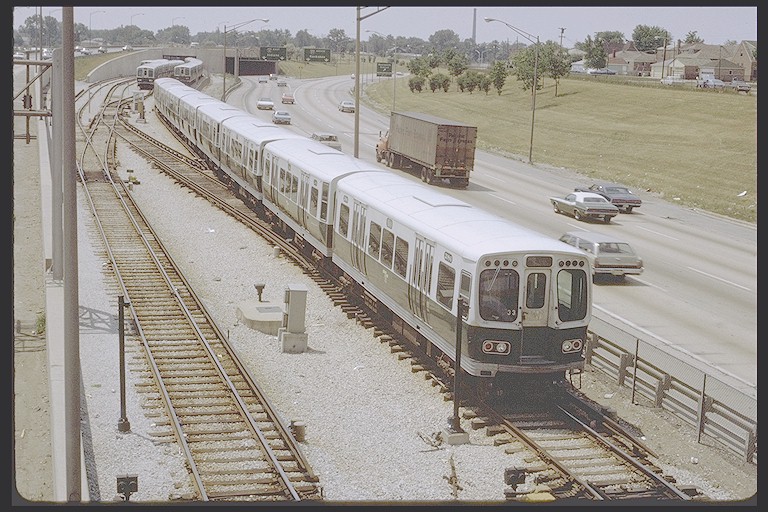
The 98th Shop is seen looking north from the State Street bridge on May 24, 1969. Construction of the shop is nearly complete, and it will open for use just a few months later. For a larger view,
click here. (Photo by George Krambles, courtesy of the Krambles-Peterson Archive) |
98th Yard &
Shops
98th Street and Dan Ryan
Expressway, Roseland
Service
Notes:
|
Located:
|

|
Red Line: Dan
Ryan
|
Quick Facts:
Address: 9800 S. State
Street
Established: 1969
Shop Area: 35,230 square feet
Yard Area: 389,760 square feet
Rebuilt: n/a
Status: In Use
History:

The land for the future 98th yard is being graded and the foundation has been built for the shop in this October 11, 1968 aerial view looking north. For
a larger view, click here. (CTA photo) |
When the Dan Ryan branch opened in 1969, a new yard and shop at 98th, south of
the 95th terminal, opened.
The yard and shop were small, constrained
within the median of the Dan Ryan and Calumet expressways, though because it was located at the interchange between the two highways the expanded space between the roadways and ramps as they bowed out and curved to facilitate the junction provided more room than the more typical expressway median would otherwise offer (which constrained its contemporary cousin, Jefferson Park Yard, at the end of the Kennedy Extension, which opened the next year).
South of the 95th station, a series of crossovers expanded the two main line tracks to four tracks, which were used as both the throat to the yard but also to turn back revenue trains. (When 95th opened, the standard operation was to come into the station in the west platform pocket, unload, proceed south of the station to this area, change ends, then re-enter the station in the east pocket and board passengers for the trip north.) The tracks then merged back into two tracks again before entering a tunnel, which carries the northbound lanes of Interstate 57 (Dan Ryan Expressway, West Leg) over the southbound lanes of Interstate 94 and the CTA tracks. Emerging from this tunnel, the tracks fan out and the storage yard begins. As originally built, 98th Yard had a storage capacity of 118 cars.

98th Yard, in its original configuration and filled with 2000-series railcars, is seen looking southeast from the northbound I-57 ramp in March 1970. The shop is in the background on the left. For
a larger view, click here. (CTA photo, courtesy of the Krambles-Peterson Archive) |
The yard is located between the northbound and southbound lanes of Interstate 94 (originally the Calumet Expressway, now the Bishop Ford Freeway) and originally consisted of 13 tracks located between the northbound I-57 lanes and the State Street bridge over I-94. The tracks were numbers #1 through #13 from west to east. Tracks #1 through #9 were storage tracks, and each could hold 8 cars, except for tracks #1 and #6, which could hold 10 cars, and tracks #4 and #5, which could hold 6 cars each. Track #10 was often used for cleaning the exteriors of railcars and so was not normally used for storage, though it too could hold 8 cars if needed. Tracks #11, #12 and #13 led to the maintenance shop.

The interior of 98th Shop is seen in March 1970, with a 2000-series car on the lift on track 11, and a 2200 on the lift on track 12. For
a larger view, click here. (CTA photo, courtesy of the Krambles-Peterson Archive) |
The 98th maintenance shop building was a small, narrow, rectangular, modern-style building set in the expressway median. Stylistically identical to the Foster Shop built at the same time on the counterpart Kennedy Extension, the building has a tan brick exterior supported by a steel frame, exposed and painted white at the corners, along the roofline, and between sections along the sides of the building. A band of windows along the top of the west side elevations provided some natural light inside. Inside, the small shop had three tracks: tracks #11 and #12 could hold two cars and had lifts, while track #13 could hold four cars and included an inspection pit. The shop was located at the southeast corner of the yard and backed up to the State Street bridge over I-94, so the south end of the shop extended an additional level higher, allowing it to meet and have an access point on the bridge. An elevated deck spans between the shop building and the roadway bridge, providing a connection. A large overhead door allows for deliveries via this access point. A simple box canopy covers the driveway.
Circa 1976, capacity of the yard was increased from 118 cars to 128 cars. However, no additional trackage was added; the increase was accomplished simply by counting the car capacity of one of the four tracks between 95th station and the tunnel that had been designated for turnbacks toward the yard capacity.
Yard Expansion
The 98th Yard remained largely unchanged for about 20 years after its opening. By the mid-1980s, CTA was seriously studying swapping its North-South and West-South route pairings, so that the Howard and Dan Ryan services -- which had much higher ridership than their mates at the time -- could be through-routed. However, in addition to a new connector subway to physically link the two, a number of other capacity constraints on the lines would need to be addressed in order to implement the new through-route. One of these was that there was insufficient car storage capacity at both Howard Yard and 98th Yard to store the increased number of cars that would need to be assigned to the newly-created high-ridership route. The Howard-Dan Ryan Through-Route and Capacity Analysis published by CTA in December 1984 addressed the issue at 98th Yard:
Storage capacity for transit cars at the Dan Ryan terminal yard, south of 95th is inadequate, even for present operations, containing less than half (45%) of the yard space for the existing Lake/Dan Ryan pair. When the Dan Ryan line is linked with Howard Line, the situation will be aggravated by an increased number of vehicles, assigned, in order to operate the more frequent service. This increased capacity is to be accomplished by construction of an expanded yard at 98th Street within the right-of-way of the Calumet Expressway... The existing car maintenance building is undersized and should also be expanded. The overall cost for the expansion is approximately 11.6 million dollars (1981 dollars). It will require 2 to 3 construction seasons to complete.
...
Because the car storage capacity of 98th Yard is inadequate even now, the yard is filled before all the cars operated in afternoon rush hours can be taken out of service as soon as they are no longer needed to satisfy northbound passenger demand. The excess cars must therefore be transferred to the yard at Harlem, the other end of the line, where there is room to store them. They must then be put in service from Harlem yard before they are needed eastbound, in order to be available for northbound service from 95th. Unless 98th Yard is expanded to provide more storage capacity, this diseconomy will be increased when the through-route is implemented, because more cars will be operated to improve Dan Ryan service.

Construction is underway on the expansion of 98th Yard southeast in this view looking east from the State Street bridge on June 12, 1988. For
a larger view, click here. (Photo by Art Peterson, courtesy of the Krambles-Peterson Archive) |
The yard was expanded to the south and east within the right-of-way of the Calumet Expressway by extending tracks #1 through #6, bridging over the I-94 northbound-to-I-57 westbound ramp (where the original yard ended at a retaining wall along the north edge of this ramp) and under the State Street bridge, then spreading into 10 total tracks beyond. Tracks #1 through #6, which extended the full length of the yard, kept their original numbers. Tracks #7 through #10 in the original yard became tracks #7N through #10N, while additional tracks in the yard expansion were numbered #7S through #9S to denote that these tracks did not run through the full length of the yard and which half they were confined to. (An additional tracks in the expended yard between #3 and #4 was numbered track #1AS.) As the yard continues southeast, the median of the Calumet Expressway narrows and tracks either end or merge. Only tracks #1, #2 and #3 continue under the Michigan Avenue bridge, numbered #1S, #2S and #3S to differentiate them from the portions of those tracks in the main part of the yard. As the median continues to narrow, each track successively ends, starting with #3S, with #1S extending the farthest, ending at Indiana Avenue. This track, from the start of track #1 in the north end of the yard to the end of track #1S at the southeast tip of the yard, extends approximately 2,300 feet. Finally, the tracks that feed the shop, originally numbered #11, #12, and #13, were re-designated tracks #A, #B and #C to differentiate that they fed the shop rather than being yard storage tracks.
By providing adequate car storage capacity, the need to deadhead cars to another location for storage when they are no longer needed in service was eliminated. Most storage tracks are accessible from both ends, reducing the number of cars that can be blocked by a malfunction from entering or leaving a storage track.
Plans to expand the car maintenance building, including an eight-car trouble repair track to be able to inspect an 8-car train without breaking it up and potentially accessible from both ends, never came to fruition, however. The shop remains in its original size and capacity.
Construction of the yard expansion was undertaken in stages. By early 1991, enough of the new trackage was in service that yard capacity had been increased to 198 cars. On February 17, 1993, the full expanded yard was placed in service; four days later, the through-routes were realigned and the new Howard-Dan Ryan Red Line service was instituted. The yard nearly doubled its size, with a car storage capacity of 234 cars.
Starting on November 1, 2007, tracks #7N, #8N, #9N, and #10N were temporarily removed from service for construction a facility for the Rail Car Appearance department.

98th Yard is seen looking southeast from the State Street bridge on August 26, 2007. This part of the yard was an expansion built in the 1980s and early 90s in anticipation of the inauguration of Howard-Dan Ryan service (today's Red Line), which had a higher car requirement necessitating additional yard capacity. For a larger view,
click here. (Photo by Graham Garfield) |

 |
98thYard_19660221.jpg (355k)
The future site of 98th yard and shop are seen in this aerial view looking northwest on February 21, 1966 at the junction of the Dan Ryan and Calumet expressways in which they would be nestled. The original 1969 yard will be between the two curving ramps in the center right, above the bridge (State Street) across the center of the photo. The 80s-90s yard expansion would eventually take up the space between the roadways in the lower left corner, below the bridge. (CTA photo) |
 |
98thShop_19681029.jpg (208k)
98th Shop is under construction, with its steel frame erected, in this October 29, 1968 view looking north from the State Street bridge. Less than a year later, the shop would be completed and in service. (CTA photo, courtesy of the Krambles-Peterson Archive) |
 |
98thYard_19690917.jpg (277k)
The original 98th yard and shop are seen from above, looking northwest on September 17, 1969, a couple weeks before the Dan Ryan line opened for service. The original yard was rather small when it first opened compared to the size it would eventually be expanded to. The shop, however, remains the same as when it originally opened. (CTA photo, courtesy of the Krambles-Peterson Archive) |
 |
98thYard_19690921.jpg (217k)
The car storage yard at 98th Street is seen looking northwest from the State Street bridge on September 21, 1969, one week before the Dan Ryan line opened, with just four 2000-series cars parked. Once the line was in service, the yard would rarely be this empty, other than perhaps during rush hour. (Photo by George Krambles, courtesy of the Krambles-Peterson Archive) |
 |
98thShop_19700000a.jpg (208k)
2200-series car 2215 is up on the lift for repairs on track 11 on the left, with a 2000-series car also up in the air on track 12 on the right, inside 98th Shop in 1970. (CTA photo) |
 |
98thShop_19700000b.jpg (204k)
The interior of 98th Shop is seen looking northwest from the mezzanine at the back of the shop in 1970, with a 2000-series unit on track 12. The inspection pit on track 13 can be seen on the right. (CTA photo) |
 |
98thYard_19700104a.jpg (150k)
98th Yard is seen looking southeast from the throat of the yard on January 4, 1970, filled with 2000-series railcars. (Photo courtesy of the Krambles-Peterson Archive) |
 |
98thYard_19700104b.jpg (195k)
This view looks south on January 4, 1970 at the tracks between the 95th station and the 98th yard that served both as the throat to the yard as well as to turn back revenue trains. The four tracks in this area south of the station merged back into two tracks as they entered the tunnel, which carries the northbound lanes of Interstate 57 (Dan Ryan Expressway, West Leg) over the southbound lanes of Interstate 94 (on the right) and the CTA tracks. (Photo by George Krambles, courtesy of the Krambles-Peterson Archive) |
 |
98thShop_19700220.jpg (177k)
This view looking northwest from the expressway ramp connecting inbound I-94 to outbound I-57 on February 20, 1970, demonstrates that the 98th Shop is actually more than two levels, something obscured by the fact that it's actually built into a berm. This photo would not be possible to take today, as the expanded yard resulted in a bridge for the extended yard tracks that crossed the roadway in the foreground here, obstructing this view. (CTA photo) |
 |
98thShop_19700300b.jpg (191k)
98th Shop is seen looking southwest from the northeast corner of the yard, at the end of track 13, in March 1970. The shop doors are closed on track 11 and 12, but a 2200-series car peaks out from the open door on shop track 13. The yard is full of 2000-series railcars. (CTA photo, courtesy of the Krambles-Peterson Archive)) |
 |
98thYard_19710508.jpg (219k)
Because it is a Saturday, the yard is fairly full of 2000- and 2200-series cars that are not needed to hold down the lower level of service run off-peak, seen looking northwest from the State Street bridge on May 8, 1971. (Photo by George Krambles, courtesy of the Krambles-Peterson Archive) |
|
cta2084b.jpg (151k)
Car 2084 is at the near end of an 8-car train of 2000-series cars, still in their original paint scheme but already about
seven years old, looking south at throat to 98th Yard from
95th Street on July 4, 1971. More 2000s are visible in the background. At the time, all 180 cars in
the series were assigned to the Lake-Dan Ryan service. (Photo by Joe Testagrose) |
 |
98thYard_19880612a.jpg (267k)
Construction to extend 98th Yard across the I-94-I-57 ramp and under State Street to expand capacity for planned Howard-Dan Ryan service is well underway in this June 12, 1988 view looking northwest from the State Street bridge. The yard is particularly full -- here, with 2400- and 2600-series cars -- because it is a Sunday, and the car requirements for scheduled service are far below the line's maximum car requirements set by rush hour service. Note the graffiti on the 2600-series unit on the far left. (Photo by Art Peterson, courtesy of the Krambles-Peterson Archive) |
|
ctaS-601.jpg (110k)
Flatcar S-601 is laid up in 98th
Yard on May 2, 2004 between uses. S-601, built by Itel
in 1990, was usually assigned as a Skokie
Yard supply car and has a carry capacity of 100,000
pounds. (Photo by Matthew Isoda) |
 |
98thYard_20070826b.jpg (300k)
98th Yard is seen looking northwest from the State Street bridge on August 26, 2007. (Photo by Graham Garfield) |
 |
98thShop_20070826.jpg (150k)
Street access to 98th Shop is provided on the State Street bridge, where the shop building is designed with a raised level to meet the height of the roadway bridge. A large overhead door in the shop elevation facing the bridge allows for deliveries via this access point, with a simple box canopy providing weather protection for the driveway, seen in this northwest view. (Photo by Graham Garfield) |
 |
98thYard_20180330.jpg (314k)
96th Interlocking is seen from the 95th/Dan Ryan station south bus bridge, looking south on March 30, 2018. Two tracks lead from the terminal station to the interlocking, where they spreads to four tracks for about 400 feet, then merge back into two tracks to go through the tunnel under the inbound I-57 ramp and on to the yard. (Photo by Graham Garfield) |
|

|

|