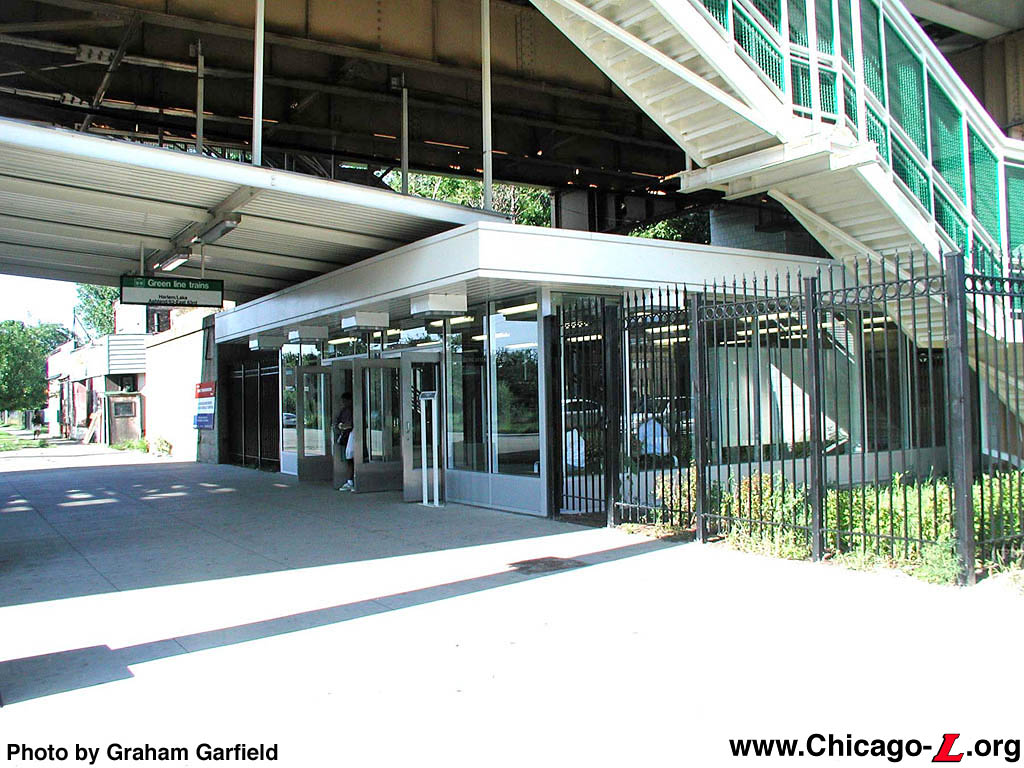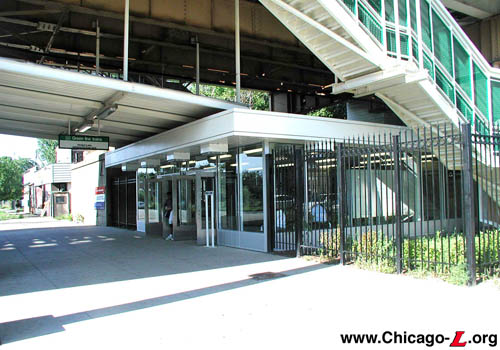
The new Indiana station
house, looking northeast in mid-August 2001. The glass and
steel facility sits in the same location as the original
1892 station. The stairs to the platform are lined with
green metal mesh, which provides little protection from the
elements. For a larger view, click here.
(Photo by Graham Garfield)
|
Indiana
(4000S/200E)
Indiana Avenue and 40th
Street, Grand Boulevard
Service
Notes:

|
Green Line:
South Side Elevated |

|
Accessible
Station |
Quick Facts:
Address: 4003 S. Indiana
Avenue
Established: August 15, 1892
Original Line: South Side Rapid Transit
Previous Names: none
|
Skip-Stop Type:
|

|
Station
(1949-1963)
|

|
Station
(1963-1993)
|
Rebuilt: 1907
(new station house),
1988 (new
platforms), 2000-01
(new station
house)
Status: In Use
History:
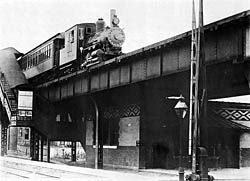
South Side Rapid
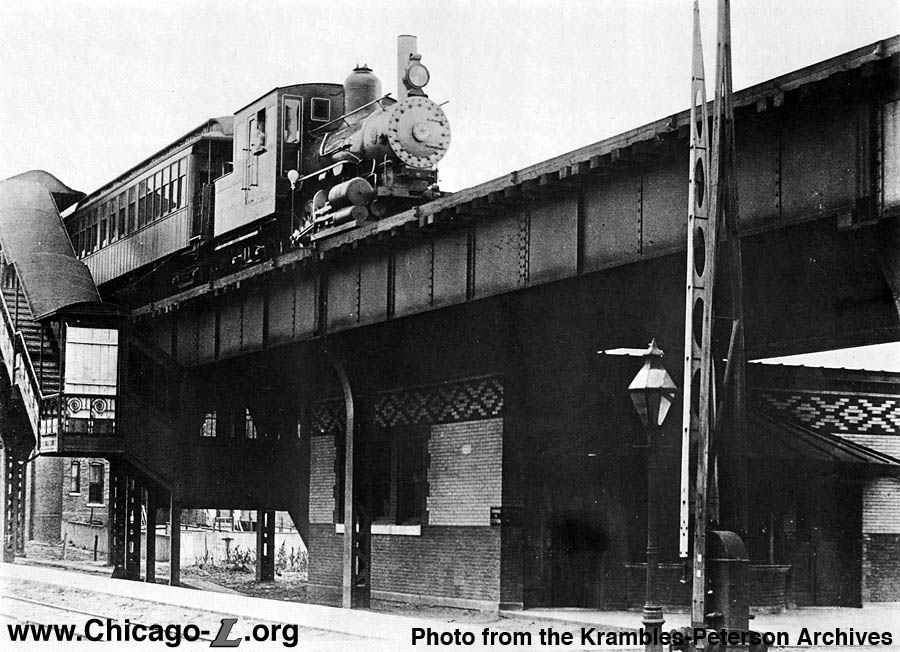
Transit Baldwin locomotive 25 stops at Indiana on a
northbound trip in 1895. The crossing gate is for
the tracks of the then-at-grade Chicago Junction
Railway (seen on the left), which served on the
Stock Yards. The tracks were later elevated
alongside the "L"s. For a larger view, click here. (Photo from the
Krambles-Peterson Collection) |
Indiana station was built as part of the South Side Rapid
Transit's extension to the Columbian Exposition in 1892. Although mainly north-south in alignment, the South Side main line takes a turn at 40th Street which moves the right-of-way from between State and Wabash north of 40th Street to between Calumet and Prairie south of 40th, resulting in a four-block section that runs east-west. Along this east-west section is Indiana station, originally just one of several local stations along the line.
The
original station building was a grade-level structure that
resembled other stations built as part of the extension,
such as the building still at Garfield and those now removed from 43rd, 47th, 51st, 58th, and 61st. Designed by architect Myron H. Church and built by the
Rapid Transit and Bridge Construction Company (under general
contractor Alfred Walcott and engineer R.I. Sloan), the
station house is designed with a Queen Anne-style influence.
The building was constructed of brick with stone sills and
foundation with polychrome brickwork along the top of the
exterior in a latticed diamond pattern. Perhaps the
building's most prominent feature was the bay that projected
from the front elevation, with its broad half-cone roof. The
building's bay and brick frieze display many qualities of
the Queen Anne style, although the flat terra-cotta cornice
and other elements show some examples of early Chicago
School of architecture.
The dual side platforms consisted of
a wooden deck on a steel structure. The original canopies
were humped-shaped, typical of the original South Side Rapid
Transit designs, but were replaced early on with short
canopies of steel posts supporting a flat tin roof.
The original facility was demolished by 1907. As part of
an ordinance to allow the South Side Elevated to install a
third track for express service, all stations north of 43rd Street, including this one,
were required to replace their grade-level facilities with
mezzanine-level stations, clearing the alley way beneath the
tracks.
Transfer Station
On September 30, 1903, the Chicago Junction Railroad and the South Side Elevated signed a 50-year lease, with options for two 50-year renewals and an option to buy, for the CJRR to built two "L" branches along its right-of-way and for the "L" company to operate them. The Kenwood branch projected east from where the east-west mainline turned back south, while the Stock Yards branch continued west from where the mainline turned north. Indiana station became a transfer station, and a new interlocking tower was built to control the complex of interlocked switches.
The mainline was three tracks -- two local tracks outside with an express track in the center with service operated in the peak direction of travel -- with the third track having only recently been completed in 1907. The Indiana platforms were on the outsides of the local tracks. The two track Kenwood branch entered the junction from the east, with the two branch tracks connecting to the two local mainline tracks. The Indiana station platforms were immediately west of this junction. The two-track Stock Yards branch approached the mainline tracks where the latter curved east at 40th Street and Wabash, then ran -- but did not connect with -- the mainline tracks, parallel and adjacent to the south of them. After about a block and a half of running parallel, a complex of interlocked switches connected the three mainline tracks with the two Stock Yards tracks. East of the interlocking, the Stock Yards tracks converged into a single stub track, which terminated along the south side of the outbound Indiana platform, converted it into an island platform.
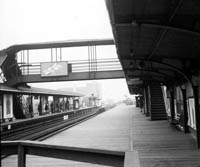
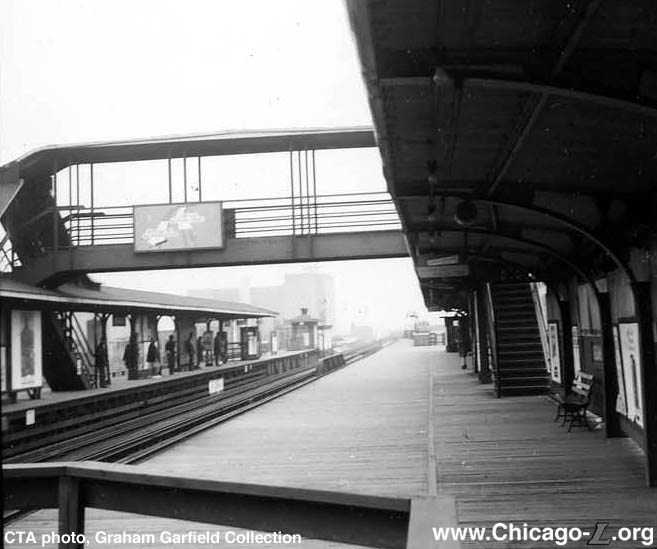
This view looks west from the east end of the inbound Indiana station platform, from the former Kenwood stub track and shuttle platform, already out of service for four years in this December 1, 1961 photo. Note how the platform extends far in front of the canopy -- this space was formerly occupied by the northbound local track. For a larger view, click here. (CTA photo, Graham Garfield Collection) |
An interlocking tower was built at the far east end of the inbound platform, beyond the platform canopy. The tower was elevated above the canopy, providing a birds-eye view of the complex of switches west of the station, as well as the junction immediately to the east. In normal operation, the Stock Yards trains ran as shuttles to and from Indiana, stubbing in and out of the single-track pocket on the south side of the outbound platform. Kenwood trains ran a more complex operation, with Indiana-Kenwood shuttles alternated with through trains between the Loop and the Kenwood branch. There were some other service patterns run over the years, however, including Kenwood-Stock Yards trains and Stock Yards-Jackson Park trains. Circa 1913, an overhead bridge was added to the east end of the station platforms to allow passengers to transfer between them. Around the same time, the station platforms were renovated, with the canopies replaced and extended, including around and beyond the tower.
On July 31, 1949, the CTA instituted its North-South
Route service revision, which turned the Kenwood and Stock Yards trains into shuttles to Indiana, with all through-services discontinued. The operation of express trains on the mainline was discontinued, replaced with A/B skip-stop service during heavy ridership periods. As a result, one of the three tracks was removed from service on the mainline. West and north of Indiana station, the center track was removed from regular service, although it was kept operable for a number of years. Though Indiana station and south to 43rd (where the tracks converged from three to two), the former northbound local track was removed from regular service, with northbound trains using the former bidirectional express center track. The northbound track was removed through Indiana station, with the inbound station platform widened across the former local trackway to serve the center track now used by northbound North-South trains. The former northbound local track terminated at the east end of the northbound platform, underneath the tower and just east of the transfer bridge. This left a bit of the platform still alongside the track, with the platform extended a bit farther east, essentially forming a narrow dog-leg extension off the east end of the wider platform. Kenwood shuttles stubbed in and out of this pocket. The tracks were reconfigured such the two Kenwood tracks merged east of the junction using a spring-and-return switch which allowed inbound shuttle trains to trail through the switch into the pocket at Indiana, with the switch automatically realigning itself for the turnout, routing shuttle trains onto the outbound track upon their return. The switch connecting the former northbound local track may have remained interlocked but was rarely used, except perhaps for equipment moves. The only connection between this track and the mainline was a hand-operated switched where they merged at 43rd Street. The Stock Yards stub was similarly reworked, with a spring-and-return switch located east of the platform. A single left-hand switch connected the outbound Stock Yards track with the mainline, and a complex set of switches remained west of the station, though they too were now rarely used in regular service. The tower seems to have remained, however, to work the interlocked switches as needed.
On October 6, 1957, all Stock Yards service was discontinued. This was followed by the suspension of all Kenwood service on November 30, 1957. A week earlier, on November 22, 1957, Indiana interlocking was removed from service. The Kenwood and Stock Yards tracks were quickly removed, along with all switches associated with them. The tower was demolished by 1961, but was more than likely removed soon after the interlocking was removed from service. Indiana station returned to being a modest, local neighborhood station.
Return to a Local Station, Deterioration, and Renovation
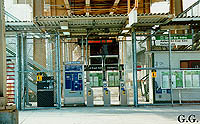
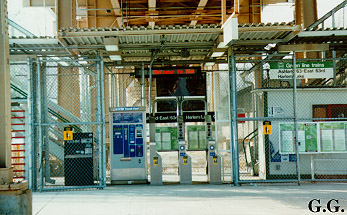
The Indiana fare
collection area in 1998. This 'temporary' fare
control area, established when the mezzanine
station house was demolished, was in service for
many years. For a larger view, click here. (Photo by Linda
Garfield) |
The mezzanine fare control facility remained until the
1960s, when the CTA removed it in favor of a simple street-level fare control
area. A high chainlink fence was installed around a concrete
slab on the east side of the street, which served as the
station entrance. A ticket agent's booth was installed at
the opening to the fence to collect fares. Passengers
continued to reach the existing platforms using the existing
stairways.
In 1987, the CTA planned to shut down the Indiana Avenue station because of
its "severely deteriorated condition," but in 1988 instead
decided to embark on a project to renovate a number stations
including this one, 58th, and
others. This resulted in the platform being completely
rebuilt to modern specifications in white-painted steel with
wood floors and a full-width canopy. The fare collection
remained at street level, using "open air" facility
consisting of turnstiles and an agent's booth enclosed by a
simple, tall chainlink enclosure and protected by an
overhead canopy.
On February 21, 1993, the South Side Englewood-Jackson Park service,
formerly paired with the Howard service and forming the North-South
Route, was repaired with the Lake Street service and formed the
CTA's new Green Line.
On January 9, 1994, the Green Line closed for a two-year
rehabilitation. All stations on the line, including Indiana, closed for
renovation. Since the station had been rebuilt so
recently, little work was required at platform level during
the 1994-1996 Green Line rehab, except for the installation
of stainless steel windbreaks with mountings for station
signs.
On September 15th, 1999, the
CTA announced that
the Indiana station would receive a new station house. The
facility is at ground-level on the east side of the street
(where the original 1892 station house was), supplementing
the platforms and canopy that were rebuilt in 1988. The new
masonry station house includes a customer assistant kiosk,
modern lighting, HVAC systems, and two new elevators to make
station handicapped accessible. There will also be
station-wide improvements to the public address system.
Construction began in 2000 and by early 2001, the
structure of the station house, the elevator cabs,
electrical and mechanical systems, roofing, stair canopy
steel, stair mesh screens were installed. The existing
stairs and station fare control area on the west side of the
street were converted to an auxiliary exit and the fare
controls were removed. The exterior finish of the new
station house is white and green glass and steel in the open
plan design typical of modern
CTA facilities. The
new Indiana station facility opened on Tuesday, March 20,
2001, but was not complete until May 1, 2001.
The North-South Route (Temporarily) Returns, Thrice
In 2013, the CTA launched the Red Line South Reconstruction Project, a track renewal project to rebuild the Dan Ryan branch tracks from the bottom up, excavating down to the bottom of the trackbed to rebuild the underground drainage system then installing new ballast, ties, and tracks. Some modest station improvements were also performed. In order to perform the work more quickly and cost-effectively, the CTA closed the Dan Ryan branch for five months while work was performed. During that time, there would be no 'L' service on the Dan Ryan branch south of Roosevelt station.
As part of the alternate service plan for Dan Ryan riders, Red Line trains were rerouted via the old 13th Street Incline from the State Street Subway to the South Side Elevated, where they operated to Ashland/63rd via the South Side Elevated tracks in a pattern reminiscent of the old Howard-Englewood "A" trains of the North-South Route days. Harlem-Cottage Grove Green Line trains continued to operate as well, but due to limited track capacity some Green Line trains from Harlem that would've gone to Ashland/63rd were turned back to Harlem downtown during the weekday rush periods (at Roosevelt in the morning rush and via the Outer Loop in the evening rush).
Red Line service to Ashland/63rd began on Sunday, May 19, 2013. Following the five-month track reconstruction and renovation work on the Dan Ryan, Red Line service to 95th resumed at 4am, Sunday, October 20, 2013. At the same time, Red Line service via the South Side Elevated and Englewood branch was annulled and Green Line trains resumed service to Ashland/63rd, alternating between the two 63rd Street terminal branches.
Red Line service between Howard and Ashland/63rd via the South Side Elevated returned temporarily in 2017, although it was only select trains and only during weekday rush periods; during most times, normal service via the Dan Ryan branch continued. The diversion was necessitated by the $280 million 95th Terminal Improvement Project to expand and greatly improve the 95th/Dan Ryan Red Line station -- as construction continued on the new terminal, including foundations and structural steel work next to the tracks, track alignment work, and platform construction, CTA needed to close both the east and west platform tracks (at separate times), severely constraining capacity during rush and requiring a reduction in the number of trains in and out of the station.
On April 3, 2017, CTA began rerouting some Red Line trains, primarily in the off-peak direction, for a few hours each weekday onto the Green Line to or from the Ashland/63rd station. Reroutes onto the south Green Line in the off-peak direction took place in the morning (7:56 to 9:14am) and evening (4:40 to 5:58pm) rush periods (times at Roosevelt, just north of the diversion point); there were also a small number of trains that operated between Ashland/63rd and Howard in the peak direction, though primarily for car-balancing purposes. CTA officials said the reroute affected less than 10 percent of all Red Line trains.
The diversion of select rush period Red Line trains to/from Ashland/63rd lasted for approximately six months, with the last Howard-Ashland/63rd trains running Wednesday evening, November 22, 2017.
The Red Line Ashland/63rd service resumed on July 30, 2018, to allow additional work in, over and around the platform tracks at 95th/Dan Ryan; the last day of this iteration of the service last ran on April 26, 2019.
.
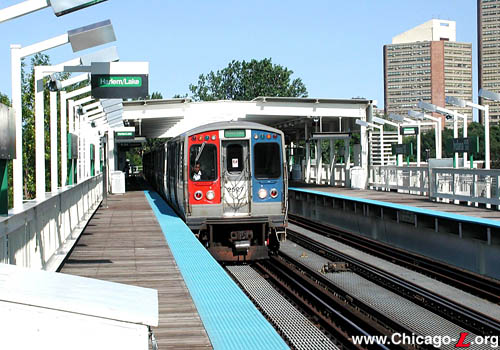
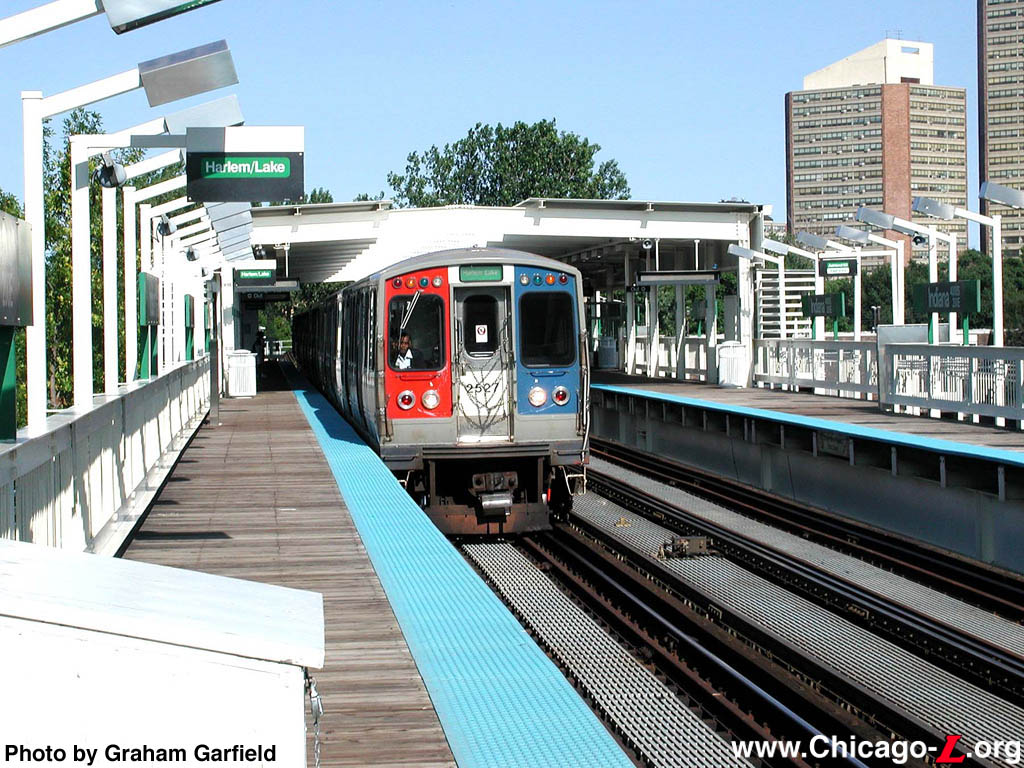
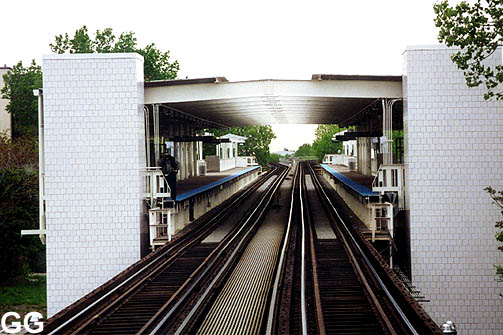
Indiana's platforms, looking
east as a Loop-bound Green Line train pulls in in mid-August
2001. The platforms date from a 1988 rebuilt, with only two
new elevators (visually blocked by the full-width canopy)
and new signage added since its construction. For a larger
view, click here.
(Photo by Graham Garfield)
|

|
indiana00.jpg
(195k)
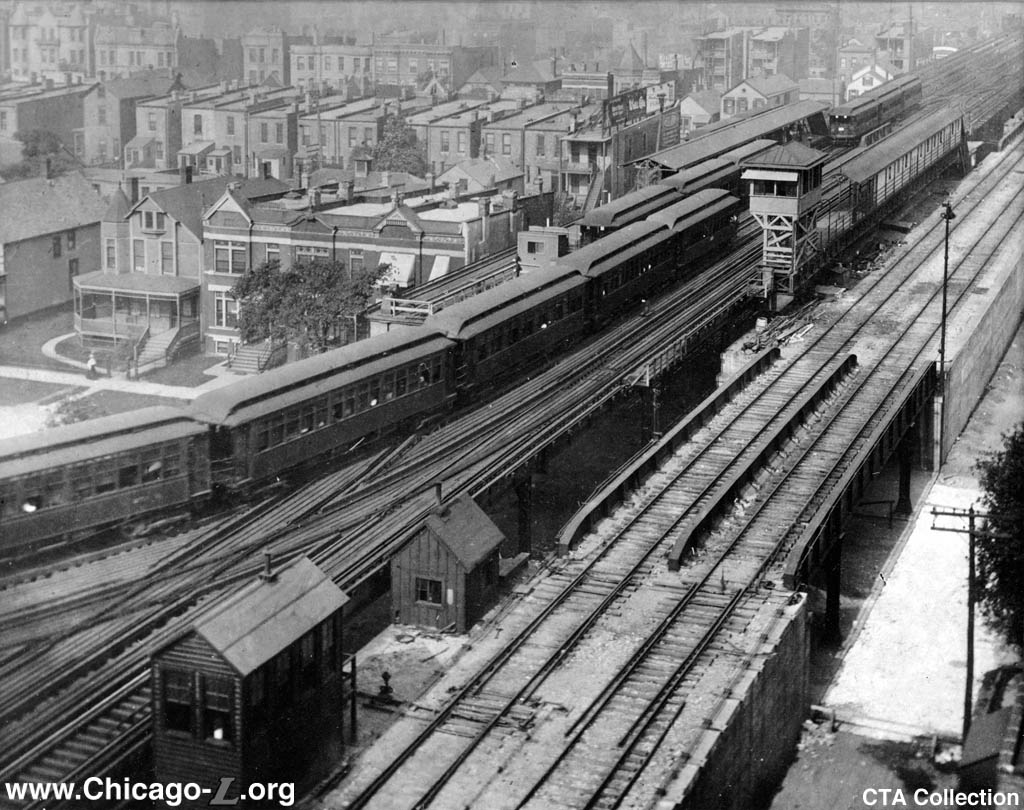
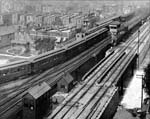
The 1910 view looking west at Indiana Junction shows an express train moving through the junction east of the station, while a three-car local leaves the station southbound as another three-car local enters -- headways were clearly very close. Indiana Tower is seen on the right, at the end of the inbound platform. As the platforms were extended, the tower would eventually be enveloped. (Photo from the CTA Collection)
|
|
indiana01.jpg
(158k)
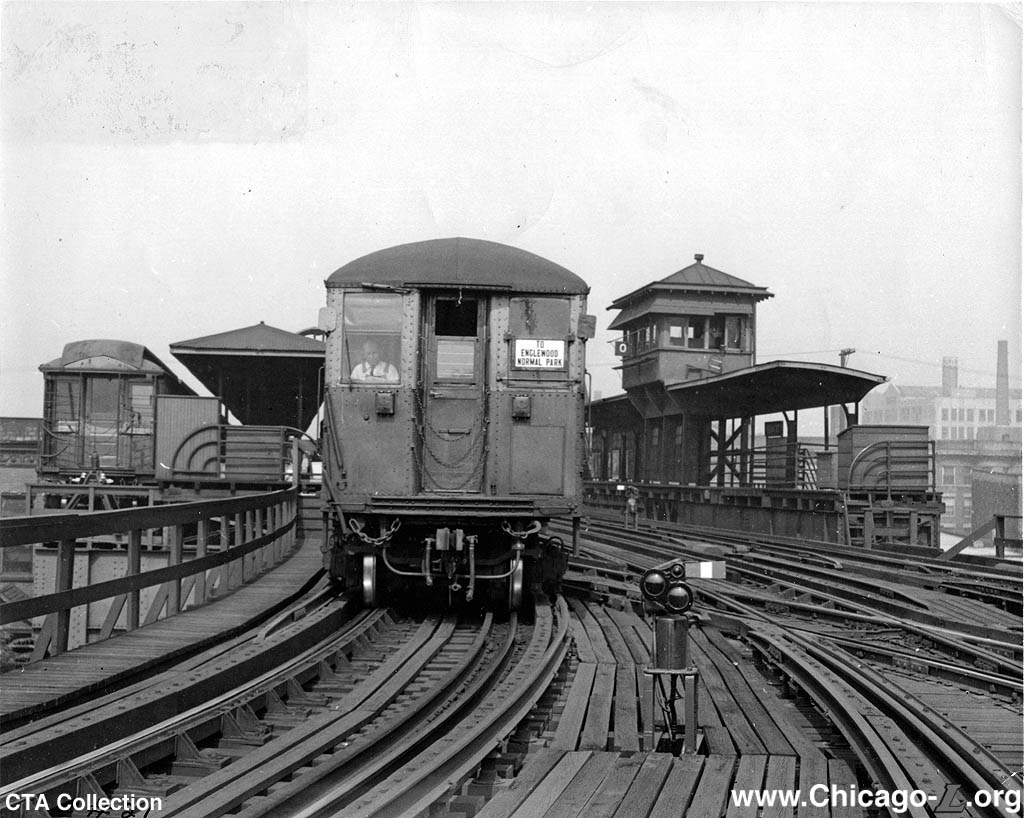
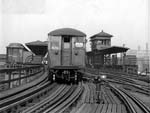
A southbound Englewood-Normal Park train led by a "Baldie"
4000-series car
pulls out of Indiana Avenue. At left, a Stock Yards trains
waits on the stub track for connecting passengers to board
before beginning its westbound trip.
(Photo from the CTA Collection)
|
|
indiana11.jpg (86k)
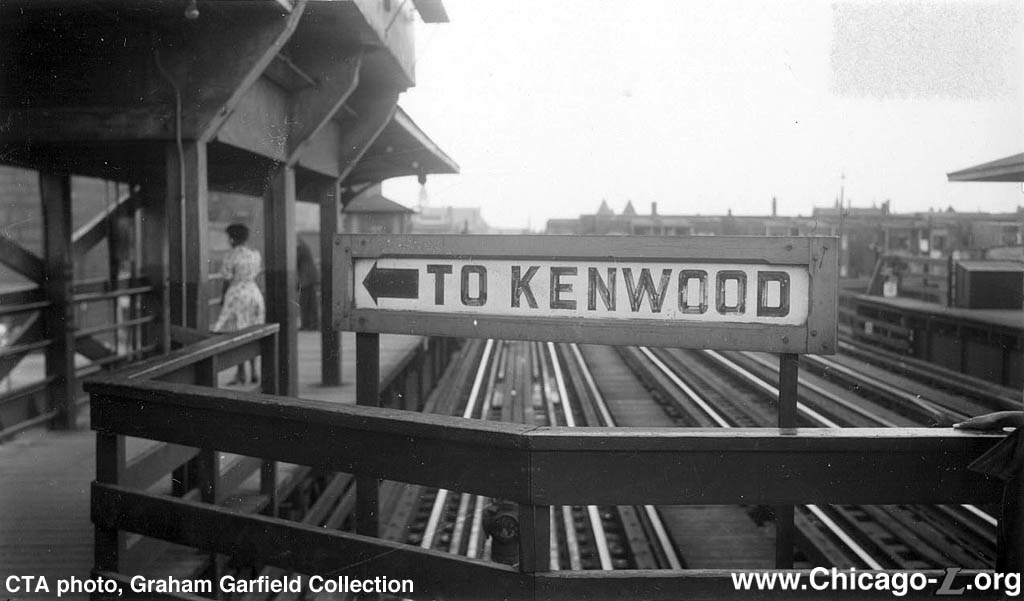
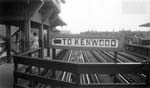
This mid-1950s view looks east on the inbound Indiana platform at the pocket for Kenwood shuttle trains, which loaded on a stub of the former northbound local track served by an extension of the inbound platform. Indiana Tower is visible above on the left. (CTA photo, Graham Garfield Collection) |
|
indiana12.jpg (58k)
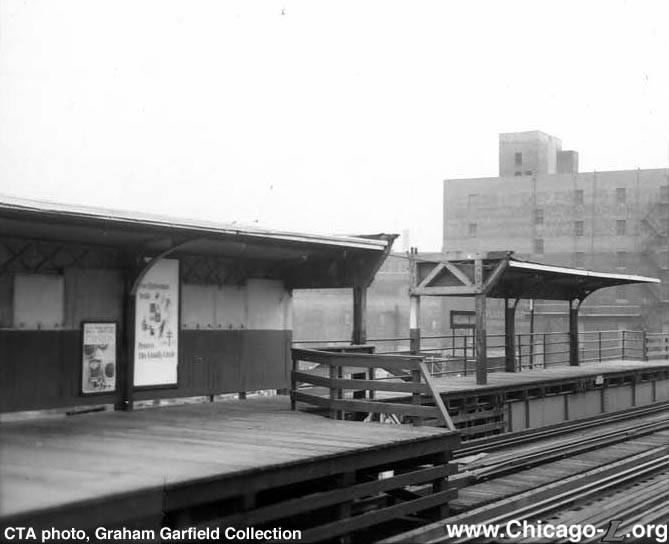
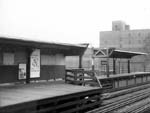
This view looking northeast at the east end of the inbound Indiana station platform shows the former Kenwood stub track and shuttle platform, already out of service for four years in this December 1, 1961 photo. The gap in the canopy was formerly occupied by Indiana Tower. The shuttle platform spur appears to still be accessible to passengers even though it serves no revenue purpose. (CTA photo, Graham Garfield Collection) |
|
crt1706.jpg (91k)
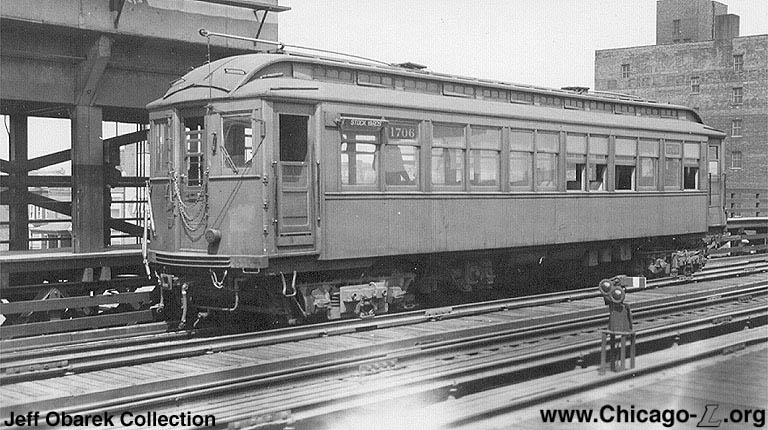
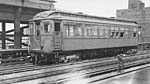
CTA car
1706, a 1903 St. Louis product, sits in the Kenwood pocket
track at Indiana station in this undated view. The car is
displaying "Stockyards" destination signs, so it may have
just come up from 61st
Street Yard to fill a Kenwood schedule, with the crew
had yet to change the signs for the Kenwood trip. This car
was scrapped in August of 1954. (Photo from
the Jeff Obarek Collection) |
|
cta6258.jpg (104k)
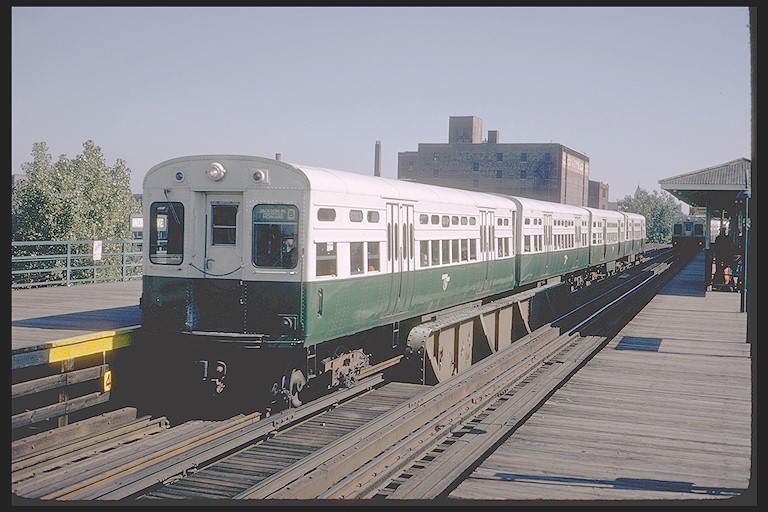
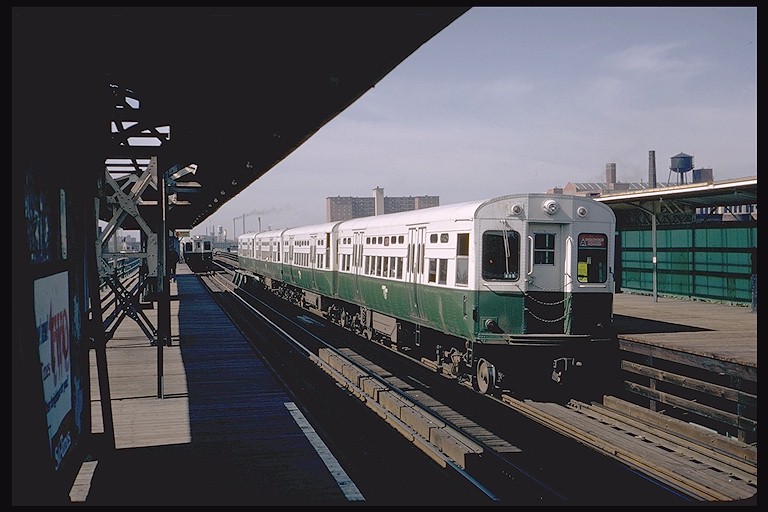
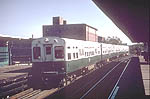
Car 6258, in its Mint Green and Alpine White livery, leads a
northbound Englewood-Howard "A" train at Indiana Ave. on
October 2, 1972. The extra wide platform in the background
is the result of a third track that was removed and covered
over. (Photo by Steve Zabel, Collection of
Joe Testagrose) |
|
cta6313.jpg (113k)
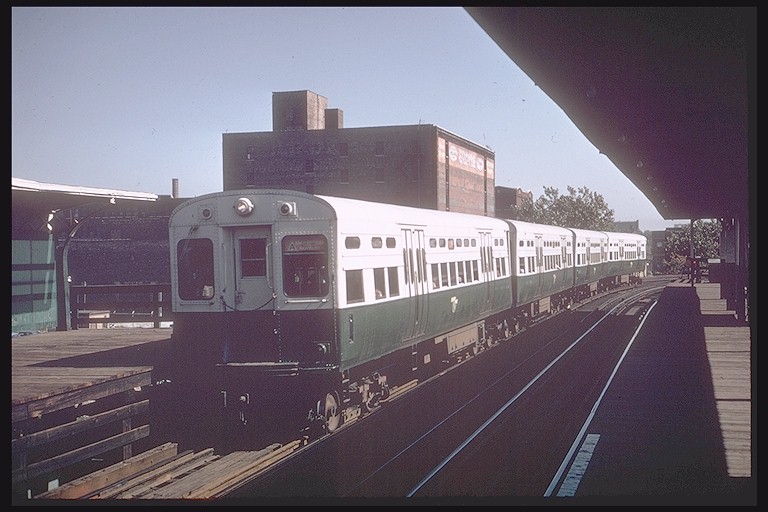
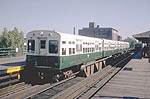
A Jackson Park-Howard "B" train, led by 6313, passes "A"
station Indiana on October 2, 1972. Note the extra wide
northbound platform. Originally, there was a third track
where the forward part of the platform is now (the track
occupied by 6313 was an express track). The Kenwood branch
continued straight from where the tracks turn right in the
background. Another train of 6000s passes on the southbound track. (Photo by
Steve Zabel. Collection of Joe Testagrose) |
|
cta6428.jpg (99k)
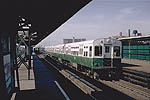
Car 6428 trails a northbound Englewood-Howard "A" train at
Indiana on October 2, 1972. Although the platform on the
left (southbound) was originally built as a side platform,
its later conversion to an island platform to transfers to
the Stock Yards Line is evident, even about fifteen years
after the Stock Yards Line's abandonment. (Photo by Steve Zabel, Collection of Joe
Testagrose) |
|
indianaSign.jpg (12k)
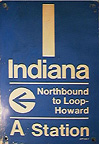
An Indiana sign from before 1993. (Sign from
the collection of Graham Garfield) |
|
indiana05.jpg (115k)
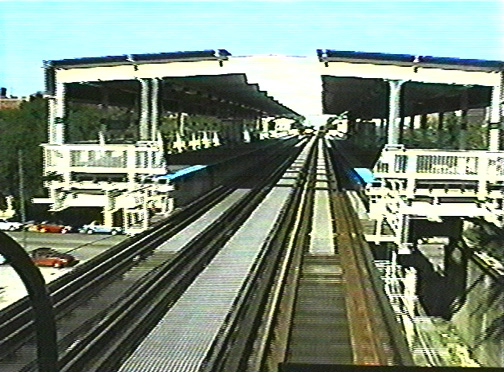
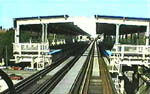
A Harlem-bound Green Line train approaches the Indiana
Avenue station in 1996, soon after the line
reopened. (Photo from Chicago's "L"/Subway System: Take a Ride on the Wild
Side from All-the-6000s-You-Missed
Productions) |
|
indiana06.jpg (100k)
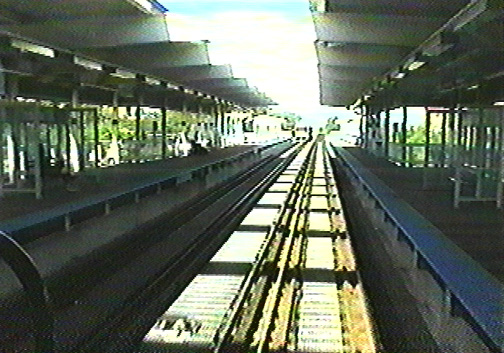
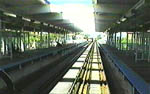
A view of the Indiana platform, looking west from a Green
Line train loading and unloading passengers. (Photo from Chicago's "L"/Subway System:
Take a Ride on the Wild Side from
All-the-6000s-You-Missed Productions) |
|
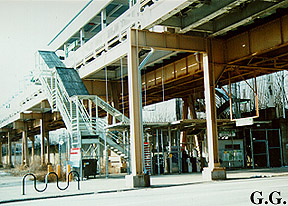
indiana02.jpg
(43k)
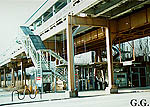
The Indiana station complex, looking northwest in January,
1998. Access to the substantial white steel platform is
regulated by the surprisingly temporary-looking (but
unfortunately permanent) fare controls at street-level,
surrounded by a simple chain link fence.
(Photo by Linda Garfield)
|
|
indiana07.jpg
(19k)
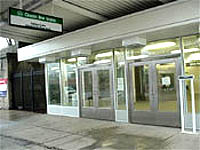
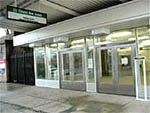
The entrance to the new Indiana station, about a month after
it opened in March 2001. (Photo from the
CTA
web site)
|
|
indiana08.jpg
(57k)
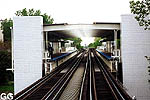
A view of the retrofitted Indiana station, looking west from
a Green Line train. The platforms date from 1988, but the
elevators are a new addition to make the facility ADA
compliant. (Photo by Graham
Garfield)
|
|
ROW@Indiana_station.jpg
(363k)
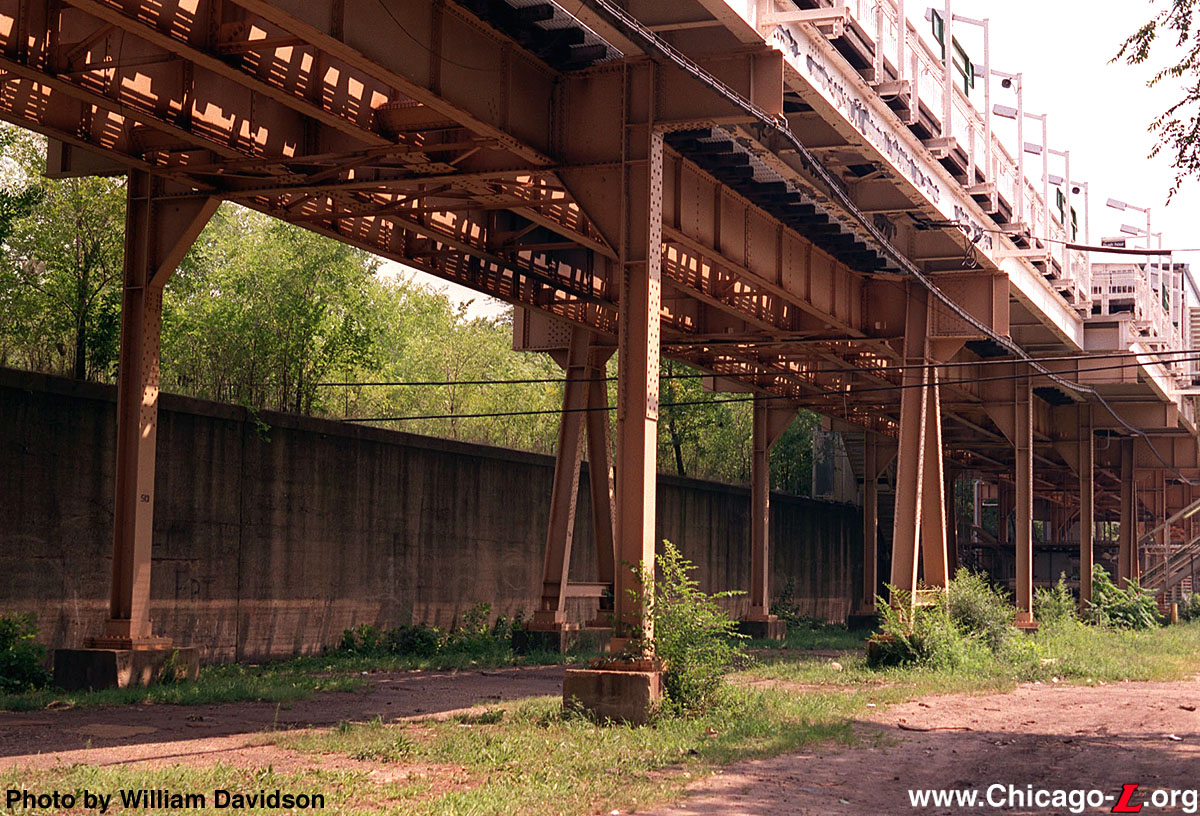
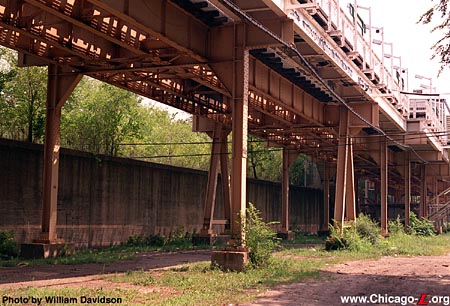
The elevated structure through Indiana station was largely
rebuilt between 1988 (when Indiana station's platform were
rebuilt) and 1996 (when the Green Line rehab was completed),
hence relatively little of the 1890s structure remains here.
The embankment on the left carried the Chicago Junction
freight tracks. (Photo by William Davidson)
|