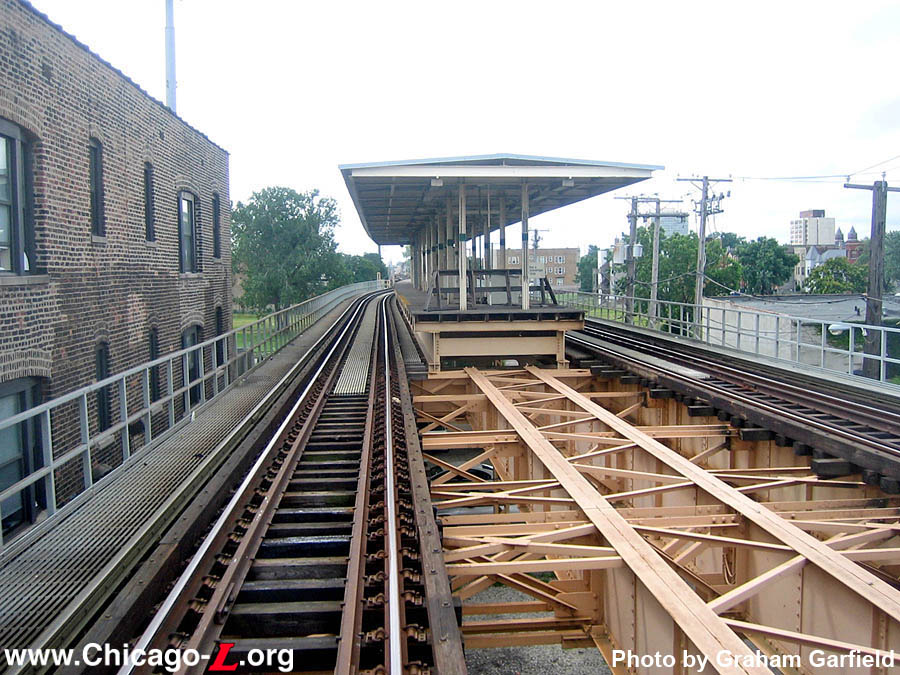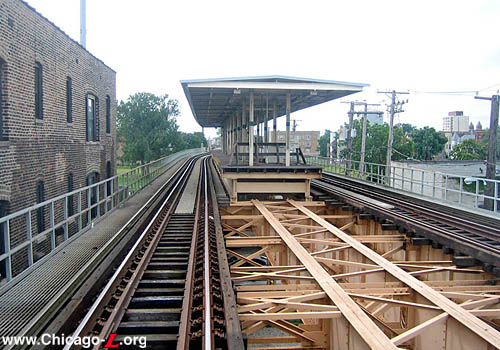
The 58th island platform,
abandoned at the time of the photograph, looking south on
July 18, 2006. The 1988-built canopy has a simple design of
a horizontal beams, supported by a dual row of I-beam
columns, topped with a slightly peaked roof. A sign on the
end of the platform reminds trains train operators that 58th
is "Not a passenger stop". The space between the tracks in
the foreground formerly had a center stub track. For a
larger view, click here.
(Photo by Graham
Garfield)
|
58th
(5800S/300E)
58th Street and Prairie
Avenue, Washington Park
Service
Notes:

|
Green Line:
South Side Elevated
|
Quick Facts:
Address: 320-24 E. 58th
Street
Established: January 22, 1893
Original Line: South Side Rapid Transit
Previous Names: none
|
Skip-Stop Type:
|

|
Station
|
Rebuilt: 1983
Status: Demolished
History:
58th station was built as part of the South Side Rapid Transit's
extension to the Columbian Exposition in 1892-93. The original
station building was a grade-level structure that resembled other
stations built as part of the extension, such as the building still
at Garfield and those now removed from
Indiana, 43rd,
47th, 51st, and
61st.
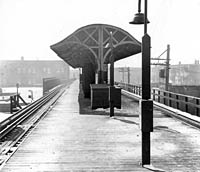
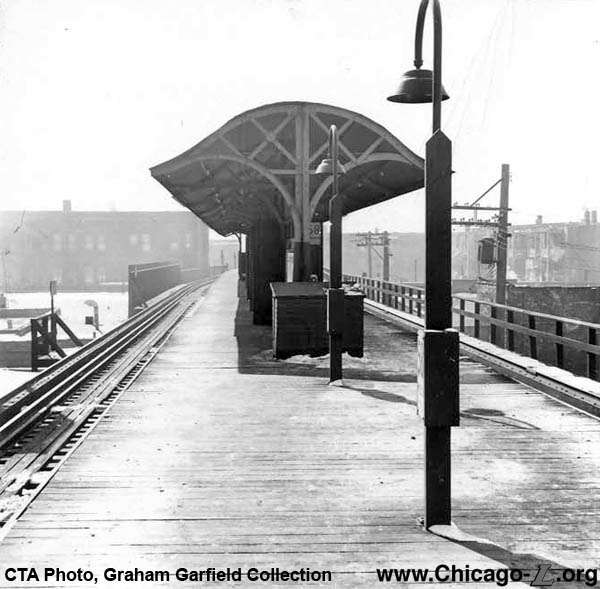
The 58th station platform is
seen looking south on March 1, 1960 with its original 1893
hump-shaped canopy. The 58th station was one of the only
South Side stations to keep its original canopy for most of
its existence. For a larger view, click here.
(Photo from Graham Garfield Collection)
|
Designed by architect Myron H. Church and built by the Rapid Transit
and Bridge Construction Company (under general contractor Alfred
Walcott and engineer R.I. Sloan), the station house was designed with
a Queen Anne-style influence. The building was constructed of brick
with stone sills and foundation with polychrome brickwork along the
top of the exterior in a latticed diamond pattern. Perhaps the
building's most prominent feature was the bay that projected from the
front elevation, with its broad half-cone roof. The building's bay
and brick frieze display many qualities of the Queen Anne style,
although the flat terra-cotta cornice and other elements show some
examples of early Chicago School of architecture.
Unlike other South Side stations, which had dual side platforms,
58th station was designed with a single island platform. The platform
consisted of a wooden deck on a steel structure. The original canopy
was humped-shaped, typical of the original South Side Rapid Transit
designs. Unlike the other South Side stations whose canopies were
replaced early on with short canopies of steel posts supporting a
flat tin roof, 58th kept its original canopy until the 1980s.
58th station took on new significance when, on November 3, 1905,
the South Side Elevated's Englewood
branch opened. The Englewood
branch left the main line at 59th
Street, making 58th the last station before the split and an
important transfer station. When the Englewood
branch first opened,
shuttle trains were operated from the branch to 58th station, which
turned around on a center stub track north of the station platform.
At 58th, passengers had to transfer to Jackson Park trains to
downtown. On November 3, 1906, when the branch was opened as far as Harvard station, an express through
service to the Loop was instituted during rush hours, but the shuttle
to 58th remained in operation at all other times. In 1911, the
shuttle service was discontinued and all Englewood trains were routed
downtown. Facilitated by its island platform configuration, 58th
remained the primary transfer station between Englewood and Jackson Park trains until 1949, when A/B
skip-stop service was instituted. Under this express scheme, 58th
became an "A" station, with "A" trains serving the Englewood
branch ("B" trains served Jackson Park). With no Jackson Park service at
58th, the transfer point became 51st station
(the first "AB" stop after the junction) and later Garfield
station (which became "AB" in 1982). In 1993, the
CTA suspended A/B service on
the Englewood-Jackson Park route and all trains called at 58th
station again.
In 1983, the CTA began a
project to renovate the 58th station. As was done at several South
Side Elevated stations, the renovation was to take place in piecemeal
fashion, with the platform and station house rebuilt separately,
years apart, under separately-funded projects due to the limited
funds CTA had available for
such endeavors. The first part to be rebuilt was the island platform
in 1983. The new station platform includes a new canopy with a
slightly peaked roof extending out over the centerline of each
track.
The reconstruction of the station house was to follow in 1986. In
a letter that year, the Commission on Chicago Historical and
Architectural Landmarks described the Victorian station house as
being "in poor condition". This state was apparently brought on, in
part, by erosion of the station house's masonry surfaces following a
sandblast cleaning several years before. Such treatment of masonry,
if not done carefully and correctly, provides a short-term aesthetic
improvement but often causes long-term damage by removing the brick's
protective glazing.
The project to rebuild the station house was delayed. In September
1988, the CTA Board awarded
$1.1 million in contracts to Interlock Services Corp./Atlas
Construction Services to build new stations at the Pulaski
on the Douglas branch and at 58th on the North-South Route. The
original 1893 station house was removed, but for some reason the new
station house was never built. New temporary fare controls were
installed on the platform at the top of the stairs from the
street.
On February 21, 1993, the South Side Englewood-Jackson Park Line,
formerly paired with the Howard Line and forming the North-South Route, was repaired with the Lake Street Line and formed the
CTA's new Green Line.
On January 9, 1994, the Green Line closed for a two-year
rehabilitation. All stations on the line, including 58th, closed, but
unlike most other stations 58th did not reopen. During the
renovation, CTA decided that
some sections of the Green Line had stations too close together --
58th station is three blocks south of Garfield
station -- and chose to close some stations permanently to control
the costs of the renovation project, improve operations, and reduce
operating costs when the line reopened. The new station platform was
used for just ten years before the
CTA closed it.
The platform and canopy remained in place for 18 years after the station closed, abandoned with the stairs gated off.
The CTA was required to keep
the station intact and in operable condition due to the use of federal
monies in its renovation until the grant investment had amortized. By 2010, the wooden platform decking had deteriorated to the point that it was cordoned off even from employee access, although the steel structure of the platform and canopy appeared to be in reasonable condition. The CTA demolished the remains of the station between January and early February 2012, removing the platform stringers and joists and the canopy columns and roof. Today, nothing of the station remains.
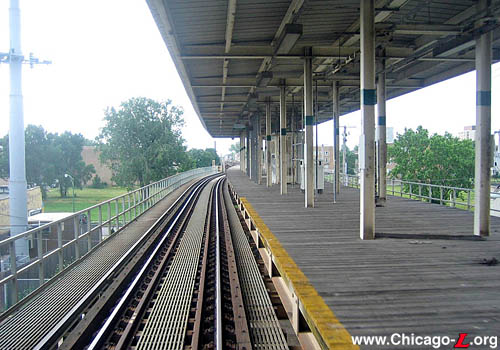
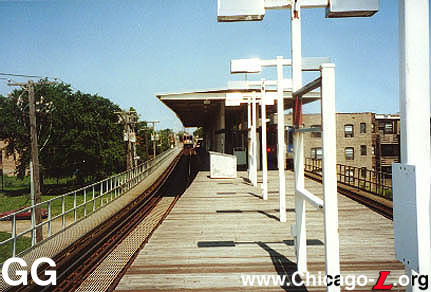
The 58th station platform is
seen looking south under the canopy on July 18, 2006.
Visible in the background between the rows of canopy
supports are a disused agent's booth and an exit rotogate.
Although most of the signage has been removed, a Board Here
sign is visible in the distance. For a larger view, click
here.
(Photo by Graham Garfield)
|

|
58th01.jpg
(68k)
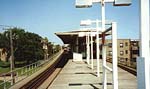
The 58th island platform, abandoned at the time of the
photograph, looking north in Summer 2000 as a Harlem-bound
2400-series Green Line train passes through and a southbound
train approaches in the distance. All of the station signs
have been removed, their mountings left empty. (Photo by Graham Garfield)
|
|
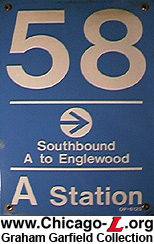
58thSign.jpg
(58k)
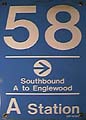
A 58th Street symbol sign. Despite the fact that 58th was an
A station (normally red), the sign is blue (usually for AB
stations) because it was made after 1990, when it was
decided to drop the color-coding on the signs and make them
all Olympic Blue,
CTA's then-official
color. (Sign from the collection of Graham
Garfield)
|
 |
58th05.jpg (174k)
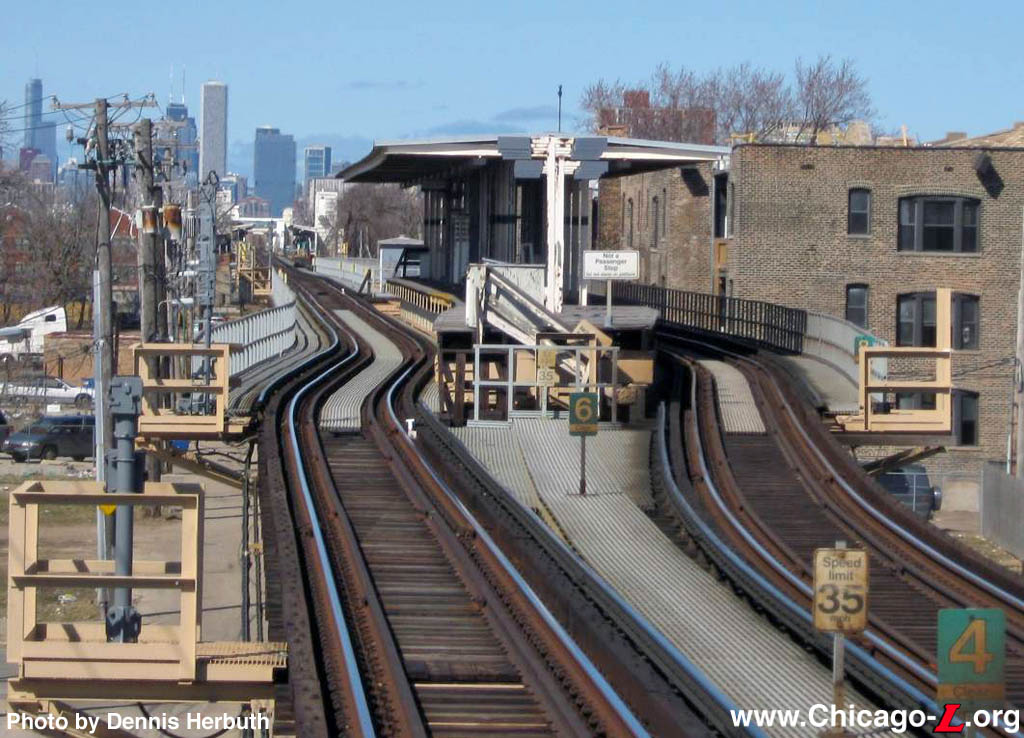
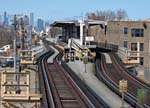
The 58th station platform is seen looking north on March 27, 2011 from the rear of IRM's 2011 Snowflake Special charter train. The platform and canopy are structurally intact, but in the absence of regular maintenance the platform decking has deteriorated over the years. The sign on the end of the platform reminds train operators that 58th is not a passenger stop, and informs all personnel that no one should walk on the platform. (Photo by Dennis Herbuth) |
|

|

|