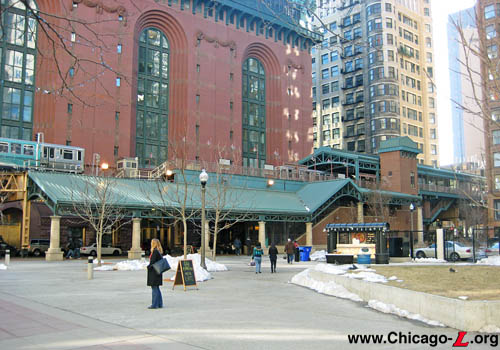
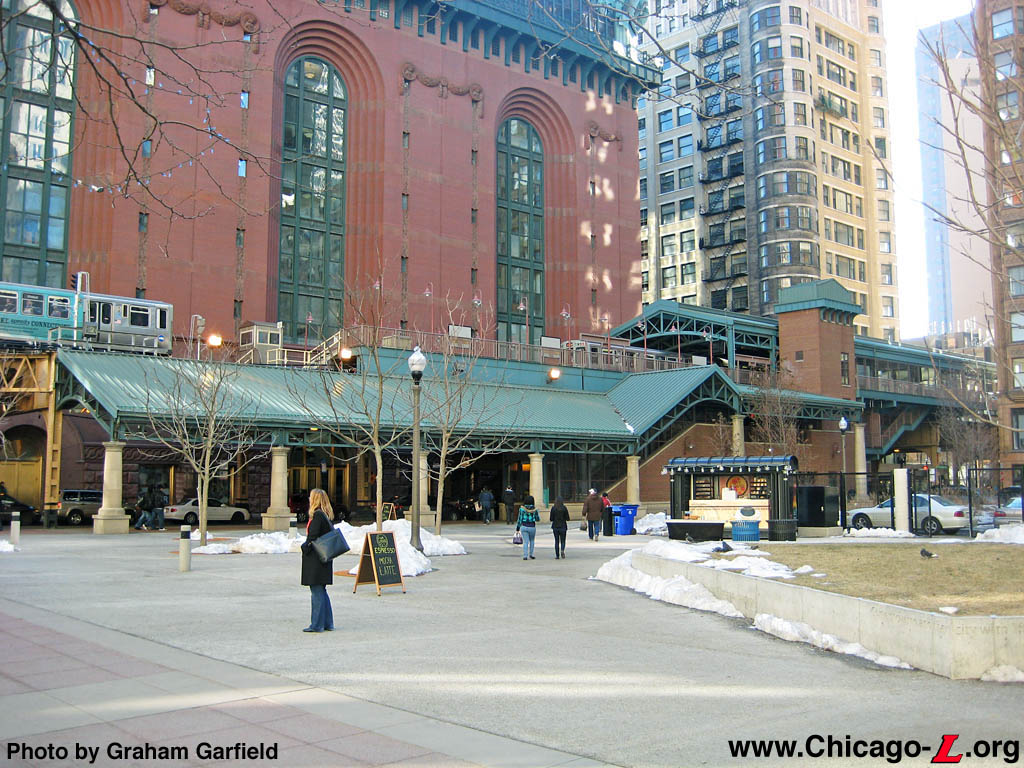
Harold Washington Library station, with its brick walls and European-style train shed, is seen looking southwest across Pritzker Park on March 5, 2010. Looming in the background is the Harold Washington Library Center -- the intended aesthetic coordination between the two facilities is evident. For a larger view, click here.
(Photo by Graham
Garfield)
|
Harold Washington Library-State/Van Buren
(1W-400S)
Between State and Dearborn
Streets and Van Buren Street, Loop
Service
Notes:

|
Brown Line:
Ravenswood
|

|
Orange Line:
Midway
|

|
Purple Line:
Evanston Express
|

|
Pink Line:
54/Cermak-Loop
|

|
Accessible
Station
|

|
Transfer
Station
(Transfer to Red and Blue line subways by farecard only;
all other transfers unrestricted)
|
Quick Facts:
Address: 1 W. Van Buren
Street
Established: June 22, 1997
Original Line: n/a
Previous Names: Library-State/Van Buren
Skip-Stop Type: n/a
Rebuilt: n/a
Status: In Use
History:
When the Loop opened on October 3, 1897, there were three Colonial
Revival stations on the Van Buren leg, including one at State/Van
Buren. Amid a year of extensive service revisions and station and
station entrance closures, the CTA closed the State/Van Buren station
on September 2, 1973, presumably fallen ridership.
For additional information
and photos of the earlier State/Van Buren elevated station
(1897-1973), click here
to see the State/Van Buren station profile.
This location did without a Loop "L" station for the next 24
years. In the late-1990s, a new station, Library-State/Van
Buren, was built between State and Dearborn in conjunction with
the construction of the new Harold Washington Library. From 2030
hours on Friday, July 12th to 0430 hours on Monday, July 15, 1996,
the Van Buren leg of the Loop was taken out of service to permit
structure renewal as part of the construction of the new station. On
June 22, 1997, the new Library-State/Van Buren station opened at 0720
hours, serving Brown, Purple Express, and Orange Line trains.
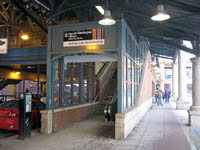
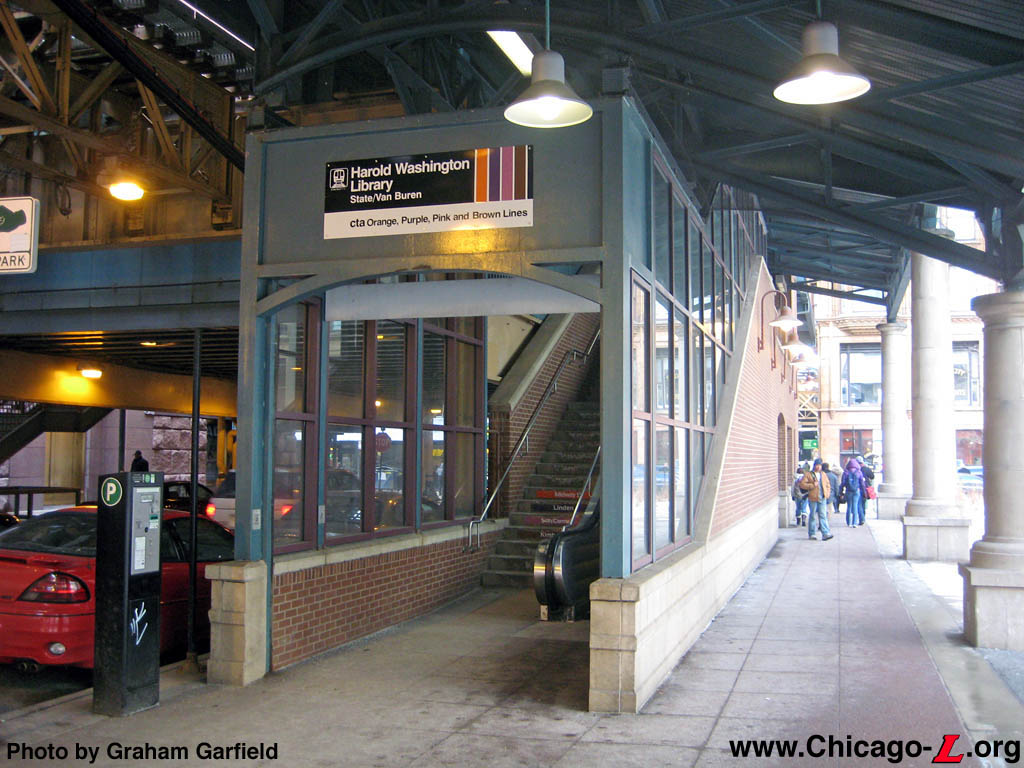
The enclosure for the stairs/escalator to the mezzanine on the north side of Van Buren Street is seen looking west on February 24, 2011. For a
larger view, click here. (Photo by Graham Garfield) |
The new Library station was designed by Diane Legge Kemp of DLK Architecture to
harmonize with the Harold Washington Library, which meant extensive
use of red brick and green steel for a more classical look. The
Library station, with its modernized prairie school look and
European-style train shed, was designed to have a direct-to library
entrance, but this was never built.
The station actually starts west of State -- so that berthed
trains don't interfere with the signals at Tower
12 one block east -- and extends west of Dearborn Street. Fare
controls are in a mezzanine platform between State Street and
Plymouth Court. From there, riders proceed up to one of two long
platforms, covered by two separate green steel train sheds. The
crooked lights are similar to the classic lights that have decorated
the older stations since the "L" first opened. Auxiliary exits are
located at Dearborn Street.
The Library-State/Van Buren
station was built in an excellent position, with it stairs at both State and
Dearborn Streets, to serve as a transfer point to both the Red and
Blue Lines subways, but the transit card turnstiles were not originally
programmed to allow free transfers for passengers using farecards. A
direct connection between the paid area at Library and the paid area
at Jackson-Van Buren/State was
contemplated when the latter station was remodeled in 1996-2000, but this
plan was not executed. However, when the Pink Line began operation in 2006, Library was changed to function as a transfer station between the Loop Elevated and the Red and Blue line subways. The Loop-subway connection is a "walking transfer" and requires passengers to use the same farecard they entered the rail system with, similar to the transfer between the Lake subway station and the State/Lake Loop station.
The station was built adjacent to, and to serve among other destinations, the Harold Washington Library Center. The station opened in 1997 as "Library-State/Van Buren", with "Library" added shortly before the station opened -- it was originally planned to simply be called "State/Van Buren", like the previous station on the site. Following an informal campaign by several African-American residents who appeared before the CTA board and at other city hearings and public meetings over several years, the CTA changed the name of the station to reflect the full name of the adjacent library center, which honor's Chicago's first African-American mayor. On October 6, 2010, the CTA board voted unanimously to change the name of the Library-State/Van Buren station to the "Harold Washington Library-State/Van Buren" station.
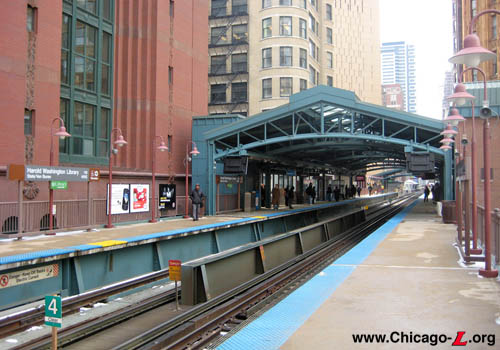
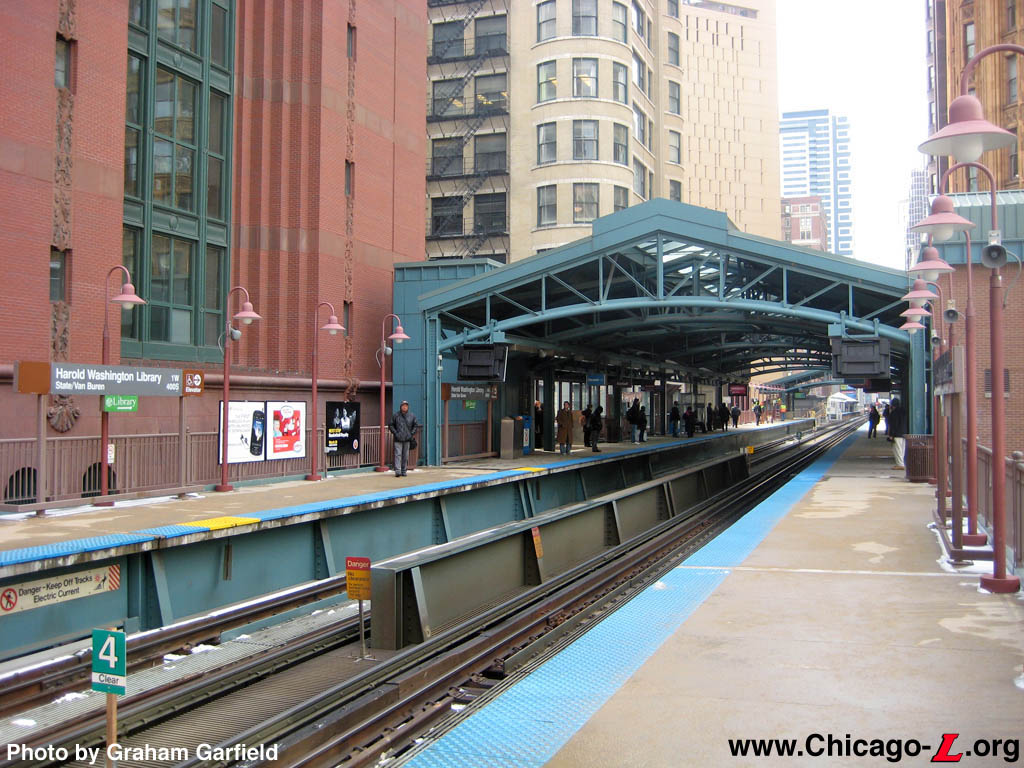
The Harold Washington Library-State/Van Buren station platforms are seen looking west from the Inner Loop platform on February 24, 2011. With its olive steel
shed, the facility resembles a classic train station, similar to the station at Davis
in Evanston. The lights are also reminiscent of the "L"'s
original platform lights. For a larger view, click here. (Photo by Graham Garfield) |

 |
library02jpg (31k)
A contemporary aerial view of the Library-State/Van
Buren station, looking west as a Midway train stops to load
passengers. (Photo
from the Proposed 1999 CTA Annual Budget) |
 |
cta3457.jpg (85k)
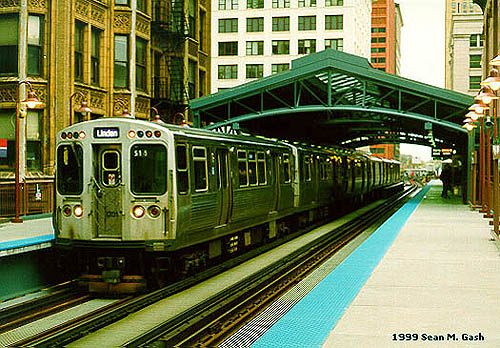
Car 3457 leads car 3458 and the rest of a six-car Purple Line Express train at Library-State/Van Buren on April 3, 1998. Unit 3457-3458 are an unusual pair: although numbered in the 3200-series, one is a 3200, while the other is a 2600-series car whose mate was permanently damaged. With its olive steel shed, the facility resembles a European train station, as well as the station at Davis in Evanston. The lights are also reminiscent of the "L"'s original platform lights. (Photo
by Sean Gash) |
|
library03.jpg
(102k)
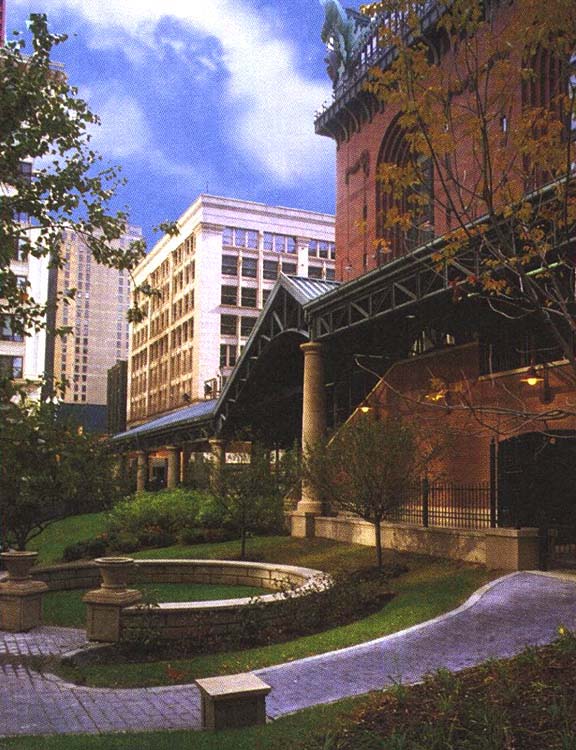
The green landscape of Pritzker Park and the red
brick and olive metal ornaments of the Harold Washington
Library provide both the idyllic backdrop and the influence
for the architecture and design of Library station, looking
southeast in Pritzker Park circa 1999.
(Photo from the Collection of the Chicago Transit
Authority)
|
 |
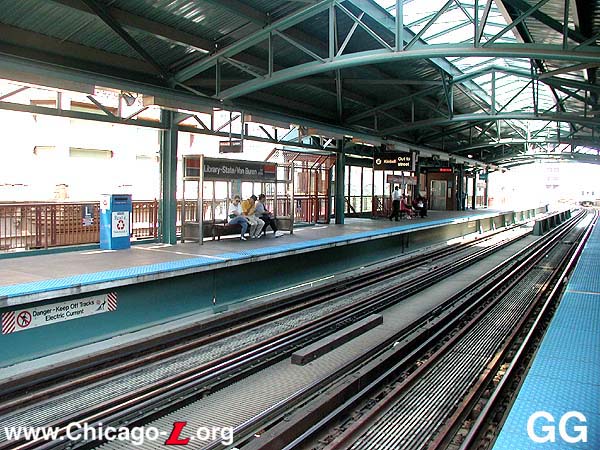
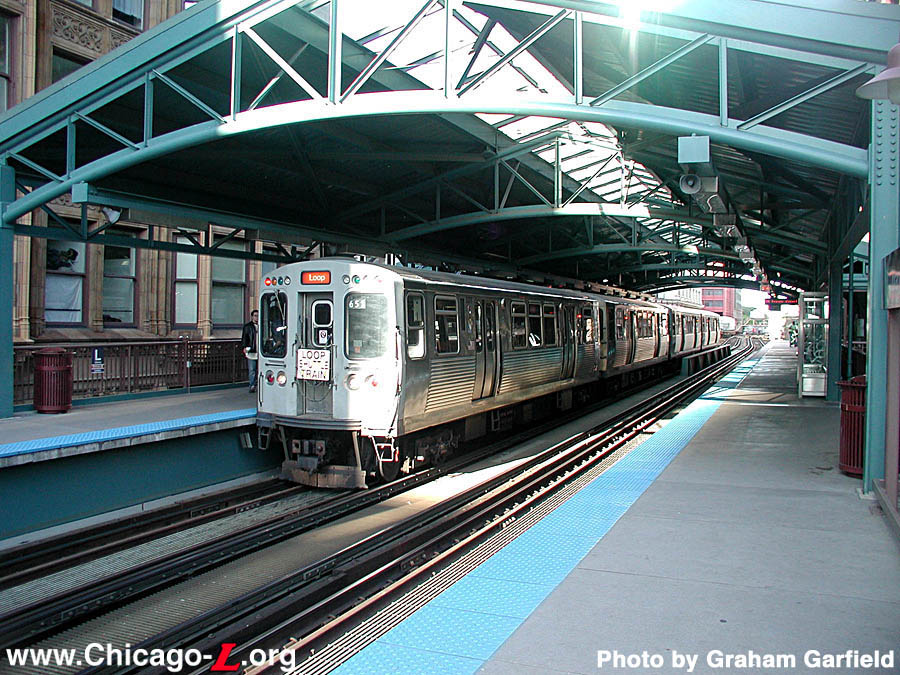
library01.jpg (117k)
The latticed train shed-covered side platforms at Library-State/Van Buren, looking east at the Orange/Purple Line Inner Loop platform in Summer 2001. (Photo
by Graham Garfield) |
|
cta2577flags01.jpg
(126k)
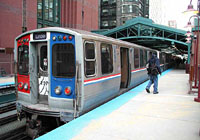
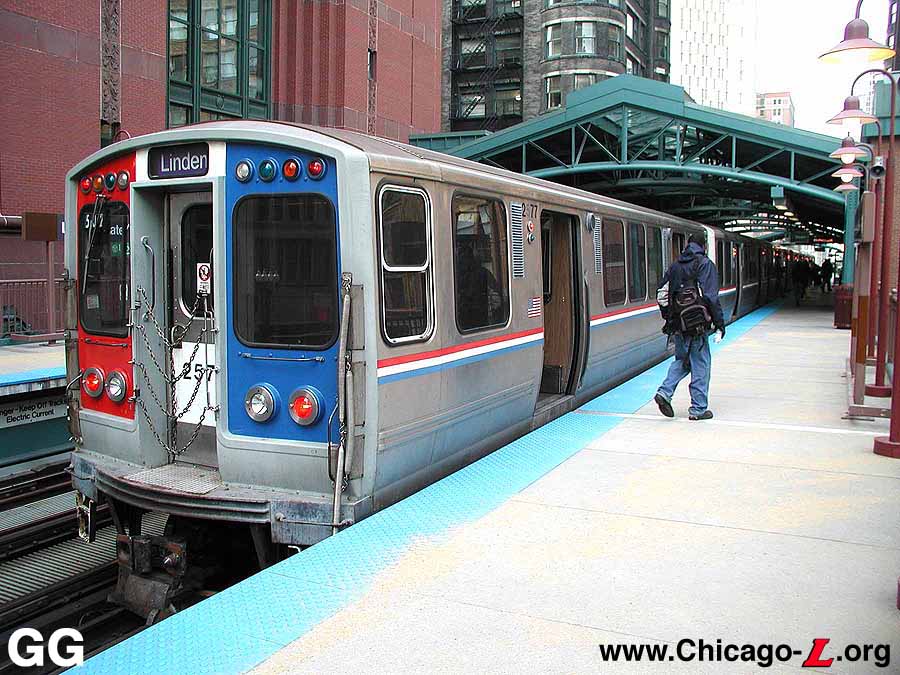
Car 2577 stops at Library/State-Van Buren during the
morning rush hour on January 7, 2002. The newly-applied
American flag, along with the red, white, and blue belt rail
and car ends, give this 2400
an especially patriotic feel. The application of "Old Glory"
is a systemwide program and the decal has begun appearing in
late December 2001. (Photo by Graham
Garfield)
|
|
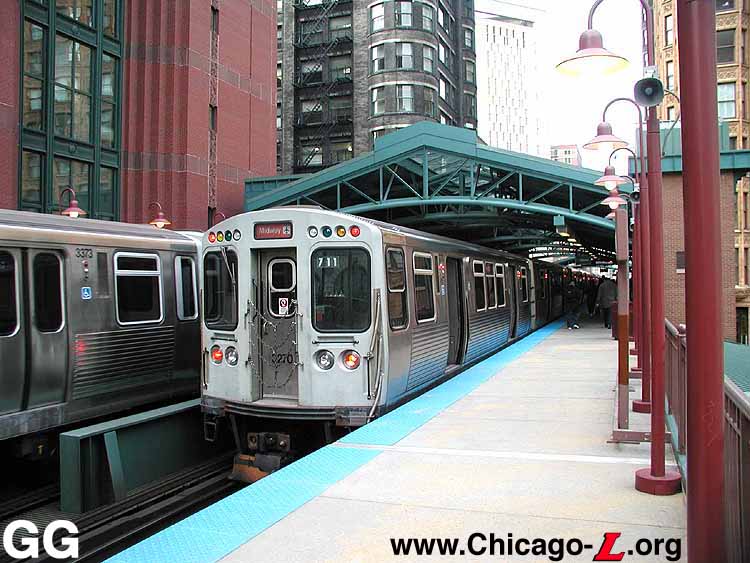
cta3270@Library.jpg
(91k)
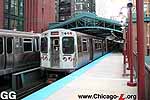
A Tale of Two 3200s:
An Orange Line train with car 3270 at the rear pulls into
the Library-State/Van Buren station, its first stop on the
Loop, as a Brown Line train with car 3373 in the consist
pulls out toward Tower
12 on January 7, 2002. (Photo by Graham
Garfield)
|
|
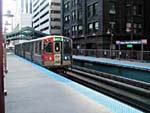
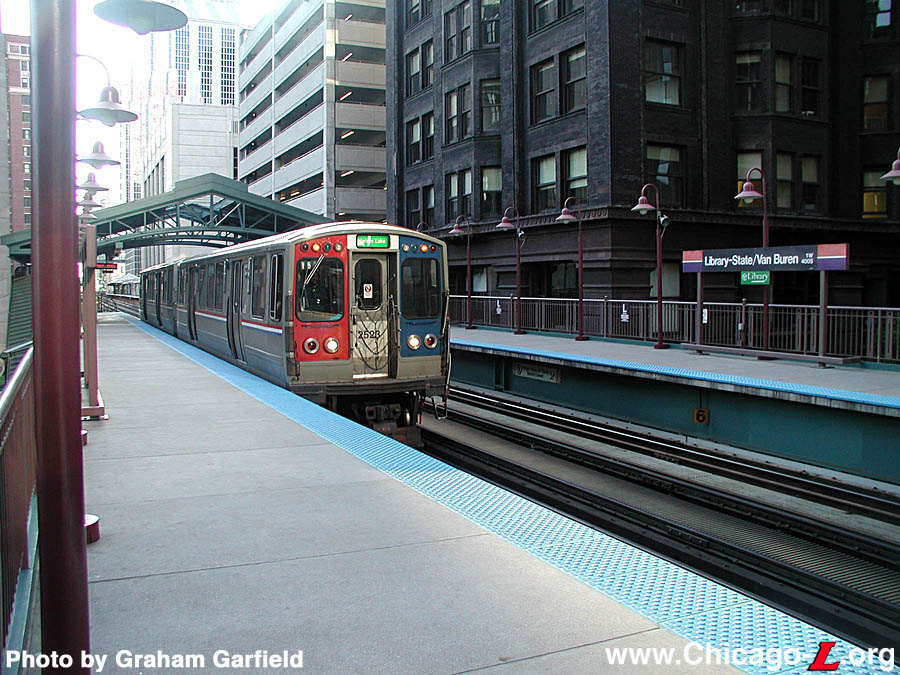
cta2523.jpg
(179k)
A Green Line train at Library station?! It happened over
Memorial Day weekend 2003, when Green Line trains from
Harlem were short-turned on the Outer Loop due to the
reconstruction of Harrison Curve. Here, car 2523 leads a
Green Line train pulling into Library on May 26, 2003.
(Photo by Graham Garfield)
|
|
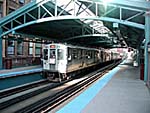
cta3378.jpg
(205k)
While Orange Line was truncated at Roosevelt over Memorial
Day weekend 2003 due to Harrison Curve reconstruction, there
would've been no service on the Inner Loop. To compensate
for this and aid in circulation of passengers around the
Loop, a shuttle was operated all weekend with Orange Line
equipment, as seen on Library on May 26, 2003, with car 3378
leading the 4-car consist. To see a close-up of the sign on
the chains, click here.
(Photo by Graham Garfield)
|
|
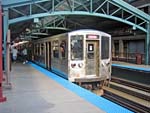
cta2217.jpg
(183k)
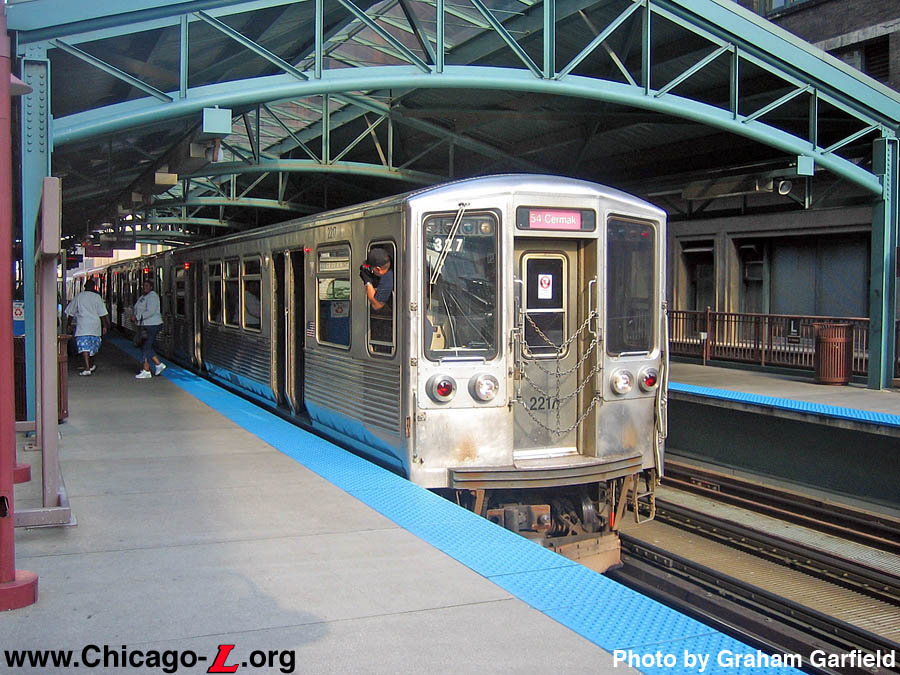
Car 2217, a 1969-vintage unit, is at the lead of a Pink
Line train stopping at Library station on July 3, 2006
as the operator makes manual station announcements and
checks for passengers before closing his doors. The
2200-series cars,
which make up half of the 44 cars assigned to the Pink
Line, are only used when 4-car service is operated on
the route. Otherwise, only 2600-series
cars are used. (Photo by Graham
Garfield)
|
|
cta5010f.jpg (176k)
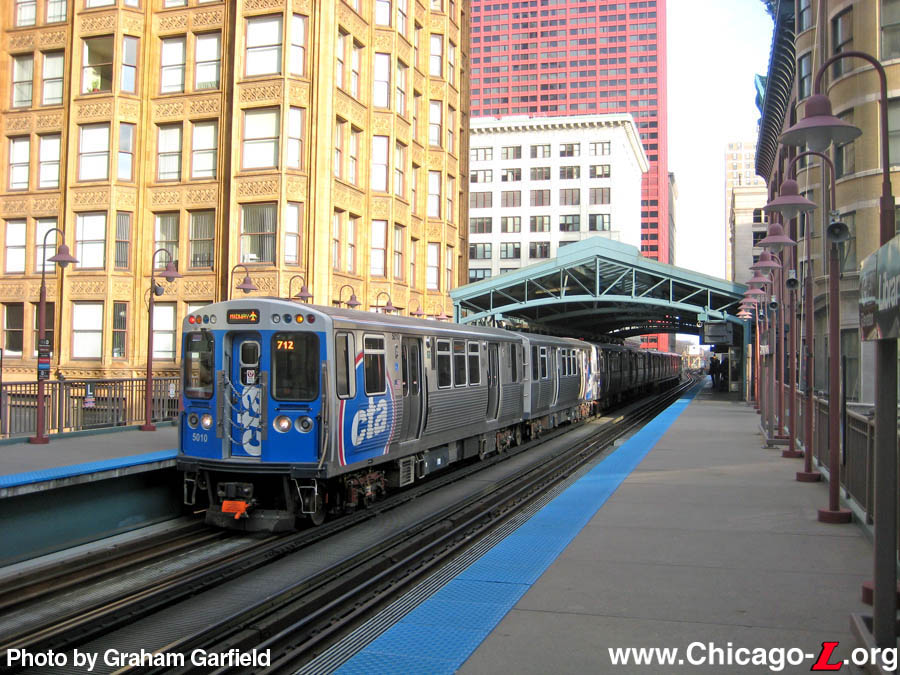
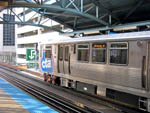
Car 5010, decked out in its promotional graphics, leads an 8-car train of prototype 5000-series railcars in Orange Line service on November 19, 2010. The train is pulling into Harold Washington Library station (about a month after the CTA Board approved the new name for what had formerly been known as "Library" station, but about three months before the signage was changed) on a Friday mid-afternoon; the historic Fisher Building is looming in the left background. (Photo by Graham Garfield) |
|
cta5010g.jpg (174k)
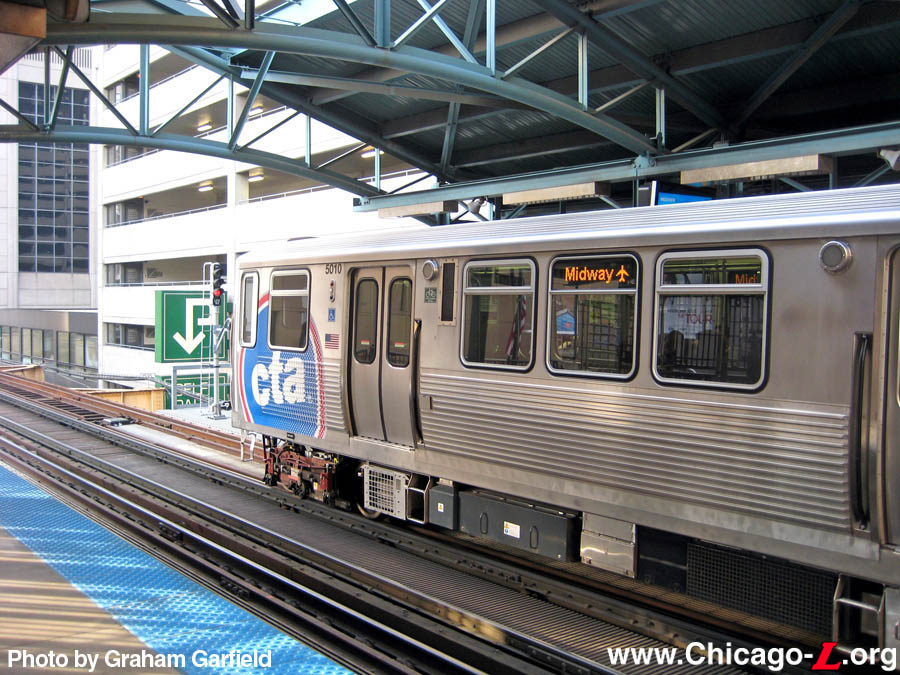
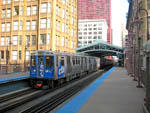
Orange Line Run 712 is led by 5000-series prototype car 5010, as it stops at Harold Washington Library station on November 19, 2010. The LED side destination signs approximate the typography of the mylar roller curtains on the older cars, presenting the destinations in an approximation of mixed-case Helvetica Bold text. Even the airplane symbol from the "Midway" roller curtain readings is replicated. The main difference is that all readings on the digital signs are amber characters on a black background instead of the color-coded readings on the mylar roller curtains. (Photo by Graham Garfield) |
 |
library07.jpg (173k)
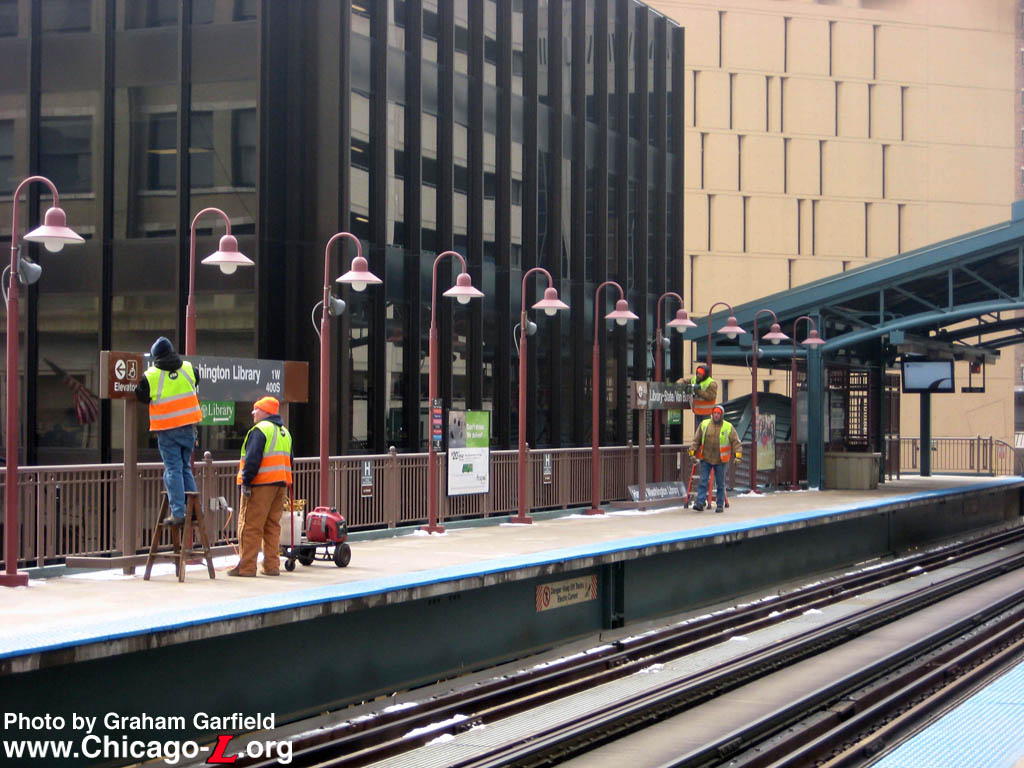
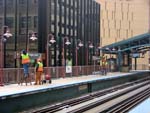
CTA tradesmen replace the original "Library-State/Van Buren" station name signs with new "Harold Washington Library-State/Van Buren" signs, looking west at the Outer Loop platform on February 24, 2011, a few months after the name change was authorized by the CTA Board. The changeout of all the necessary signage in the station took a couple days. (Photo
by Graham Garfield) |

- Library_next.wav
(184k): "Library-State and Van Buren is next. Doors open on
the right at Library-State and Van Buren."
(Sound courtesy of Tony Coppoletta)
.
- Library_Orange-orig.wav
(256k): The is the original recording of the Library
station announcement. Its pronunciation was criticized for
sounding like he's pronouncing the name "Lie-berry" and later
replaced (see next): "This is Library-State and Van Buren.
Transfer to Brown Line trains at Library-State and Van Buren. This
is an Orange Line train to Midway."
(Sound courtesy of Tony Coppoletta)
.
- Library_Orange.wav
(302k): After the original announcement for Library
was criticized for poor enunciation (see above), this new
version was rerecorded. Note how he over-enunciates the word
"Library" this time: "This is Library-State and Van Buren.
Transfer to Brown Line trains at Library-State and Van Buren. This
is an Orange Line train to Midway."
(Sound courtesy of Tony Coppoletta)







)