|
|



|
|
|


.
"L" Signals:
A Brief History and Overview
|
|
|
|
|
.
"L" Signals:
A Brief History and Overview
Looking for a guide to the meaning of specific signal readings? See the Signal Aspects and Indications page in the Operations section.
In the early days of the "L", the only signal system on the "L" were wayside signs and signals, with no positive enforcement mechanism. A wayside signal is basically any signal -- electrical, mechanical or otherwise -- in a fixed location outside a train along the track.
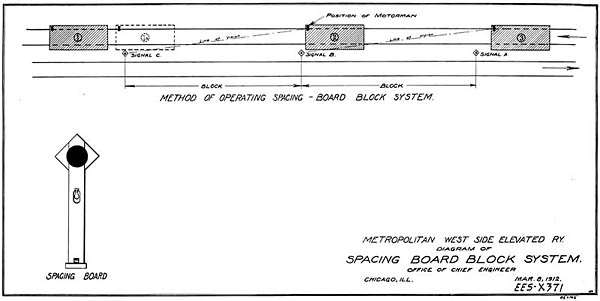
When the CTA inherited the elevated system in 1947, much of the system still operated "on sight", which depended on the motorman's comprehension of and compliance with safe following distances and the rules governing them. To aid their judgment, the "L" used "spacing boards" to give the motorman a point of reference. The State Street Subway, which had opened in 1943, had the most advanced system at the time, a Automatic Block Signal System (ABS). This electro/mechanical system provided more protection and a fail-safe device to stop non-compliant motormen, as well as signals to visually convey instructions.
Later, the CTA upgraded to an Automatic Train Control (ATC) system, which provides instructions electronically not only on wayside signals but also in the motorman's cab onboard the train. With the upgrade of the Dearborn Subway and Forest Park (Congress) branches from ABS to ATC in late 2009, the entire "L" system is now under ATC signal protection.
Spacing Boards | Automatic Block Signals | Automatic Train Control
|
Although the Metropolitan main line and part of the Northwest branch were originally equipped with an early (and then-quite advanced) Rowell-Potter block signal system, it remained in use for only about a decade. In 1908, the Met installed spacing boards on its system.
Spacing boards are four foot high poles topped with a white diamond-shaped target with a black center. A single incandescent bulb mounted below the diamond was all that was provided for nighttime operation. Unlike modern signals, spacing boards were placed on the left side of the track so that they were diagonally placed from the motorman's cab. They were placed at intervals varying from 200 to 1000 feet. A letter from the Met to riders announcing the system explained their operation this way:
The city's other elevated companies also quickly adopted spacing boards. The devices remained in used until the 1970s when electronic cab signals finally phased them out.
|
The earliest automatic block signals used on the system were on the Metropolitan West Side Elevated's main line and part of the Northwest branch. The Rowell-Potter signals were used only until 1908.
The middle express track on the South Side main line used them between 18th Street and Indiana Avenue. Fitted with two-aspect (colored light) electro-pneumatic operated semaphores, the signals protected against rear collisions around curves and other dangerous locations. (Most rear-protection block signals use a three-aspect color light signal.)
The first extensive use of automatic block signal system on the "L" came when all five double-track miles of the State Street Subway were equipped with them in 1943. This improved version of the ABS system had a three-aspect signal, each fitted with a left side mounted track trip to engage a spring-loaded carborne trip valve on any train passing a restrictive indication (signal). On the 4000-series cars (which used air brakes), an emergency stop was triggered when the track-mounted trip arm caused the brake pipe on the train to vent to atmosphere. In the case of the more modern all electric cars, the track trip would strike the side trip lever on the train, activating the electrical emergency braking system.
To insure adequate protection, circuitry was overlapped to protect the rear of a train by the space between two blocks, not just one. (A "block" is the area between two signals.) Thus, if a train somehow managed to pass one signal without being stopped, there was still adequate time for an emergency stop to be enacted.
The wayside ABS signal color-lights displays one of the following three aspects:
If so authorized, a motorman may operate a track trip manual release on the wayside signal to override the ABS system, causing the trip to lower.
The ABS system was also installed in the Milwaukee-Dearborn Subway, which opened in 1951. The Congress Line received them in 1958 and the same year, the old Met Logan Square line (Northwest branch) received them from the subway portal at Evergreen/Milwaukee to the Logan Square terminal. This meant that the entire Congress-Milwaukee A route was equipped with an ABS system, the only line in Chicago at the time to have such a system for its entire length.
Expansion of automatically signaling lagged for some time after 1958. In 1964, the first speedometers were installed on the new 2000-series cars, as well as a few other experimentally on other car types.
At the same time, breakthroughs were made in the fields of solid state electronics and audio frequency track circuits. This allowed the development of the automatic train control system. In ATC, wayside equipment detects the presence of trains or other speed-limiting factors and send electronic commands dictating the maximum speed a following train may operate through the rails. These signals are picked up by equipment on a train and compares it to the actual speedometer reading. If the actual speed exceeds the maximum allowed speed, visual and audio displays alert the driver to lower his speed. If the driver fails to stop or reduce his speed, a penalty full stop is imposed.
The ATC system is in continuous contact with each train, not just when a train passes a fixed wayside signal as with the ABS system. Therefore, speed commands are updated continuously and will alter as soon as conditions ahead change. The installation of the ATC system was 40% less than the estimate of what it would have coast to install an ABS systemwide.
The first installation of the ATC was on eight miles of the Lake Street Line from Harlem to the Chicago River in 1965. The Dan Ryan and Kennedy lines had them when they opened in 1969-70, and starting in 1975, the rest of the system was converted line by line, covering the "dark" (unsignalized) trackage bit by bit, focusing on lines that did not already have any type of automatic signals: the Douglas line in 1974, the North-South and Evanston and Skokie lines in 1975, and the Ravenswood line in 1976. Starting with the O'Hare Extension in 1983, new signal systems included bidirectional capability. In 2001, the block signals in the State Street Subway were replaced with cab signals, followed by the Dearborn Subway and Forest Park branch in 2007-09; at that point, the whole "L" system was under ATC.
Over the years, different generations of signal equipment were used, with newer equipment replacing older models but often multiple generations co-existing on the system at the same time. While compatible with one another, this became more of an issue over time as newer generations introduced capabilities the older equipment didn't have. In addition, as train technology advanced, issued began to surface. An attempt to implement solid-state (chopper) propulsion control in the late 1970s was halted when prototype testing on cars 2491-2492 revealed unanticipated electromagnetic interference, which could have affected the signal track circuits. In particular, with the planning for the 5000-series AC propulsion cars, particular attention was paid to the various signal systems and the car equipment to ensure that no harmful interference might occur. Much of this analysis was based on experience other rail transit systems had had in this regard. The GRS Type 1 signal equipment then in use on portions of the Loop, West-Northwest and West-South routes was replaced in the period prior to the delivery of the 5000-series cars. CTA had already planned to replace the wayside block signals on the Milwaukee-Dearborn Subway and the Forest Park branch; this replacement was accelerated to occur at that same time as that of the GRS Type 1 signals.
|
|
|