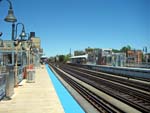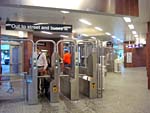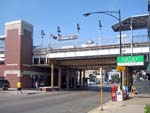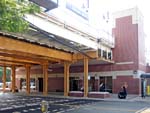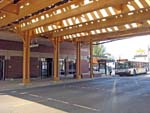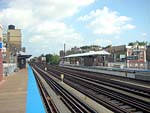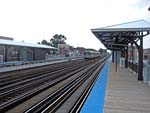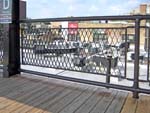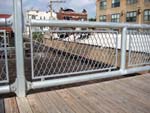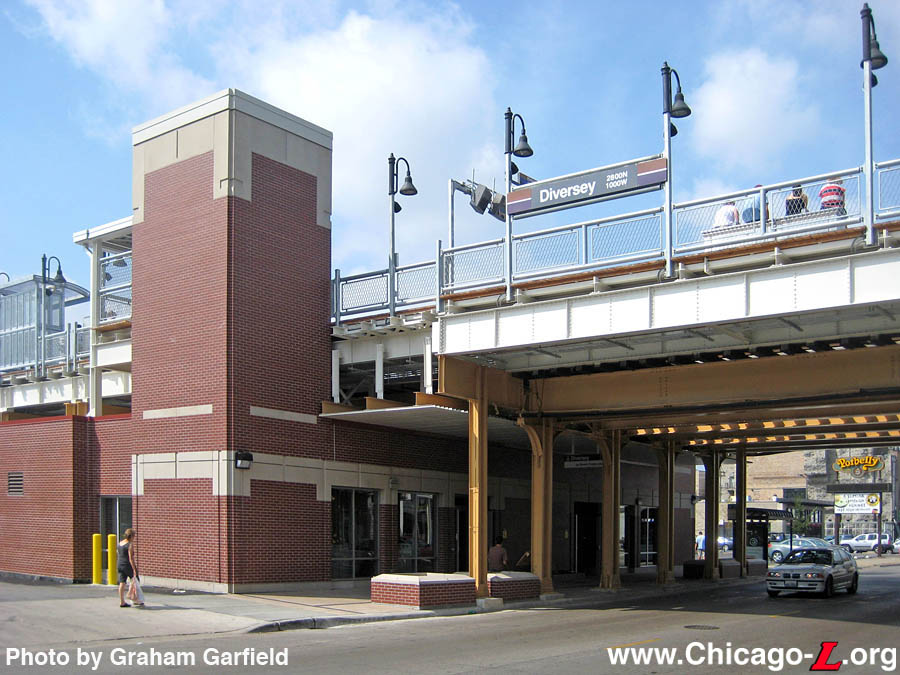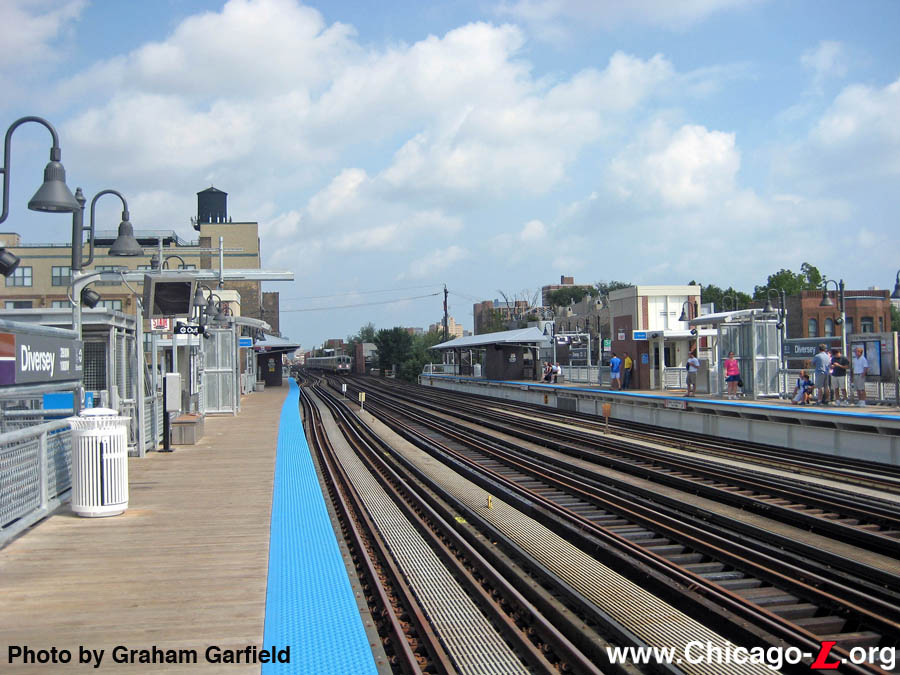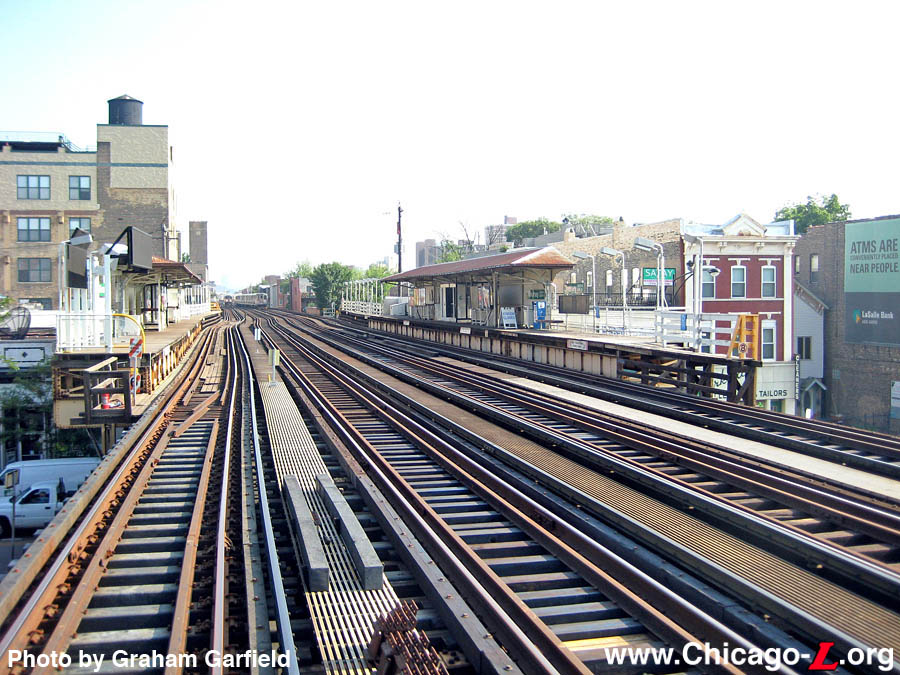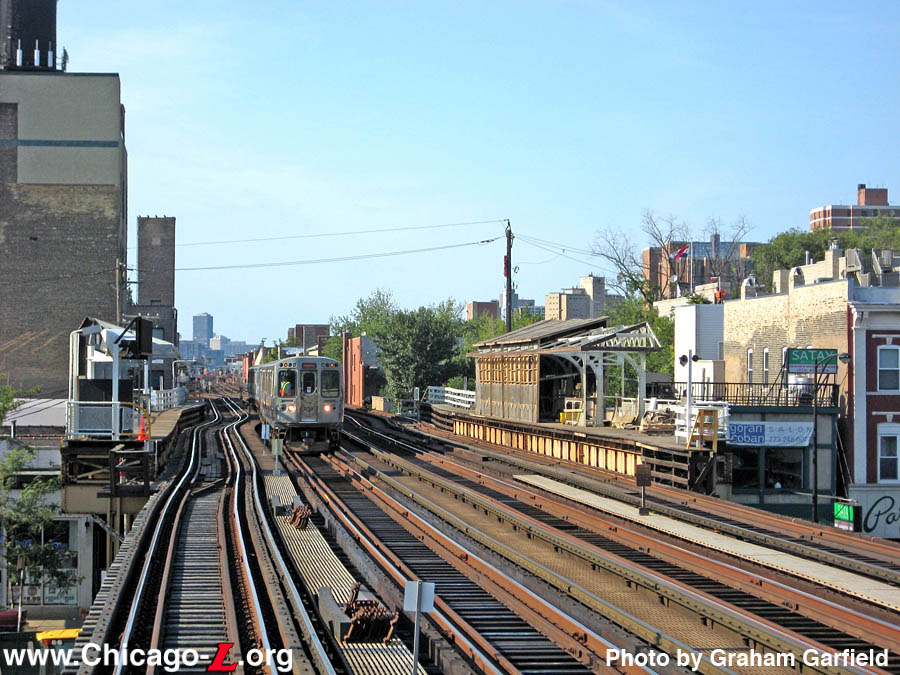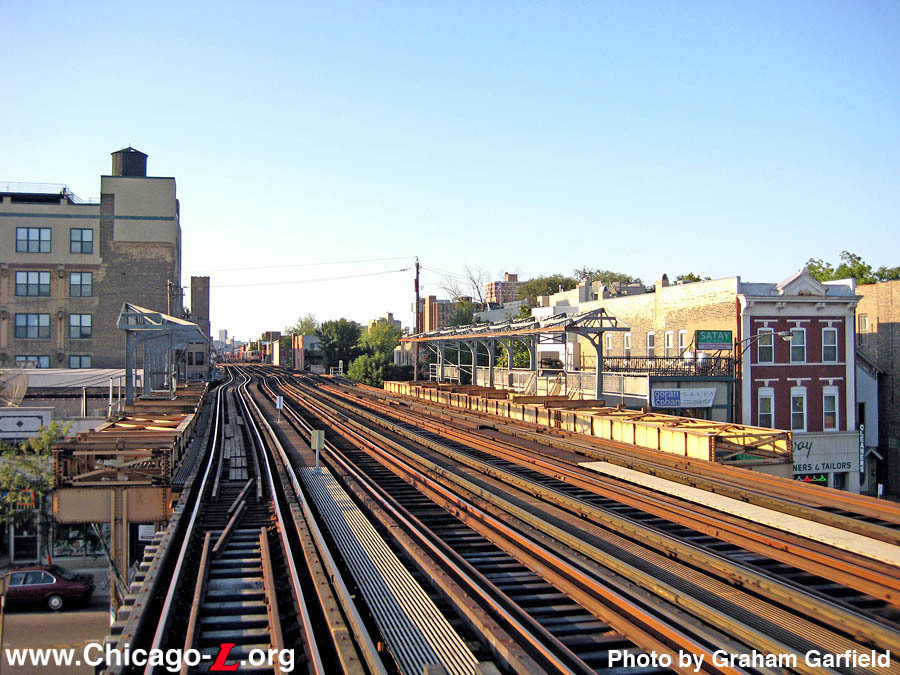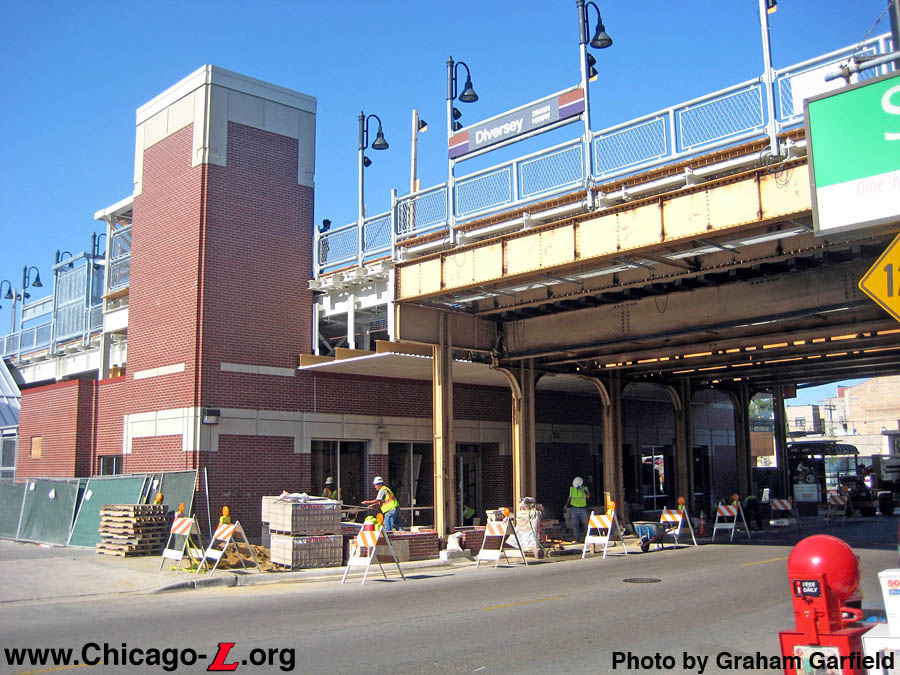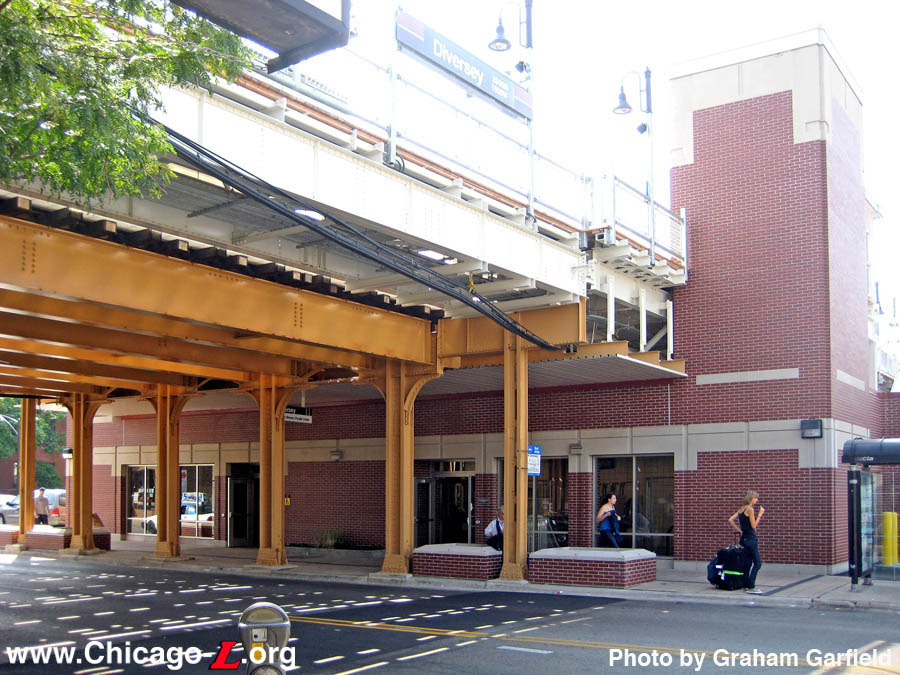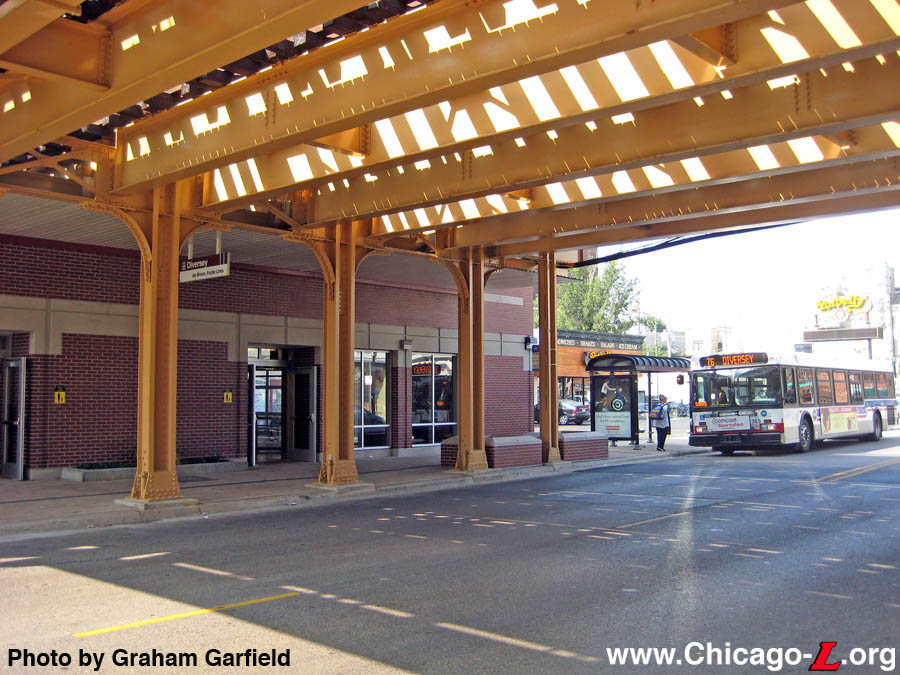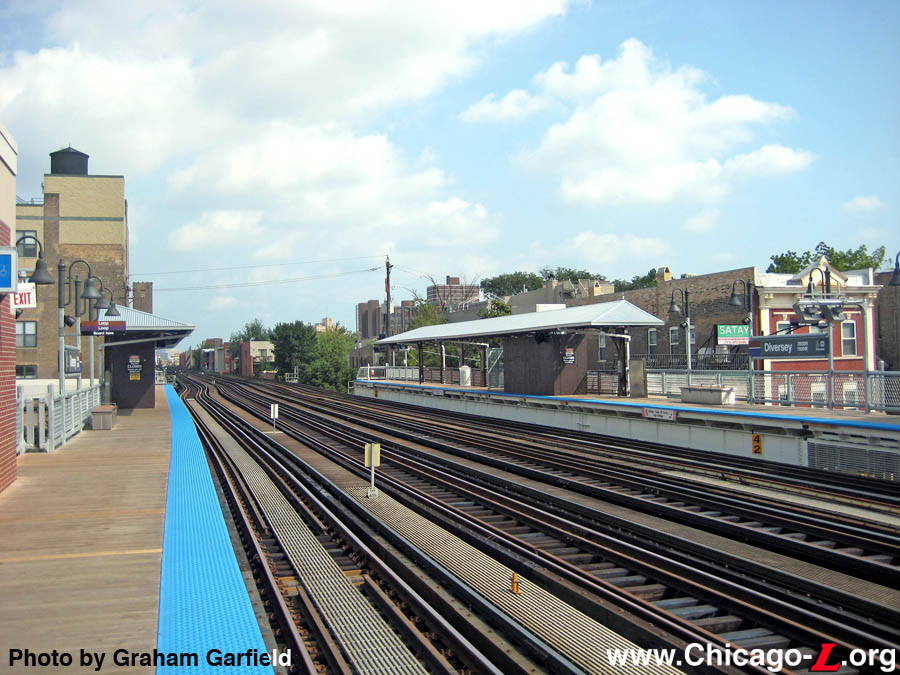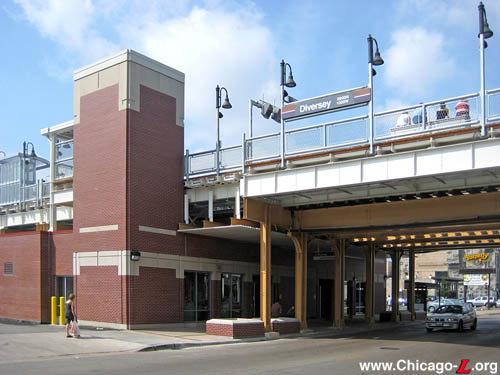
Diversey station, with its distinctive elevator towers, brick facing, and precast concrete lintels and details, is seen looking southwest on August 23, 2008.
The new steel railings and gooseneck lights on the platform are designed to evoke the historic character of the original, restored station elements to the north. For a larger view, click here.
(Photo by Graham
Garfield)
|
Diversey
(2800N/1000W)
Diversey Parkway and
Sheffield Avenue, Lincoln Park
Service
Notes:

|
Brown
Line: Ravenswood
|

|
Purple
Line: Evanston Express
|

|
Accessible
Station
|
Quick Facts:
|
Address:
|
943 W. Diversey Parkway
(main
entrance)
|
|
940 W. Diversey Parkway
(auxiliary exit)
|
| |
944 W. Diversey Parkway (historic station house) |
Established: June 9, 1900
Original Line: Northwestern Elevated Railroad
Previous Names: n/a
|
Skip-Stop Type:
|

|
Station
(1949-1983)
|

|
Station
(1983-1995)
|
Rebuilt: 2007-08
Status: In Use
History:
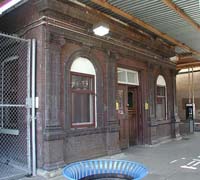
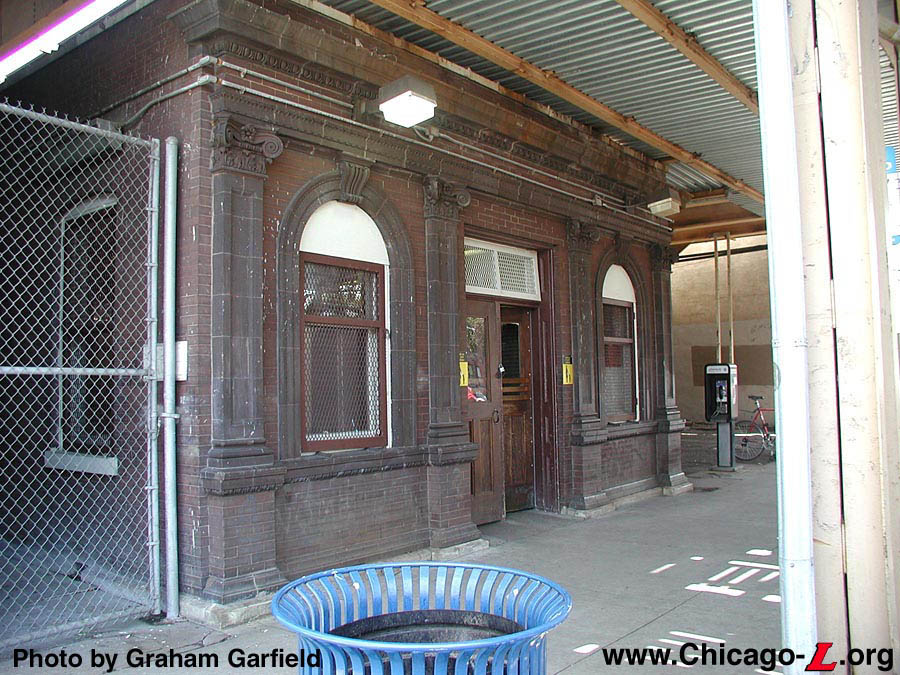
The Neo-Classical features of the brick and terra cotta Diversey station are evident in this May 13, 2002 view looking northeast at the historic building. The top arched portion of the front windows were blocked off to make replacement of the window glass easier. For an enlarged view, click here. (Photo by Graham Garfield) |
The path of the initial section of the Northwestern Elevated Railroad, from
Lake and Wells Streets to Broadway and Wilson on the what was then the far North Side, was cleared in 1895 and erection of the steel was begun January 23, 1896. Financial difficulties delayed construction several times, necessitating extensions of deadlines for commencement of service in the company's franchise with the city. All-night shifts were eventually required to complete the structure on Christmas Day 1899, days before their deadline to begin service. But most of the stations were incomplete December 31 and, after some negotiating, another extension was obtained. Northwestern Elevated service between the Loop and Wilson began on May 31, 1900. However, due to a two-week strike construction was not complete at all stations1. As a result, seven stations, including Diversey, opened 1-2 weeks after the inauguration of "L" service. Diversey station finally opened for service on June 9, 19002.
The Diversey headhouse was one of
several stations built from a design by William Gibb on what is now
the Brown Line.
Constructed entirely of brick with terra-cotta trim, the Classical
Revival design was inspired by the work of the great 16th century
Italian Renaissance architect Andrea
Palladio3. The bold modeling of the
details, especially the columns and segmented arched windows, is
characteristic of Italianate work of the late 19th century.
The interior featured plaster walls with extensive wood detailing
in the door and window frames, ceiling moldings, and tongue-in groove
chair rail paneling. Nearly all of this detail remains, although
nearly all of it was painted over by the 1990s. Also still in place
at Diversey is the ornate, intricately-detailed ticket agent's booth
designed for the station. With its paneled walls, dentils ands
moldings around the top, and ornate metal grill over the window
formally used by the ticket agent, this is the last original
1900-vintage Northwestern Elevated booth left on the system (the
original booth was at Sedgwick until its
renovation in 2006; another was at Chicago
until 1999).
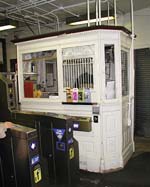
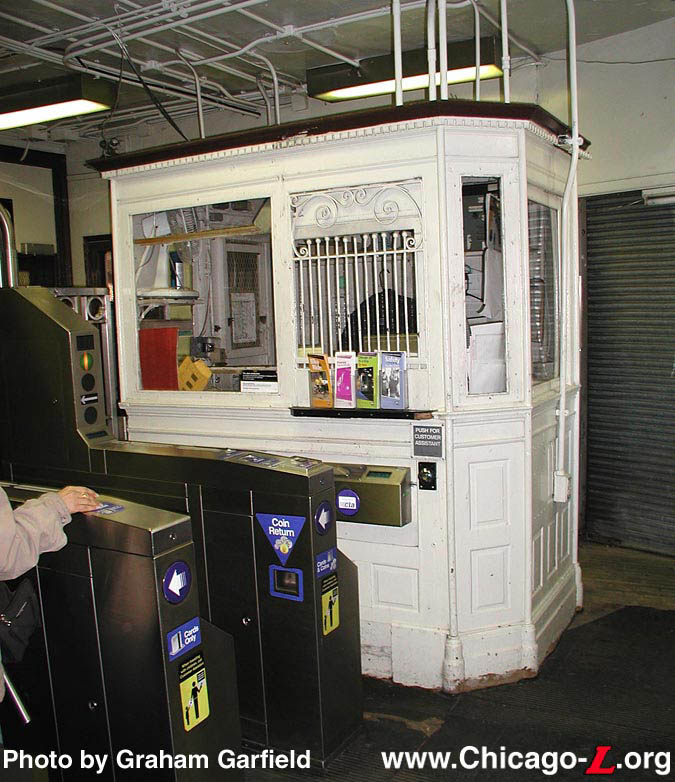
The customer assistant booth
at Diversey, seen here on May 13, 2002, is one of the few
original Northwestern Elevated ticket agent booths left. For
an enlarged view, click here.
(Photo by Graham
Garfield)
|
The dual side platforms at Diversey were covered in the center by
two peaked-roof canopies of steel supports with a gently-curved
bracket and intricate latticework, covered by a corrugated metal
roofing. Originally, these covered about half the platform length,
but the platforms were subsequently lengthened multiple times to
allow longer trains to berth. Many sections of the original platform
area retained their original railing, which consisted of tubular
railings and posts with panels of decorative, ogee patterned
metalwork inside, until the station's renovation in 2007-08. The
platform extensions had plain wooden railings. The platform at the
extreme north end of the outbound platform was noteworthy for its
extremely narrow width, such that the overhead lights had to
be turned sideways to give clearance for the trains, and the slight
curve in the tracks here that make line-of-sight difficult.
Under the initial Northwestern Elevated configuration, Diversey,
whose platforms are on the outer tracks, was a local station,
inaccessible by the expresses utilizing the inner tracks. After the
State Street
Subway opened in 1943 and the route configurations were
overhauled in 1949, Diversey became a station on the Ravenswood
Line and served only "B" trains under the A/B
skip-stop express scheme. Beginning in 1983, Diversey began
serving all trains on the route.
Brown
Line Capacity Expansion Project
By 2004, ridership had exploded on the Brown
Line -- an 79% increase since 1979 and a 27% increase since 1998
-- such that during peak periods many trains were at crush-loaded,
resulting in commuters left standing on platforms unable to board the
loaded trains, sometimes waiting as one or two trains passed before
they were physically able to board. The problem in large part was
that all Brown Line stations could only accommodate six-car trains
(with the exception of Merchandise
Mart, Chicago, Fullerton
and Belmont, which could already hold
eight-car trains), which, along with the limitations of the cab
signal system, limited the line's capacity.
As a result, the CTA decided to plan for the Brown
Line Capacity Expansion Project, the largest capital improvement
project undertaken by the CTA at the time (surpassing even the Douglas
Renovation Project, which was the largest up to that point). The
main objectives of the Brown Line Capacity Expansion Project are to
expand the line's overall ridership capacity by lengthening station
platforms to accommodate eight rather than six-car trains,
rehabilitate rail infrastructure and stations, provide for station
enhancements to meet the accessibility requirements of the Americans
with Disabilities Act (ADA), and upgrade or replace traction power,
signal and communication equipment. By far, the largest part of the
Brown Line
Capacity Expansion Project was the station renovations. Of the
Brown Line's 19 stations, only one (Merchandise
Mart) was not touched at all due to its modern construction
(1988) and ability to berth eight-car trains.
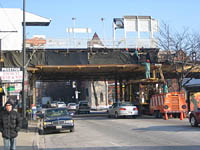
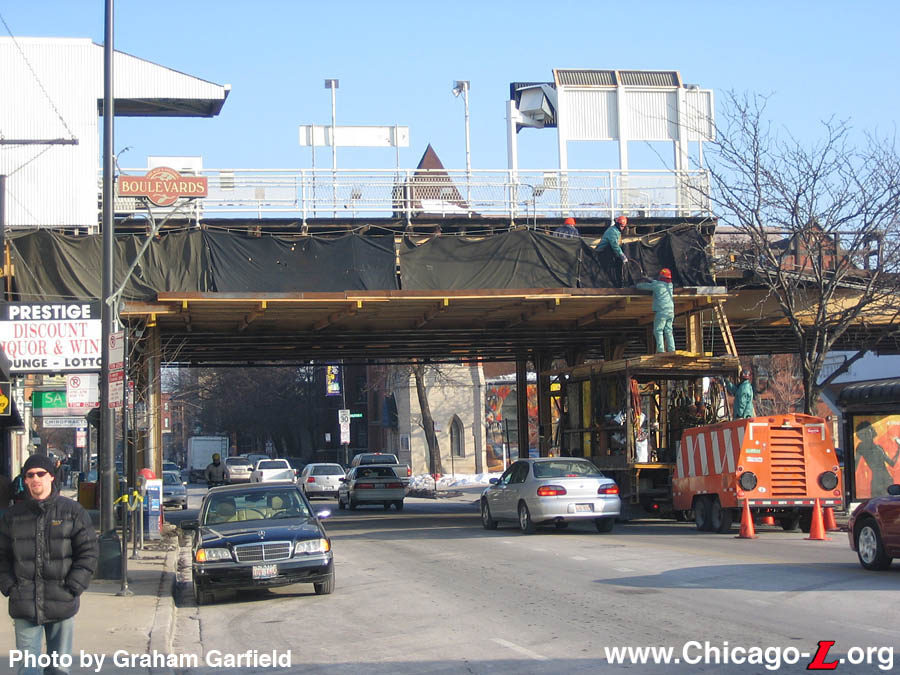
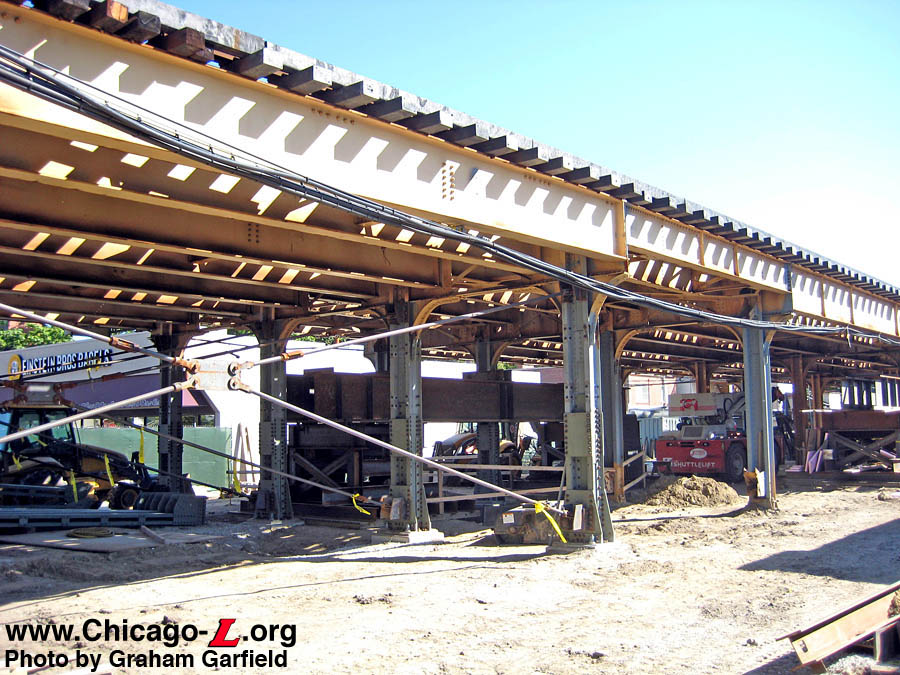
CTA maintenance workers
perform some preliminary work at Diversey, including cable
relocation and some steel rehabilitation work, in advance of
the contractor beginning work in this view looking east on
December 20, 2005. For a larger view, click here.
(Photo by Graham
Garfield)
|
On April 13, 2004, the CTA announced that it had officially received a Full Funding Grant
Agreement (FFGA) from the Federal Transit Administration (FTA).
However, in May 2004, CTA received construction bids for the project that substantially
exceeded the budget. As such, the Chicago Transit Board voted on June
9, 2004 to reorganize the project into several discrete pieces to
help attract more competitive construction bids. Station renovation
work was modified and grouped into five separate packages according
to location to help reduce the overall cost of station construction.
Diversey station was grouped with Wellington,
Southport and Paulina
-- all of which were designed by the same consultant, Teng
-- in a bid package. Station designs were also revised to reduce
costs. Most changes concentrated on non-customer areas such as
reducing the size of janitor closets, employee restrooms, electrical
rooms and communication rooms. Other areas that were studied for cost
reduction were standardizing common station elements, the use of less
expensive materials, canopy designs and coverage, and temporary
station closures to provide contractors better access to the
sites.
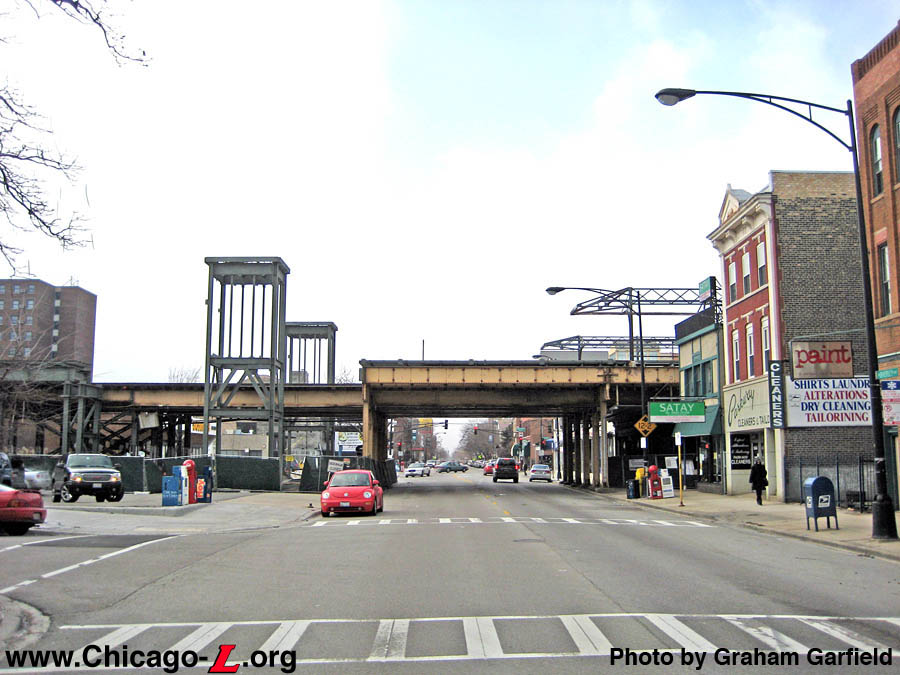
During Autumn 2005, demolition of buildings that will be in the
way of the new stations and structures was initiated at Belmont,
Diversey and Fullerton. At Diversey in late October 2005, strip
mall-type commercial buildings, which abutted the elevated structure
on the south side of the street, had roughly 25 feet of buildings
nearest the "L" demolished, and new exterior walls built on the newly
downsized structures, to allow room for the new station house.
The Paulina/Southport/Wellington/Diversey
contract was the fifth and last of the reorganized station packages
to be bid out. At the December 12, 2006 board meeting, a $66.9
million contract for the renovation of these stations was awarded to
FHP Tectonics
Corporation.
Station Design
The contract includes construction of a new, modern station house,
extension of platforms to accommodate 8-car trains, and installation
of elevators for ADA accessibility. The new expanded station facility
features more turnstiles and farecard vending machines. New, wider
stairs and elevators take customers to the boarding platforms.
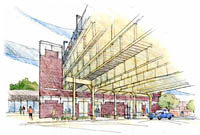
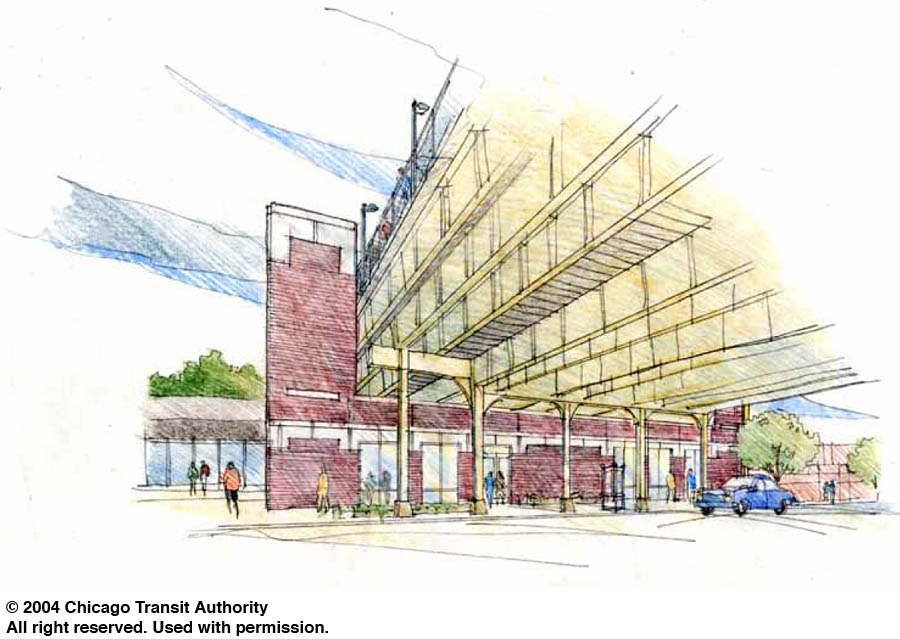
Artist's rendering of the
design for the renovated Diversey station. A new masonry
station house with glass panels, decorative masonry, and
prominent elevator towers will replace the 1900-built
entrance, although the historic station house will be
retained and restored. Brown Line-standard railings and
lights are visible at platform level above. For a larger
view, click here.
(Image provided courtesy of
the Chicago Transit Authority)
|
The new station house is located on the south side of Diversey
Parkway, on the opposite side as the old station house. The station
house is clad in brown brick with a precast concrete base and
pre-finished aluminum metal coping along the top. The front of the
station house is divided into bays, with the end bays (which form the
bottom of the elevator towers) and center bay decorated with darker
brick between the lighter toned pilasters. A glass and aluminum
storefronts occupy the three bays on either side of the center with
two doorways framing the center bay. The bays are topped with a band
of precast lintels. Dual brick-clad elevator towers, decorated with
dark brick in the center and topped with a precast cornice and
pre-finished aluminum coping, dominate the facility's massing.
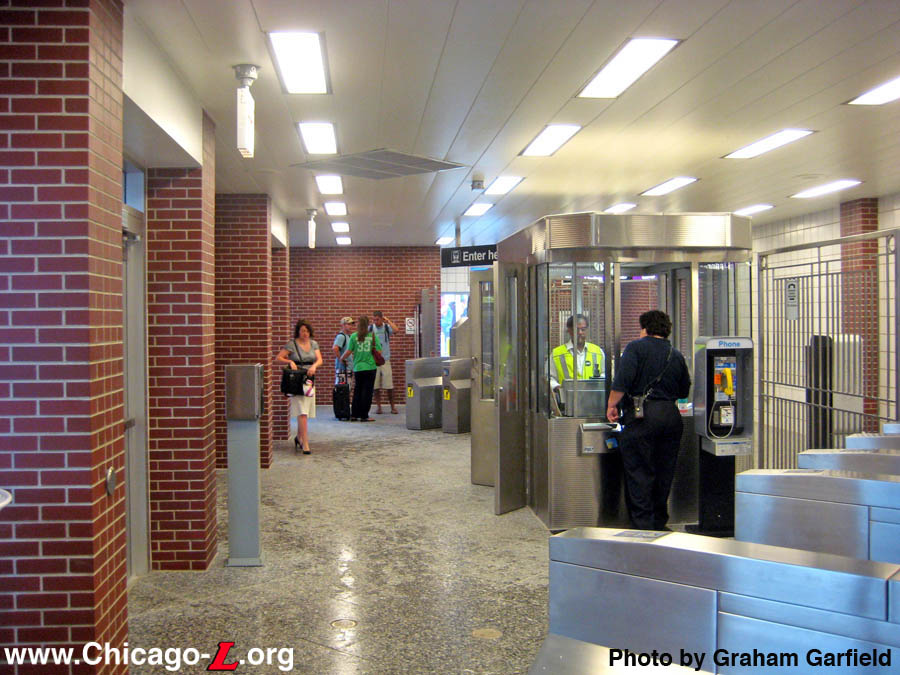
The interior has a largely open plan. A Customer Assistant booth
is located in the center, with rows of turnstiles on both sides at a
45-degree angle separating the unpaid and paid areas. The new
stainless steel CA booth, standard for the new Brown
Line stations, features stainless steel lower panels and roof and
glass panels around the sides for a high level of visibility. The
farecard vending machines are located on the north wall between the
front doors. The turnstiles are angled to be aligned with angled
corridors at each side of the paid area that lead to a set of stairs
from the paid area to each platform. The elevators to each platform
are located outboard of the stairs. The station interior walls are
clad in glazed tile in a stacked bond pattern. The stairways to the
platforms are closed in a wire mesh grille system. A bicycle parking
area is located on the west side of the unpaid area, while a
concession is located in the east side.
The dual platforms were renovated with new decking, railings,
lighting, signage, and other fixtures. The existing original,
historic canopies were retained and refurbished, stripped of decades
of paint, repainted dark brown, and topped with new corrugated metal
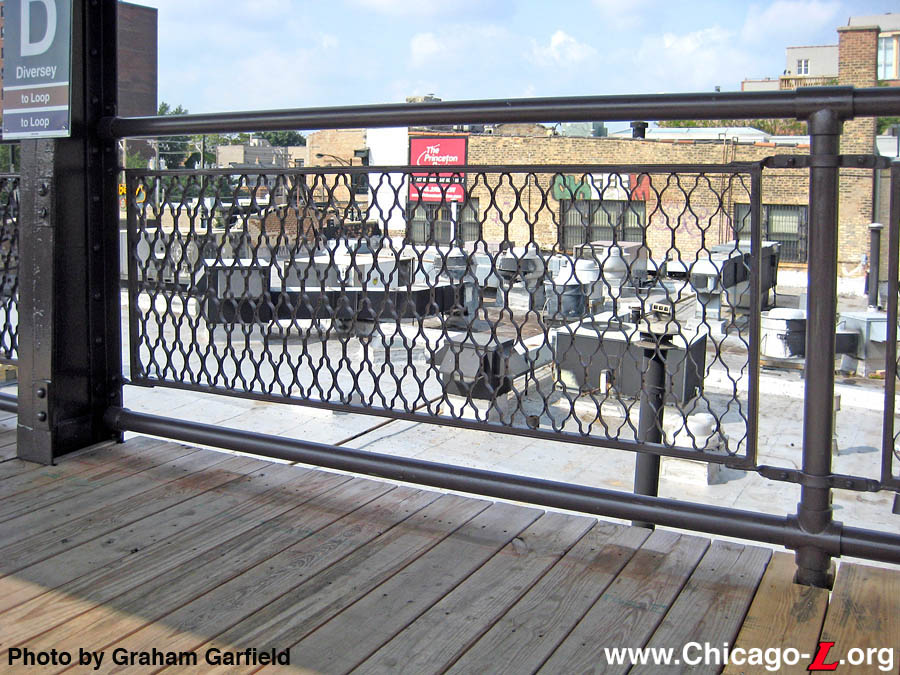
hipped roofs. The new railings are a hybrid of the standard design
for the rebuilt Brown
Line elevated stations and reproductions of the original
1900-vintage railings. The railings have thick tubular top and bottom
horizontal members like the other renovated Brown
Line stations. However, the grilles are reproductions of the
original Northwestern Elevated diamond grilles. The new railings and
light poles, as well as the other new metalwork, are hot-dipped
galvanized. Sections of the railings under the historic canopies
reuse original, historic railings, with the original plumbing pipe
tuning and refurbished original diamond grilles. These sections are
painted brown. The platform is lined with gooseneck lights. The
platforms are finished with windbreaks integrated into the railing
system, with the glass panels protected by metal grilles, benches
with sandboxes integrated into them, A/V signs suspended over the
platforms on long horizontal arms, and Transit Information
panels.
Auxiliary exits are provided to the north side of Diversey
Parkway, across from the main entrance, to allow for more egress
capacity and better connections to westbound #76 Diversey buses. The
auxiliary exits use original stairways under the historic canopies
and lead to exit rotogates to the east of the historic station
house.
Other improvements included new signage; electrical,
communications, and HVAC equipment; new customer heaters on the
platforms; and a new public announcement system.
The 1900-built historic station house has been preserved and
restored.
Station Artwork
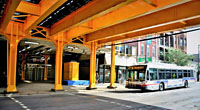
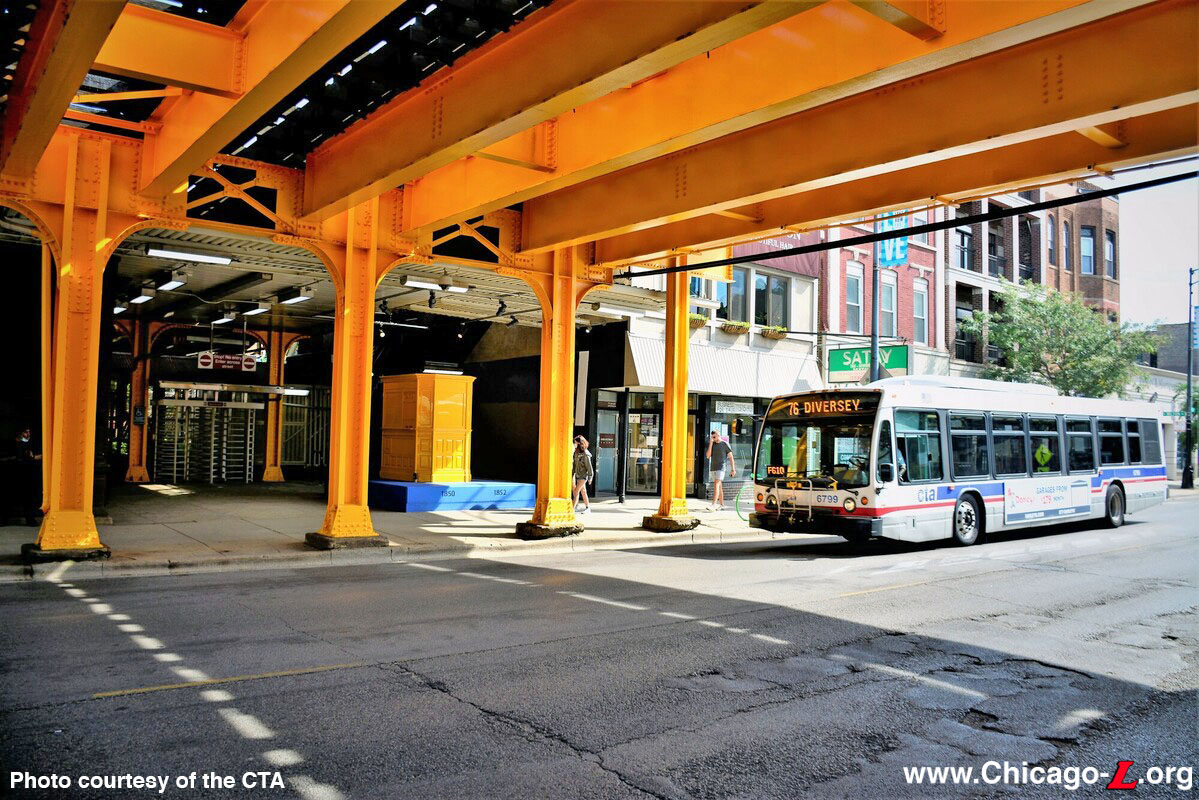
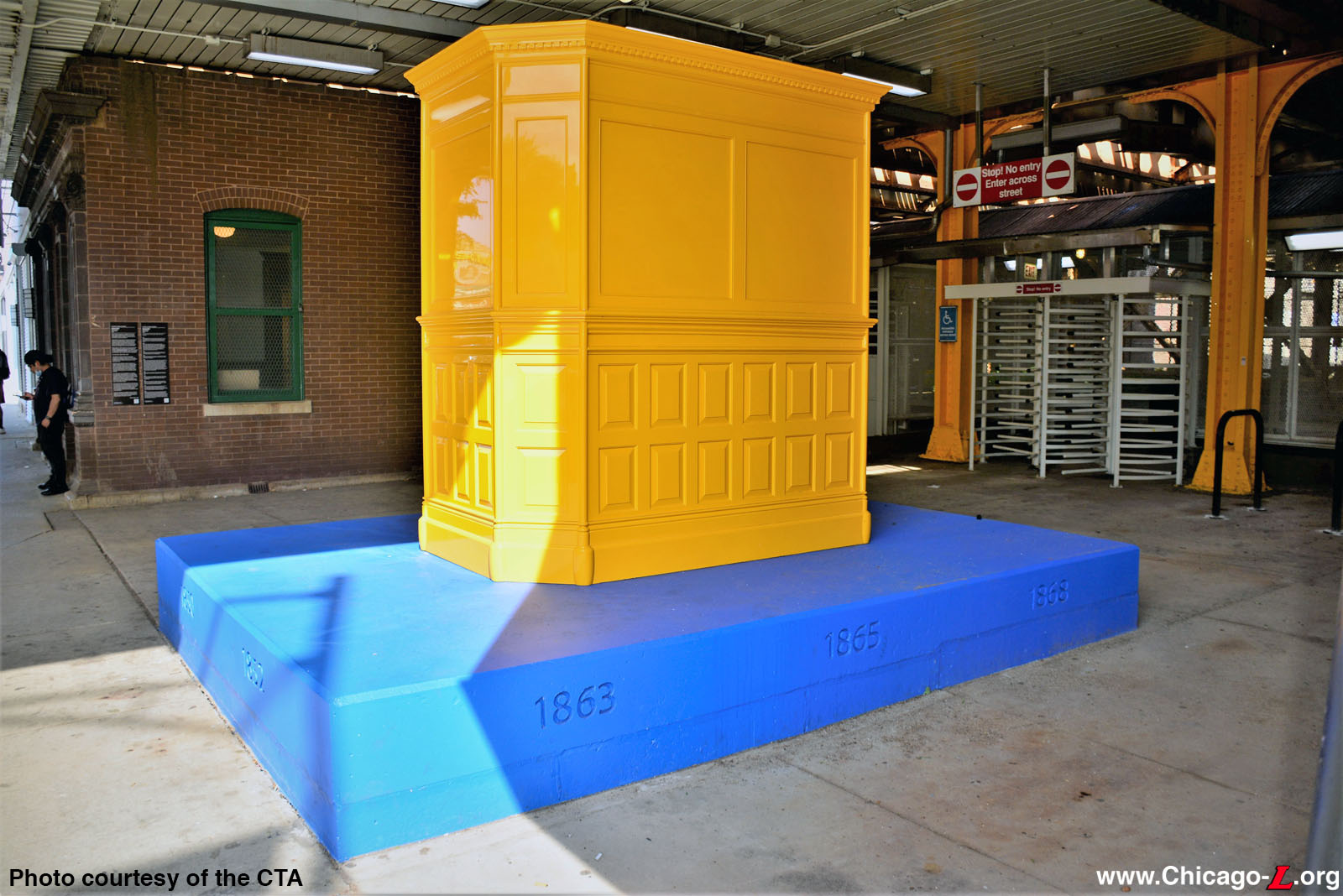
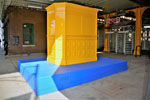
The art installation Ordinary Relic at DIversey station includes painting the elevated structure spanning the street bright yellow and a bright yellow and blue sculptural replica of the vintage ticket agent's booth from the adjacent historic station house. For a larger view, click here. (Photo courtesy of the CTA) |
CTA partnered with the City of Chicago's Department of Cultural
Affairs to install public art at the 18 stations included in the
Brown Line project. The
Diversey station featured a large-scale outdoor sculpture
entitled Arriving Home, created by international sculptor Dennis
Oppenheim that was installed in late 2008 adjacent to the north
auxiliary exit. The 10-foot high sculpture, made of steel and
polycarbonate and acrylic materials, was in the shape of a torqued
spiral which represented travel and the experience by an individual as
they approach their destination. However, the sculpture was subsquently removed after vandals broke it in late 2013. CTA said the art was permanently damaged and the "pieces that were broken were very difficult to replace." Also complicating any potential repair was the fact that Oppenheim, known for his industrial architecture, died of cancer in 2011. The CTA worked with Ald. Tom Tunney (44th) to install new artwork.4
In late summer 2020, new artwork was installed at the Diversey Brown Line station. Intended to inspire the daily act of seeing and holding history in the collective memory, Ordinary Relic is a unique, conceptual art installation that uses the bright and bold elemental colors of yellow and blue to draw attention to key elements of the art installation, which are featured throughout the facility.
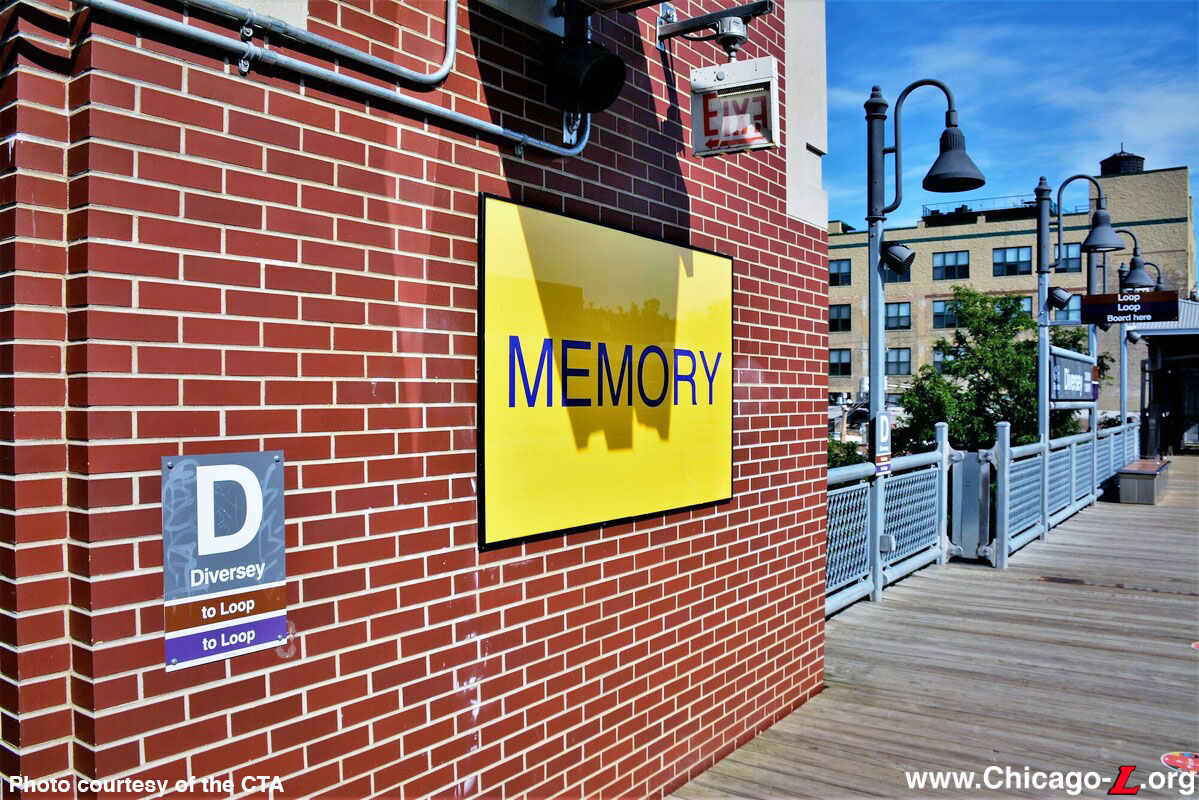
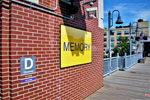
Key elements of the installation include the repainting of the existing elevated structure spanning Diversey Parkway using a bright yellow paint. Along both platforms are six message panels with the words "MEMORY" and "HISTORY" that lead toward the north stairway of the auxiliary exit. Situated outside the auxiliary exit at ground-level is a bright yellow and blue sculptural replica of the vintage ticket agent's booth from the adjacent historic station house. Embossed in the pedestal of the sculpture are 10 dates of local historic significance.
Created by Chicago artist Mathew Wilson, it is his hope that the various art pieces throughout the Diversey station will inspire travelers to celebrate the forgotten history of the city and recognize the importance of the past in creating Chicago's contemporary cultural landscape.
The collective value of the the installation and another at Montrose Blue Line installed about the same time was $200,000 and was paid for using Federal Transit Enhancement funds provided by the Federal Transit Administration (FTA).
Station Renovation Work
Construction at the Diversey and Wellington
stations is expected to last approximately 16 months, with the
stations subject to temporary closure during construction. However,
no two adjacent stations will be scheduled to close at the same time
on weekdays so customers may go to the next closest station for
service. During periods of temporary closure, customers are
encouraged to use the most convenient existing
CTA bus and rail service in
the area.
During spring 2007, contractor FHP
Tectonics and their subcontractors began preparatory work at
Diversey. Activities included elevated structure steel and foundation
renewal, lead abatement on the existing structure, and utility
relocation.
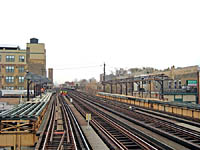
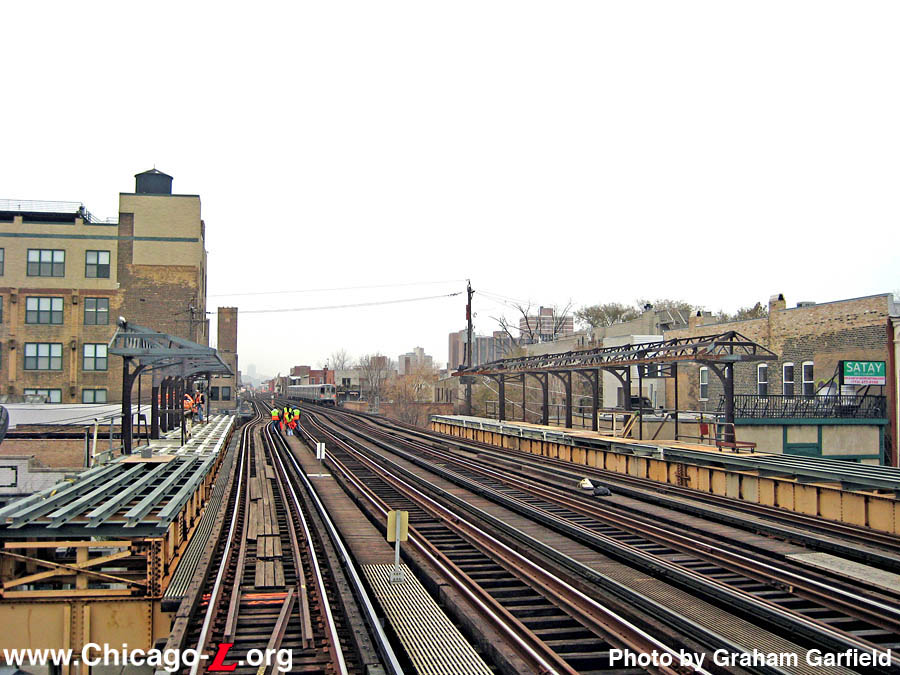
The platform decking and
canopies have been stripped, the original platform stringers
have been refurbished, and new joists have been installed at
Diversey as flagmen protect the contractors from passing
trains as they work on November 26, 2007. For a larger view,
click here.
(Photo by Graham
Garfield)
|
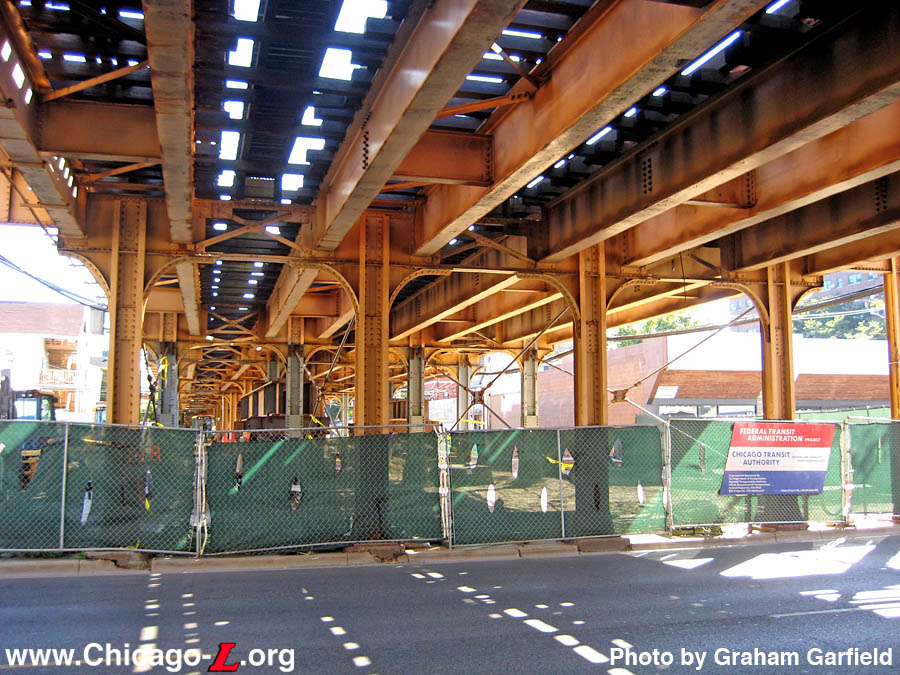
On Monday, June 25, 2007, Diversey station temporarily closed for
renovation. Diversey station will be closed for up to 12 months while
construction crews rebuild the station and make the station
accessible to customers with disabilities. The adjacent stations --
Wellington and Fullerton
-- will remain open during the temporary closure of the Diversey
station so customers may continue to use them to access Brown
Line service. Diversey station is also located in an area where
CTA service is plentiful. In
addition to nearby rail stations, there are six existing
CTA bus routes that provide
service near Diversey station on weekdays and weekends: the #8
Halsted, #11 Lincoln/Sedgwick, #22 Clark, #36 Broadway, #74 Fullerton
and the #76 Diversey.
Shortly after the station closed, work began on dismantling the
old station platforms. In July, the roofs were stripped off the
canopies and refurbishment began. The canopies were enclosed in wood
barriers and canvas enclosures to contain dust and particles as
contractors stripped the old paint off and performed lead abatement.
The enclosures also allowed the contractors to work without flagmen
protection without interfering with passing trains. After the
canopies were stripped, the metal structures were primed.
The elevated structure column bent foundation replacement work
that began in spring 2007 continued through summer and into
autumn.
Following the refurbishment of the original platform stringer
steel, new steel joists were installed on the original stringers
beginning in September and continuing through autumn. Later in
autumn, work began to install the steel stringers and supports for
the platform extensions to the south of the original steel. Steel for
the platform stringers and joists was completed in January 2008. The
steel frames for the elevator towers were installed in December
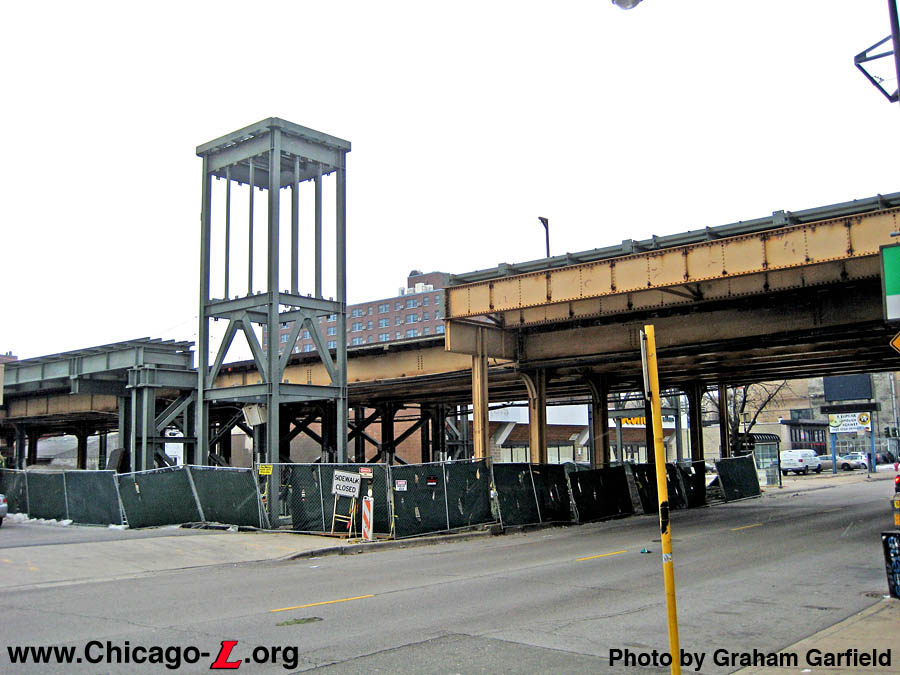
2007.
Work on the new station house structure began at the end of 2007.
The foundation for the new station house on the south side of
Diversey Parkway was installed in December 2007 and January 2008.
Erection of the steel frame for the station house began in early
January and into April 2008. By late January, work began on the new
building's roof, which was completed about a month later.
Installation of the station house Concrete Masonry Units (CMUs) and
cinder blocks began in late February and continued into early May.
Installation of the drip pan roofing over the sidewalk in front of
the station house began in early March.
In addition to work on the station house, construction of the new
platforms began in early 2008. Installation of wood platform decking
also began in January and continued into March 2008. Installation and
detailing of the new, permanent platform railings and light posts
began in early March but continued for several months. The first
sections were installed over the street during a weekend street
closure on March 8-9. New corrugated roofing was installed on the
historic canopy structures during late February and early March.
|
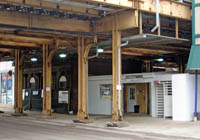
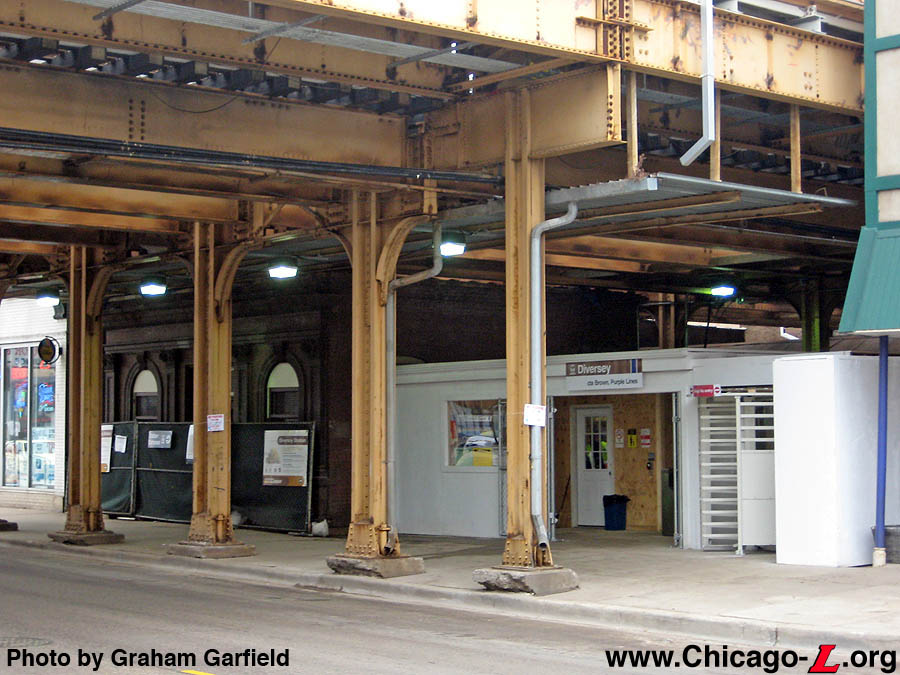
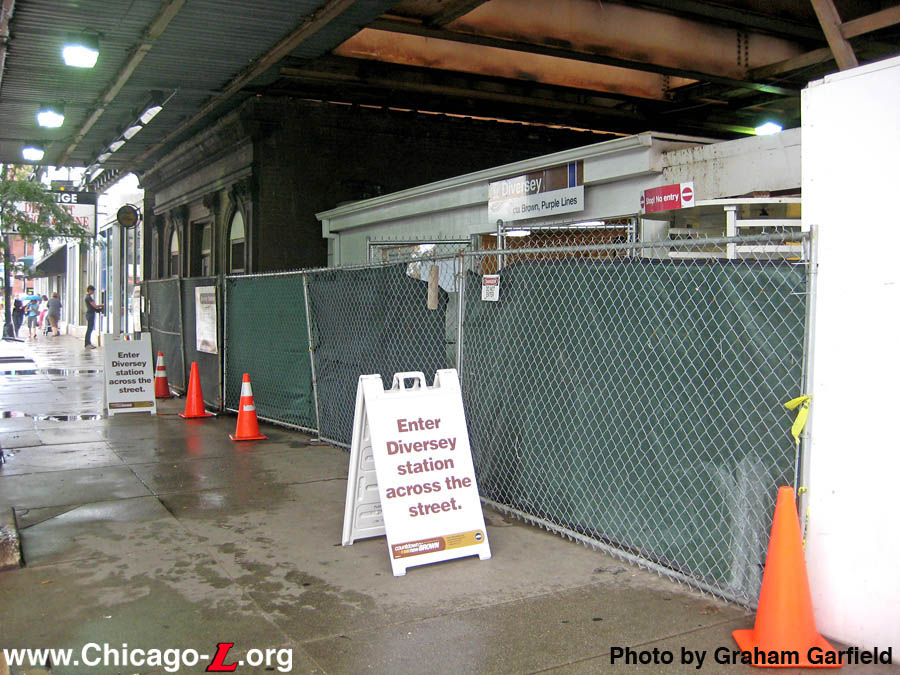
The Neo-Classical features of the 1900-built brick and terra cotta are juxtaposed with the simple wood-frame, plywood-clad temporary entrance at Diversey station, seen looking northwest on March 30, 2008. For an larger view, click here. (Photo by Graham Garfield)
|
In order to allow the second phase of Three-Track operation at
Belmont and Fullerton to begin -- reopening the second rebuilt
northbound track at each station and closing the first southbound
track -- it was decided to begin 8-car service on the Brown
Line. To do this, the last of the 6-car platform stations,
Paulina and Wellington,
had to close. Southport was already
scheduled to reopen and Paulina to close
on March 30, 2008, but Wellington was
not scheduled to close until late spring or early summer when
Diversey was scheduled to be completed. Instead, it was decided to
reopen Diversey early so that Wellington
could close and 8-car service could begin. To allow Diversey's early
reopening, a temporary wooden station house was constructed at street
level immediately east of the historic station house, across the
street from the new entrance under construction. The temporary
station house was a simple wood frame structure with plywood walls
and a flat, slanted roof. Inside, a Customer Assistant booth was
built-in in the northwest corner of the interior as a room with
windows and a door to interact with customers. The foundation for the
temporary station house was laid the week of March 9, with the wooden
building assembled the week of March 16. Meanwhile, the south halves
of the original stairs were restored to usable condition during
mid-March (the north halves having been removed, per the ultimate
plan for the auxiliary exits). The platforms were sufficiently
completed for the station to reopen, with temporary railings and
lights along the platforms and sufficient signage for customer use.
The station reopened, with access through the temporary entrance, on
March 30, 2008.
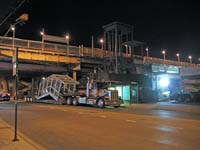
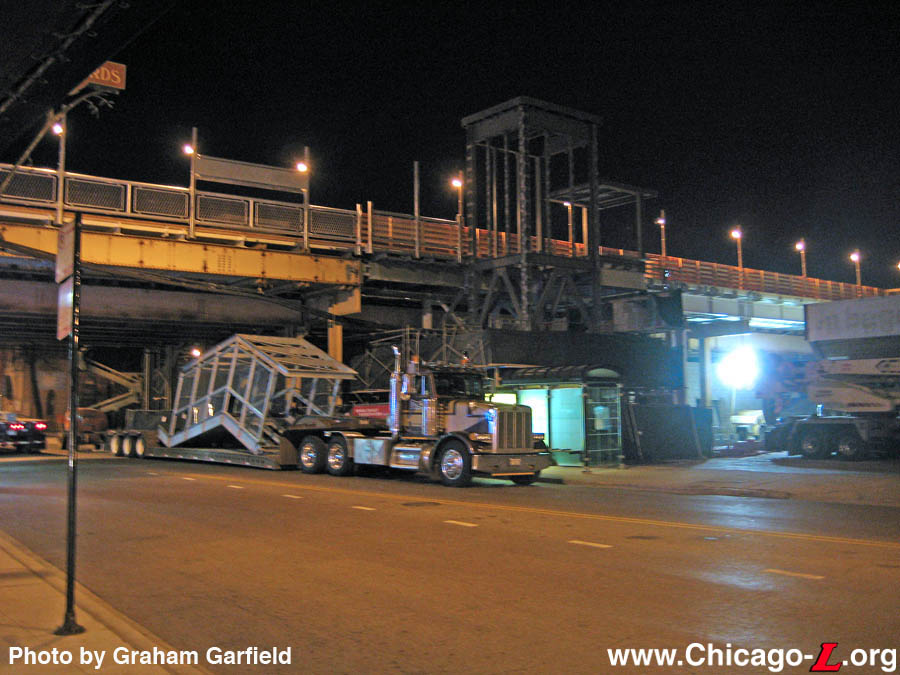
The pre-assembled stairway to the northbound platform is delivered by flatbed truck the night of April 23, 2008. It would be lifted into place by crane, then secured and detailed over the following weeks. For a larger view, click here. (Photo by Graham Garfield) |
Following the reopening of Diversey station, work continued on the
rest of the permanent facility. The pre-assembled permanent stairs
from the new station house to each platform were lifted into place in
April 2008, with the southbound installed in early April and the
northbound installed in late April. The two stairs were detailed, with
the roofing, mesh grilles on the sides, and other fittings installed,
from late April through May. Steel windbreaks were installed on the
platforms during May, as were light fixtures and speakers, starting
with the northbound platform.
Construction of the new station house, inside and out, continued
during this period as well. Face brick was installed on the exterior
of the station house and elevator towers during May 2008. The
elevator cabs and equipment was installed from May through late
July.
Restoration of the historic station house, including the exterior
brick and masonry, began in April 2008 and continued into the summer.
The roof was removed and a new one installed during July.
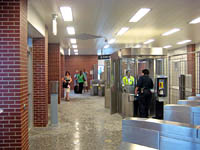
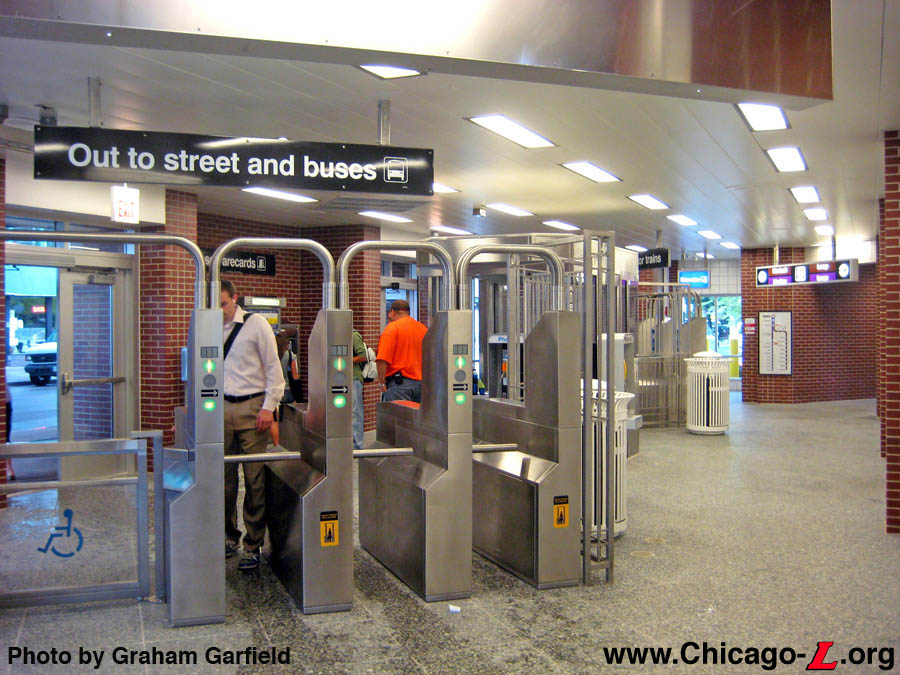
The interior of the newly-opened Diversey station is seen looking east in the unpaid area on August 4, 2008. The farecard vending machines are recessed between the doorways on the left. Two sets of angled turnstiles flanking the central CA booth provide efficient circulation to the platforms. For a larger view, click here. (Photo by Graham Garfield) |
Contractor crews spent June and July finishing the details of the
new facility. During this period the sidewalk in front of the station
was demolished and fittings like the Customer Assistant booth, fare
control barriers, bike racks, and signage were installed inside the
station house. During early and mid-July, brick flower islands were
installed, a new sidewalk was poured, and a compass rose installed in
front of the new station house. A few days before the new entrance
opened, the stainless steel Transit Information Panels were installed
on both platforms.
The main station entrance at Diversey opened at
5am, Monday, August 4, 2008. Upon the new main entrance opening, the
elevators came into use and Diversey became the 84th of the CTA's 144
station to become accessible, with other ADA-compliant features
including an accessible turnstile, tactile platform edging, gap
fillers, TTY telephones and Braille signs. At the same time, the
temporary entrance located on the north side of Diversey Parkway was
closed and subsequently dismantled in the weeks after. The stairways
down to the north side of Diversey were closed at the same time to
allow for the installation of rotogates and conversion of the stairs
into auxiliary exits.
On August 7, 2008, CTA President Ron Huberman was
joined by elected officials, including State Representative John
Fritchey and State Representative Sara Feigenholtz, to commemorate
the opening of the newly renovated Diversey Brown Line station
house.
Work on the station continued after reopening. Acoustical panels to absorb some of the train noise were installed between December 2008 and February 2009 underneath the platforms, next to the tracks. Renovation of the historic station house was ongoing into September 2009. The auxiliary exit on the north side of Diversey Parkway opened at 2pm, Monday, April 20, 2009, following the installation of exit rotogates, signage, and other elements.
The project's Full Funding Grant Agreement with the federal
government requires that the CTA complete the project by the end of
2009.
In late January 2012, contractor Paul Borg Construction installed mesh grille panels above the railings around the auxiliary exit on the northbound platform to prevent the public from accessing the roof top of the building immediately adjacent to the platform.
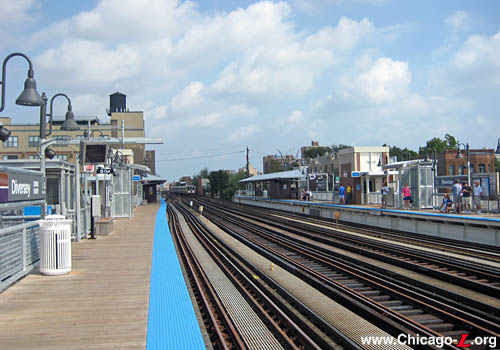
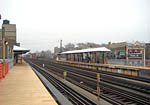
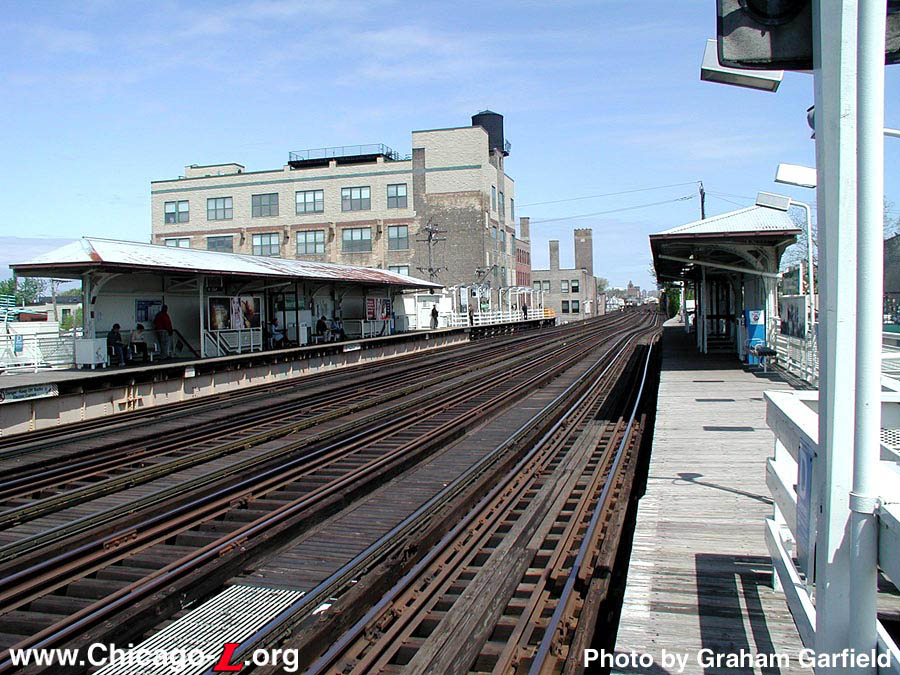
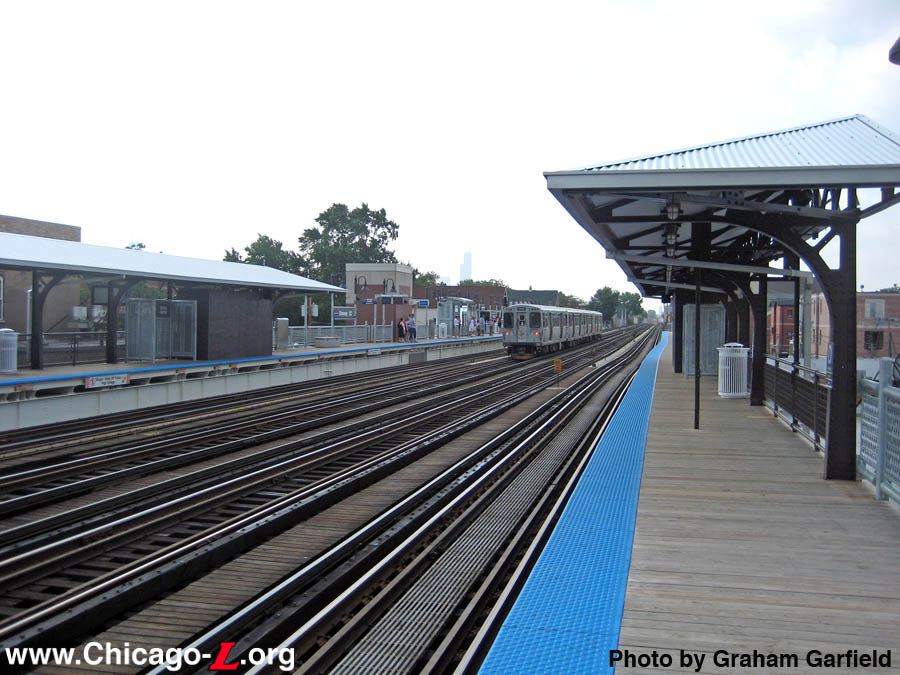
The platforms at Diversey
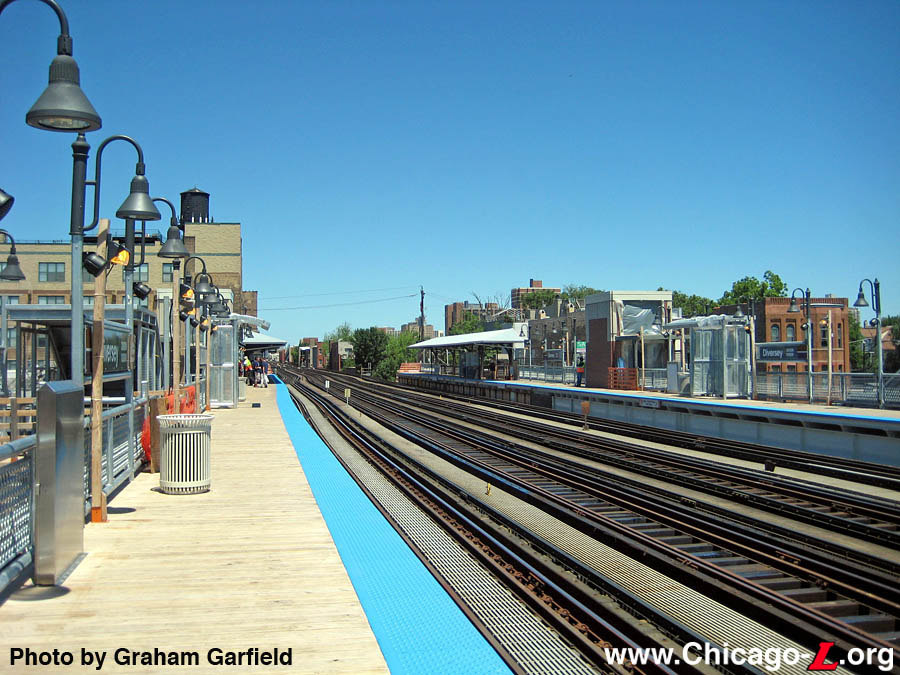
station, seen here looking north on August 23, 2008. The pair of original peaked-roof canopies, visible in the background, have been
refurbished, including new roofing and lights. In the foreground are the platform extensions, featuring new
lights, windbreaks, and railings. For a larger
view, click here.
(Photo by Graham
Garfield)
|
 Old Diversey
(1900-2007) |
New Diversey
(2005-present)
Old Diversey
(1900-2007) |
New Diversey
(2005-present)
Old Diversey
station
|
diversey02.jpg
(179k)
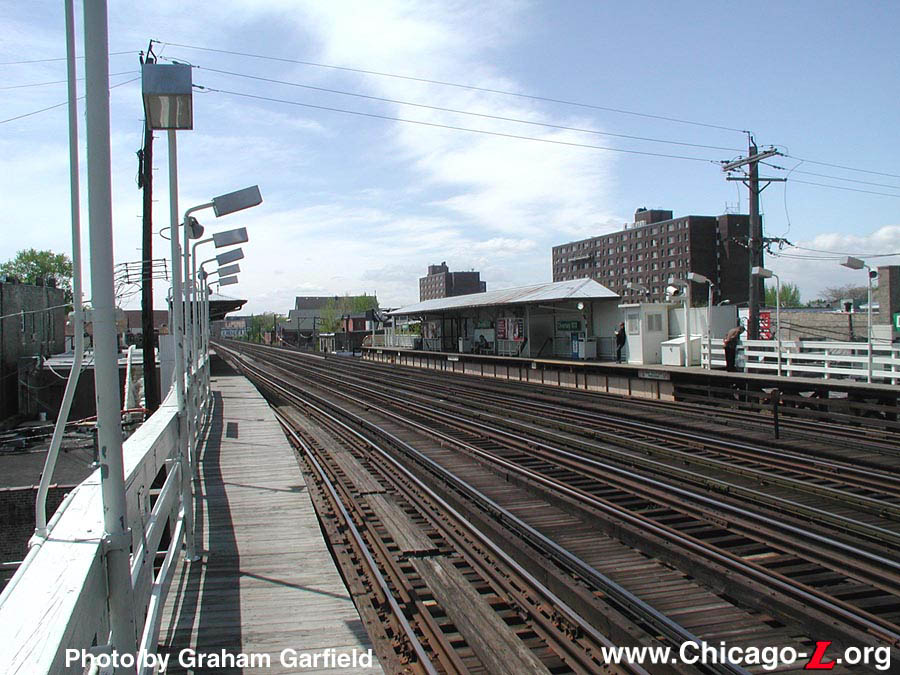
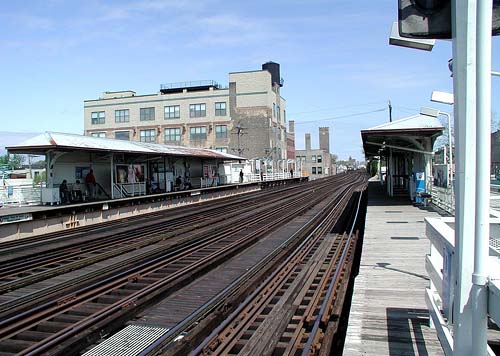
The platforms at Diversey station, seen here looking north
on May 13, 2002, had many of their historic elements still
in place at that time. These included the pair of
peaked-roof canopies, as well as a fair amount of original
railing structure. (Photo by Graham
Garfield)
|
|
diversey03.jpg
(155k)
The platform at the extreme north end of the outbound
platform, seen here looking south on May 13, 2002, is
noteworthy for its narrow width (note that the overhead
lights to be turned sideways to give clearance for the
trains) and the slight curve in the tracks here that make
line-of-sight difficult. (Photo by Graham
Garfield)
|
|
diversey09.jpg
(165k)
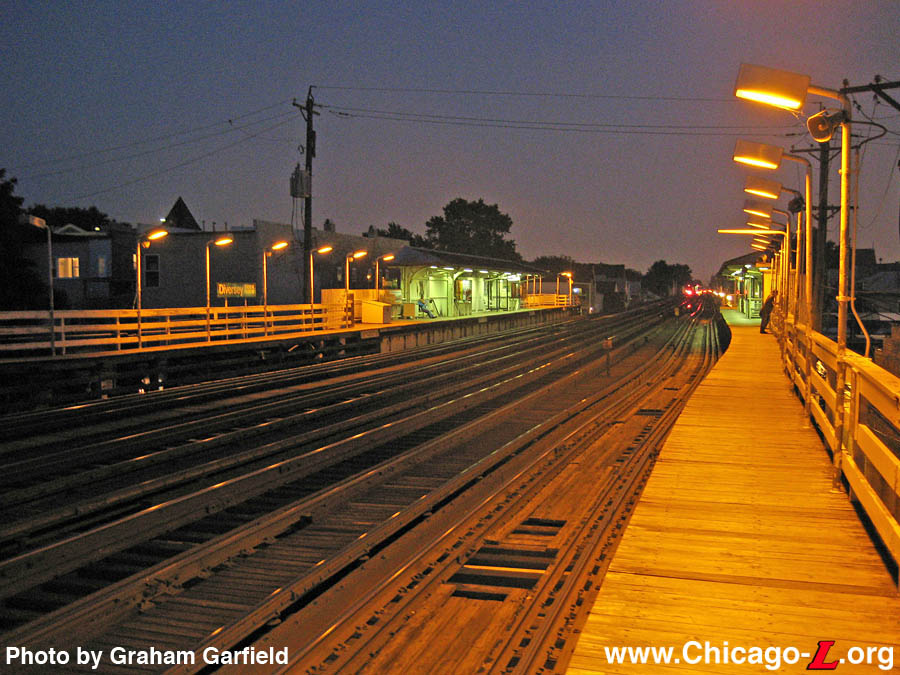
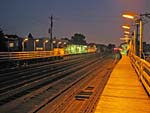
The Diversey station platforms are bathed in the orange glow
of their sodium vapor lights on their last night of service
before being closed for renovation, looking south on the
inbound platform on June 24, 2007. The curve in the
platform, which represented a problem for one-person train
operation, would be eliminated in the new station.
(Photo by Graham Garfield)
|
New Diversey
station
|
diversey05.jpg
(199k)
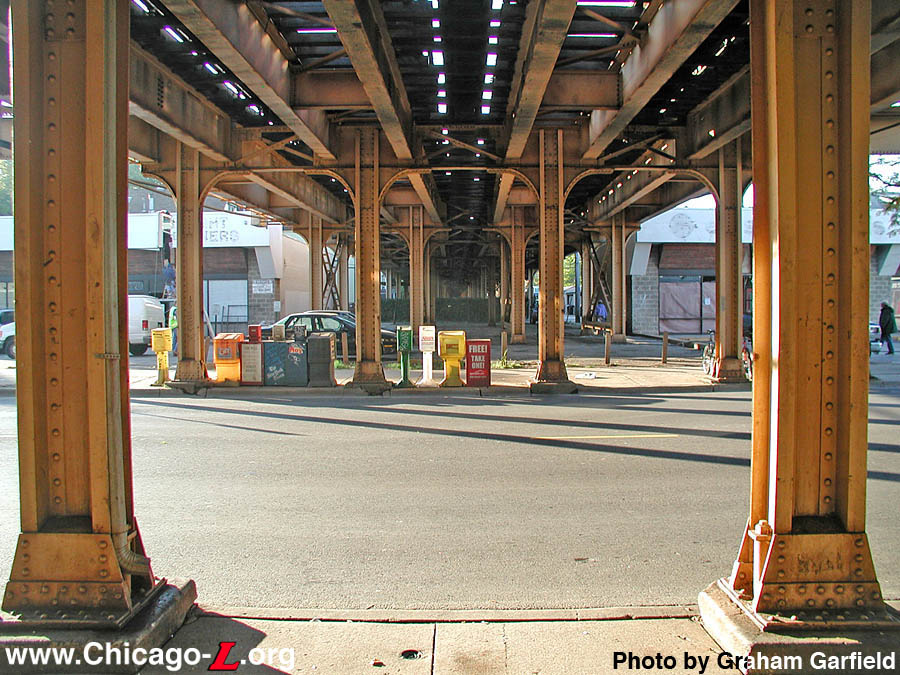
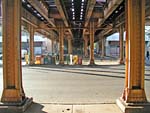
For over 100 years, the land across from the Diversey
station house underneath the elevated structure has simply
been empty land, seen looking south from the station house
doorway in this October 28, 2005 view. Soon after, a new,
modern station house would be built there to compliment the
original, historic station house. (Photo by
Graham Garfield)
|
|
diversey06.jpg
(170k)
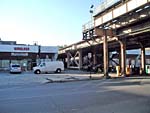
The new Diversey station facility would require more room
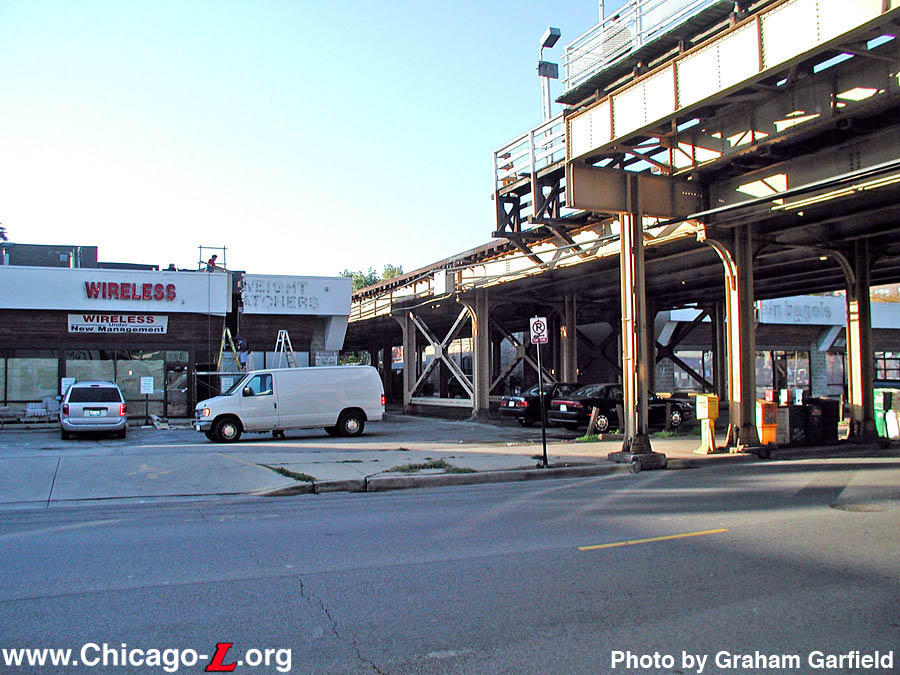
than was available underneath the elevated structure.
However, there were commercial strip mall-type buildings on
either side of the tracks. But rather than buy and condemn
the entire buildings, the
CTA bought only a
portion and only the bays closest to the
CTA right-of-way were
moved. In this October 28, 2005 morning view, crews are
literally cutting the building in two. By the next day, the
section closest to the structure was gone, with a new side
wall enclosing the building. The same thing was repeated on
the building on the other side of the elevated structure.
(Photo by Graham Garfield)
|
|
diversey10.jpg
(202k)
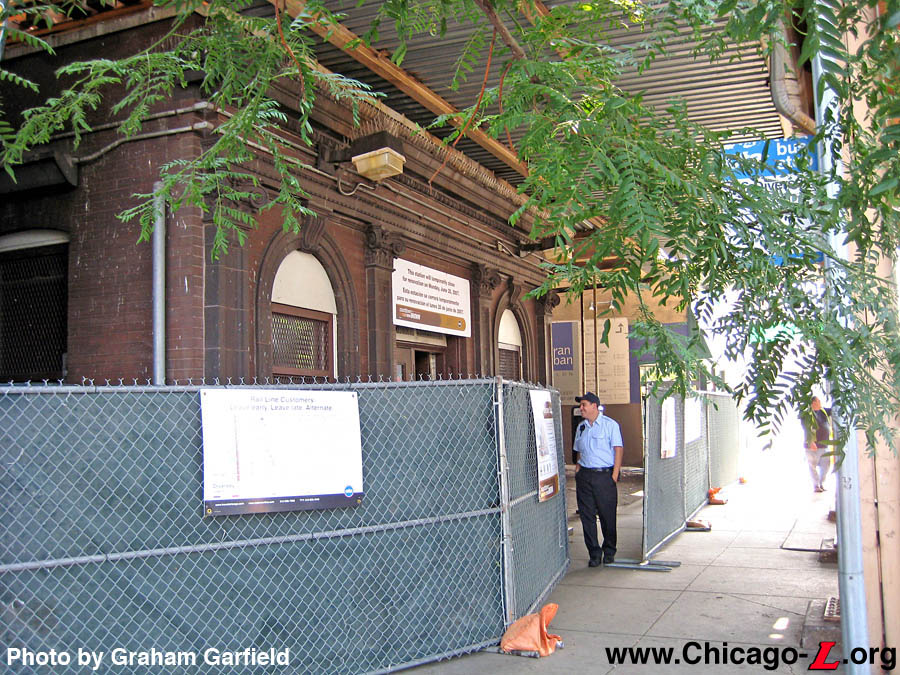
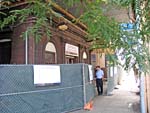
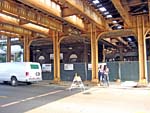
The Diversey station has been closed just a few hours in
this June 25, 2007 view looking east. Signs on the station
inform customers of the closure and provide alternate travel
information. To provide additional assistance, a Customer
Assistant has been assigned to the station for the first few
days to provide information and answer questions. The
construction fencing prevents entry into the station and
protects passersby from the work that would soon begin.
(Photo by Graham Garfield)
|
|
diversey11.jpg
(196k)
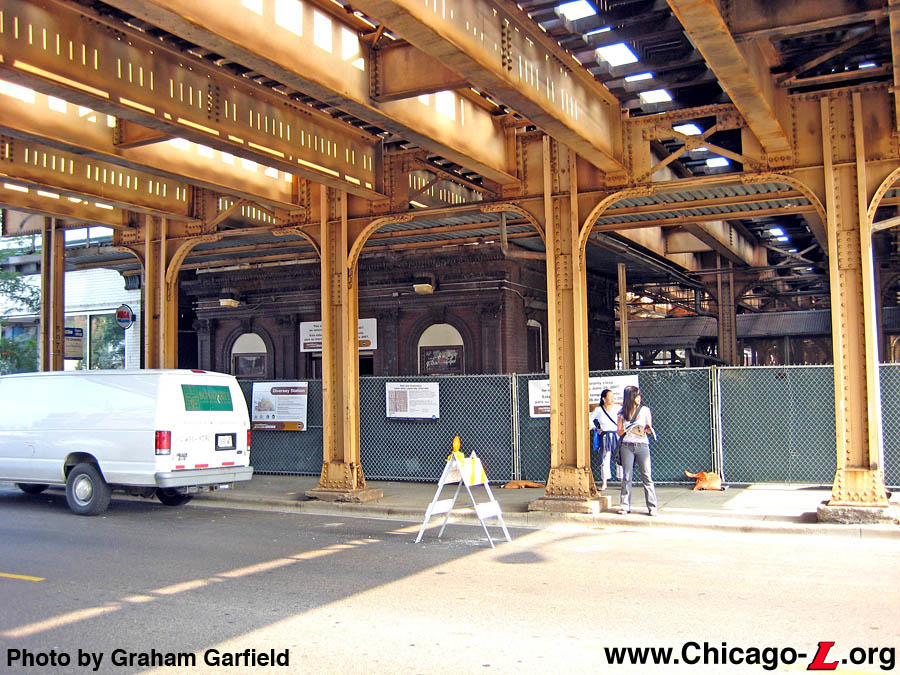
The closed Diversey station house peaks out from behind the
green canvas-covered construction fencing that barricades
the recently closed facility in this June 25, 2007 view
looking north. (Photo by Graham
Garfield)
|
|
diversey12.jpg
(196k)
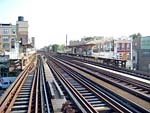
The Diversey station has been closed one day in this view of
the platforms looking north on June 26, 2007. Sandwich
boards on the platforms remind rail operators:
"STATION CLOSED". Soon, the platforms
and canopies would be dismantled. (Photo by
Graham Garfield)
|
|
diversey13.jpg
(179k)
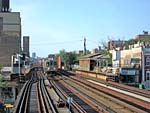
Work has begun to dismantle the platforms and canopies in
this July 22, 2007 view of Diversey station looking north.
The wood and canvas structure around the northbound canopy
on the right protects workers performing lead abatement and
paint removal work. (Photo by Graham
Garfield)
|
|
diversey14.jpg
(183k)
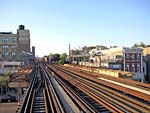
By the time of this August 12, 2007 view looking north, the
platform deck and old wooden joists have been removed and
the canopies have been stripped on both platforms at
Diversey. Once the platforms are stripped down to their
basic steel structure, the old steel stringers are
refurbished and new buildout will be installed.
(Photo by Graham Garfield)
|
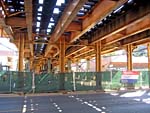
|
diversey15.jpg
(194k)
Work continues on the north side of Diversey Parkway, the
future location of the new station house, in this September
23, 2007 view looking south. Most work centers around
utility work, refurbishment of the steel elevated structure,
and replacement of column foundations.
(Photo by Graham Garfield)
|
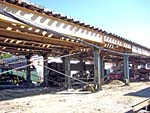
|
diversey16.jpg
(199k)
Work to rehabilitate the steel elevated structure columns
and column foundations is evident in this September 23, 2007
view looking southeast. This site is the future location of
the new station house and the steelwork must be refurbished
in advance of the station house construction because the
columns will be within the building once is it erected.
(Photo by Graham Garfield)
|
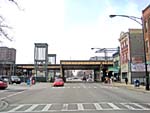
|
diversey18.jpg
(142k)
The old will soon meet the new in this view of Diversey
station under construction looking west on December 23,
2007. The steel frames for the dual elevator towers have
been erected and the new steel stringers for the platform
extensions are visible on the left. The refurbished steel of
the original 1900-built platforms and canopies are visible
on the right. (Photo by Graham
Garfield)
|
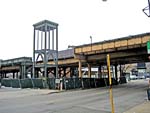
|
diversey19.jpg
(141k)
The Diversey station is under construction in this December
23, 2007 view looking southwest at the future location of
the new station house. The elevator tower structures are in
place and the steel for the platforms is in place except for
immediately around the elevator towers. This section would
soon be filled in, bridging the old platform steel stringers
to the new ones. Soon, erection of the steel frame for the
new station house would begin. (Photo by
Graham Garfield)
|
|
diversey21.jpg (152k)
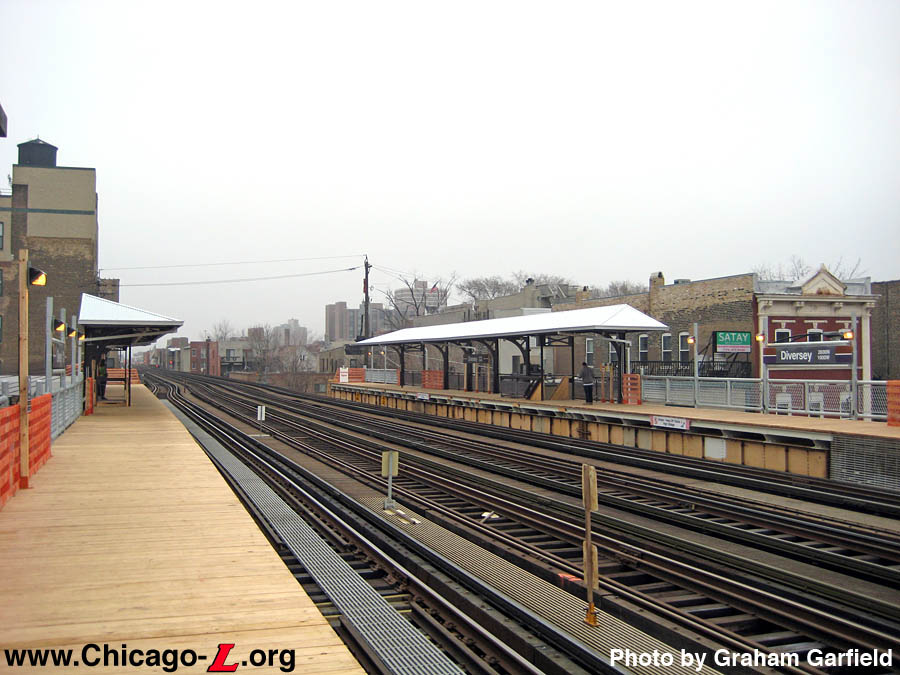
The platforms at Diversey station, seen here looking north on March 30, 2008, are part way through their renovation with some features largely completed, while others are replaced by temporary fixtures. The pair of original peaked-roof canopies have been refurbished, including new roofing and lights. The platform lights and railings are largely temporary. (Photo by Graham Garfield) |
|
diversey23.jpg (232k)
The Diversey platforms are nearing completion, seen in this view looking north from the inbound platform on June 28, 2008. The permanent railings and lights are installed, although the temporary lights are still in use. The windbreaks have been recently installed -- the plastic wrapping is still on their roofs -- while the installation of the elevator cabs and equipment continue. (Photo by Graham Garfield) |
|
diversey24.jpg (244k)
Contractors are working to put finishing touches on the new Diversey station in this view looking southwest on July 15, 2008, including building brick flower islands along the line of elevated structure columns along the curb and installing sidewalk pavers in front of the station. (Photo by Graham Garfield) |
|
diversey25.jpg (236k)
On August 4, 2008, the new Diversey station house opened and the temporary entrance across the street closed. Fencing, signage and CTA personnel greeted commuters that morning in front of the closed entrance to direct them across the street to the shiny new facility. The temporary wood-frame station entrance was disassembled a few days later and work continued on the restoration of the historic station house next door. (Photo by Graham Garfield) |
|
diversey27.jpg (220k)
This opening day view inside the Diversey station house on August 4, 2008, looking northeast from the paid area, shows the arrangement of the interior. The Customer Assistant booth is centrally located, with banks of turnstiles on either side, angled to provide a direct flow to the stairs to each platform. The farecard vending machines are located between the entrance doorways, recessed back. Elevators to the platforms are located next to the stair corridors.(Photo by Graham Garfield) |
|
diversey28.jpg (228k)
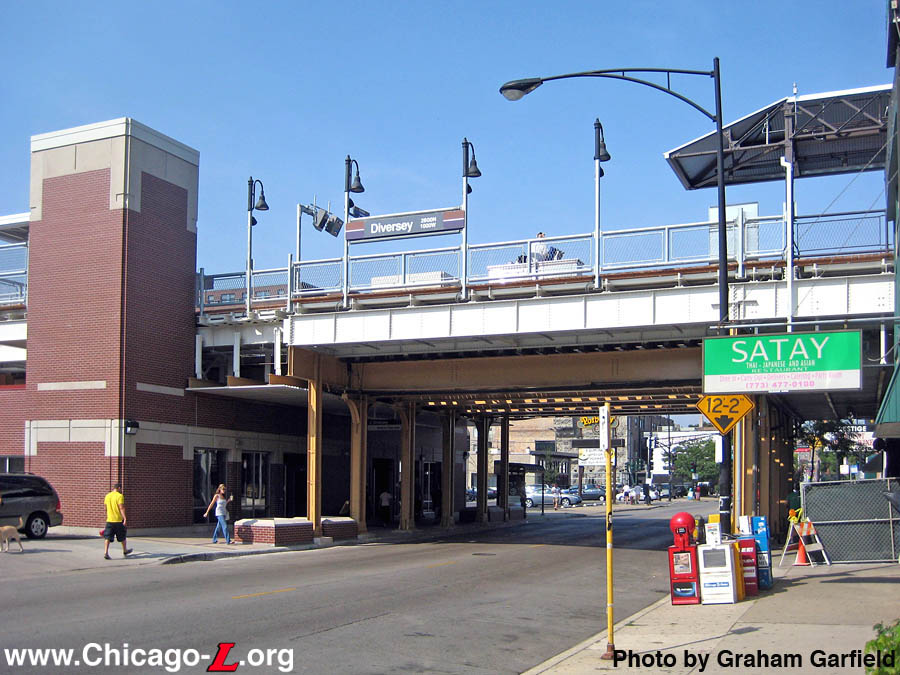
The new Diversey station is seen looking west on August 23, 2008. The new, accessible station house on the south side of Diversey Parkway is seen on the left, while the soon-to-be-demolished temporary entrance and the under-restoration historic station house are out of view behind the construction fencing on the right. The historic platform canopy peaks out from the streetwall in the upper right corner. (Photo by Graham Garfield) |
|
diversey30.jpg (240k)
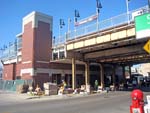
Diversey station is seen looking south on August 23, 2008. Planters line the curbline in front of the station, faced with the same brick as the station house, while a low planter is located between the two entrance door bays. The eastbound #76 bus stop is immediately west of the station house. (Photo by Graham Garfield) |
|
diversey31.jpg (228k)
The afternoon sun filters through the railroad ties and steel stringers of the elevated structure, while below an eastbound #76 Diversey bus picks up customers transferring from Diversey station on August 23, 2008. With exits on both sides of Diversey Parkway, the rebuilt Brown Line station provides easy transfers from rail to bus services. (Photo by Graham Garfield) |
|
diversey34.jpg (228k)
The north end of Diversey station, with its restored historic canopies, is seen looking north on August 23, 2008. The exit stairs under canopies are encased in plywood while the auxiliary exit on the north side of Diversey is built. Completion of this part of the station was delayed by the continued use of the north side as a temporary entrance while the new south entrance was built. (Photo by Graham Garfield) |
|
diversey35.jpg (204k)
The details of the renovated historic canopies can be seen in this August 23, 2008 view looking south. The original steelwork was rehabbed in place. A new corrugated metal hipped roof was installed while incandescent lights line the edge of the canopy. (To protect the lights, grilles were installed over them. Originally, the lights would have been a row of naked bulbs.) Note the split canopy supports in the second bay on the right where a set of stairs used to ascend to the platform, as well as the change in railing type on the right. The train passing the station is a southbound Brown Line train: trains were rerouted for construction at another location and are bypassing Diversey southbound at the time of the photo. (Photo by Graham Garfield) |
|
diversey36.jpg (260k)
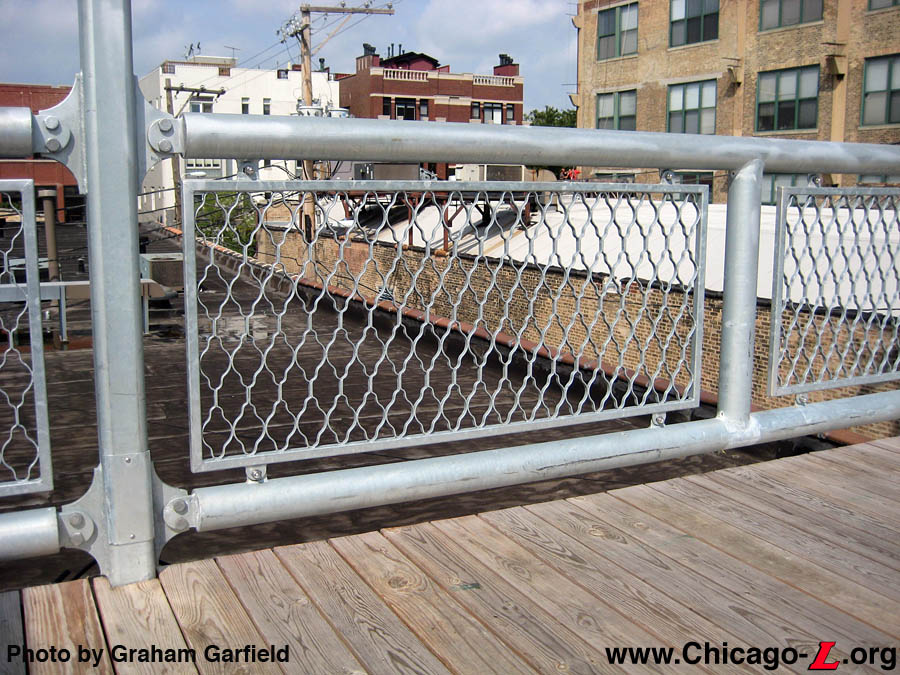
Vintage Northwestern Elevated-type railings and grilles from the station's original 1900 construction were preserved and restored underneath the historic canopy. This section of the southbound platform is seen on August 23, 2008. The NWERR's railings used plumbing pipe for the framework and had distinctive grilles with a diamond pattern connected to the railing posts with twisted metal straps. (Photo by Graham Garfield) |
|
diversey37.jpg (268k)
On the sections of the platforms with new railings, the architect provided a nod to the station's heritage by designing grilles with a reproduction of the NWERR's diamond-pattern grilles but set them within the framework of the large tubular steel railings that are standard at the rebuilt Brown Line stations. They are executed in hot-dipped galvanized metal, like other Brown Line's railings, which further help delineate the new sections from the original, authentic historic elements, which are painted brown. This portion is at the north end of the southbound platform on August 23, 2008. (Photo by Graham Garfield) |
 |
diversey39.jpg (306k)
Ordinary Relic, a unique, conceptual art installation at Diversey that uses the bright and bold elemental colors of yellow and blue to draw attention to key elements of the art installation, includes a bright yellow and blue sculptural replica of the vintage ticket agent’s booth from the adjacent historic station house. Embossed in the pedestal of the sculpture are 10 dates of local historic significance. (Photo courtesy of the CTA) |
 |
diversey40.jpg (355k)
Intended to inspire the daily act of seeing and holding history in the collective memory, Diversey art installation Ordinary Relic includes six message panels along both platforms with the words “MEMORY” and “HISTORY” leading toward the north stairway of the auxiliary exit. This panel is on the face of the elevator tower on the Loop-bound platform. (Photo courtesy of the CTA) |

- Diversey.wav
(33k): "This is Diversey." (Sound
courtesy of Tony Coppoletta)
.
- Diversey_Purple.wav
(120k): "This is Diversey. This is a Purple Line
Express." (Sound
courtesy of Tony Coppoletta)
Notes:
1. "ENDS STRIKE ON NEW "L"." Chicago Daily Tribune, 8 May 1900: 1.
2. "BOYS MEDDLE WITH “L” TRACK." Chicago Daily Tribune, 7 June 1900: 12.
3
. Bach and Wolfson, A Guide to Chicago's Train
Stations: 222.
4. Swartz, Tracy, "CTA plans to replace vandalized artwork at Diversey stop", Red Eye, 5 August 2014.