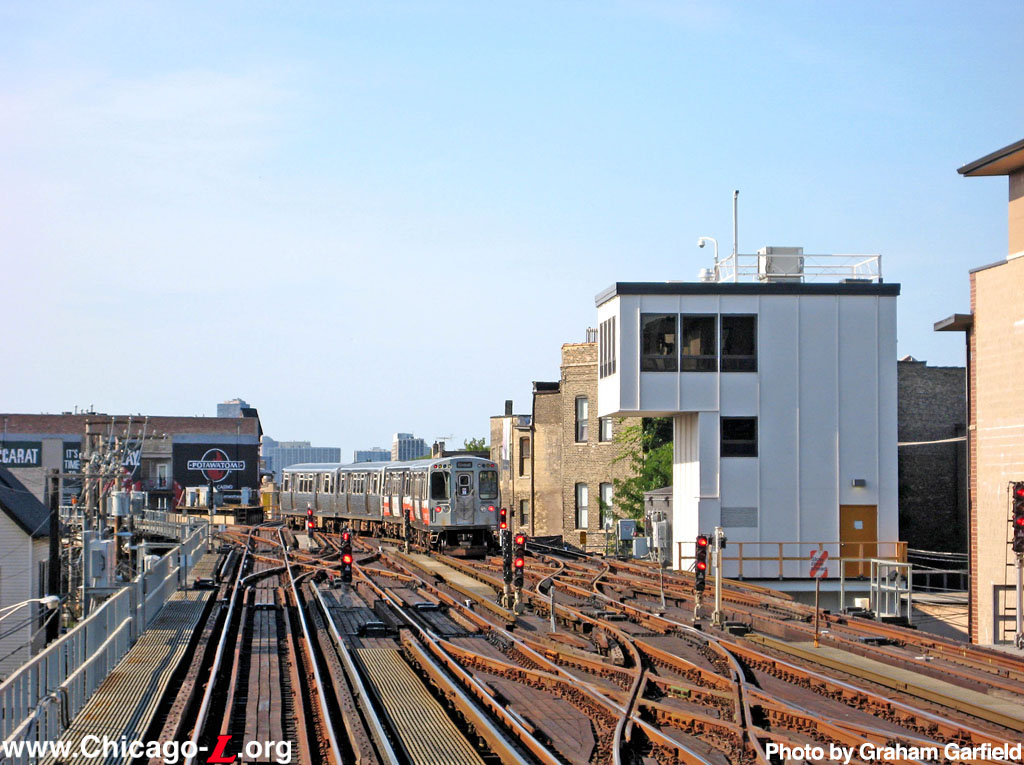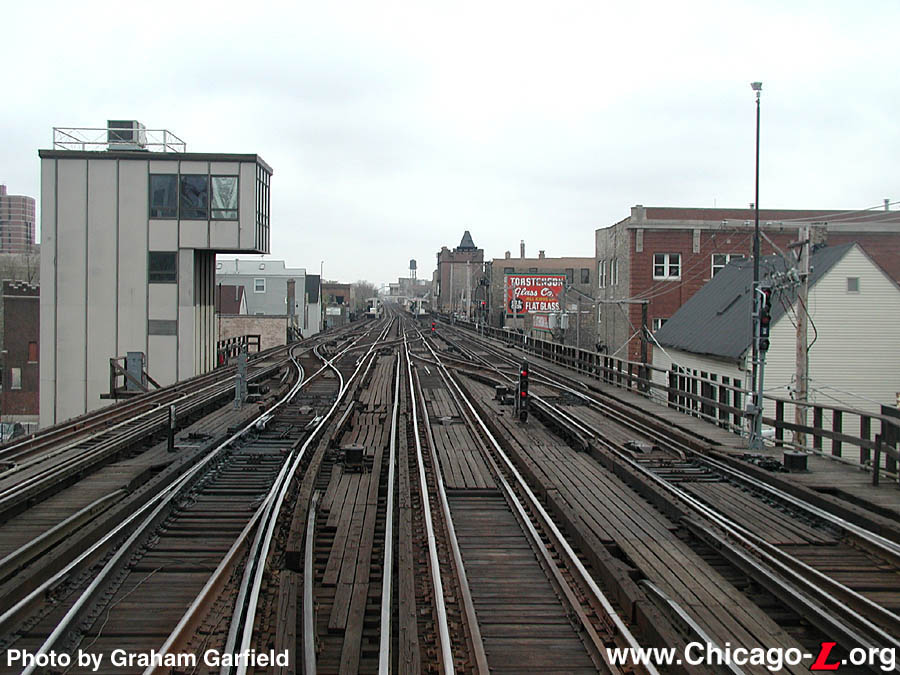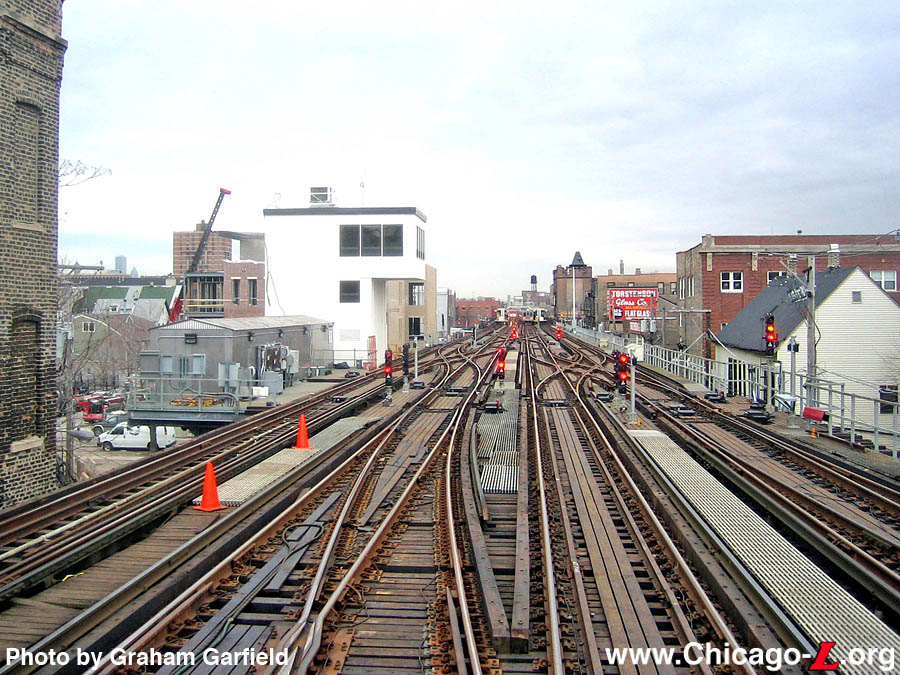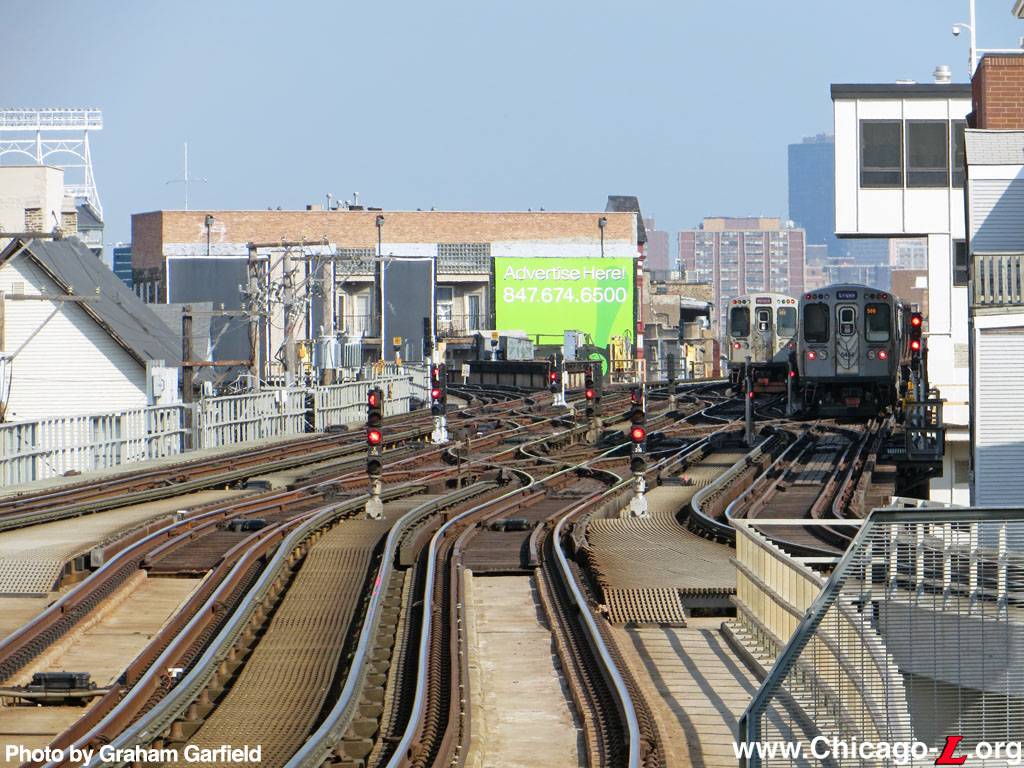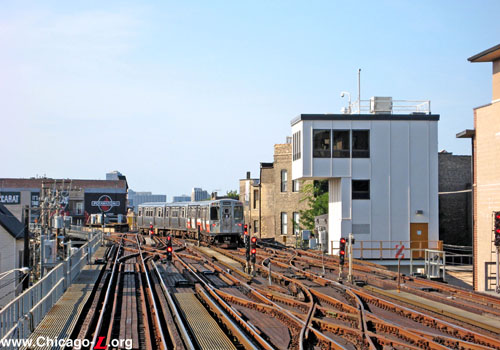
Clark Junction is seen
looking north on July 22, 2007, as a Kimball-bound Brown Line train passes through the interlocking and crosses over main line tracks 1 and 2 to access the Ravenswood branch. The 1976-built Clark Tower on the right was rehabilitated in 2006, with the interior renovated and a new tower panel installed; at the same time, the switches and signals at the junction were also replaced.
For a larger view, click here. (Photo by Graham Garfield)
|
Clark
Junction
School Street and Wilton
Avenue, Lakeview
Service
Notes:
|
Services:
|

|
Red Line:
Howard
|

|
Purple Line:
Evanston
|

|
Brown Line:
Ravenswood
|
Quick Facts:
Address: 946 W. School
Street (Clark
Tower)
Established: May 18, 1907
Original Line: Northwestern Elevated Railroad
Rebuilt: 1976, 2005-06 (new switches and signals, rehabbed tower)
Status: In Use
Profile:
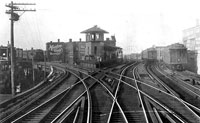
Clark Street junction and
station as they looked just prior to the 1913 switch to
right-hand running. A Loop-bound Ravenswood train waits at
the far left for southbound express and local trains to
pass. For a larger view, click here. (Photo from the CTA
Collection) |
Clark Junction and its associated tower were placed in service on
May 18, 1907 to connect the Ravenswood
branch to the North Side Main
Line. The junction is located near the corner of School Street
and Wilton Avenue, just southwest of the corner of Clark and
Roscoe.
The junction joins the two-track Ravenswood
branch with the four-track North
Side Main Line, whose two inside tracks are express tracks and
whose outer tracks were local tracks. The branch's southbound track
merged into the southbound local track, while the branch's northbound
track diverged from the northbound express track. A series crossovers
south of the junction, between School Street and Belmont station,
allowed trains to then move back and forth between the express and
local tracks as needed. Although the precise location and arrangement
of the crossovers has changed over the years, the junction is still
generally laid out in this manner.
Clark Tower was originally located at the north end of the
junction, between the tracks of the main
line and branch. A local
station already existed at Clark
Street just south of Roscoe when the junction was established
immediately south of the station. The tower was placed at the south
end of the southbound station platform, an ideal place to oversee the
junction as well as the approach tracks in all three directions. The
tower itself was a two-story affair with a wedge shaped plan and
hipped roof. Its architecture was more practical than of any
particular style, but did feature decorative window frames and sills,
and belt course moldings. The interior space was tight. With windows
on all sides for maximum visibility, the tower was heated only by a
small iron potbelly stove in the corner of the room. The junction was
equipped with a hand-operated lever form of switch and signal
control. This made the interior a dizzying array of levers and
switches, all of which had to be precisely aligned by a vigilant
towerman.
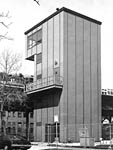
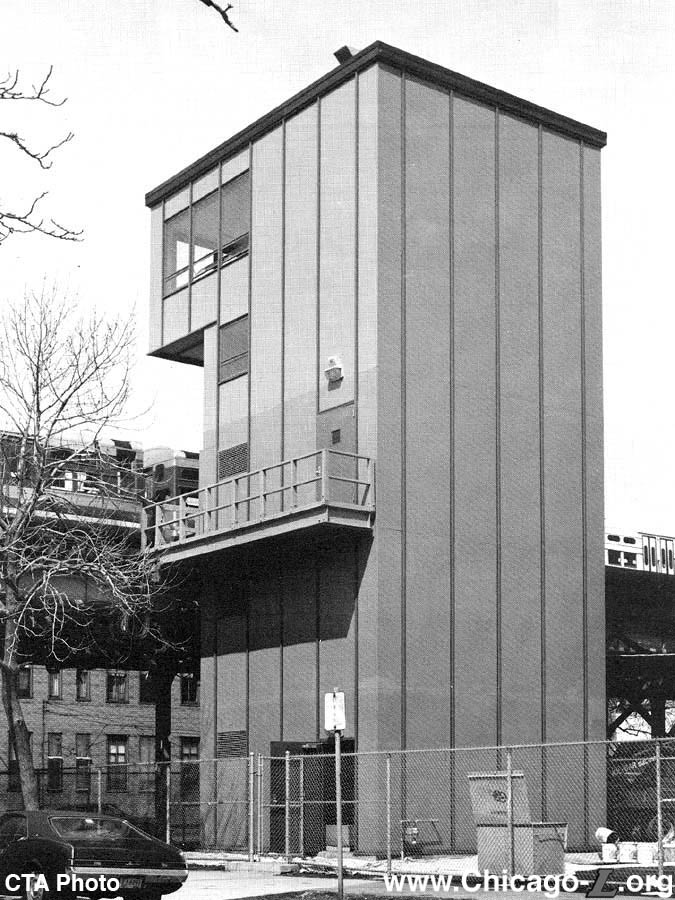
The new Clark Tower is seen
looking northwest in 1976. For a larger view, click
here.
(CTA photo)
|
Over the next several decades, Clark Junction remained relatively
unchanged. Clark station
closed in 1949, the victim of the closure of low-usage stations as
part of the CTA's North-South
Route service revision. While the station was demolished a few
years later, the tower remained, as well as a small piece of the
south end of Clark's
southbound platform around the tower.
In the mid-1970s, the CTA undertook a project to modernize Clark Junction. The old semaphore
signals were replaced with multi-aspect (colored light) wayside
signals. A new, more spacious interlocking tower was also
constructed. Situated on the east side of the main
line tracks, the new tower was five stories high, stretching from
street level to a control room cantilevered over the tracks. Access
was provided to the metal-clad building from both street-level and
track-level. The tower room on the top floor featured large picture
windows on three sides for visibility and provided more room for the
towerman to work. The new interlocking was controlled by an electric
entrance-exit tower panel, which allowed routes to be established by
means of merely pressing a few buttons as opposed to working that
huge mechanical levers of the old tower. The tower was built at a
cost of $249,000 as part of a
CTA signaling program funded
by the state and federal governments. The new interlocking plant at
Clark Junction placed was in service on August 22, 1976. The new
tower was completed a few months later. At that time, more than 950
trains carrying 130,000 people passed through Clark Junction each
weekday.
Even with the improvements the new interlocking plant brought, Clark Junction remained a busy place whose "flat junction" layout (i.e. not
grade-separated) necessitated conflicting moves. The most complex and time-consuming move through
the junction involves northbound Ravenswood
(now Brown Line) trains, which run on the outside (local) track
[Track #4] along the four-track main line. To turn onto the Ravenswood branch at the
junction, outbound Ravenswoods have
to cross the northbound inner (express) used by North-South
(now Red Line) trains. Once on the inner northbound track
[Track #3], northbound Ravenswood trains take a diverging route at a turnout switch which requires them
to cross the southbound inner track [Track #2] used by
southbound North-South trains and the
southbound inner track [Track #1] used by inbound Evanston
(Purple Line) Express trains during the rush hour. This means
that for a northbound Ravenswood train to make it onto the branch, north- and southbound North-South trains and southbound Evanston
Express trains have to wait for the Ravenswood to make it across the at-grade junction, a sometimes time-consuming
affair during rush periods when a high level of service is
scheduled.
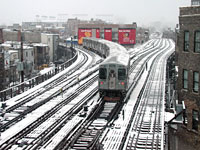
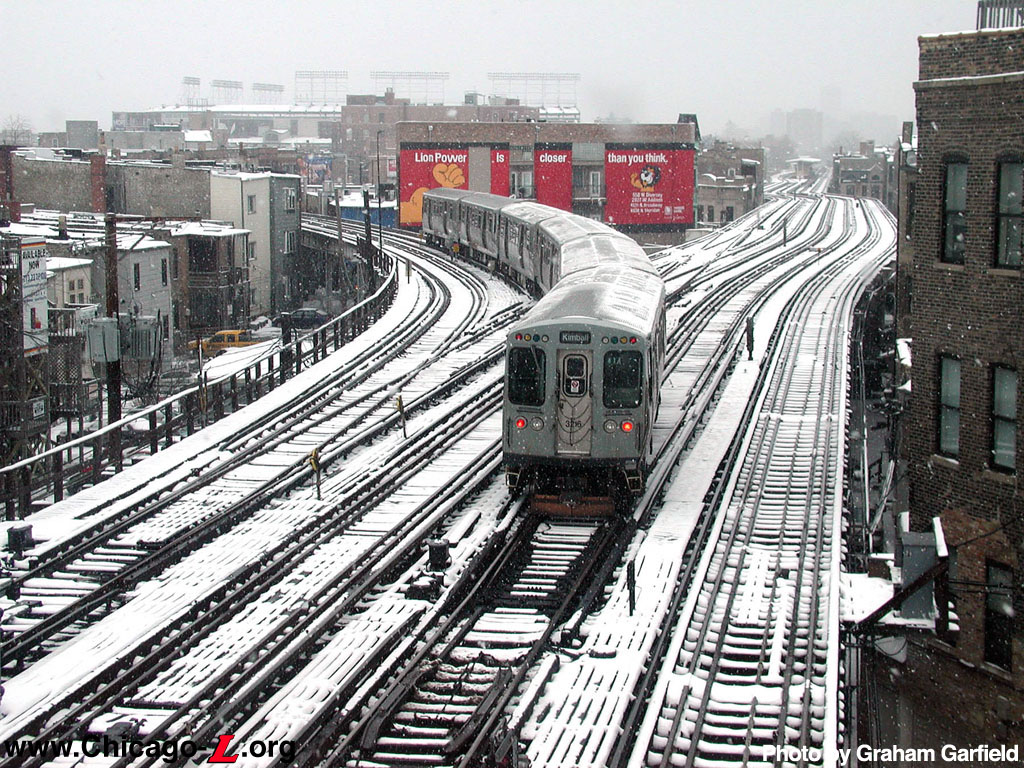
A northbound Brown Line train passes through Clark Junction, crossing tracks 1 and 2 at grade to get onto the Ravenswood branch, on a snowy February 7, 2004. The at-grade crossing, causing conflicting movements that limit through-put capacity, are why a grade-separated flyover has been proposed at various times.
For a larger view, click here. (Photo by Graham Garfield) |
A flying
junction -- one in which the diverging tracks cross over or under
the main line, so as not to block trains when crossing onto the
branch -- conceptually similar to 17th Junction was
considered as early as the 1950s, and received renewed interest beginning in the 1970s. More serious study of creating a flyover to grade-separate the junction was undertaken in the early 1980s as part of CTA's planning and engineering to realign two of the "L"'s through-routes and re-pair the Howard line with the Dan Ryan branch to create a realigned North-South Route (what is today called the Red Line). As part of creating the Howard-Dan Ryan service, each of whose high ridership were a better match than the branches' then-current pairings, CTA planned for a number of projects to increase capacity on the new through-route, including expansions of Howard and 98th yards and re-siting Addison station as an island platform instead of two side platforms to reduce switching delays. Another project CTA studied to reduce switching delays and increase capacity was creating a grade-separated junction at Clark to remove conflicting train movements. Ultimately, the CTA decided not to pursue the Clark Junction grade-separation project at that time and the Howard-Dan Ryan project proceeded without it. As such, the layout of the junction remained largely the
same for nearly three decades.
On June 18, 1987, a new Addison Interlocking was placed in service
north of Addison
station. In addition to a local control panel, Clark Tower was
modified to able to remotely control Addison Interlocking as
well.
Clark Junction is one of the busiest flat junctions on the "L" after Tower 18. By the early
2000s, a short section of northbound track at Clark Junction saw up
to 40 trains per hour during the evening peak -- 20 northbound
Brown Line trains and 20 northbound
Red Lines. To put this in proper
context, there is a comparable short section at Aldgate North
Junction, one of the busiest on the London
Underground, that sees 30 trains an hour. in 2002, Clark Junction
was the busiest CTA rail
crossing on a 24-hour basis, serving 876 trains each weekday.
Brown
Line Capacity Expansion Project
As part of the Brown
Line Capacity Expansion Project, whose primary purpose was to
renovate 16 Brown Line stations to
accommodate 8-car trains and provide ADA-accessibility, the signal
system on parts of the Brown Line
were planned to be upgraded and modernized.
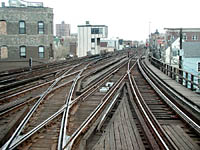
Clark Junction is seen
looking southeast from the Ravenswood branch on April 18,
2003. The 1976-built Clark Tower is seen in the background.
For a larger view, click here. (Photo by Graham Garfield) |
On October 14, 2004, the Chicago Transit Board approved a $45.5
million construction contract for Aldridge
-- Mass, AJV (A Joint Venture) to upgrade the signal system. Aldridge
rehabilitated the Brown Line's signal system from Kimball to Western,
which involves installing signal equipment along the tracks and
rehabilitating Kimball Tower. At Clark Junction, Aldridge installed a
new signal system from Armitage on the south to Addison (North
Side Main Line) and Lakewood (Ravenswood
branch) on the north. The work on this stretch, which became
known as the "Clark Junction Corridor" or simply "the Corridor"
during the project, included the installation of 14 new interlocked
crossovers at five locations -- Belden, Altgeld, Barry, Clark
Junction, and Lakewood-Seminary -- new signals, relay houses, and
local control panels, and the rehabilitation of Clark Tower. Work in
the Clark Junction Corridor began in late 2004.
During much of 2005 and 2006, single-track and reroute operations
were required at night, on weekends, and during other off-peak
periods as contractors Aldridge,
Safetran,
Target
Electric, and Suarez worked to install the new crossovers and lay
the necessary signal and communications lines. By 2006, most of the
crossovers were installed at the locations outside of Clark Junction
as contractors worked to completed the installation of relay houses
and signals at those locations. These new interlockings required the
installation of signal platforms, metal cantilevers on which wayside
signals and associated equipment are mounted. The new
Lakewood-Seminary Interlocking on the Ravenswood
branch came on-line March 29, 2006. Effective May 15, 2006, the
new Barry Interlocking was fully in service as well. On October 30,
2006, the new diamond crossovers between Tracks #1 and #2 at Belden
and at Altgeld were placed in service. On November 13, 2006, the
left-hand crossover between Tracks #3 and #4 at Altgeld and
associated interlocking plant were placed in service.
During the winter of 2005-06, the contractors with the
CTA Track Department began
installing the new crossovers at Clark Junction. This work would take
several months, as it involved a lot of complicated staging to
replace the switches while maintaining rail traffic. Replacement of
crossovers within the Clark Junction plant required the Red
and Brown lines to undergo
extensive reroutes and, for the latter, single tracks in the junction
area to vacate the tracks where the new specialwork was being
installed.
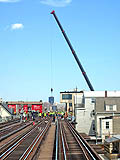
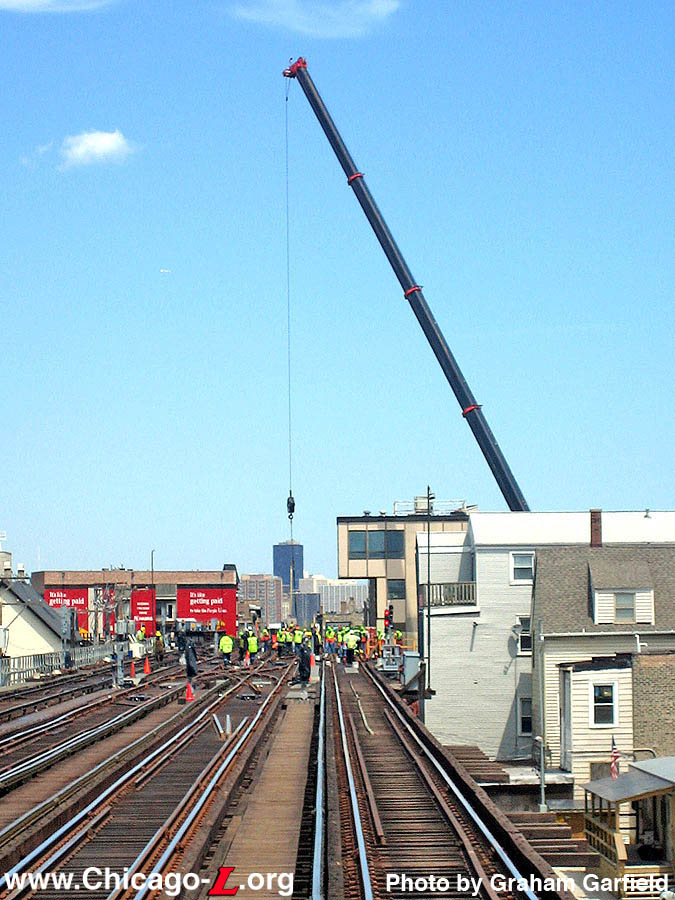
CTA Track Department
personnel and contractors are working, with the help of a
crane, to lift the new diamond crossover between tracks #3
and #4 into place on May 20, 2006. For a larger view, click here. (Photo by Graham Garfield) |
As a result of the track modifications at Clark Junction, a
temporary change was made in the operation of Brown
Line shuttle trains effective April 10, 2006. Still berthing at
Belmont on Track #1, rather
than being routed to Track #3 then onto the northbound Ravenswood
branch track at Clark Junction the trains operate against traffic
northbound on Track #1 and onto the branch, then are switched onto
the northbound track at Lakewood-Seminary Interlocking, essentially
operating in a tower-protected single-track mode.
In April 2006, a new relay house was installed at Clark Junction
immediately north of the tower. While the tower was being
rehabilitated, control of Clark Junction was temporary transferred to
a local panel in the relay house. Control of the junction was slowly
cut over to the relay house over the course of the summer of 2006.
Because each track was cut over one at a time, control of the
junction was actually split between the tower and the relay house for
approximately one month, requiring two towermen to establish train
routings in the interlocking. As one could imagine, this required
close coordination between the two towermen for the timely movement
of trains. During this period, the towerman assigned to Clark Tower
was in charge of all train movement through Clark Junction, with the
towerman assigned to the relay house control panel not permitted to
establish any lineups unless specifically authorized by the Clark
Tower towerman.
The cutover began
over the weekend of July 22-23 and completed over the weekend of
August 26-27, 2006. Vacating of Clark Tower on August 27, the
contractors began gutting the structure for its rehabilitation.
Renovation included the installation of a new, larger tower panels
that will allow remote control of all interlocked crossovers from
Addison and Lakewood on the north to Armitage on the south.
Contractors repainted the exterior of the tower building in September
2006 and work progressed throughout autumn on the installation of new
infrastructure inside.
Effective September 29, 2006, the new, bi-directional interlocking
at Clark Junction was fully placed in service. At that time, all cab
and wayside signals were functional on all tracks within the Clark
Junction interlocking limits.
Work at Clark Junction concluded in late 2006. In November 2006,
control of Clark Junction was returned to the newly-rehabilitated
Clark Tower. Final work on the tower and interlocking were completed
during the rest of 2006 and early 2007. The new Clark Tower master
panel has the ability to remotely control all of the interlockings in
the Clark Junction Corridor -- Armitage, Belden, Altgeld, Barry,
Clark, Addison, and Lakewood-Seminary interlockings. On January 4,
2007, Clark Tower assumed control of Brown
Line shuttle trains making their turnback move through
Lakewood-Seminary Interlocking. This move was somewhat short-lived,
as on April 1, 2007 -- concurrent with the beginning of "Three-Track
Operation" on the North Side
Main Line -- the Brown Line
shuttles began turning from south to north through Barry
Interlocking, south of Belmont
station rather than single-tracking back to Lakewood-Seminary. Clark
Tower controls this move as well.
Funding for the contract was provided by the Federal
Transit Administration -- both Full Funding Grant Agreement funds
and formula funds -- the Regional
Transportation Authority and the Illinois
Department of Transportation.
RPM Red-Purple Bypass Project
As part of the Red and Purple Modernization Program (RPM), a multi-phase program to completely rebuild the northern sections of the Red and Purple lines and provide CTA with the ability to add trains to meet the demands of growing ridership, the CTA proposed to build a grade-separated junction at Clark Interlocking to reduce conflicts between trains and increase capacity through the junction.
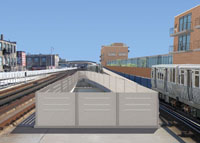
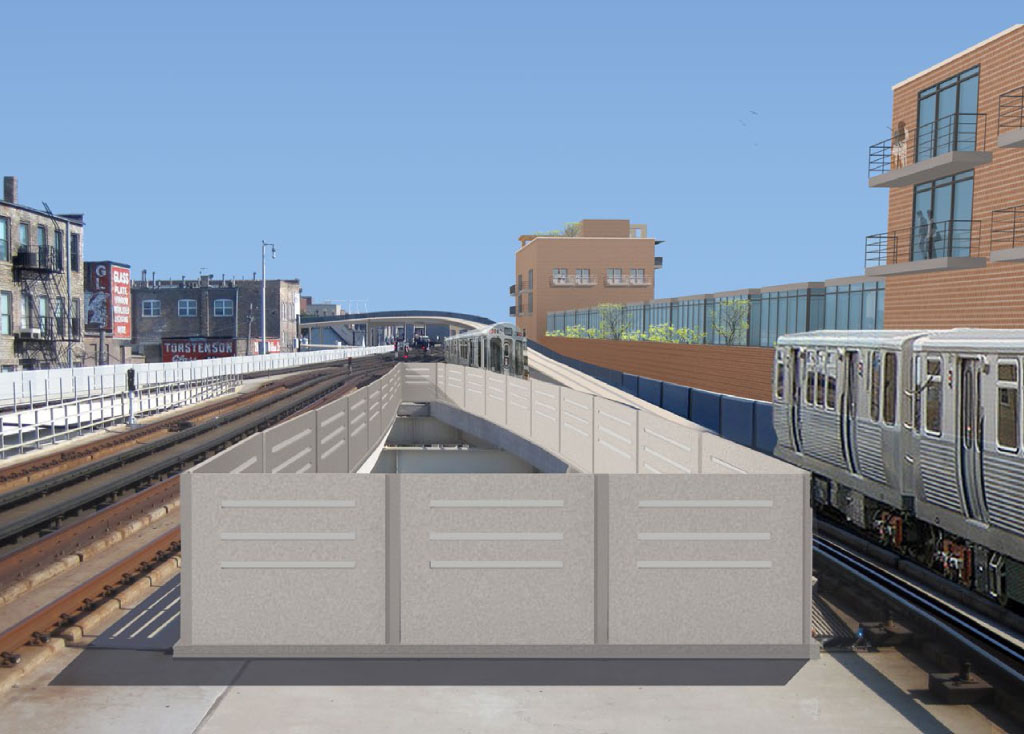
Conceptual rendering of the junction with a flyover track, looking north from Belmont.
For a larger view, click here. (Image courtesy of CTA) |
Officially called the Red-Purple Bypass by CTA, and alternately referred to elsewhere as the Clark Junction Flyover or Belmont Flyover, the project was part of the RPM planning going back to 2009-10; as planning got more advanced, CTA began more explicitly promoting the flyover portion of the RPM program in 2014 to elicit public feedback and comment. Under the CTA's plan, northbound Brown Line trains would proceed along a dedicated rail line above the Red and Purple line tracks to get from track 4 on the North Side
Main Line to the Ravenswood branch, eliminating the need for it to cross the other three tracks of the main line at-grade and stopping all Red and Purple line train movements through the junction to get onto the branch.
The total project cost is pegged at $570 million. The anticipated cost to construct and modernize the track and structure as part of the Red-Purple Bypass Project is estimated at $320 million. Additional work that would be performed as part of RPM Phase One would include bringing the Brown Line track structure west of the rail junction into a state of good repair and modernizing the signal system on the Red and Brown lines near Clark Junction. This work is included in the additional improvements expected to cost $250 million.
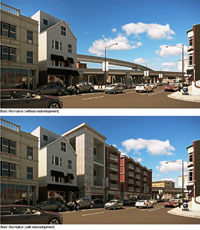
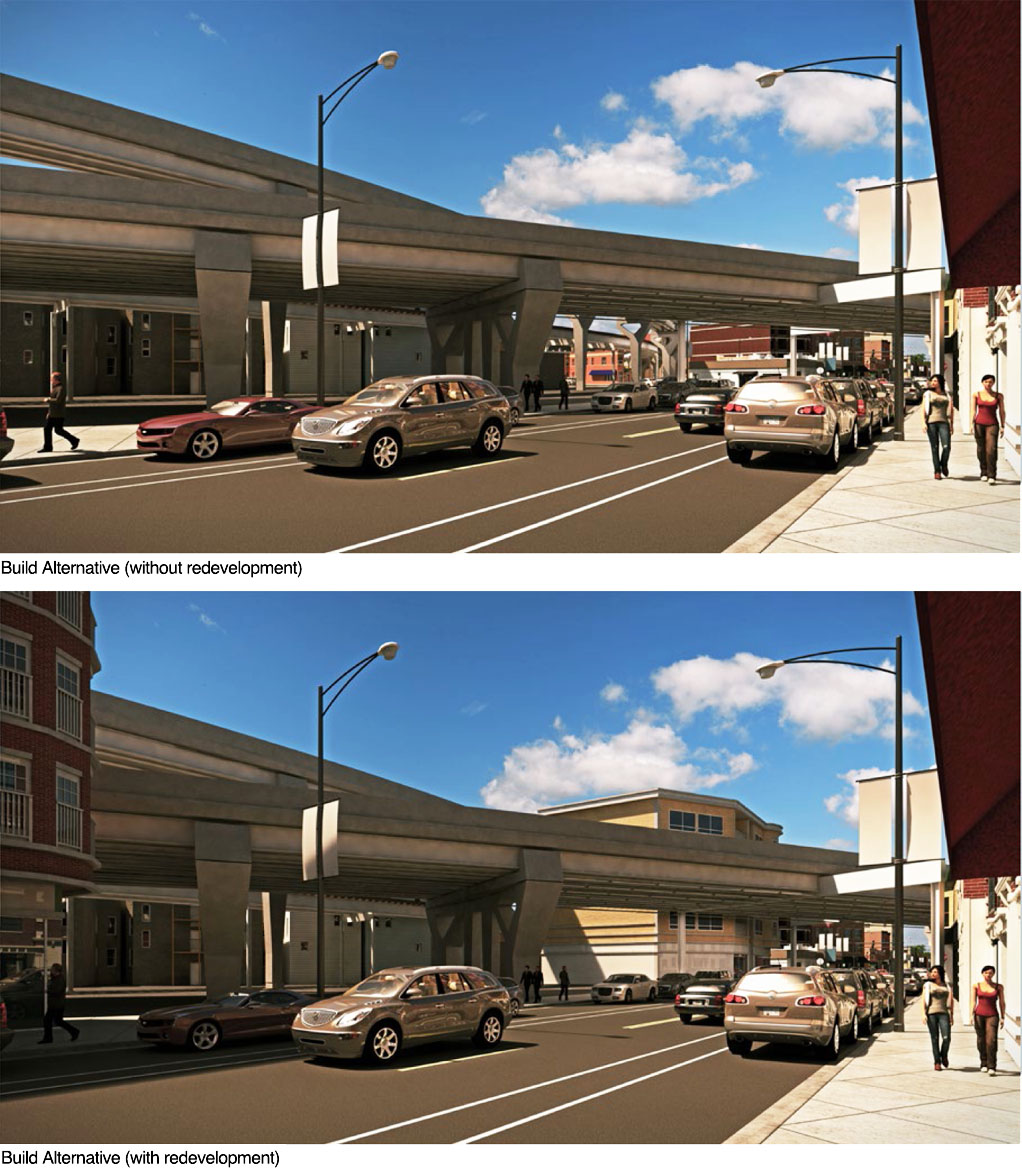
Conceptual rendering of proposed Red-Purple Bypass with and without redevelopment, at Clark Street and Buckingham Place, facing northwest.
For a larger view, click here. (Image courtesy of CTA) |
CTA argues that the improvement would allow them to significantly increase the number of trains run along the Red Line to reduce overcrowding and meet growing demand for transit service. Benefits of building the Red-Purple Bypass include being able to run up to 15 more trains per hour in one direction on the three lines during the afternoon rush and up to 12 more morning trains, cutting delays and overcrowding up and down the line. This would include the addition of up to eight more Red Line trains per hour during rush periods, which could accommodate up to 7,200 additional customers per hour during rush hour -- the equivalent to adding two traffic lanes on Lake Shore Drive in each direction. Currently, the most the agency can do is 40 to 44 trains per hour in one direction on the Red, Purple and Brown Line tracks. According to the Chicago Metropolitan Agency for Planning, 185,000 new residents are projected to move into Red and Brown Line service areas by 2040. To meet future demand, the service needs to be increase in this corridor to serve more riders during rush periods, but CTA says that with current infrastructure constraints the junction has already reached capacity.
The CTA evaluated several different alternatives to the flyover/bypass, including (with reasons CTA dismissed each option):
- building a tunnel or subway to separate the junction (would have a substantially larger project footprint for construction, greater impacts on properties and the community, and longer construction duration and greater costs);
- operating extra trains between Belmont and the Loop (would require an extra turn-back track to be built north of Belmont station, with nearly as many property acquisition impacts as the Bypass, and would still not address the capacity increases needed along the entire length of the Red Line);
- having the Red Line tracks ramp over the northbound Brown Line track instead of vice versa (would not eliminate property impacts, and severe operational impacts during construction);
- "stacking" the Purple Line tracks over the Red Line tracks to narrow the main line right-of-way requirement (would have a longer construction duration, result in greater property impacts, have substantial operational issues, and visual impact of double-stacked structure);
- lengthening the platform at Belmont station to run 10-car trains to increase capacity (doesn't help if all other stations on the Red Line aren't also lengthened); and
- making signal improvements instead to allow trains to run closer together (without removing the bottleneck at the junction, only minimal improvements are possible, estimated that at most, one additional train per hour could be added).
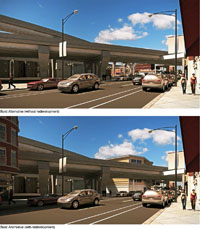
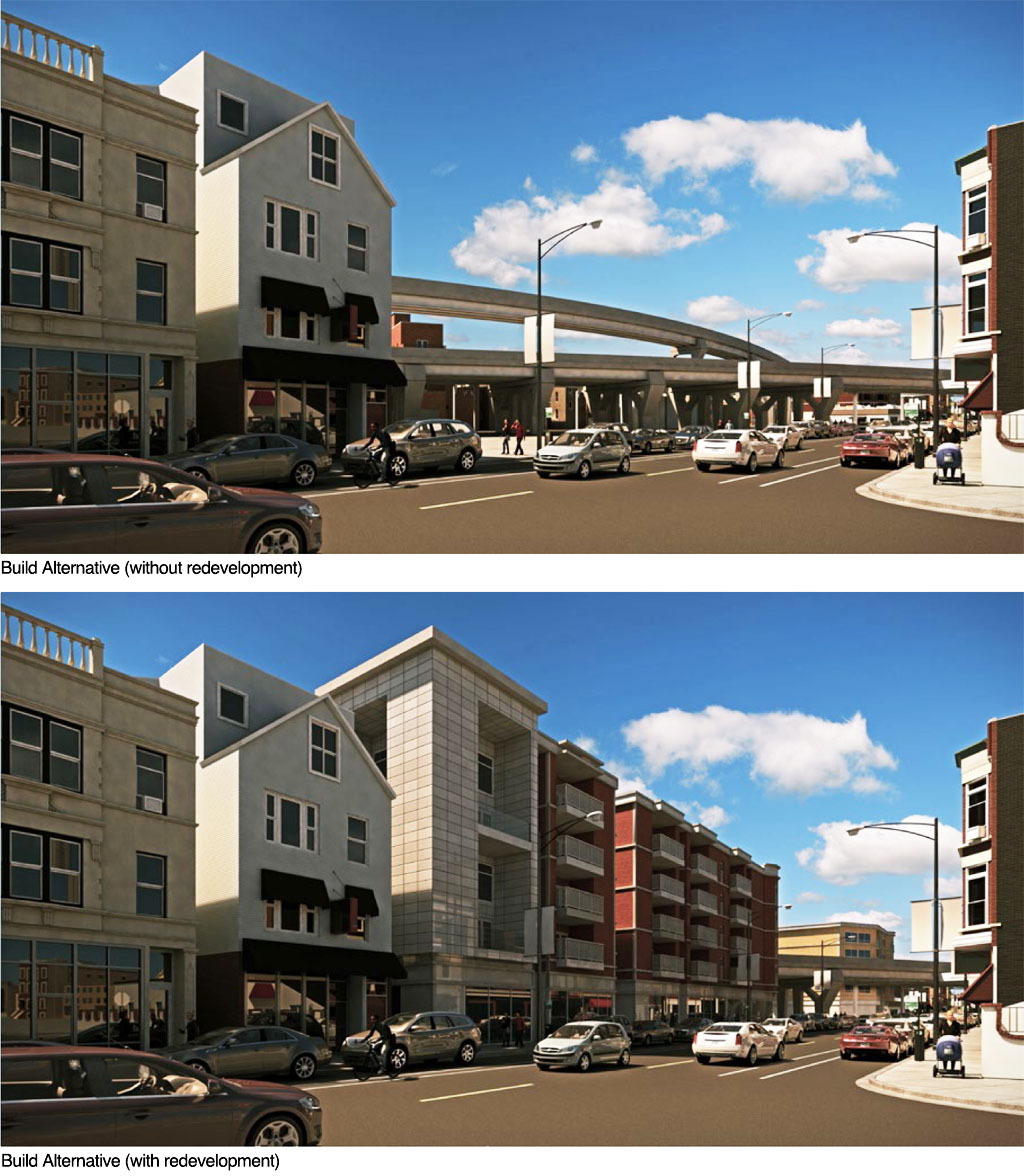
Conceptual rendering of proposed Bypass with and without redevelopment, facing northwest at Clark Street near Roscoe Street..
For a larger view, click here. (Image courtesy of CTA) |
All other options studied either did not solve the core issue, or did not provide sufficient relief and additional capacity, according to the CTA.
Although the plan -- or more generally, it's goal of increasing capacity through the corridor to allow a great service frequency -- enjoys relatively broad support, many central Lakeview residents are opposed to the flyover, which at the time was projectd to require the demolition of 16 buildings. Opponents say the proposed flyover, which would be 40-45 feet tall at its highest point, would be an eyesore for the neighborhood. Some are concerned about the vacant property that will result from the property demolitions, pointing to buildings that were razed for the renovation and expansion of Belmont station in 2006 that, as of 2016, was still vacant (though, it should be noted, the point at which the station project was complete enough to allow sale and redevelopment of those parcels came in the middle of an economic and real estate downturn). Residents form the Coalition to Stop the Belmont Flyover to lead the opposition to the project, which included a November 2014 ballot referendum that involved the three precincts of the 44th Ward that would be most heavily impacted by the demolitions. Residents voted overwhelmingly against the project, with 72 percent of the 800-some people who voted opposing the measure.
FTA and CTA published an Environmental Assessment (EA) for the Red-Purple Bypass Project on May 19, 2015, established a 30-day public comment period to accept formal comments, and hosted a public hearing for the EA on June 3, 2015. Based on a review of the EA and all public comments received, FTA issued a Finding of No Significant Impact (FONSI) for the Red-Purple Bypass project in late 2015.
CTA began demolition of buildings adjacent to the flyover the week of March 4, 2018. The demolition begins more than a year before groundbreaking for the flyover structure itself is expected to occur.
The CTA is demolishing 14 buildings in the area for the project. CTA said they planned to knock down 10 buildings in March 2018, before opening day at Wrigley Field. Those include five buildings on the west side of Wilton Avenue, four on Clark Street, and one on Roscoe Street.
Demolition of four other buildings on Clark is scheduled for fall 2018.
In addition to the 14 buildings the CTA is contracting to have torn down, another property on Sheffield has been partially demolished by its owner. Two parcels acquired for the project are vacant lots, and another is a surface lot. The historic Vautravers building at 947-949 W. Newport Ave. will be relocated by the CTA, rather than demolished.
The CTA has spent $32 million on real estate acquisitions and relocation costs for the bypass, while demolition is expected to cost an additional $3 million. The CTA has acquired all the buildings it needs for the project, and they are all vacant.
A contract for construction on the flyover will be awarded at the end of 2018, and work to begin in 2019.1

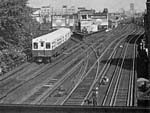
|
ClarkJct00.jpg
(266k)
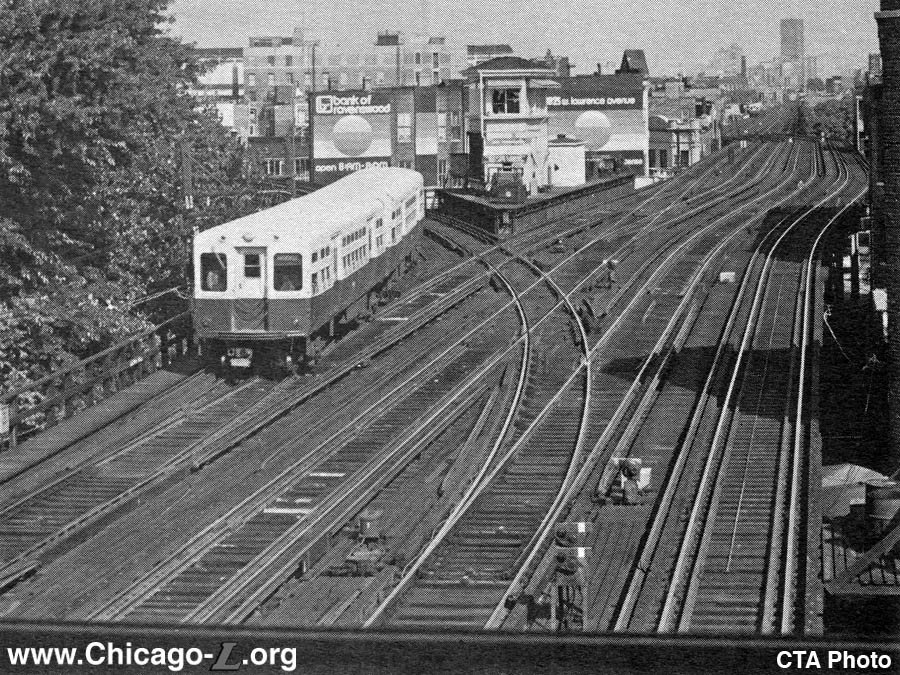
The two Clark towers coexisted for a short time. This photo
looking north from the new Clark Tower in 1976 shows the old
Clark Tower at the split in the junction as a southbound
Ravenswood All-Stop train of 6000s
comes off the branch. Note the semaphore signals still
present along the tracks. (CTA
Photo)
|
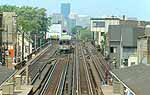
|
cta2600s05.jpg
(39k)
A North-South train of Budd/TA-built 2600s
has just passed Clark Tower as it approaches Belmont
station on its way to the South Side in July 1988.
(Photo by James Raymond)
|
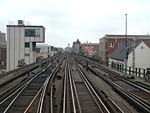
|
ClarkJct01.jpg
(135k)
View looking south at Clark Junction on September 3, 2001.
(Photo by Graham Garfield)
|
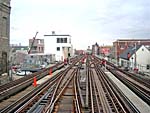
|
ClarkJct04.jpg
(203k)
The renovated Clark Junction is seen looking south on
January 4, 2007. Visible in this view are the rehabilitated
Clark Tower, the Clark Relay House in front of it (which
temporary controlled the interlocking while the tower was
being rehabbed), the new diamond crossovers that provide
flexibility at the junction, and new wayside home signals.
(Photo by Graham Garfield)
|
 |
ClarkJct07.jpg (267k)
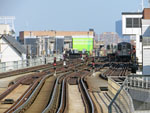
The maze of switches that make up Clark Junction are seen looking north from Belmont station on March 20, 2015 as northbound Red and Purple line trains move through the interlocking. The tower is visible on the right, peaking out from the buildings that back up to the tracks. (Photo by Graham Garfield) |

Notes:
1. Wisniewski, Mary. "As the buildings come down, CTA's Belmont flyover closer to reality in Lakeview". Chicago Tribune. March 12, 2018.