|
|



|
|
|


.
Freight Service on the "L"
.
"L" Freight
Operations | "L" Freight
Rolling Stock
Interurban Freight Operations on the "L"
|
|
|
|
|
.
Freight Service on the "L"
.
"L" Freight
Operations | "L" Freight
Rolling Stock
Interurban Freight Operations on the "L"
Although the "L" has many facets that are unusual and fascinating to contemporary riders and enthusiasts, perhaps one of the most intriguing is the concept of freight service operating over the "L".
The most conspicuous remnant of this former operation still extant today are the sections of the single-track concrete elevated structure between Leland Avenue and Montrose Avenue near Wilson station -- partially in use by southbound Purple Line Express trains, partially demolished, and partly abandoned -- although other small artifacts and vestiges exist as well.
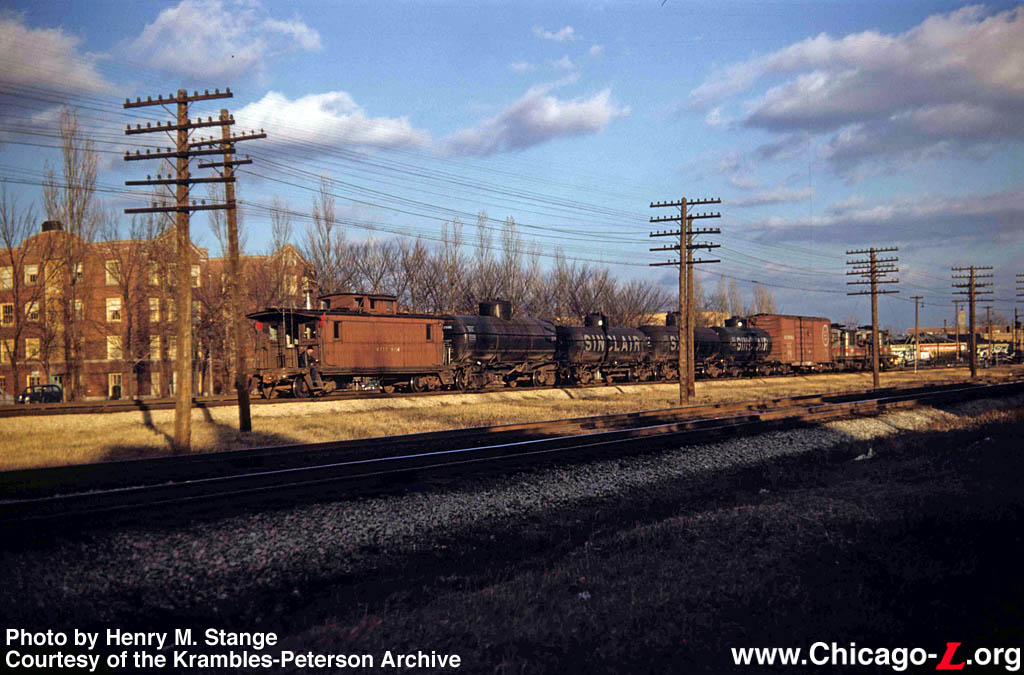
Various types of freight and non-passenger items have been carried over the "L" over the years. Interurbans like the North Shore Line and Chicago Aurora & Elgin carried both carload and less-than-carload freight from terminals along the "L" to points north and west of the "L" system. Freight such as that typically associated mainline railroads -- large boxcars, coal gondolas, et cetera -- was carried by the "L" companies and CTA, and generally limited to the North Side north of Montrose Avenue. The operation of freight over the "L" owes its origin to how the "L" was extended north from Wilson to the north city limits and into Evanston. This carload freight service over the "L" ended in 1973. The service was operated by the Chicago Transit Authority using special electric locomotives hauling freight cars owned by mainline railroads and other entities.
The origin, development, operation, and eventual withdrawal of freight service over the "L" is provided below, as well as an overview of the special electric locomotives that were used to operate the service.
The Origin of "L" Freight Service
On May 1, 1885, the Chicago, Milwaukee & St. Paul Railway opened a steam rail line connecting the suburbs of Lakeview (annexed to the City of Chicago four years later) and Evanston to Chicago, running between Calvary Cemetery in the then-village of South Evanston and Union Station in Chicago. By mid-1889, trains ran as far north at Maple Avenue in suburban Llewellyn Park (Wilmette).
The right-of-way of the CM&StP, or "Milwaukee Road", crossed the North Branch of the Chicago River north of Union Station and after some turns followed Kingsbury Street and Lakewood Avenue (running in the middle of the street for long stretches on these two thoroughfares) as far north as Belmont Avenue. At Belmont, the tracks turned northeast and proceeded diagonally to Waveland Avenue, next to Wrigley Field, where they then turned due north along Seminary Avenue. From there, the CM&StP tracks continued north along Seminary to Montrose, then followed the path of what is now the CTA Red Line and Purple Line to Wilmette. Although it was planned to extend further north, competing with the parallel Chicago & North Western line, the CM&StP's Evanston Division ended there.
Around the turn of the century, the Northwestern Elevated, which ended at Wilson and Broadway, adjacent to the CM&StP's Sheridan Park station, and the CM&StP began negotiations to extend the elevated company's trains north to the city limits and on to Evanston over the steam railway's tracks. This plan represented a very low-cost extension option for the elevated and would relieve the Milwaukee Road of the burden of operating passenger service on their Evanston Division, which did not develop the anticipated passenger traffic north of Wilson. An agreement between the Northwestern and the Milwaukee Road was reached in 1904, although franchise problems with the City of Chicago prevented finalization of the terms until 1907.
In March 1907, the Evanston City Council approved the electrification of the St. Paul's tracks through their city, but also stipulated that that the ground-level tracks had to be elevated between the city limits at Howard and University Place, just north of downtown, by the end of 1910. Chicago approved the franchise on July 1, 1907, authorizing the electrification of the steam railroad tracks from Irving Park Road to Howard, but not requiring grade-separation. They did, however, prohibit the use of third rail on the surface-level trackage (even though it was used on the ground elsewhere in the city, including on the Northwestern's own Ravenswood branch). By the end of Summer 1907, a joint operating agreement between the Northwestern and the CM&StP was signed. The right-of-way's ownership technically stayed with the CM&StP, so a special fund was established to cover maintenance and capital improvements.
"L" service was extended north of Wilson to Central in north Evanston on May 16, 1908 over the electrified St. Paul tracks. Coincident with the extension of "L" service over the St. Paul's tracks, the steam road cut their commuter operations back from Wilmette to their Sheridan Park station adjacent to the Wilson "L" stop. In June 1908, the Milwaukee Road was running two trains a day between Union Station and Sheridan Park. They ran this limited service until June 1917, after which the former-Evanston Division of the Milwaukee Road line just handled freight.
Joint "L"/Milwaukee Road Freight Operations and Track Elevation
Following the extension of "L" passenger service over the CM&StP's tracks north of Wilson, Milwaukee Road freight service along the line into Evanston continued. One of the terms written into the lease agreement was that the freight service would be handled by the Northwestern Elevated for the St. Paul at cost. However, although the joint agreement assigned freight duty to the Northwestern, the St. Paul continued to operate the service. This continued until 1920, when the "L" took over direct operation of the freight service. For most of the distance between Wilson and Howard, a separate freight track ran alongside the ground-level rapid transit tracks. Otherwise, freight and "L" trains intermingled on the same tracks.
In 1907, there were 91 industries on the Milwaukee Road's Chicago & Evanston Line, twenty north of C&E Junction (where the Chicago & Council Bluffs Division line, now Metra's Milwaukee-West Line, along Bloomingdale Avenue continued west across the North Branch of the Chicago River and joined the C&E line near Cortland Street and Clybourn Avenue) and 71 customers in the heavily industrial area south of the junction along Kingsbury. Of the total, there were three breweries, three ice houses, four powerhouses, two lumber yards, six coal yards, and two gas plants. There was also a piano factory, a printing press manufacturer, a tannery, a baking powder plant, and a feather company. There were also a number of team tracks, which are rail sidings for general usage by freight shippers where freight cars can be spotted and loaded or unloaded by an industry or shipper. The largest industry on the line was the Montgomery Ward warehouse, which had four tracks. The Milwaukee Road had two freight houses -- #5 and #7 -- on the line as well.1 Prior to the "L" taking over freight service, the CM&StP used three steam switching locomotives to haul freight as far north as Evanston.2
Between 1908 and 1931, the ground-level tracks between Leland Avenue in Chicago and Isabella Street on the Wilmette-Evanston border were elevated, completed in sections over several decades. Unlike most of the "L", this section was elevated on a "solid-fill" embankment, an elevated right-of-way shored up by two retaining walls filled with solid debris like rocks, dirt, et cetera. This elevation method was chosen because of the presence of freight service, as it was felt that a sturdier elevated right-of-way was needed to safely support the weight of potentially heavy freight cars. A typical steel trestle elevated structure most likely would not be able to safely support the weight and type of freight cars that were to be hauled.
Elevation of the tracks in Evanston between Howard and University Place was completed in 1910, concurrent with the elevation of the adjacent Chicago & North Western tracks.
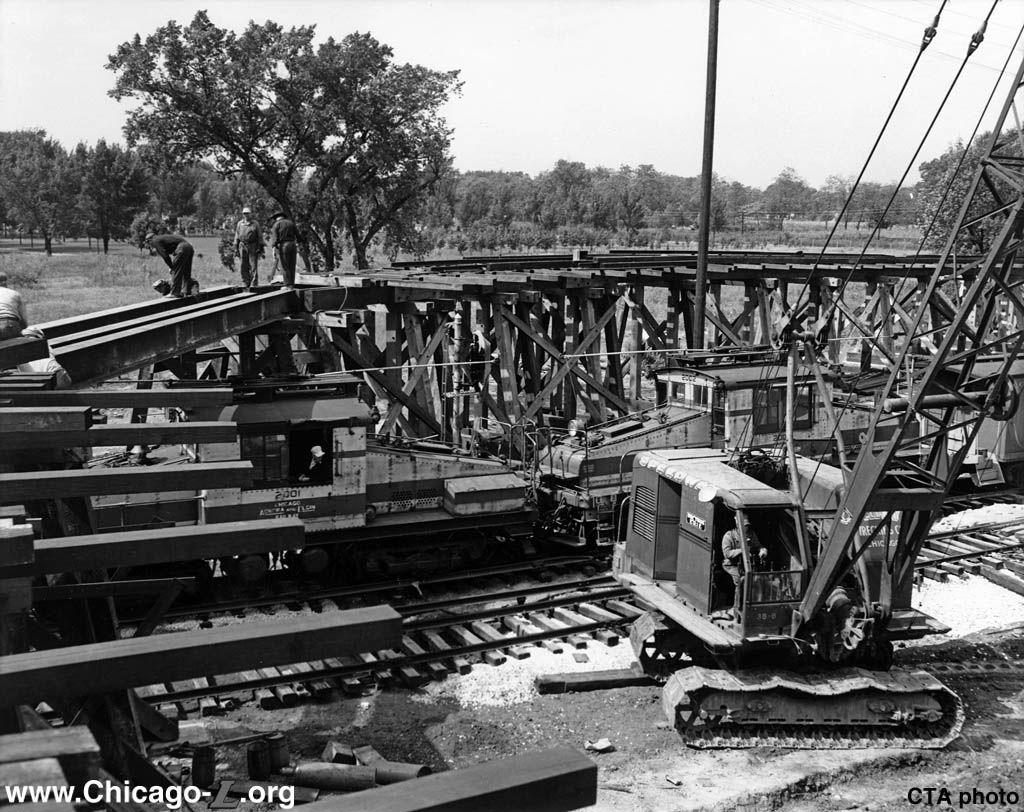
In the 1910s, the Northwestern Elevated began the task of elevating the ground-level tracks between Howard Street and Leland Avenue. The elevation of this section was a difficult task for several reasons. The right-of-way was narrow and the city refused to close intersecting streets during the construction. In early May 1914, the CM&StP closed their exclusive freight track on the west side of the "L" tracks, requiring the intermingling of steam freight and electric rapid transit trains, sometimes with dangerous results. Nevertheless, work progressed for several months until the end of August, when a lack of money required all work to be suspended. In 1915, enough financing was found to allow the project to resume and in January 1916, trains were moved into a temporary wooden trestle with temporary stations. This allowed the demolition of the original grade-level tracks and stations. Work was again suspended during World War I, however, due to manpower and materials shortages.
Work resumed after the war and by mid-1921 was virtually complete. As part of the elevation project, the line from Leland to Howard was expanded into a four-track main line with separated local and express services, as was the case south of Wilson, rather than the two tracks as in Evanston. In 1921, three of the permanent tracks were ready for use and the use of overhead wire was suspended in favor of third rail on two of these tracks between Lawrence and Howard. Overhead wire was retained on the western track for freight trains, which could not clear the third rail. Still under construction were the northbound outside express track and the permanent stations. By early 1922, the new elevated, four-track main line between Lawrence and Howard was completed and the Northwestern revised its schedules accordingly.
The "L" Takes Over Freight Operation
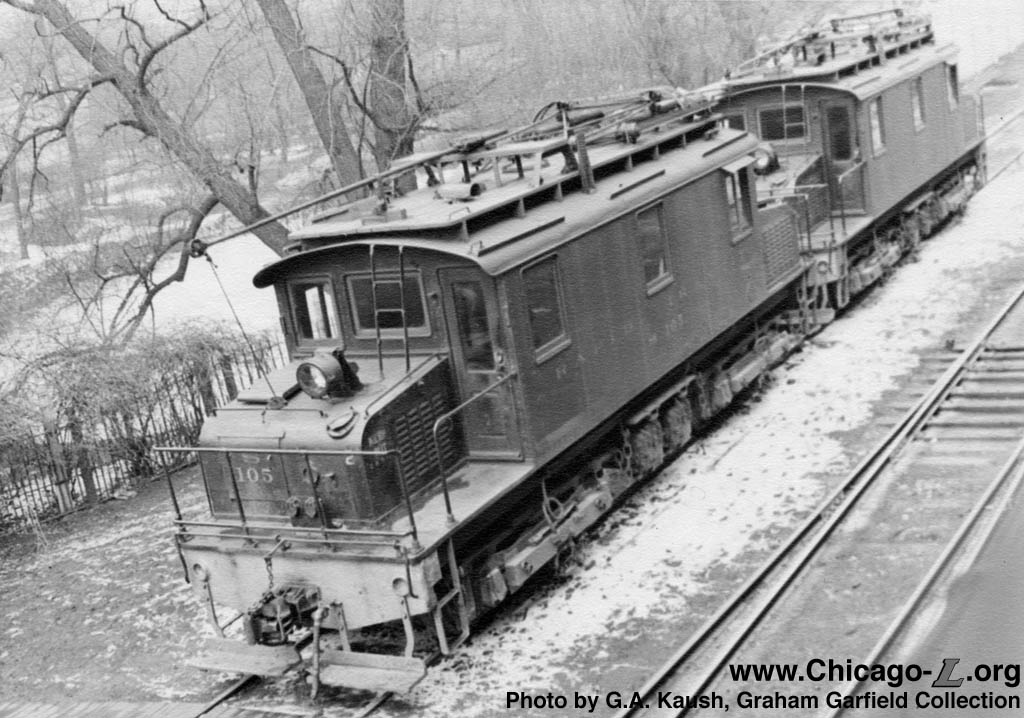
Westinghouse-Baldwin electric locomotive S-105 is seen sitting in Buena Yard between runs some time in the 1940s, with its twin S-104 staged behind it. The lettering on the side of the locomotives has become somewhat simpler, saying only "RAPID TRANSIT" rather than the full name of the company, which they bore in the 1920s after the CRT was created by the merging of the separate "L" companies. For a larger view, click here. (Photo by G.A. Kaush, Graham Garfield Collection) |
The interchange of freight cars between the two companies occurred at a ground-level interchange yard at Buena Park, next to a former CM&StP station, the Buena "L" station and Graceland Cemetery, between Irving Park Road and Montrose Avenue.
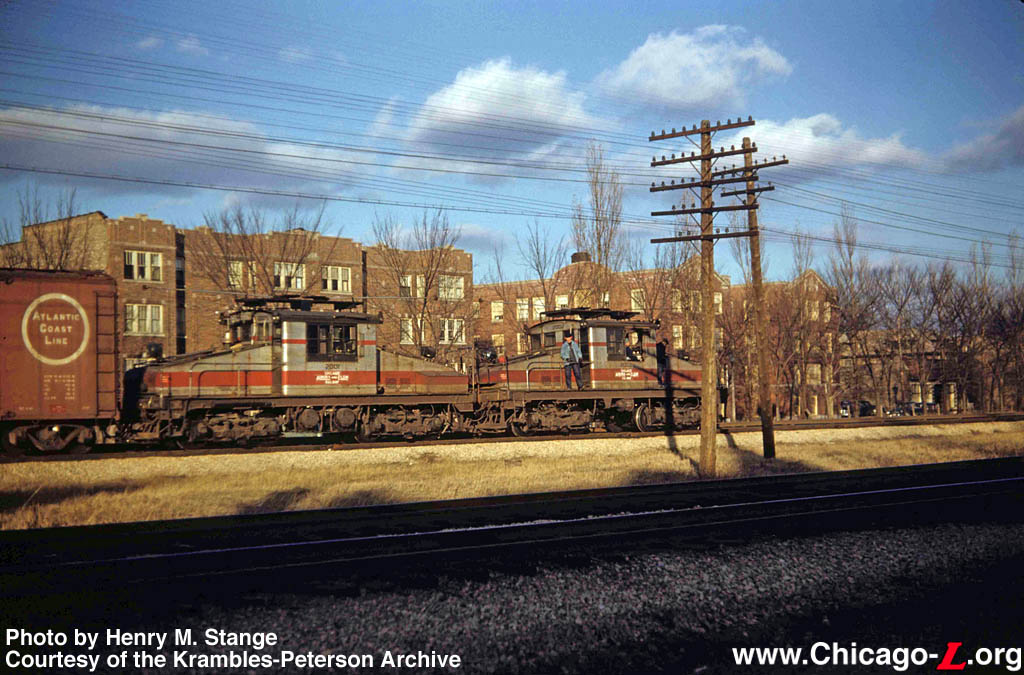
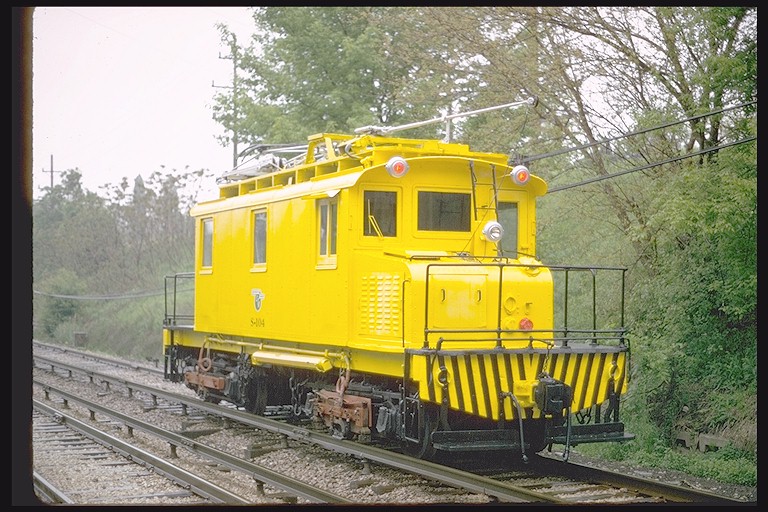
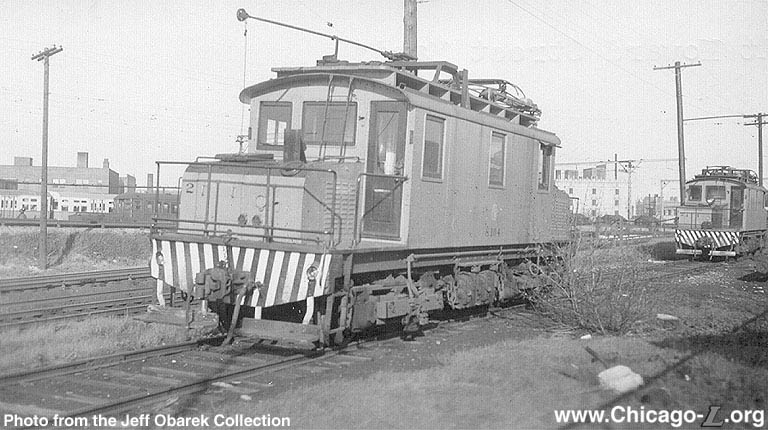
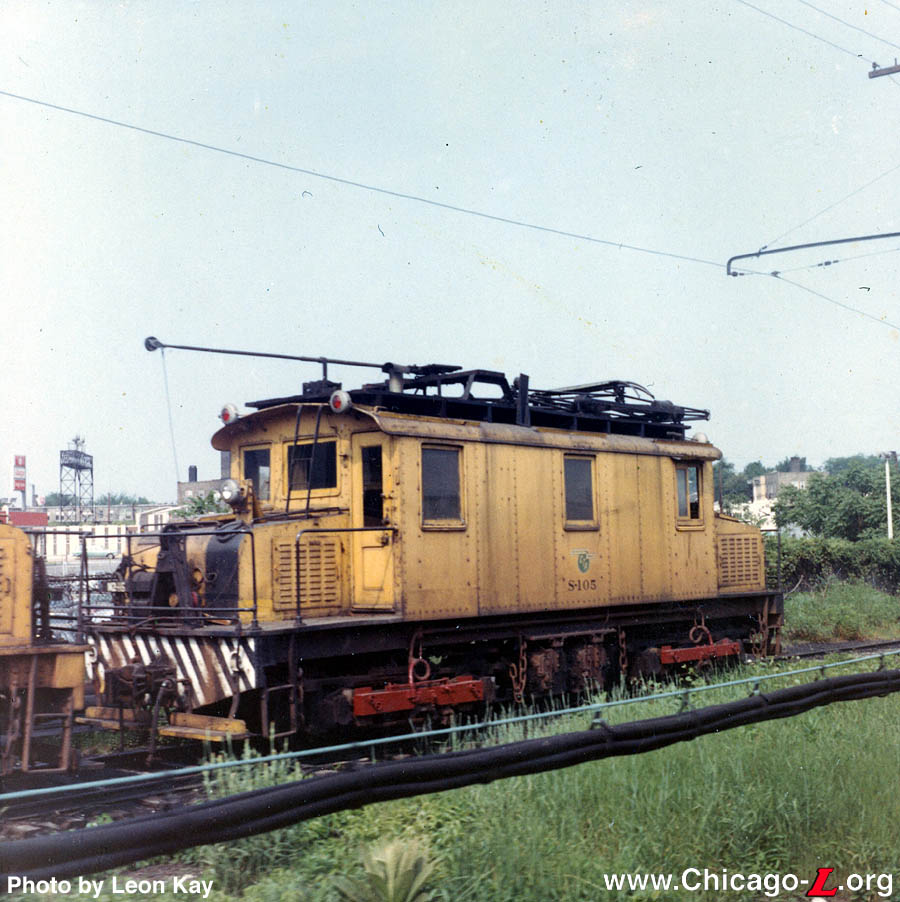
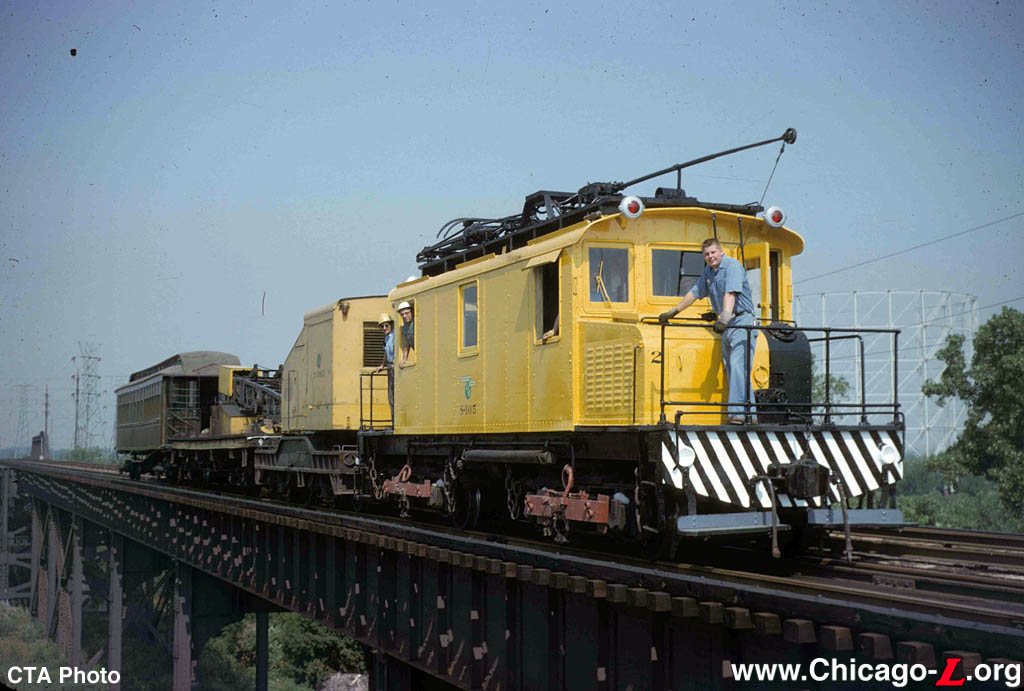
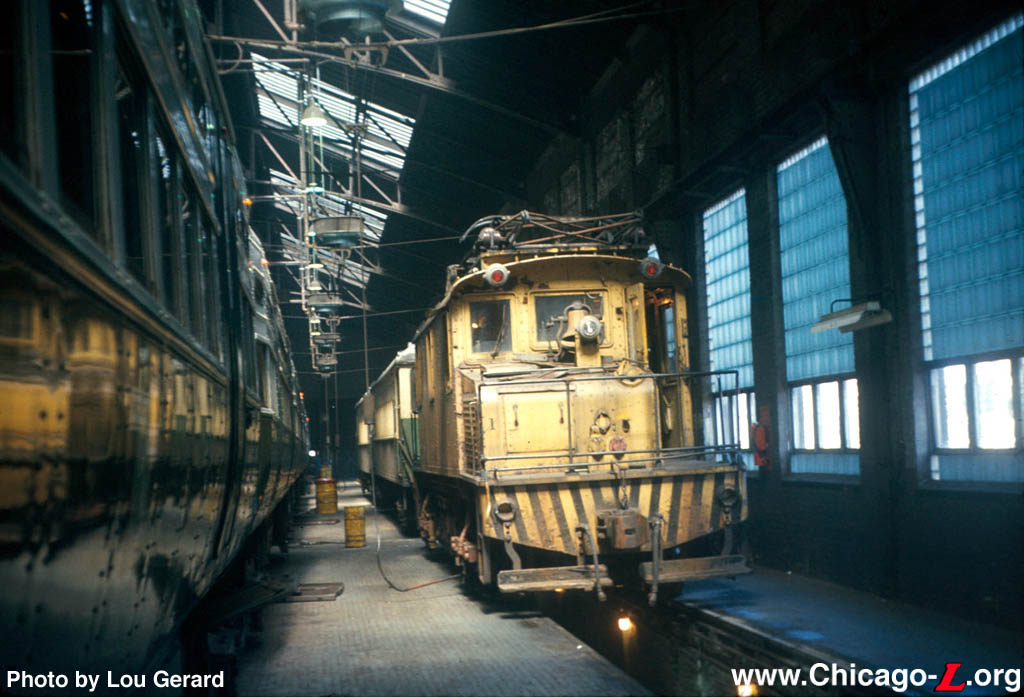
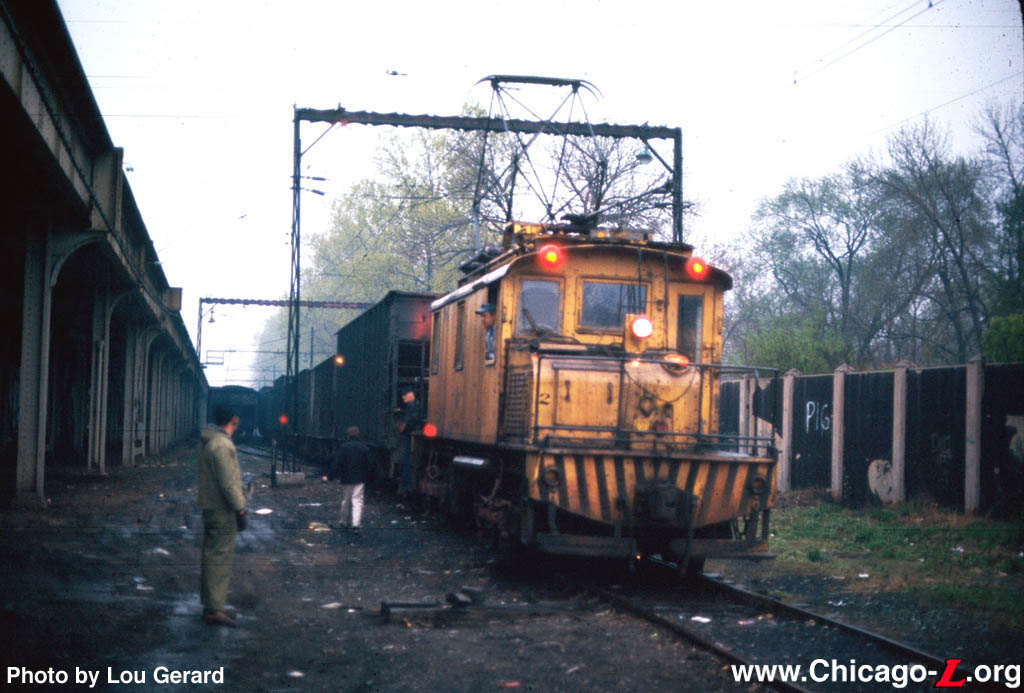
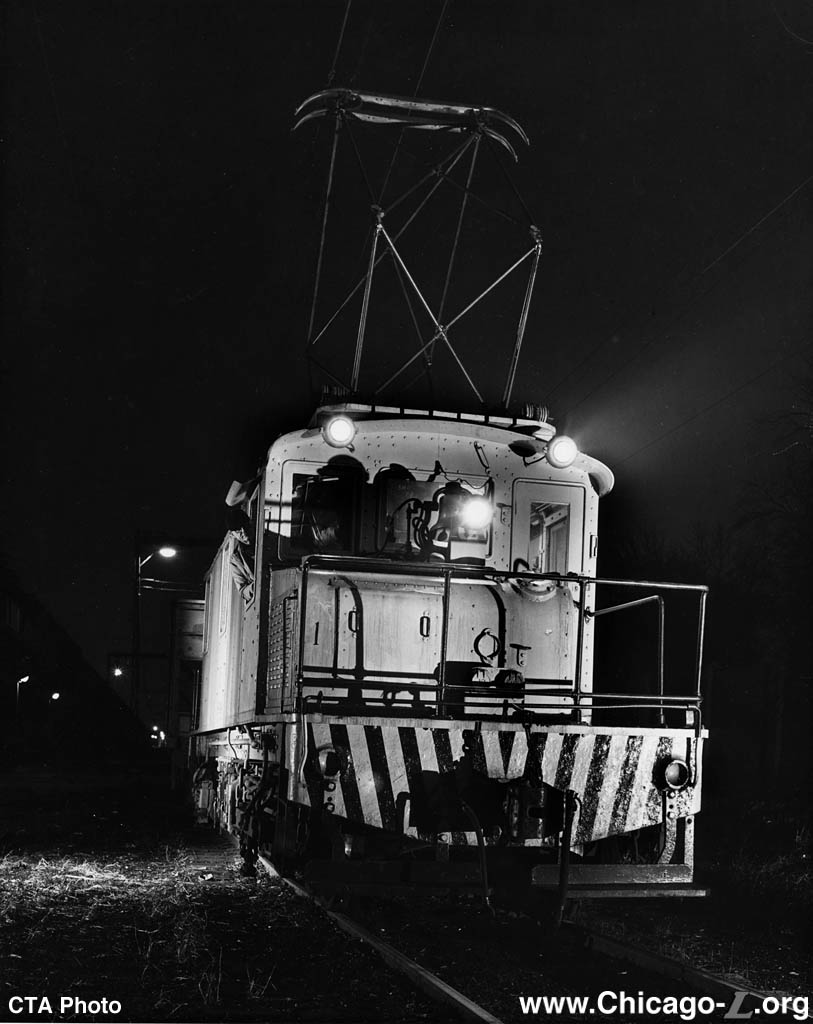
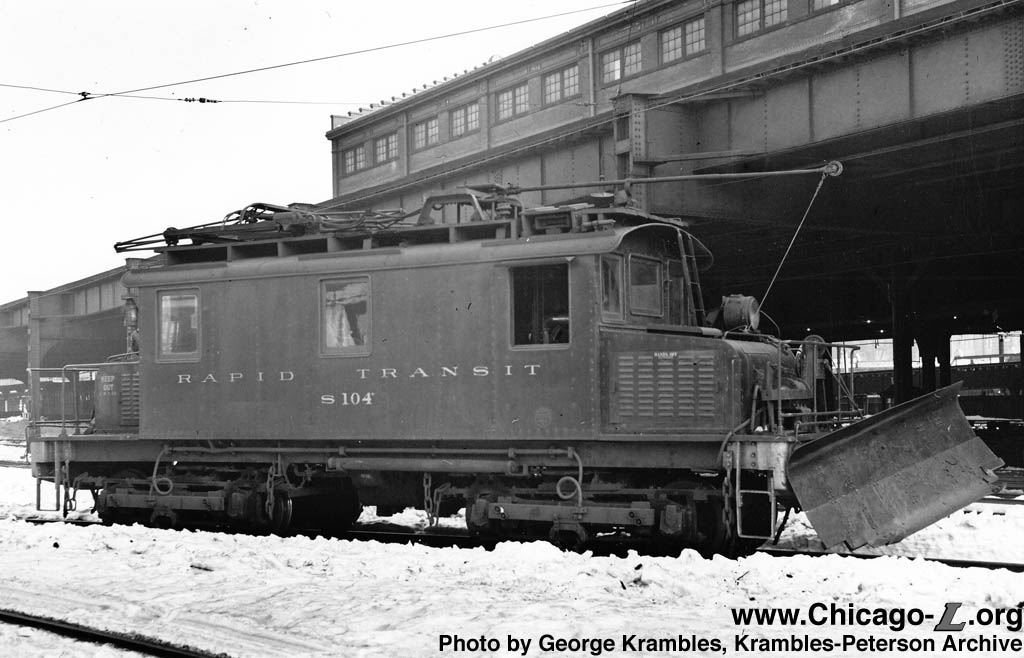
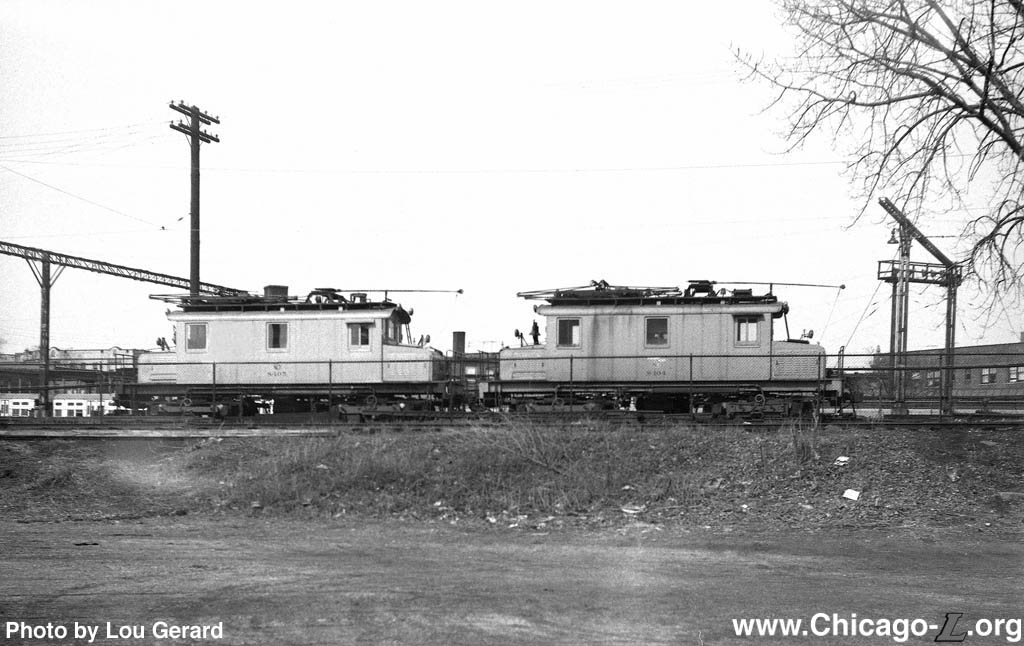
In 1920, the Northwestern Elevated purchased two Baldwin-Westinghouse 50-ton electric locomotives, numbered S-104 and S-105, for the track elevation project. Once that was completed, the locomotives were assigned to operate freight service north of the Buena Interchange Yard. These two locomotives operated "L" freight service for over 50 years, until the last freight trip in 1973. For more information on these locomotives, see the Freight Rolling Stock section.
Freight service on the "L" consisted mostly of coal, with some lumber and carload freight to the Evanston team track at South Boulevard. The South Boulevard team track was actually two tracks powered by overhead wire and extends about two blocks south from the north end of the South Blvd. station to Madison Street. On freight spurs like the one at South Boulevard, freight cars could be spotted so they could be loaded or unloaded by an industry or shipper. Many things were shipped from that team track over the years, from lumber to bricks to Tinker Toys, which were made at a nearby factory.
The "L" also handled interchange traffic for the Milwaukee Road and North Shore Line between Buena Yard and a siding on the North Shore's Skokie Valley Route between Kostner and Crawford avenues. This traffic dried by in the 1940s, however.
The Milwaukee Road had a freight station and siding on the west side of the Evanston branch north of Church Street. The local distribution branch of one or two meat packers was back in there, too. To get a freight train into that siding, one had to make a switchback move after leaving the southbound mainline track. The tail of the switchback once was used as a team track to bring in material for the Northwestern University lab that had an old truss bridge into it.
Gauntlet Tracks
After track elevation was completed on the North Side of Chicago and through Evanston, freight trains were limited to which tracks they could operate on. Between Leland Avenue (where the spur from the Buena Interchange Yard connected to the "L"'s North Side Main Line) and Howard Street, freight trains were restricted to Track 1, the westernmost track. Although Track 1 was typically used by southbound express trains, freight trains operated in both directions on this track. North of Howard Street, both tracks were shared by passenger and freight trains.
Because many of the freight cars, such as boxcars and gondolas, that were interchanged with the Milwaukee Road exceeded the side clearances of the "L" system, many of the areas that freight trains operated on the "L" has gauntlet tracks to negate clearance conflicts.
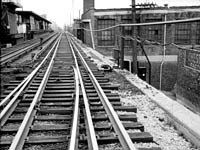
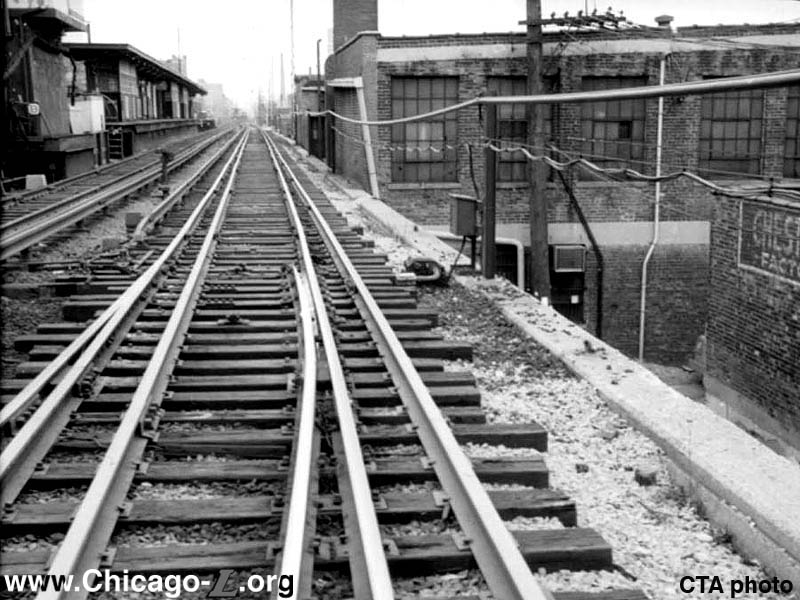
The gauntlet track on Track 1 is seen looking south from Granville Interlocking on April 18, 1967. For a larger view, click here. (CTA photo) |
Gauntlet track (also sometimes spelled "gantlet" track, or commonly referred to as "interlaced" track in the UK) is an arrangement in which two sets of railroad tracks run parallel on a single track bed. The track sets are overlapped within the same right-of-way, offset by only a few inches or feet, such that only one pair of rails may be used at a time. Railroads typically use gauntlet tracks for one of two purposes. In many instances, they are used where two parallel and separate sets of tracks converge onto a single roadbed to pass through a narrow passage such as a bridge or tunnel without actually merging, thus eliminating the need for frogs and switches. The other instance, and the one necessitating their use on the "L", is where some trains (but not all) need wider clearance around a fixed object next to the tracks, such as a platform or the third rail in the case of the "L". The second set of tracks for freight trains was offset just enough for the main set of tracks for passenger "L" trains to allow freight trains sufficient clearance from the third rail and platform edges by moving freight trains further away from those fixed objects.
Gauntlet tracks existed at the following points along the "L" into the early CTA era:
No gauntlet track was needed for third rail clearance on Track 1 between Howard and Granville because there was no third rail there until November 1964, this section instead being solely powered by overhead wire.
In a rare instance of the extent of gauntlet track being extended in the CTA era, the gauntlet on Track 1 was extended from Leland Avenue to south of Wilson Avenue along the freight spur in 1959. This was the result of the reconfiguration of the tracks through Wilson station in this period, and southbound express and North Shore Line passenger service being rerouted down this track. A side platform was built on the freight spur for southbound trains, resulting in the need for a gauntlet there to provide sufficient freight train clearance through the new platform.
During the later years of freight service, sections of gauntlet track were slowly removed from service and customers dwindled and the need declined. The station gauntlets north of Church Street on the Evanston branch were removed from service in 1960 or 1961. The station gauntlets between Juneway Terrace and Church Street on the Evanston branch were removed from service in 1961, though those through South Blvd. station on Track 2, providing access to the South Blvd. team track, remained in service later. The gauntlet for platform clearance at Howard remained in service until some time between 1965 and 1973.
The north end of the North Side Main Line Track 1 gauntlet track remained at Granville until sometime between 1965 and 1973. By 1975, the north limit of the gauntlet was at Bryn Mawr station, while the south end remained at Wilson. On June 20, 1975, two years after freight service had been discontinued, the gauntlet on Track 1 between Wilson and Bryn Mawr was officially removed from service.
Freight Service in the CTA Era
When the CTA took over the operations of the Chicago Rapid Transit Company on October 1, 1947, they inherited the obligation to operate freight service from the CRT.
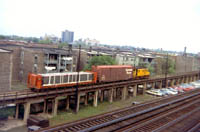
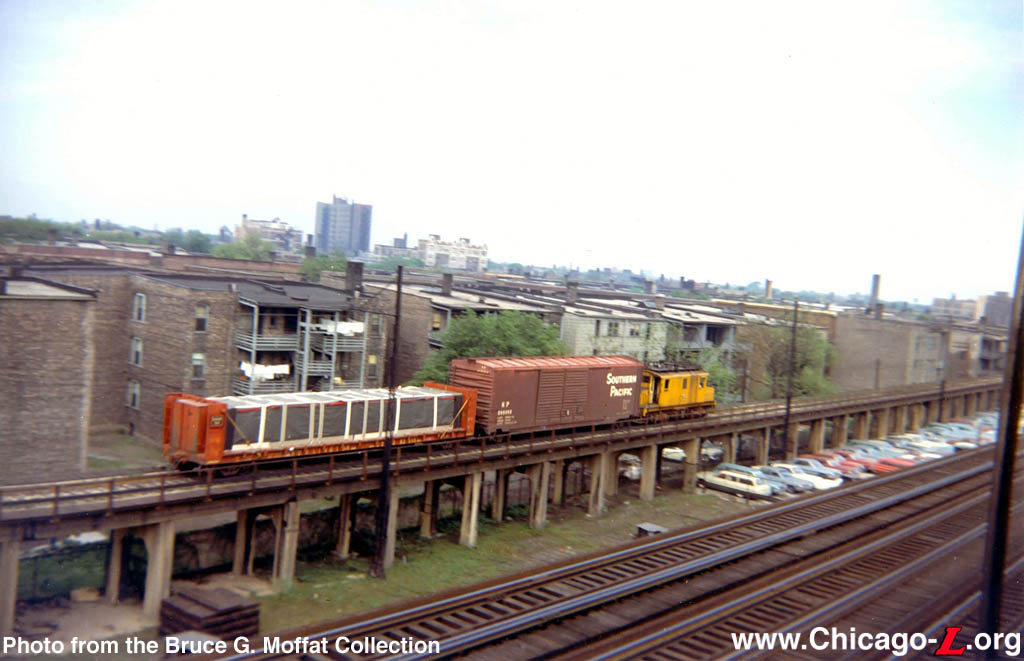
One of the CTA's electric freight locomotives hauls a two-car train consisting of a Southern Pacific boxcar and a bulkhead flatcar loaded with lumber on the lead connecting to Buena Yard north of Montrose circa the mid-1960s. For a larger view, click here. (Photo from the Bruce G. Moffat Collection) |
The CTA took ownership of all of the CRT's assets, but as described above the Milwaukee Road, as part of the agreement by which "L" service was extended north over their tracks, actually maintained ownership of the right-of-way north of Leland Avenue to the end of the line at Linden, as well as the single-track spur between Leland and Montrose leading down to the Buena Interchange Yard. The Milwaukee Road owned the property and leased it to the CRT and later the CTA until 1952, when CTA finally bought it. The Ninth Annual [1953] Report of the Chicago Transit Board explains:
"Effective October 1, 1953, a section of the right-of-way of the Evanston Division of the Chicago, Milwaukee, St. Paul and Pacific Railroad Company was purchased by Chicago Transit Authority for $7,000,000. This section, 7.68 miles in length, with 25.48 miles of regular track and 3.28 miles of gauntlet track or 28.76 track miles in all, extends from Montrose Avenue in Chicago to Linden Avenue in Wilmette. . . .
"The Milwaukee Road purchased Seven Million ($7,000,000) Dollars in CTA revenue bonds from the Authority. This provided CTA with money for payment for the purchase of property. These bonds are due July 1, 1982 and bear interest at 4-1/2% commencing October 1, 1953. . . ."
So, the property changed hands in 1953, but the Milwaukee Road could collect $315,000 annual interest on the bonds until 1982. This was not as much as the rental would have been, but on the other hand it freed the railroad from taxes or other expenses associated with ownership.
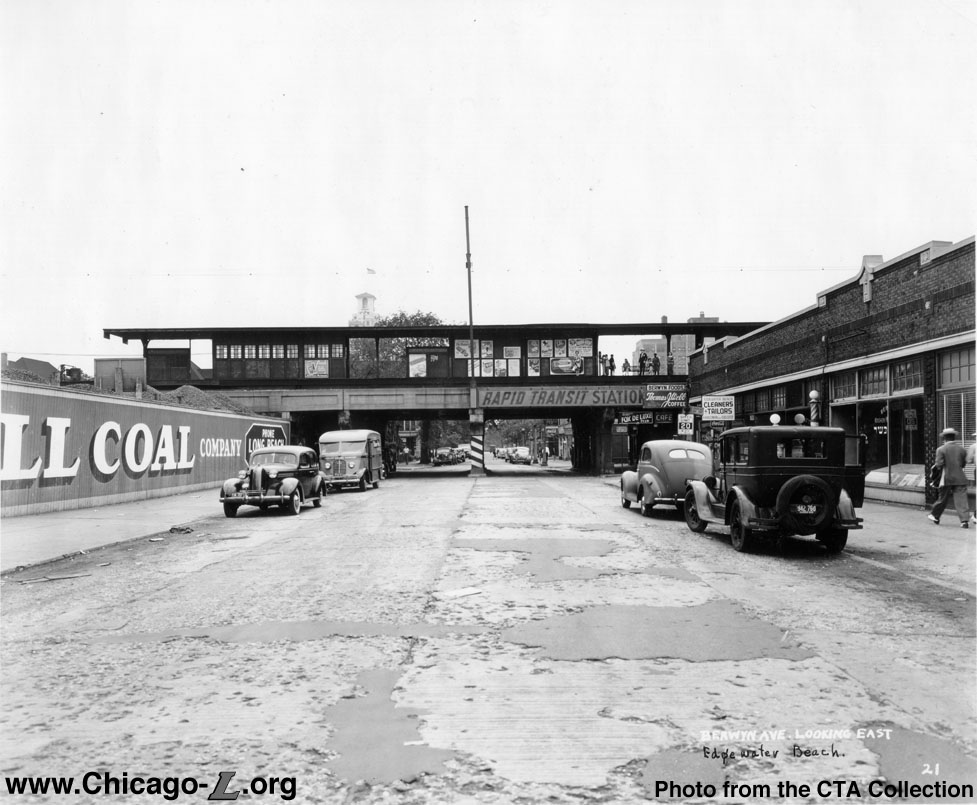
Early in the era of CTA operating the "L"'s freight service there were will a number of customers along the North Side Main Line and Evanston Division. There were active freight sidings off the gauntlet on Track 1 south of Granville (Jacob Best Coal), at Berwyn (Lill Coal Company), and at Wilson (J.B. Seeburg Corp., a warehouse that would receive carloads for customers and store them until taken out by truck). At Howard, there were sidings south of the station (Consumers Company of Illinois) and two to the north (both serving Hines Lumber). There were also several sidings in Evanston. There was a siding north of Main to receive bulk gasoline, a coal trestle south of Davis, and a siding for the Public Service Company of Northern Illinois near Church Street, north of Davis station. The South Blvd. team track was also still active.3
The Public Service siding in downtown Evanston produced both inbound and outbound loads. When the facility was dismantled, the CTA freight hauled away the bricks from the demolished buildings. The South Blvd. team track produced a variety of interesting loads, from bricks to Tinker Toys, which were made in a nearby factory. During a Chicago & North Western railroad strike in 1962, the CTA handled a number of customers that typically shipped via the C&NW, and crews were taking cars to the South Blvd. team track most every night.
Decline of Freight Service
While there had at one time been enough freight work to require two separate crews, as time went on, and there were fewer and fewer customers and the required manpower was reduced to require only one crew. Several factors contributed to the decline of the "L"'s freight service. As was occurring all over the United States during the post-World War II era, the amount of freight transported by railroads declined overall as the national highway network was expanded and shipping by truck became more prevalent. As a result of this and other urban development factors, many businesses along the "L" that shipped freight closed. After the loss of Edward Hines Lumber Co. near Howard as a customer in the 1960s, the work became more sporadic and highly seasonal, with coal for heating being the last loads handled.4 But even this source of business was quickly drying up -- coal was largely being phased out in favor of gas or oil for heating purposes.
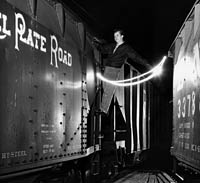
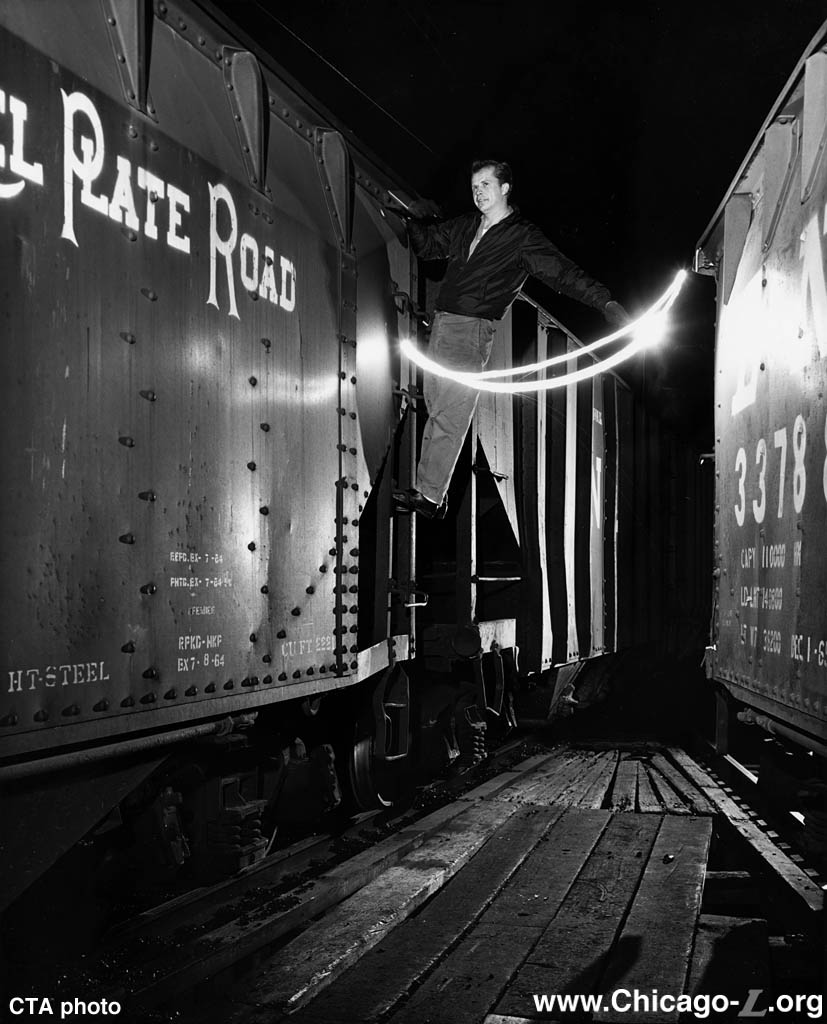
Freight switchman Carl Lyday hands signals to the locomotive motorman with a fuzee from cars staged on the Lill Coal spur on November 2, 1965. For a larger view, click here. (CTA Photo) |
The Traders Building Material Co., later the Wisconsin Lime & Cement Co., spur track north of Howard was inactive by 1946. By the 1950s and 1960s, the number of customers was steadily declining. A coal trestle on the Evanston branch south of Davis near Lake Street was removed circa 1951-53. A spur into the Consumers Coal Co. north of Greenleaf Street was disconnected by 1955.
Railroads were fighting a losing battle nationally for their share of freight traffic, and in an effort to drum up additional business, in the early 1970s, the Milwaukee Road implemented a tariff which gave customers a special rate for batches of 45 cars. While producing economies of scale for the Milwaukee Road, handling that many cars at once was a problem for the "L". The Lill Coal Company, located just opposite the Berwyn station, took advantage of this discount and 45 cars would show up all at once at Buena Yard. The "L" freight crew couldn't handle that many cars at once, so the Milwaukee Road would spot the cars south of Irving Park Road along Seminary Street and would move them up into Buena as the CTA crew and Lill could handle them. Lill could handle up to 18 cars at a time, so the CTA crew was forced run 18-car trains between Buena and Lill. It would require four nights to complete the work, with an 18-car loaded train being moved up to Lill one night and the empty cars brought back to Buena for the Milwaukee Road to take back the next night. While this was perhaps more economical for the Milwaukee Road, it was inefficient for the CTA, since Lill was now buying coal in larger batches, resulting in a month between orders. If Lill's coal order was the only freight to move, the CTA crew would only have four nights' work a month. As a result, the motorman and switchman who picked the freight run would go on the extra board when there was no freight to handle.5
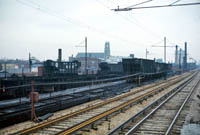
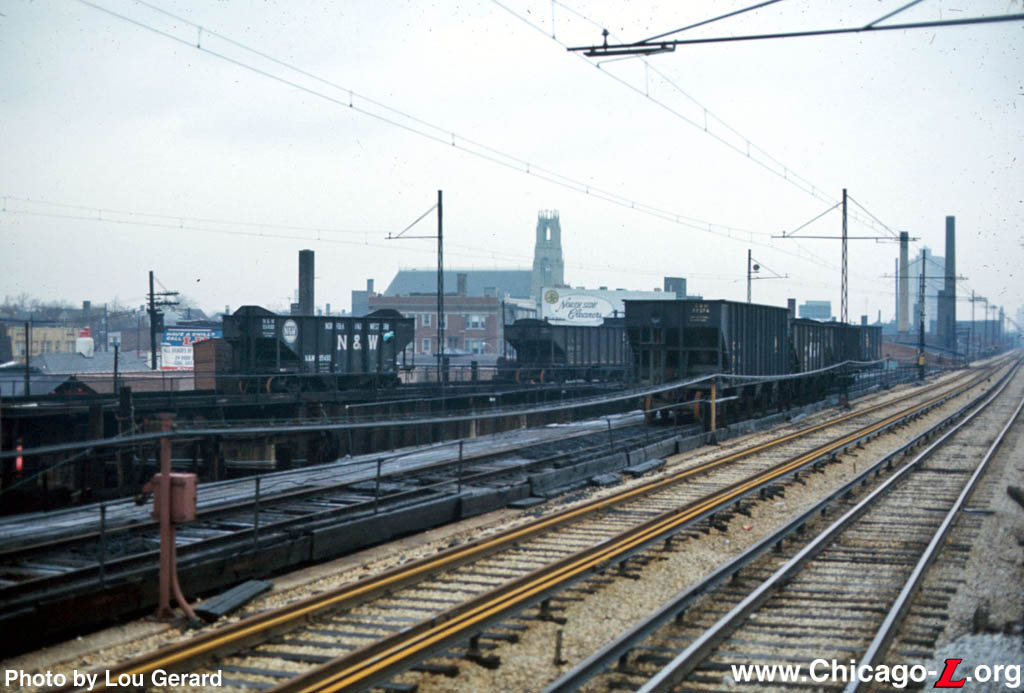
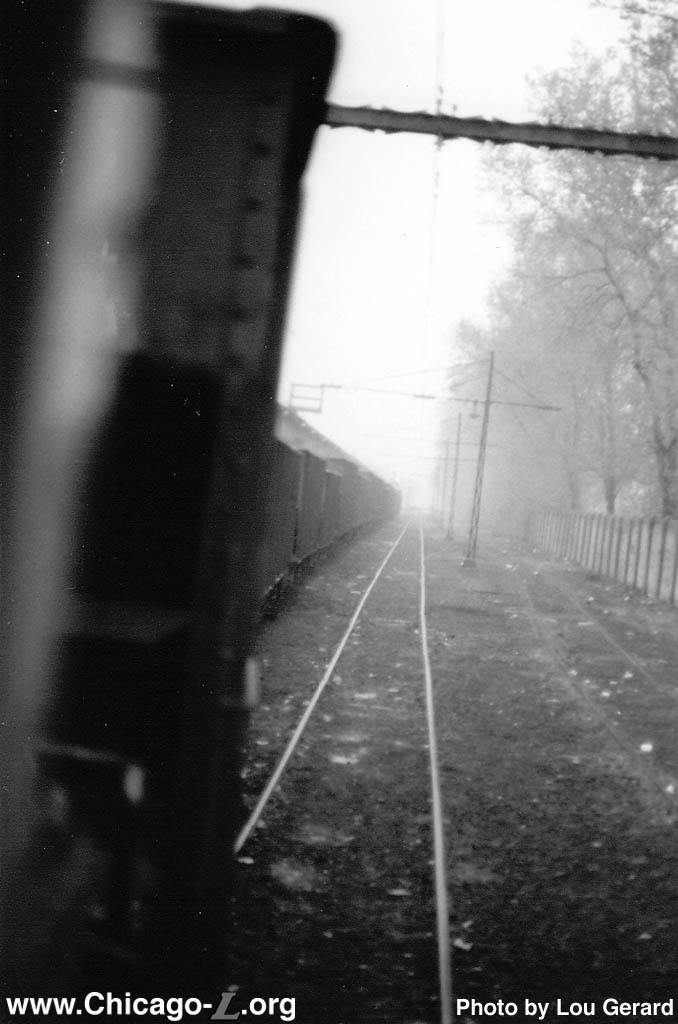
The two Lill Coal spurs north of Berwyn Avenue are seen with several coal hoppers staged on them looking north on April 21, 1973, a week before the end of CTA freight service. For a larger view, click here. (Photo by Lou Gerard) |
The last train to run over the Milwaukee Road's swing bridge over the Chicago River was on March 31, 1969. In later years, the bridge had been used for transfers from Division Street Yard on Goose Island to Union Station and Western Avenue on the Milwaukee Road Elgin Division. Freight service on the South Boulevard team track more or less ended in the late 1960s, with the last known shipment, a 50-foot boxcar of bricks for a contractor, occurring around 1970.
With the loss of customer at the north end of the North Side Main Line and in Evanston, the CTA began to dismantle some of the freight service infrastructure in the 1960s. The track gauntlets for platform clearance on the Evanston branch between Juneway Terrace and Church Street were removed in 1961. On April 12, 1971, the freight gauntlet on Track 1 from south of Bryn Mawr to Granville was removed from service. An additional section of gauntlet on Track 1 through Howard station was removed from service on September 26, 1971.
By the 1970s, several factors were spelling the end for CTA's freight service. The operation was becoming costly, with per-car switching costs on the order of $50.6 The CTA had safety concerns over various aspects of the operation, including the need to push the 18 empty cars back to Buena due to the Milwaukee Road's tariff and the switch layout at Lill. Customers were drying up.
After several years of trying to abandon "L" freight service due to poor revenues and high costs, the CTA and Milwaukee Road were finally successful in 1973. By this time, there was just one freight customer left: the Lill Coal Company. Unusually, during the last month of freight operations, the train ran during daylight hours, usually right after the morning rush, rather than at night.7 April 30, 1973 was the last day of CTA freight operations. That morning, the CTA picked up eight loaded hopper cars from Buena Yard and took them to Lill Coal for the last time. That evening, after the last southbound Evanston Express train left Howard Street at the end of rush hour, the S-104 came out of Howard Yard and returned to Lill, picked up the eight empty hoppers, and pushed them down Track 1 and into Buena Yard to return them to the Milwaukee Road, marking the end of a unique operation. The crew and riders on that last trip included regular motorman Tony Grabski, conductor Ed Gratz, and switchmen Jim Zepp, Walter "Hotdog" Lindberg, and Ed Irwin, plus Bob Janz and Lou Gerard.8
Epilogue: After CTA Freight Service
The "L"'s freight service left a legacy in several forms. Much of the infrastructure remained in place for a number of years, and some still continues in service today.
A new switch was installed on June 20, 1975 on Track 1 south of Wilson where the revenue service track splits off from the Buena yard lead to return to the main line. At the same time, the gauntlet and trolley wire north of Wilson was removed from service. The gauntlet switch and Lill Coal Co. lead switch at Berwyn were also removed. The spur tracks around Howard into the Edward Hines Lumber Co. were removed sometime between 1978 and 1990.
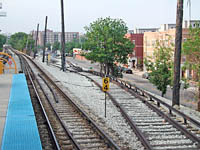
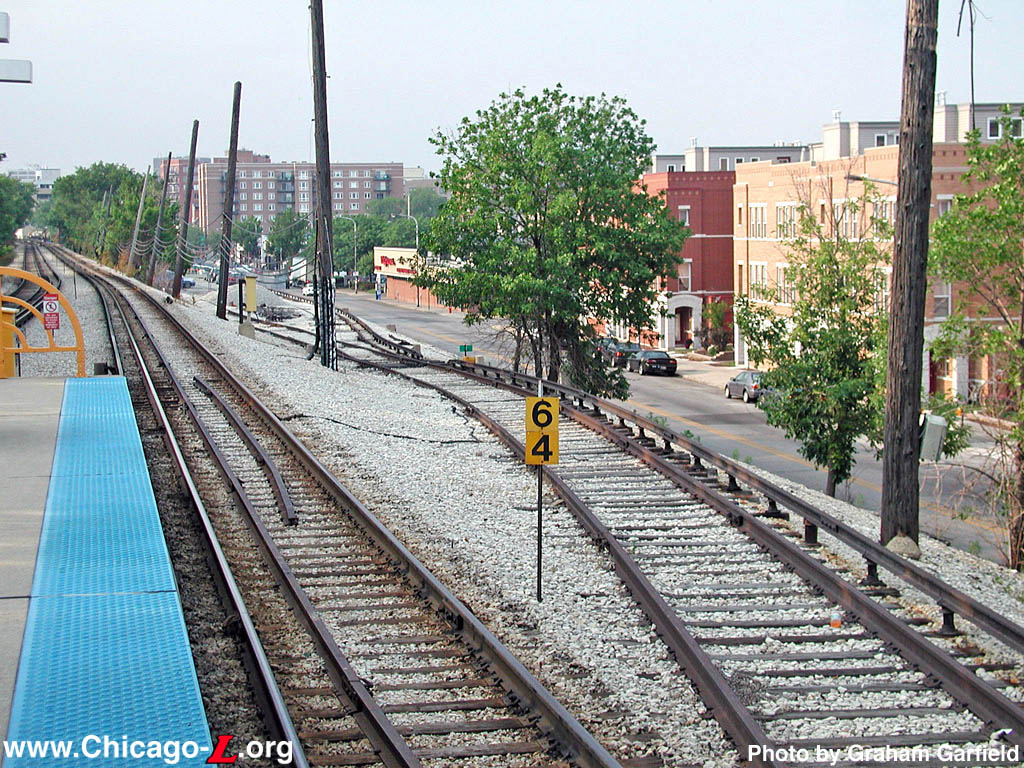
The South Boulevard team track is seen looking north from the South Blvd. station platform on July 12, 2005. Although the team track is not regularly used anymore, it is kept in service and see occasional use for loading rail-borne equipment or delivery of materials. For a larger view, click here. (Photo by Graham Garfield) |
The CTA used the South Blvd. team track for loading ballast cars while the North Side Main Line was rebuilt between Lawrence and Howard 1975-77. After that, it has seen only very sporadic use. Occasionally a work train is laid up here, such as while Skokie Shops was being reconstructed in the 1990s and track space there was very limited. There have been problems with vandalism when cars are left on the team track for extended periods, so this was something that has not typically been done unless absolutely necessary. On December 10, 1981, third rail was put in service on the South Boulevard siding, replacing the overhead trolley wire.
Remnants of some sidings continue to exist. Although the switches and tracks were disconnected in 1959, remnants of the spur from Track 1 into the former J.B. Seeburg Corp. warehouse at Wilson remained until 2000 and path of the spur is still clearly discernible. Although the spur into the Consumers Coal Co. north of Greenleaf Street on the Evanston branch was disconnected by 1955 and the site was later developed -- a Jewel grocery store sits on the site today -- remnants of the spur track remain visible in the underbrush and tree growth along the east edge of the embankment along the edge of the Jewel's parking lot. There is also a spur track on the Evanston branch that formerly connected to a coal yard, disconnected from the main line tracks between 1953 and 1955, going off to the east visible just north of Lake Street where the Lions Club Building now stands.
The spurs to the George Lill Coal Co. were removed in 1973, not long after freight service ended. Today, a Jewel grocery store stands on the former site of the Lill Coal Co.
After Buena Yard was closed it stood abandoned for a number of years. In 1991, the half-mile long narrow sliver of land between the North Side Main Line elevated structure and Graceland Cemetery was rehabilitated and transformed into a park and parking lot.
The largest and most visible remnant of the former freight service are the embankments for the Red and Purple lines north of Wilson, whose type of right-of-way construction is a legacy of its need to support the weight of freight cars. Perhaps more conspicuous is the single-track elevated guideway, constructed of a concrete deck supported by a dual row of columns, between Leland and Montrose Avenues, that connected Track 1 with the incline down to Buena Yard. As a result of a track realignment project around Wilson station in 1959-61, Track 1 for southbound revenue trains was rerouted onto the freight spur between Leland and a new connection back to the old main line Track 1 around Sunnyside Avenue. The spur south of Wilson across Montrose Avenue remained extant long after freight service ended in 1973. Sections have been removed over time. The through girder bridge with ballasted deck that carried the freight lead over Montrose Avenue was removed on September 26, 1998. The Chicago Department of Transportation removed it as part of an improvement project on Montrose. The bridge itself was preserved, brought to the Illinois Railway Museum two days later as three 15-foot wide loads. IRM planned to use it to span a creek. The right-hand crossover south of Wilson between from Track 1 to the freight lead was temporally removed from service for four days beginning September 15, 2005 while the CTA Track Department repaired and installed new switch points. The work was necessary because a contractor planned to use the lead to load materials onto the elevated. Most of the remaining elevated yard lead structure, from between the Track 1 switch south of Wilson to a point between Sunnyside and Montrose, were demolished in 2010 to make room for the adjacent Truman College to construct a multi-level parking deck. The only portion of the concrete yard lead structure remaining is a section a few hundred feet long immediately north of Montrose Avenue, behind the old Clifton Substation.
Milwaukee Road Freight Abandonment
The story of the Milwaukee Road freight tracks between downtown and Irving Park Road has always been intertwined with the story of freight service on the "L", and its operation continued for a few decades after freight service was discontinued on the "L".
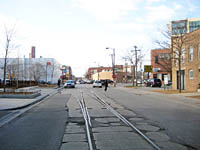
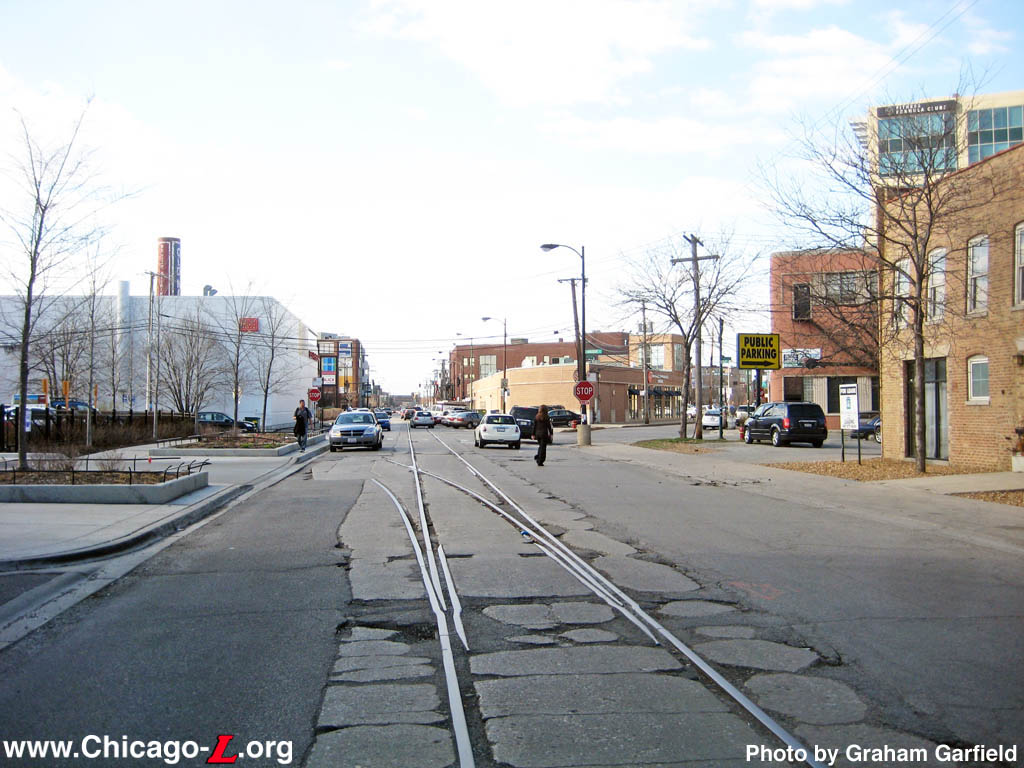
Some sections of the Milwaukee Road's tracks remain in situ, as seen looking northwest on Kingsbury Street toward Weed Street on April 11, 2011. The switch visible ahead led to the Midwest Zinc company spur. The Chicago Midwest Zinc plant closed in January 2001. Today, a Whole Foods grocery store stands on the site. For a larger view, click here. (Photo by Graham Garfield) |
The Milwaukee Road continued to haul freight on part of the old Chicago & Evanston Railroad line for many years. As far back as 1971, the Milwaukee Road desired the line to be abandoned north of Clybourn Avenue due to a poor revenues9. After 1973, the tracks at the north end of the line, south of Buena, were gradually abandoned. By 1984, the tracks were only in service as far north as Belmont Avenue. At that time, the remaining customers were a fuel oil company on Racine Ave., the Reed Candy Company, the Hostess Bakery, and the Peerless Confectionery Company. The Reed Candy Company, located just south of Belmont, was acquired by Wrigley and production was moved to a more modern facility near Yorkville. The Reed Candy building was closed around 1984 and was torn down in 1987. In the 1980s, the limited freight traffic was handled by Milwaukee Road Job 1561 in the afternoon with an SW1200 locomotive10. At that time, there were still several industries along Kingsbury Avenue where the freight tracks ran for a few miles.
As sections of the Lakewood branch were abandoned, many portions were filled in with new buildings and other construction. In some areas, this redevelopment has largely obscured the path of the former tracks. However, in many areas, the route of the freight line is still revealed by unusual features such as buildings and other elements that have unusually angled shapes and boundaries, which conform to the property lines delineated by the old Chicago & Evanston right-of-way.
By the 1990s, some trackage remained in use south of Diversey Avenue, by then operated by Canadian Pacific Rail/Soo Line. The last freight customer on the Lakewood branch, north of Cortland Street, was the Peerless Confectionery at Diversey and Lakewood. By the 2000s, the so-called "candy train," which made its way along Lakewood Avenue on Tuesdays and Thursdays to serve the candy company, was the only freight service on the line. The last shipment to Peerless via the Lakewood branch is believed to have been made on February 27, 2007. A single tank car still sat on the Peerless siding on March 8, 2007, but was gone the next day, suggesting this was the last successful move made on the former Chicago & Evanston Lakewood branch tracks north of Cortland. The last move of any type took place in 2009 when cars were moved onto the line for storage11.
Today, there is very little left of the railroad. Vestiges of siding tracks may be found on a few properties between Goose Island and Irving Park Road. Rails may occasionally be found in the streets in which the line once ran, such as Lakewood and Kingsbury, often largely covered by asphalt, but even these are continuing to disappear. In 2009, the City of Chicago filed an adverse abandonment petition against the Chicago Terminal, the short line railroad that succeeded the Canadian Pacific as the owner and operator of what remained of the Chicago & Evanston. A settlement was reached in which the Chicago Terminal received compensation for vacating the right-of-way in Lakewood and Kingsbury where the City desired to rebuild the streets. As of 2011, a few hundred feet of track remain south of Clybourn on the Goose Island lead for use as a tail track when freight trains service Finkl Steel on the Deering Line.12 In April 2012, construction crews began to remove the old Chicago & Evanston tracks in Kingsbury from North Avenue to Scott Street, and in Scott from Kingsbury to Halsted Street, as part of a $4.3 million "streetscape improvement" of the streets. After removing the 2,500 feet of tracks, crews reconstructed the pavement, curbs, gutters, driveways and sidewalks.13 Paving work was completed in August, after which landscaping work began. The entire project was completed in October 2012.14
The C&E tracks remain north of North Avenue.15
For more information on the Lakewood branch freight tracks and other remnants of the Chicago & Evanston line south of Irving Park Road, see the Lakewood Branch and Chicago Switching Web sites.
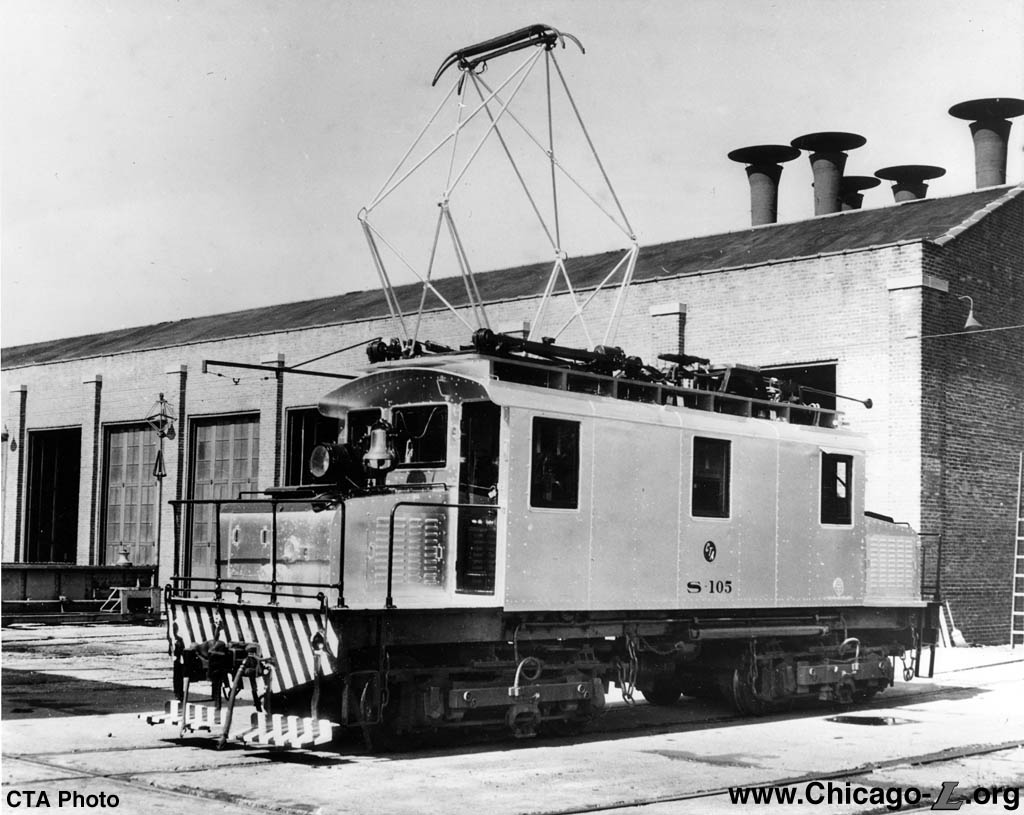
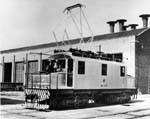
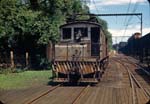
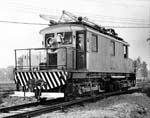
In 1920, the Northwestern Elevated purchased two Baldwin-Westinghouse 50-ton electric steeple-cab locomotives for the track elevation project. The Northwestern numbered the locomotives S-104 and S-105. Once the track elevation project was completed, the locomotives were assigned to operate freight service north of the Buena Interchange Yard.
For the sake of standardization, the two locomotives were equipped with the same size wheels, the same motors, and the same gear ratio as that used on the most current type of steel cars (the Baldie 4000-series) purchased by the elevated lines at that time. Each locomotive was equipped with four Westinghouse 567-R-1 motors. The wheels were 34" in diameter and the gear ratio was 17 to 60. The April 2, 1921 issue of Electric Railway Journal described the locomotives' equipment in detail, explaining,
The motors are of the field control type, developing 165 hp. each on one-hour rating. The locomotives are arranged for multiple-unit control so that they may be coupled together for pulling a train as long as twenty-five cars up the 2 per cent grade approaching the elevated structure. They are equipped with Economy watt-hour meters. There are three running points provided in the control, providing three operating speeds. These are derived by connecting all four motors in series, two motors in series and two in parallel, and four motors in parallel. The motorman notches up the throttle-type controller through sixteen points to the full series position, then brings the controller back and throws a change-over lever which provides for the parallel running points.16
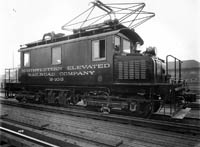
Recently delivered from the Baldwin Locomotive Works, locomotive S-105 is spotted outside the Northwestern Elevated's Wilson Shop in 1920, posed for the company photographer. For a larger view, click here. (Photo by A.F. Scholz, Krambles-Peterson Archive) |
The control positions were in opposite corners of the cab, so when the motorman had the change ends he moved to the other side of the cab. As noted above, the locomotives' master controllers had 16 points, and through the use of a series/parallel switch at each of the two control positions in each cab it could effectively become two two-motor locomotives (in parallel) or one four-motor locomotive (in series). One could not from the series to parallel without shutting off the controller and throwing the series/parallel switch, however.17
The series mode was meant for two purposes: low-speed switching and high tractive effort. The parallel mode was for higher speed operations. The locomotives could be started in series or parallel, but more smoothly in parallel due to the lower available tractive effort in parallel. In actual use, the locomotive was switched into parallel after going through all the points in series. The parallel position was used when climbing the grade travelling up the ramp out of Buena Yard onto the single-track connection lead to the main line. According to former CTA Transportation Department employee Bob Janz,
with a heavy train the operating practice was to have the locomotive in parallel before it reached the small yard office at Buena. Full power would be maintained until a point just short of the top of the grade. The engineer would then back off a few points to avoid overloading the locomotive, to prevent the roof-mounted 600v dc ribbon fuse from blowing.18
There were three air-operated reverses on each locomotive. This was different than the standard arrangement for most electric locomotives. Two of them were in the motor circuits to reverse the direction of rotation of a pair of motors. The third reverser was controller by the series/parallel switch.
As delivered, the brake equipment was of the Westinghouse 14 E.L. locomotive automatic type with air supplied by a Westinghouse Type D-3-F 35-ft. compressor designed for continuous duty. All equipment was mounted inside the cab. The locomotives had independent and automatic break valves, which allowed the air brakes on the locomotives to operated independently or in concert with the freight cars being hauled, so long as the cars' air systems had been charged by the locomotive. Janz explained, "Once the cars were charged, their brakes could be operated with those of the locomotive, or if desired, the locomotive could be held in release, a feature that was used to avoid sliding."
Although Electric Railway Journal reported that the locomotives, coupled together, were designed to haul up to 25 cars up the ramp from Buena Yard to the elevated tracks, in practical operation (at least by the later years of freight service) they could handle up to 18 loaded cars coming out of the yard, and then only with the help of some sand laid on the tracks to improve traction. The locomotives had sanders built into the cars, with the supply boxes built into the hoods on each end. However, the sandboxes tended to be damp, preventing the sane from flowing readily. At one time, a lighted kerosene lantern was placed in each box to keep the sand dry and flowing. In later years the use of the sanders was dispensed with and switchmen riding the footboards would dispense the sand from long-spouted water cans.19
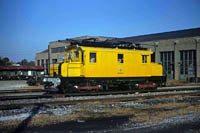
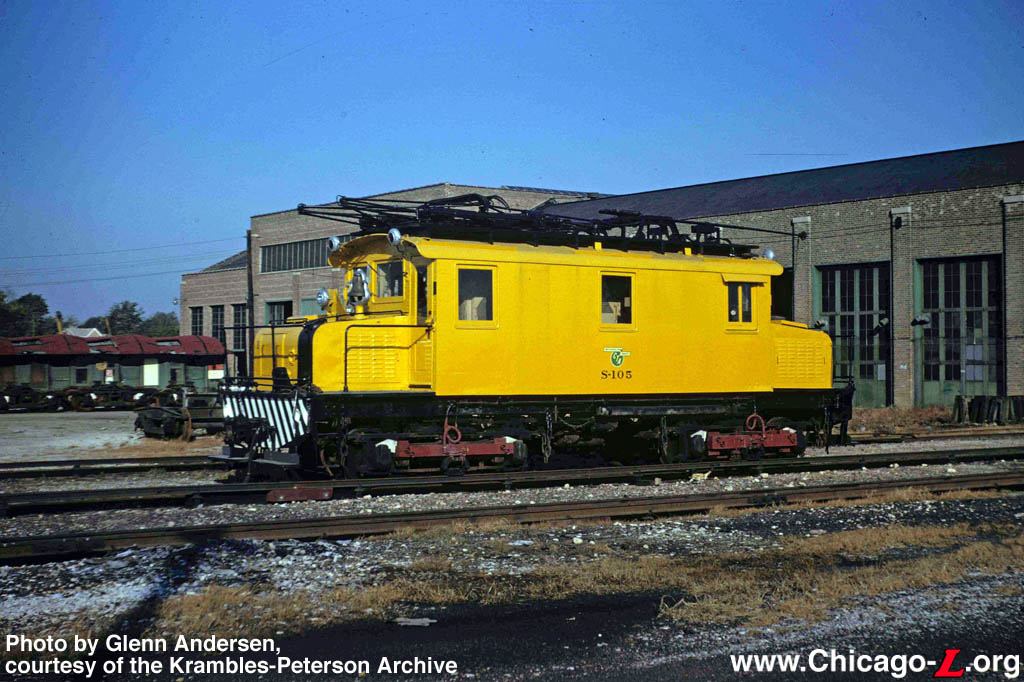
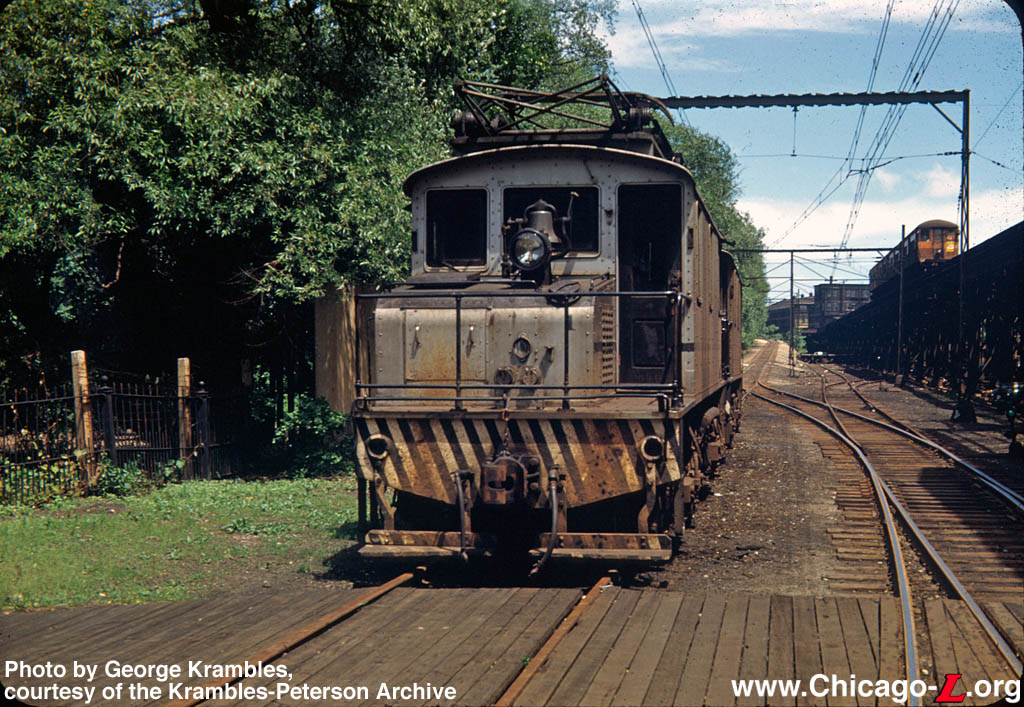
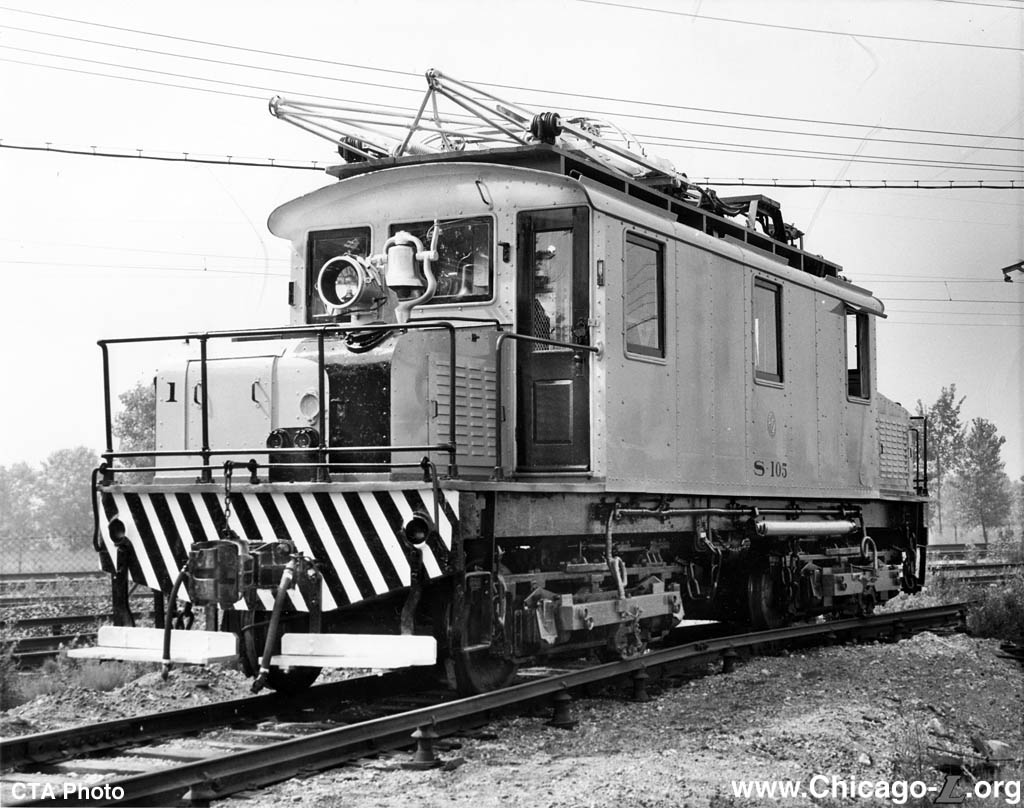
As part of improvements performed as part of an overhaul, the locomotives received a fresh yellow paint job in the 1960s, mostly similar to the one applied in 1953 but with some minor differences, including the newer CTA herald with "Metropolitan Transit" banner and painting all of the roof-mounted power equipment and apparatus black. The S-105 is seen outside Skokie Shops in its fresh paint in September 1963. For a larger view, click here. (Photo by Glenn Andersen, courtesy of the Krambles-Peterson Archive) |
The locomotives could operate powered either by third rail or overhead trolley wire. Each unit was equipped with four trolley shoes -- one per truck -- to draw power from the powered third rail. In addition, each engine had a pantograph (or "pan") and a single trolley pole mounted on top. The changeover between drawing power from the third rail and the trolley wire was accomplished by throwing a manual switch. The electrical switch gear was mounted in the middle of the car body, covered by mesh panels. When the locomotives were operated on the gauntlet track south of Granville, the pantograph was typically used. North of Granville, including on the gauntlets in Evanston, the trolley pole was used to collect current from the overhead wire. Because each locomotive only had one pole, one of the switchmen would have to run the pole around the car if the unit changed directions.20
As delivered, the locomotives were painted a dark color, probably Pullman green, with light (perhaps white, silver or gold) lettering on the sides. The cars probably remained in this paint scheme into the CTA era. According to Headlights magazine's June 1949 issue, the cars received a new aluminum-colored silver paint scheme the year before. The carbody was silver, while certain components such as the headlights and cast stands that held the bells on the hood were painted black. On the sides, under the center side windows, was an orange CTA herald and below that the car number painted in black.
The aluminum paint job weathered, and in September 1953 the locomotives were repainted yellow, which became the CTA's standard color for work equipment. The carbody was yellow, while the various handles and grab irons, end railings, and other components were black. Again, under the side center windows was a CTA herald (now green instead of orange) and a black car number. The locomotives retained this paint scheme for the rest of their CTA service lives.
In the mid-1960s, during a major inspection of S-105 resulting from reports of a leaky distributing valve in the locomotive's air brake system, the unit's portable kerosene markers and 600v DC headlight were replaced with battery-operated sealed-beam lights. This required the installation of batteries and a battery charger on the locomotive. S-104 was upgraded with battery-powered lights soon after. Throughout their lives, the locomotives' coal stoves remained in use for heat, later supplemented by a portable electric heater.
These two locomotives operated "L" freight service for almost 60 years. During that time, due to their size, weight, and operating characteristics, they performed some other duties as well. While the Skokie Valley Line was being built, they were used to tension the overhead catenary on the line. During World War II, they helped the North Shore Line handle their record level of freight traffic, working along side the North Shore's fleet of electric freight locomotives. The interurban would borrow the steeple cab locomotives during the day and return them to the "L" at night so they could work their normal duties. Their extreme weight made them good snowfighters, and during the 1967 snowstorm the S-104 and S-105 were coupled together, end to end, with plows mounted on their ends and used to clear the North Side Main Line and Skokie Swift.21
After freight service ended on April 30, 1973, the two Baldwin-Westinghouse freight locomotives, S-104 and S-105, were stored at Skokie Shops. The day after they were retired from freight service they were given a fresh yellow paint job at Skokie, then were used for the Central Electric Railfans' Association's 35th anniversary celebration over Memorial Day weekend. The two electric locomotives were kept for use at Skokie Yard, employed for snow plowing and handling the occasional interchange of freight with the Chicago & North Western's Mayfair Subdivision adjacent to Skokie Yard, pulling in a car of material or taking a car of scrap out.22 The locomotives were subsequently sold to the Toledo Edison Company in 1978 for use at their power plant.
On November 14, 1996, the Toledo Edison Company sold the two former "L" freight locomotives to Bob Harris, one of the promoters of an interurban railway heritage project in Michigan City, Indiana. The plan was to develop a site to display three restored South Shore Line interurban cars and other small exhibits. It is likely that Harris planned to modify the S-104 to more closely resemble a South Shore Line steeple-cab, none of which survive. The S-104 remains on a siding in Michigan City, surrounded by chainlink fencing and still wearing its yellow CTA livery with a Toledo Edison logo on the side. The S-105 was resold to the East Troy Electric Railroad Museum, then sold to the Illinois Railway Museum in 2007. It was undergoing restoration at IRM as of 2011.
Interurban Freight Operations on the "L"
Although the two interurbans that ran over the "L" into Chicago using trackage rights -- Chicago North Shore & Milwaukee and Chicago Aurora & Elgin -- hauled freight of various types via the "L", they did not serve freight customers on the "L". They loaded and unloaded freight at points in Chicago, then hauled it beyond the "L" routes into their home territories. However, since they had freight terminals along the "L" and ran via the elevated lines, their freight operations as they related to the "L" bare some mention.
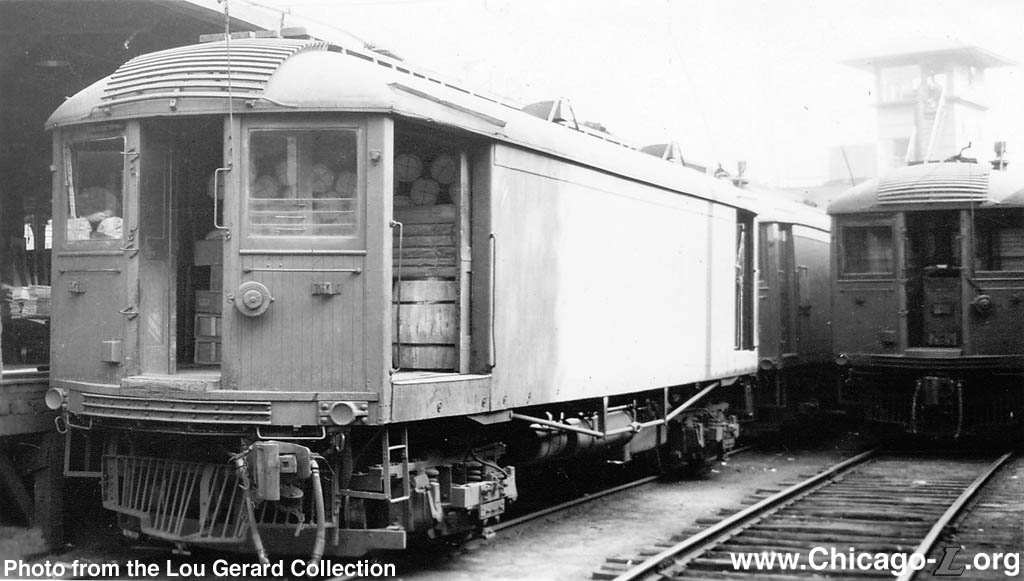
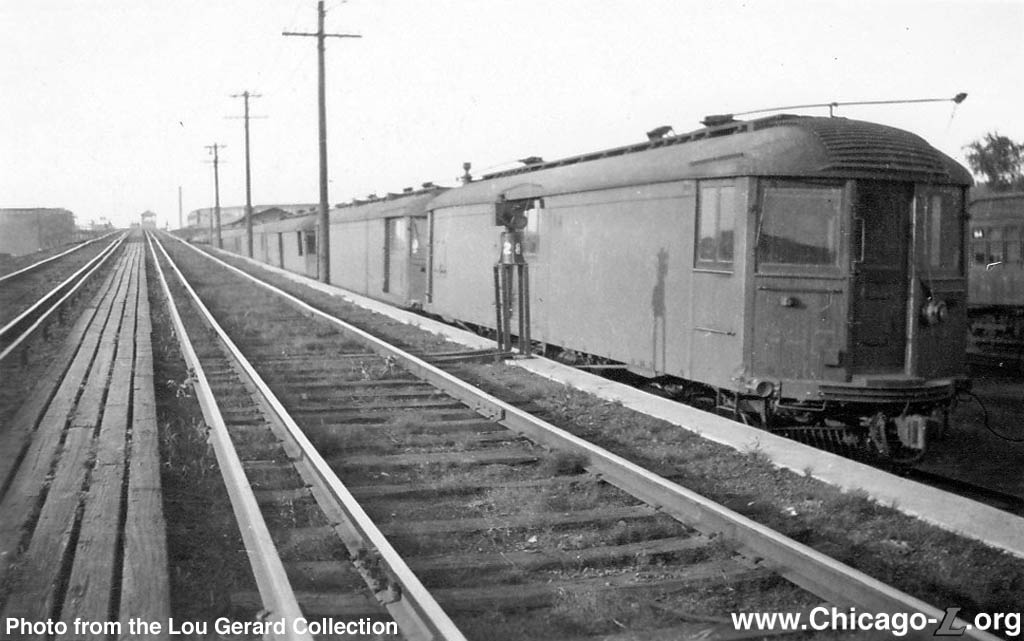
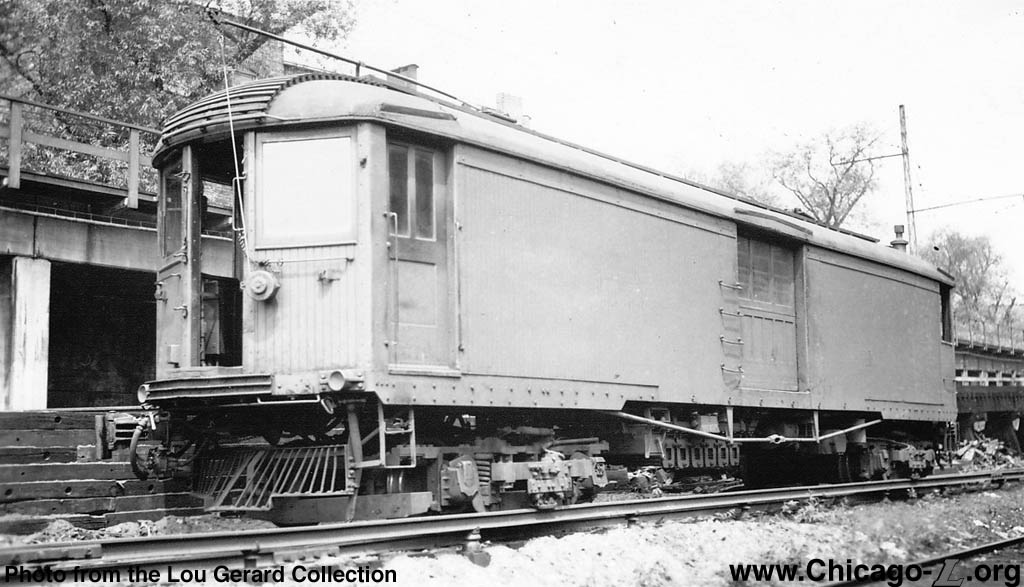
The North Shore Line and Chicago Aurora & Elgin carried items such as newspapers, baggage, and express and less-than-carload merchandise despatch (spelled "despatch" rather than "dispatch", owing to Chairman Samuel Insull's British heritage) service. This cargo was carried in regular interurban passenger cars, combination passenger/baggage cars, or special freight cars, depending on the type of freight, that conformed to "L"/interurban clearances and specifications. These types of freight operations occurred all over the "L" system, but were generally operated along the lines on which the interurban lines operated -- the Evanston branch, Niles Center/Skokie branch, North Side Main Line, South Side Main Line and Jackson Park branch for the North Shore Line; and the Metropolitan Main Line, Garfield Park branch and Westchester branch for the CA&E.
The North Shore Line
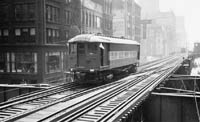
Car 209, one of the North Shore Line's merchandise despatch cars, is seen on the Loop near Adams/Wabash. Four of the cars, 209-212, were used for a public service advertising campaign during World War II and received identical red, white, and blue paint jobs promoting the purchase of U.S bonds for the war effort. For a larger view, click here. (Photo from the Lou Gerard Collection) |
The North Shore Line never had any freight customers on the "L". The interurban didn't operate freight service on their Shore Line branch (which connected to the "L"'s Evanston branch at Linden) south of about Highland Park, while the North Shore Line's freight locomotives on the Skokie Valley branch (which the "L" ran on as far north as Dempster/Skokie) went only as far as the Weber Industrial District on the C&NW near McCormick Boulevard. North Shore freight locomotives never had third rail shoes, so they would have been limited as to where they could run on the "L". On the other hand, while "L" freight locomotives S-104 and S-105 did have third rail shoes, everywhere they ran also had overhead wire.
Some of the North Shore Line's earliest "freight" carried over the "L" were newspapers. Interurbans were a major distributor of newspapers in the days before paved highways and delivery trucks. Newspapers were carried in passenger-baggage cars, or sometimes just on the end platforms of passenger cars. The North Shore's newspaper operation began on October 1, 1916, shortly after Samuel Insull took over control of the interurban. Insull also controlled the "L", and although it would be a few years before interurban passenger service would be inaugurated over the "L", Insull management lost no time in making full use of the two systems for other operations. Newspapers would be loaded hot off the presses at the Wells Street Terminal used by Metropolitan Division "L" trains and the Chicago Aurora & Elgin interurban, the latter of which also ran a newspaper service (see below). The North Shore trains would be operated by an Elevated Lines crew, backed out of Wells Street Terminal, and operated via the Loop and North Side "L" to Linden. There, a North Shore crew would take over and operated to Waukegan in 70 minutes, including stops to unload newspaper bundles too large to be thrown from the train "on the fly". In later years, the crew change was dropped and North Shore crews worked the train all the way to and from downtown Chicago. Also, the loading location for North Shore newspaper trains was changed to the North Water Stub terminal just north of the Loop, where an electrically-powered conveyor belt would bring newspapers to the platform to the loaded into trains. By 1921, two North Shore newspaper specials were being operated nightly.23
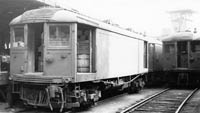
A merchandise despatch car is seen on the left at the Montrose Avenue freight house platform. The car is loaded with barrels, crates, and other express parcels. For a larger view, click here. (Photo from the Lou Gerard Collection) |
The North Shore also handled less-than-carload (LCL) freight and package traffic from an early date. The service was run under the name Merchandise Despatch and was handled by the interurban's Traffic Department. When the US entered World War I, the steam railroads were running at capacity and the North Shore was able to capture more of the LCL market. As business increased, the cars the North Shore leased from the "L" became inadequate, so the interurban began buying new cars designed specifically to handle the burgeoning LCL freight business. The North Shore also needed to improve their freight facilities along both their railroad and along the "L" to better handle the business. It was impractical to bring LCL freight to and from downtown Chicago over the "L" tracks, as the loading and unloading of the cars would've blocked "L" trains. So, as part of the North Shore's trackage rights agreement that also brought interurban passenger service to the Loop, a freight house and loading terminal was established in 1919 on the North Side of Chicago. The facility was located at Montrose Avenue, at ground level at the south end of the "L"'s Wilson Yard property.
Although the Montrose freight facility was a big improvement, having the LCL terminal so far from downtown Chicago made it difficult to compete with the steam railroads whose freight terminals and spurs were located in the industrial and warehousing districts that ringed downtown. Therefore, the North Shore Line opened another freight terminal just north of downtown Chicago to provide a more convenient, nearby location for shippers to transfer their loads to the interurban. Although located under the "L" structure on the southwest corner of Wells and Hubbard, just north of Merchandise Mart station, the terminal had no rail connection or loading facilities at track level. Instead, an office was located there which would accept packages and trucks were used to ferry the LCL from there to the Montrose Avenue facility for loading onto merchandise despatch cars.
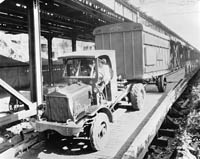
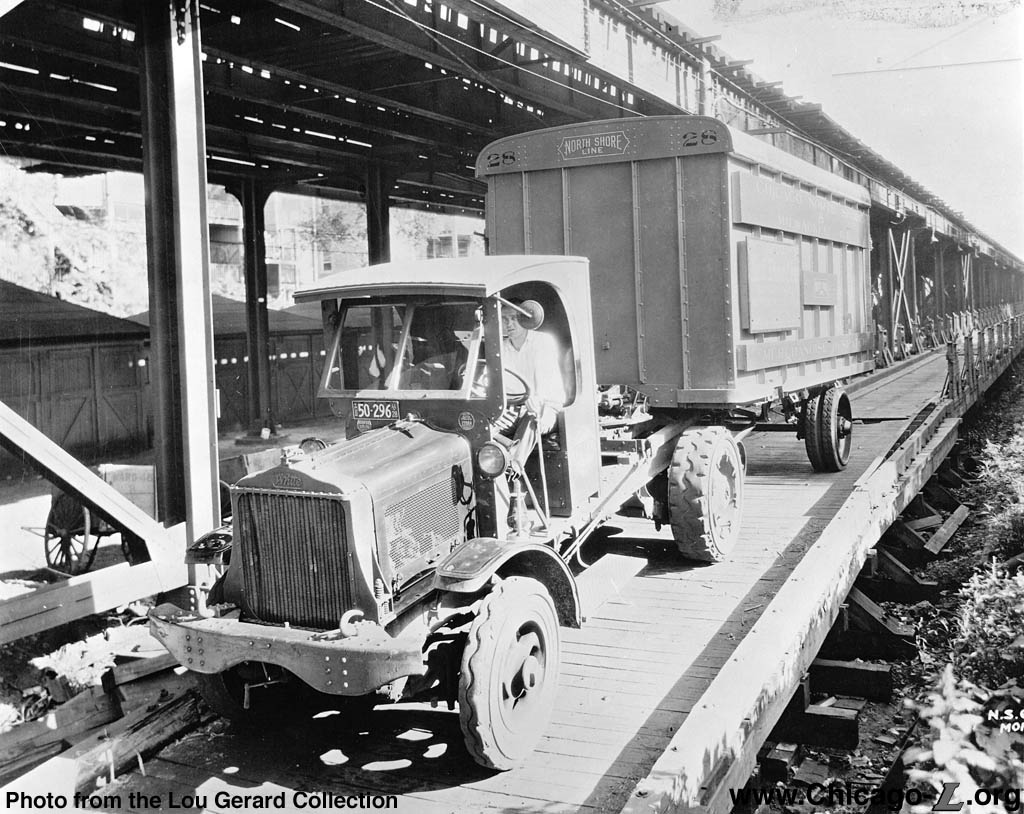
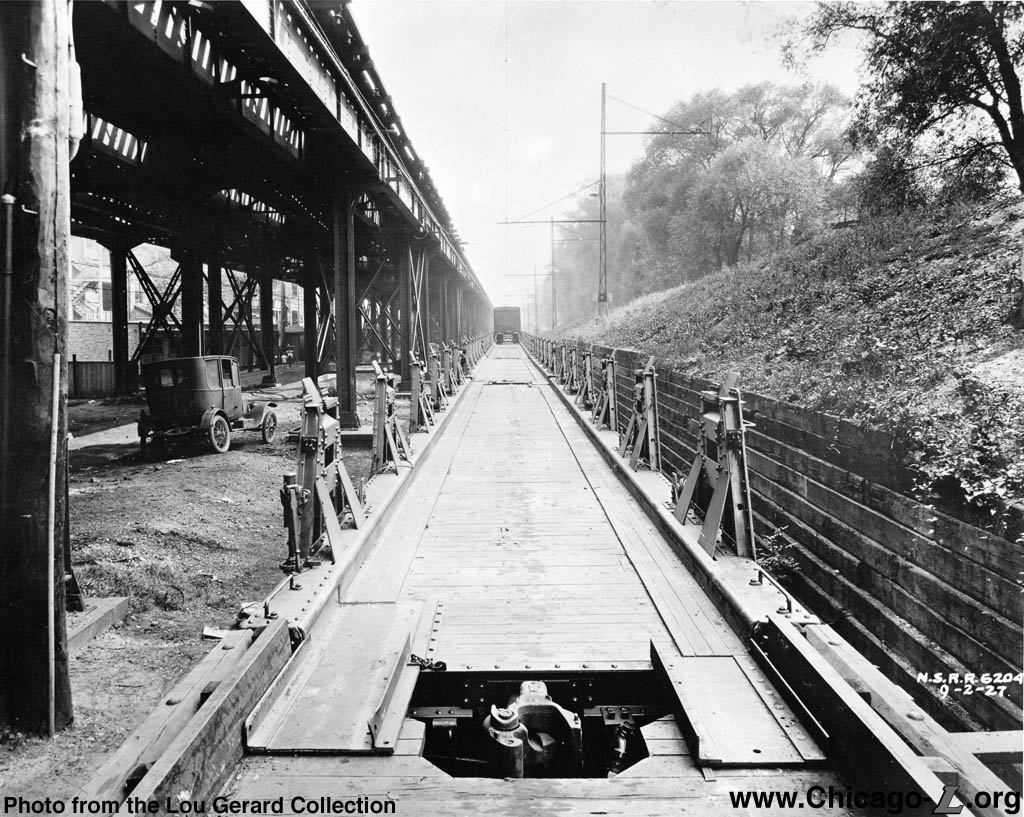
A ferry truck backs up the Montrose Avenue ramp and onto a string of waiting flatcars specially designed to secure the containers on September 2, 1927. Loading of the containers onto the flatcars was accomplished by backing one trailer at a time up a ramp and onto the flatcars, a procedure still used today for "piggyback" freight operations. For a larger view, click here. (Photo from the Lou Gerard Collection) |
The North Shore went on to establish additional freight terminals with trucking operations at other "L" properties -- although, like the Hubbard/Wells terminal, these had no rail connections or train-loading facilities, the use of un- or under-developed land owned by the same interests (Samuel Insull controlled the "L" as well as the North Shore, South Shore, and CA&E interurbans) made for an economical solution to increase the attractiveness of the interurban's LCL freight service to potential customers. These terminals, which were located in commercial or industrial areas to attract customers, also served the Chicago Aurora & Elgin to some degree, but primarily handled freight for the North Shore Line. Some of these facilities were located at 41st Street and Union under the Stock Yards branch on the site of the never-used "L" yard, and on the Douglas branch near the Hawthorne industrial district. A LCL facility was also located at 63rd Street and Calumet on the site of the Lower 63rd Yard, and apparently had some direct rail service provided by the newspaper cars that were stored in the yard between trips.24
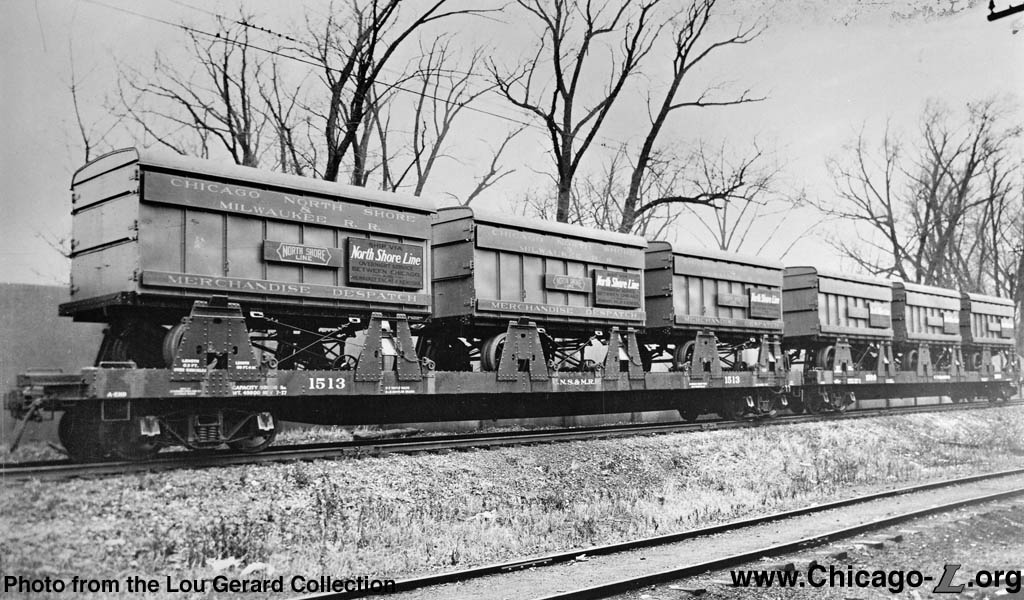
The opening of the North Shore Line's Skokie Valley Route (part of which was used by the "L"'s Niles Center service) provided the interurban with even more opportunities to haul freight (which were limited on the line's original Shore Line Route), and the railroad capitalized on this with the inauguration of their "ferry truck" service. This trailer-on-flatcar service was the precursor of today's "piggyback" transport container service, wherein a freight container is transferred between a trailer truck and railroad flatcar for parts of the shipment, eliminating the need to unload and rehandle the freight when transferring modes. The North Shore inaugurated its ferry truck service in May 1926, and transfer of containers between trucks and trains was performed at a special facility at the north end of Buena Yard, across from the North Shore's Montrose Avenue merchandise despatch terminal. (There were also ferry truck facilities at Harrison Street in Milwaukee, and at the Racine, WI station.) The Montrose Avenue facility consisted of a long ramp beginning at the street and extending into Buena Yard, ascending an incline until it met a stub track used for loading. Loading of the containers from the ferry truck onto the flatcar was accomplished by backing the trailer truck up the ramp and onto the waiting flatcar. The North Shore Line reported that this procedure took nine minutes at the Montrose facility. Once backed onto the flatcar, the trailer was secured using side supports that folded inward and engaged the trailer sides. The northbound freights left the Montrose Avenue ground level terminal late at night. They backed into Buena Yard, proceeded up the ramp to the "L", then proceeded north over Track 1 as regular "L" freights did. At Howard, the North Shore freight trains would head west on the Skokie Valley Route and on to points north.25
During World War II, interurban freight did very well, as the mainline railroads were taxed to their limit, and ferry truck service in particular reached a peak. In 1943, 18,000 trailers were hauled. However, after the war ended, demand plummeted and it became clear it would not return. Competition from paved roads, new inter-city highways, and more flexible motor trucks could not be overcome. On April 30, 1947, all merchandise despatch was discontinued. LCL traffic was only hauled on Tuesdays and Fridays for a few more months, but it too was eliminated on December 20, 1947. Thus ended the hauling of freight by the North Shire Line over the "L".26
Chicago Aurora & Elgin
The Chicago Aurora & Elgin's freight business was a lot less extensive than the North Shore Line's. While the CA&E had newspaper runs, and package and less-than-carload (LCL) service, they did not develop a significant carload freight business, in part due to the limited distances that system covered, making it uneconomical and less desirable for shipments to be interchanged with the CA&E unless absolutely necessary.
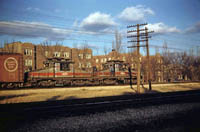
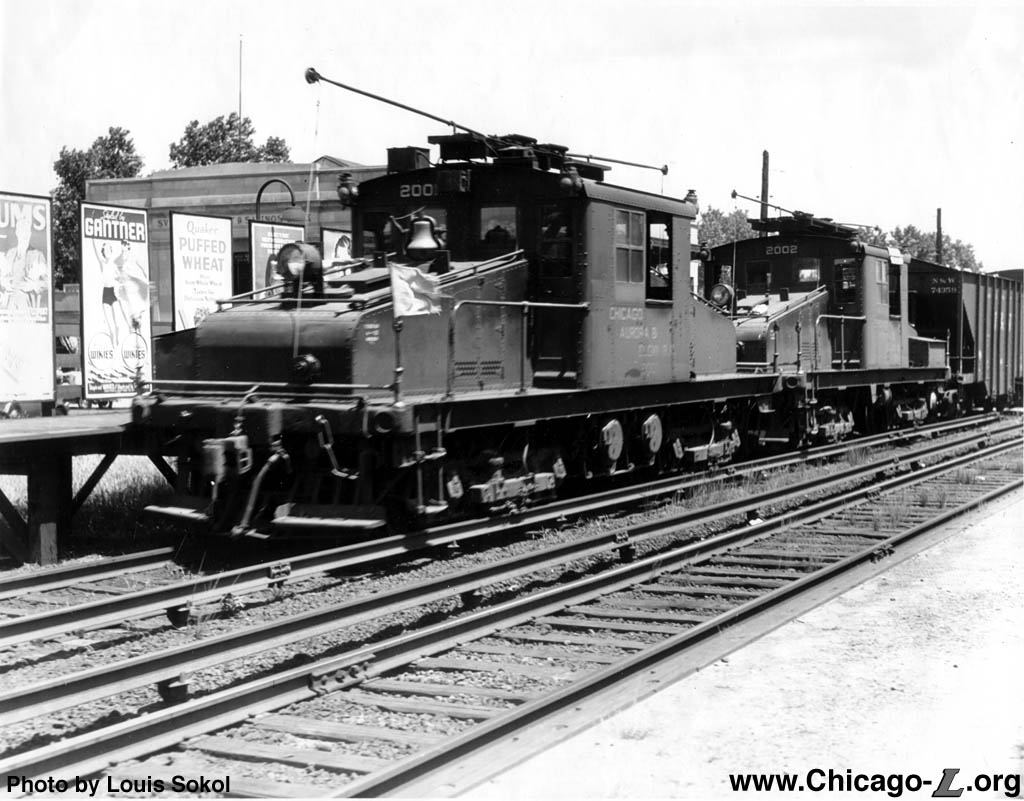
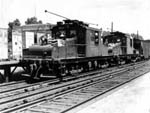
CA&E freight locomotives 2001 and 2002 haul a freight consist eastbound past Clarence Avenue, east of Oak Park station, on November 18, 1951. For a larger view, click here. (Photo by Henry M. Stange, courtesy of the Krambles-Peterson Archive) |
The AE&C (predecessor of the CA&E) began hauling newspapers from downtown Chicago to points in the western suburbs in 1903, almost 15 years before the North Shore Line started a similar business and two years before the interurban began passenger service to downtown via the "L". Despite having no franchise to operate into the City of Chicago via the "L", two passenger coaches were brought downtown around 4am each morning27 with copies of the Chicago Record-Herald loaded at Canal station for the delivery to the towns west of Chicago.28 By 1910, newspaper train loading had been shifted to Wells Street Terminal, which had a special platform and conveyor belt to speed loading.29 The CA&E continued hauling newspapers into the 1950s. In fact, newspaper business was the only form of LCL traffic the railroad maintained after losing its entry into Chicago via the "L" in 1953. After that point, newspapers were trucked to Forest Park, where they were loaded onto the interurban trains for delivery.30
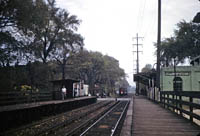
The 5th Avenue station is seen looking east on the inbound platform circa 1952. Note the hinged flaps on the edge of the platforms, which would be flipped up to allow wider freight trains to clear the platforms. For a larger view, click here. (Photo by Robert V. Mehlenbeck, courtesy of the Krambles-Peterson Archive) |
The AE&C began LCL freight service using box motors in 1905. Service was initially run from Wheaton to Laramie Avenue. In the 1920s, the company, under Insull management, tried to build this class of traffic, heavily soliciting area businesses to ship via the interurban. Freight was accepted at the terminals in Chicago on "L" company property described above, jointly operated with the North Shore Line. However, the NSL's service was far more successful, as many shippers found it too expensive to move their goods via the CA&E due to the high cost and time consumed handled the freight compared to the CA&E's relatively short runs. As a result, the CA&E abandoned this business before the end of the 1920s. They continued handled relatively small packages, however, under the name "Emergency Package Service." These packages were carried abroad regular passenger trains, delivered to the stations from which they were forwarded under the motorman's care. Almost all of this business had its original or destination in downtown Chicago, so the packages were often delivered to or from "L" stations, but neither required nor used any special facilities since the parcels were so small. This service was suspended once the CA&E lost its access to Chicago via the "L" in 1953.31
In 1923, seeking new sources of revenue, the CA&E tried to develop a business in the interchange of freight in carload lots with the steam railroads. The CA&E crossed and connected with several main line railroads at multiple points along its routes. After Samuel Insull took control of the interurban in 1926, he was able to build the business further my influencing the routing of material for his allied utility companies via the CA&E. This type of railroad freight was not hauled on the elevated portions of the "L", but was handled on the ground-level portions of the Westchester branch and Garfield Park branch west of Central Avenue, which the "L" and interurban shared. An interesting aspect of this operation concerned the stations between Bellwood (where the "L"'s Westchester branch split off from the CA&E main line) and Central, along the portion shared by the two carriers. These stations, like all other "L" stations, had high-level platforms. This, however, hampered the operation of railroad freight cars, whose width and clearance were often in excess of the "L" and interurban cars, meaning the freight cars would not clear the platforms. This problem was solved through the ingenious use of hinged flaps along the edges of the platforms, which were flipped up and out of the way by a brakeman riding the locomotive footboards and flipped back down in place by a man riding the caboose steps. This allowed standard-width railroad freight cars to pass the "L" platforms along this portion of the route. A more serious clearance problem was posed by the third rail, which unlike other interurban was used extensively over the CA&E's trackage (gaining it the nickname "The Great Third Rail"). This could not be cleared by certain freight cars with usually massive trucks, or by some low hopper or depressed-center flatcars. Unlike the North Side Main Line used by "L" freights, these lines did not employee gauntlet tracks to permit clearance of the third rail, so any cars that exceeded that clearance envelope had to be rejected for delivery via the CA&E.32 Carload freight service over portions of track also used by the "L" ended in 1953, when the CA&E was cut back to Forest Park. (The "L"'s Garfield Park trains had stopped running west of Forest Park two years earlier.) The CA&E continued hauling freight, including over portions of line formerly serviced by Garfield Park/Westchester trains west of Forest Park, until 1959, two years after the interurban suspended passenger service.
Thanks to Art Peterson and Lou Gerard for providing a wealth of information and photographs for this page.

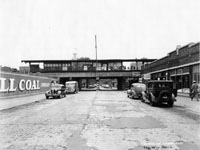 |
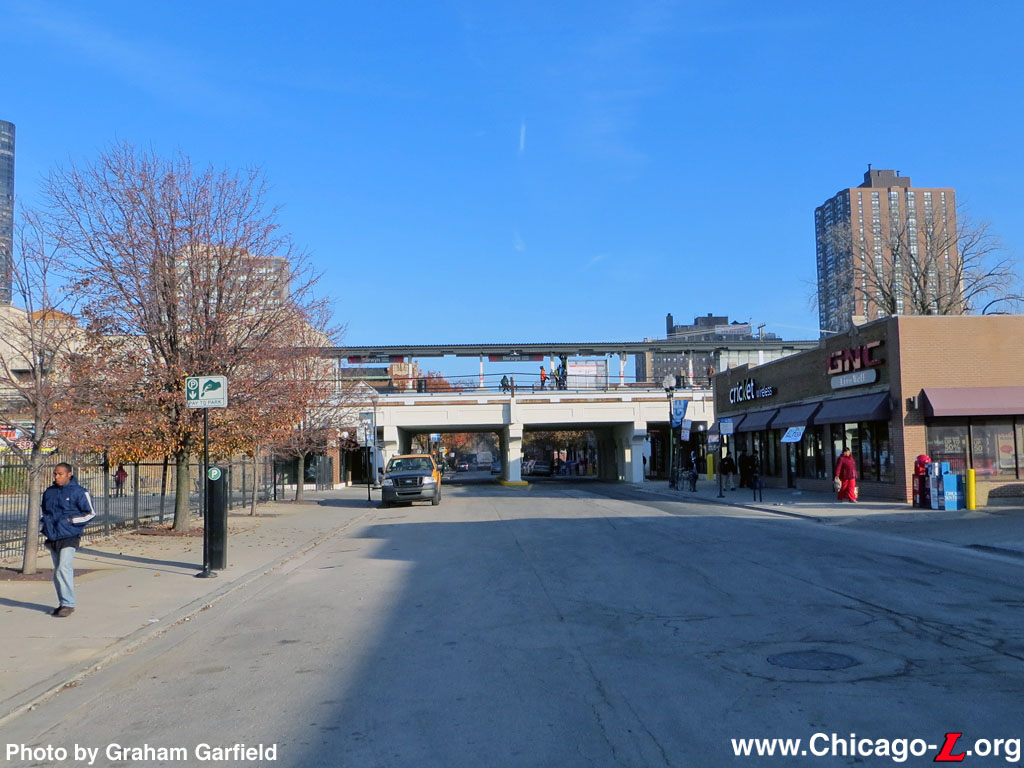
berwyn01.jpg (152k) Berwyn station is seen looking east on Berwyn Avenue circa the 1940s. Although the details have changed -- the partitions, furniture, and stairway enclosures on the platform; the identification sign on the viaduct; the cars and street lights on the street -- the structure is the same today, as seen in the same view in 2012. The Lill Coal Company, the CTA's last freight customer, is visible on the left, where a Jewel-Osco grocery store is in 2012. (Photo from the CTA Collection) |
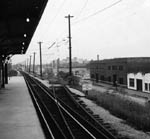 |
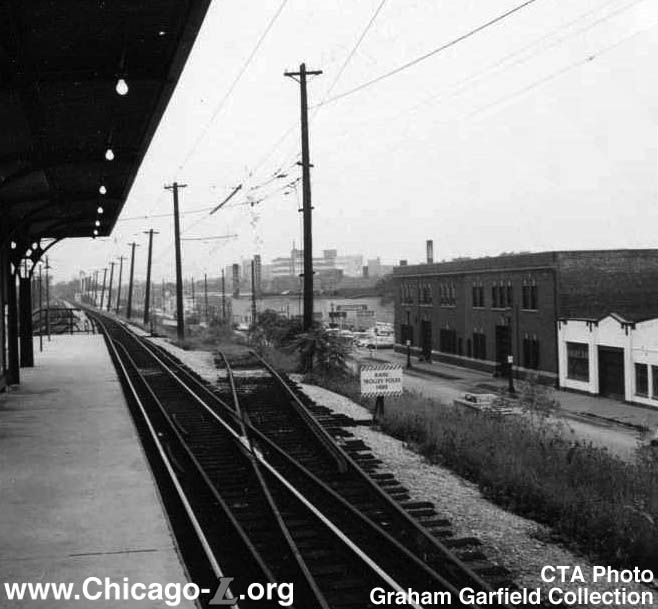
ROW@SouthBlvdTeamTrk01.jpg (77k) |
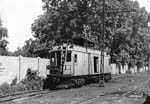 |
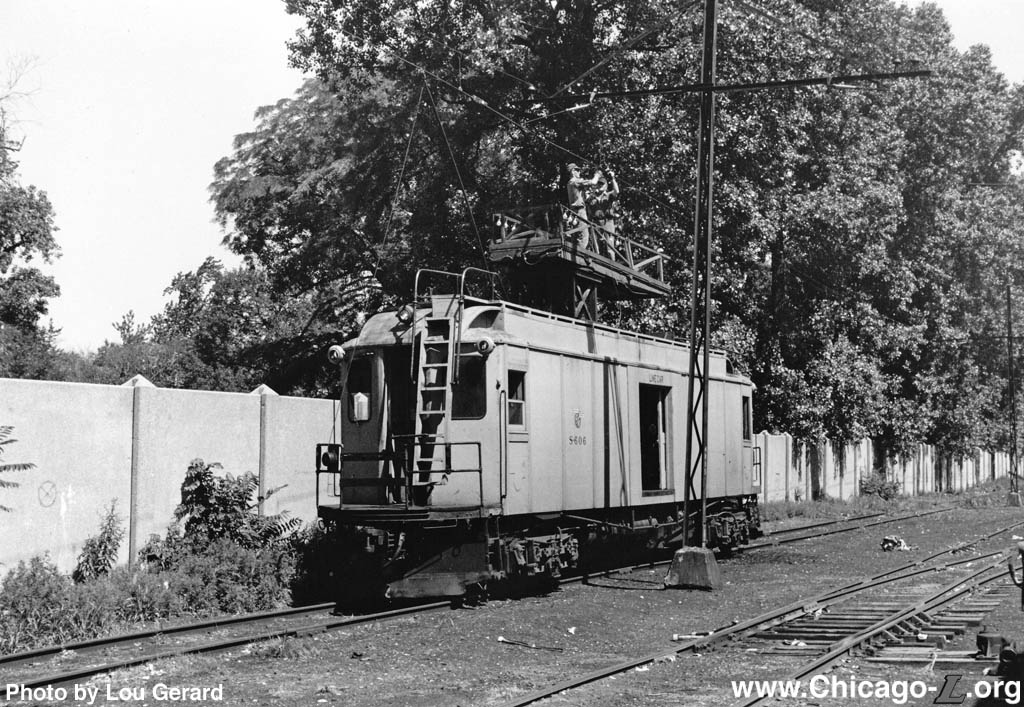
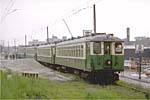
ctaS-606b.jpg (218k) Linemen are working to maintain the overhead wires in Buena Yard in July 1971, utilizing line car S-606 to access the wires. In less than half a decade, Buena Yard would be closed. Like other cars in the CTA service fleet, S-606 was painted yellow. The overhead wire poles and equipment were manufactured by Westinghouse and Drew. Due to a lack of space, the use of 24-foot mast arms on one side on a single line of poles were required in some parts of the yard to support the overhead over the three tracks. (Photo by Lou Gerard) |
|
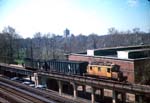
cta4325b.jpg (194k) |
 |
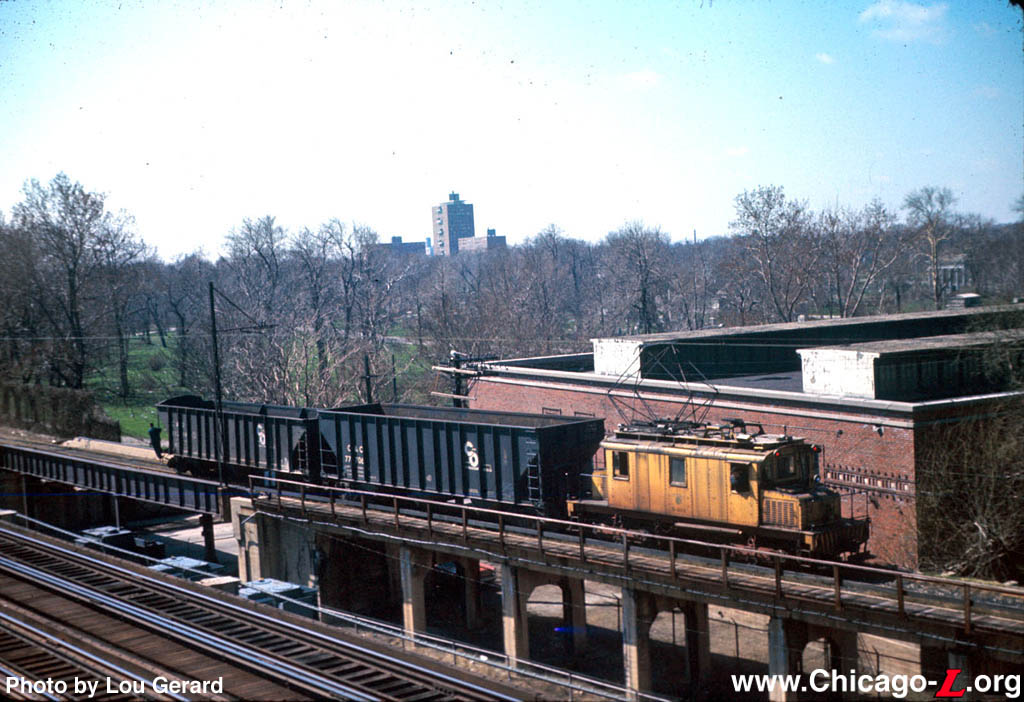
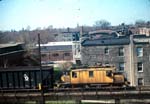
ctaS-104e.jpg (160k) During the last month of freight service, locomotive S-104 is push two empty hopper cars back to Buena Yard on the freight lead in April 1973. The freight train has just passed over Montrose Avenue and is heading north on the elevated connection between Buena Yard and Track 1 at Wilson station, seen looking southwest from the Wilson Shops lunchroom. (Photo by Lou Gerard) |
 |
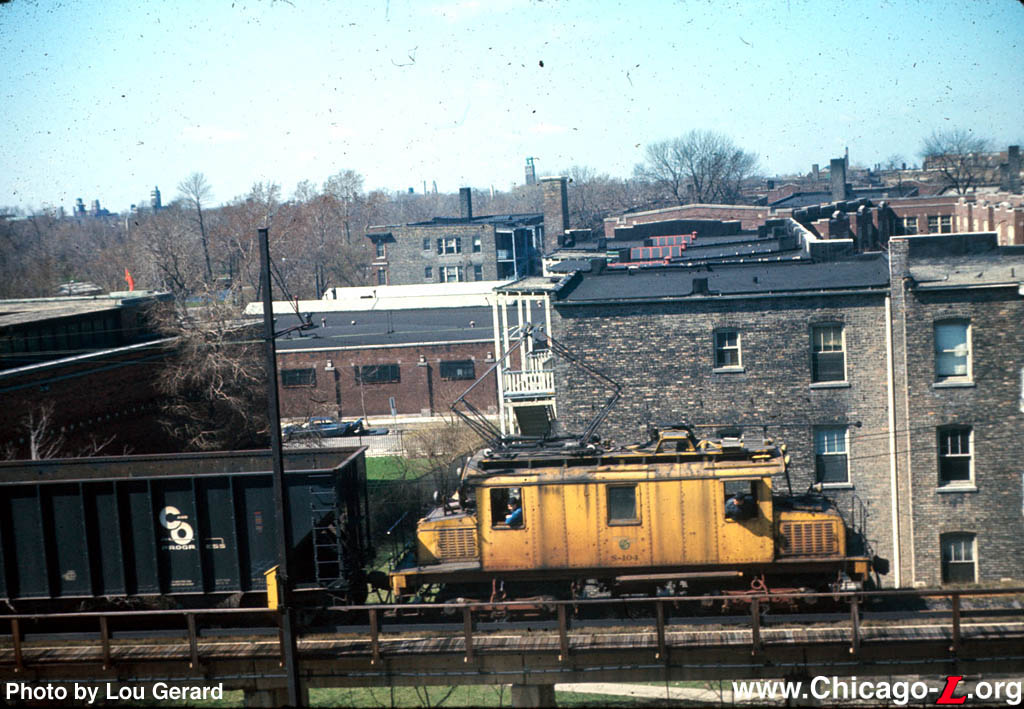
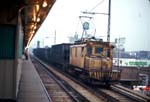
ctaS-104f.jpg (173k) Another view of S-104 at the north end of a freight consist, pushing two empty Chesapeake and Ohio Railway hopper cars south as the train travels along the elevated freight lead between Buena Yard and Wilson station, seen looking west from the Wilson Shops lunchroom in April 1973. The end of freight service is near, and the locomotive has seen better days. (Photo by Lou Gerard) |
 |
ctaS-104g.jpg (119k) On the last day of CTA freight service, locomotive S-104 is seen shoving the last empty hoppers south down Track 1 back to Buena Yard, passing Berwyn station on April 30, 1973. This would be the last in-service freight run on the "L". (Photo by Lou Gerard) |
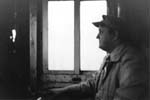 |
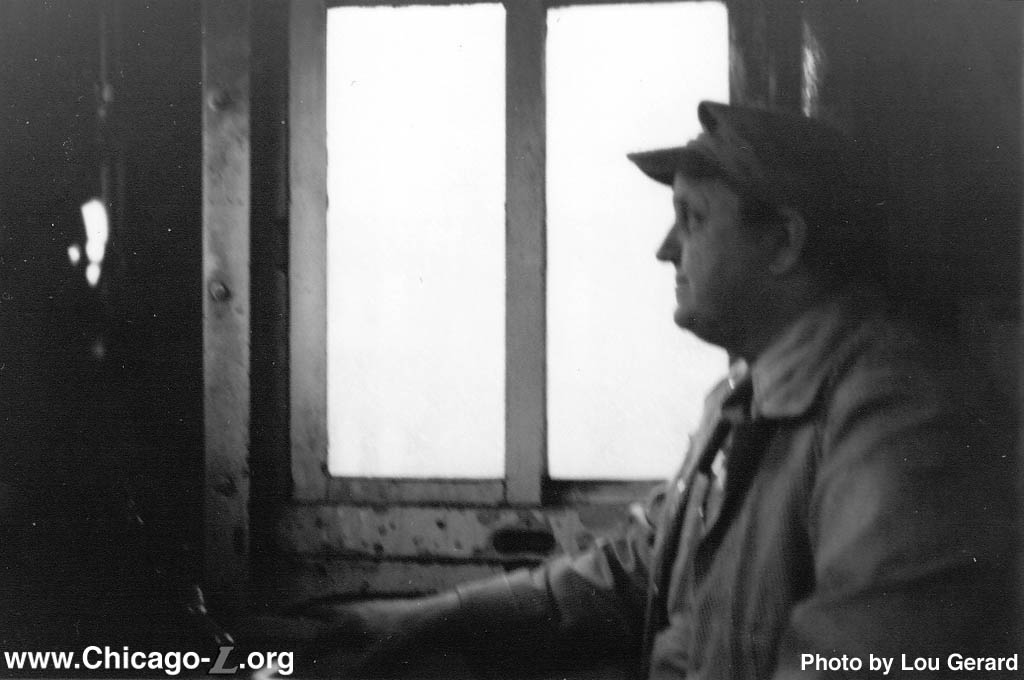
freight_motorman.jpg (81k) Motorman Tony Grabski operates electric freight locomotive S-104 on the last day of "L" freight service, on April 30, 1973. (Photo by Lou Gerard) |
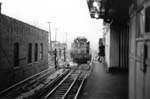 |
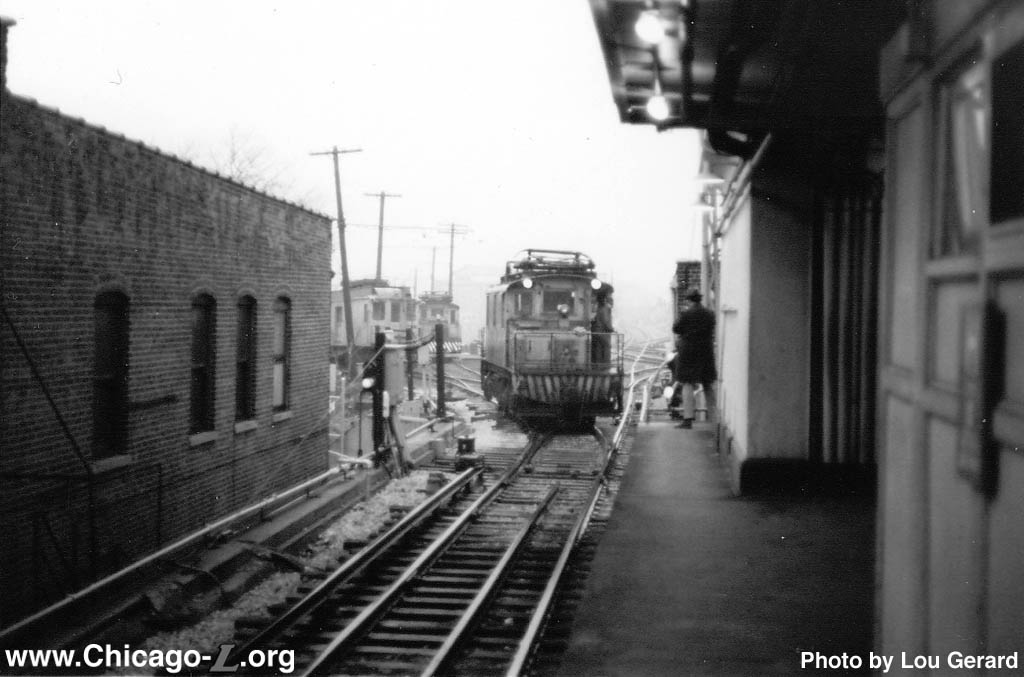
ctaS-104k.jpg (99k) Electric locomotive S-104 is coming out of Howard Yard and pulling onto Track 1 for its last trip in freight service, looking north from the Howard station platform on April 30, 1973. Visible in the background, in the yard, are S-104's twin, S-105, as well as line car S-606. (Photo by Lou Gerard) |
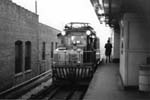 |
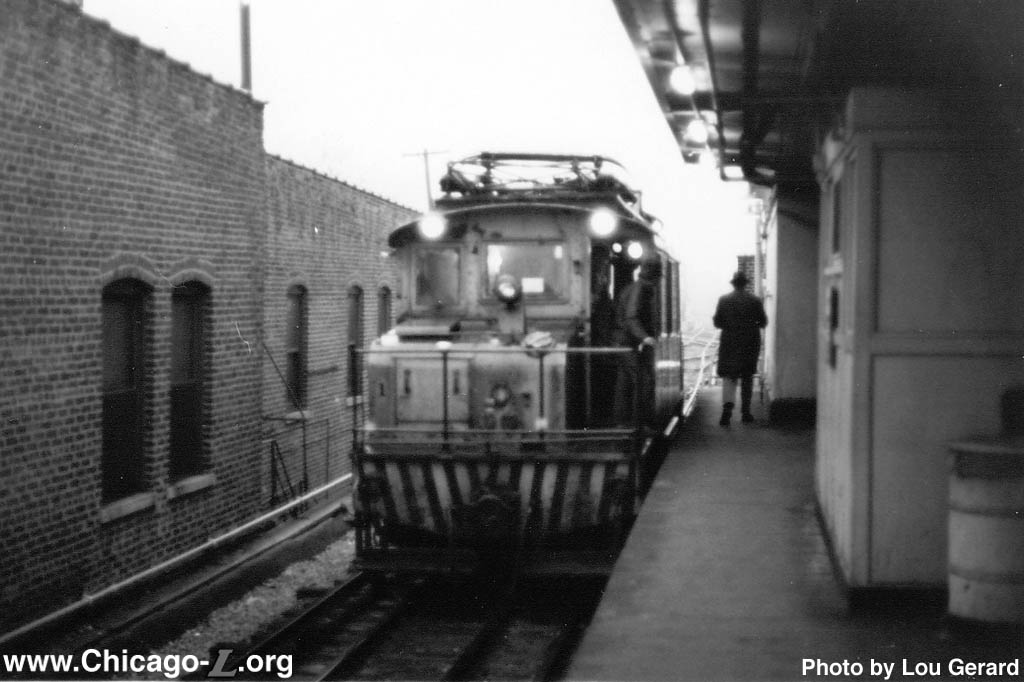
ctaS-104l.jpg (99k) S-104 is pulling through Howard station on the last day of freight service, April 30, 1973, on its way to Buena Yard to pick up its final batch of freight cards to bring to the Lill Coal Company. It's a rainy, dreary day, befitting the somber end of an era in "L" history. (Photo by Lou Gerard) |
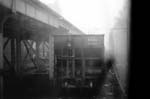 |
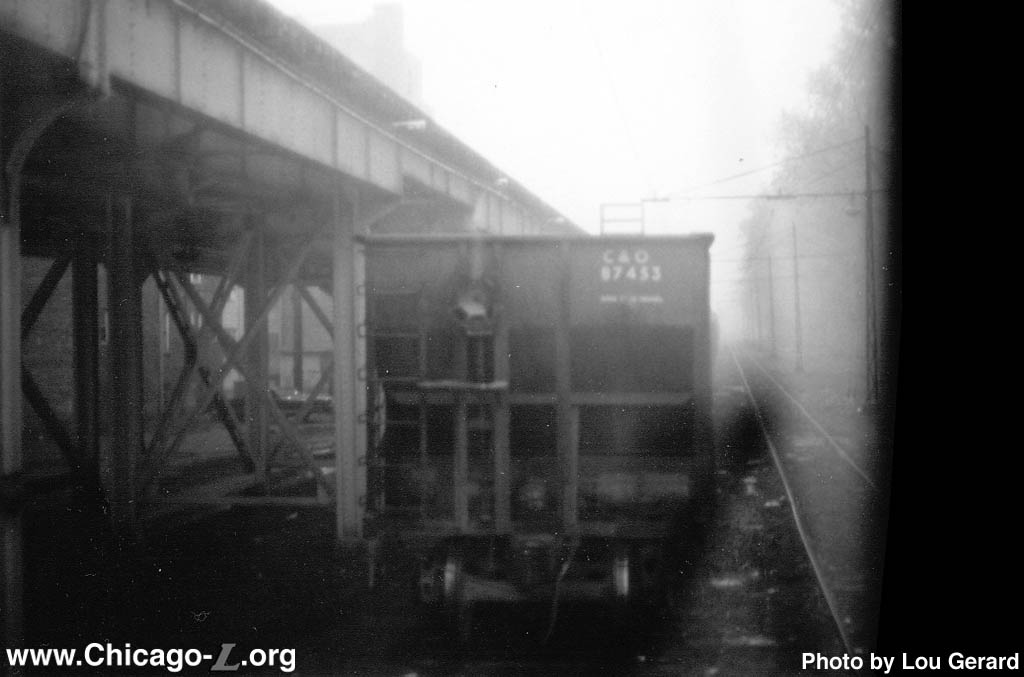
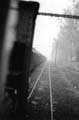
buena03.jpg (75k) Looking south from inside one of the freight locomotives, a Chesapeake and Ohio Railway hopper car is on the rear of a long string of freight cars in Buena Yard on the last day of "L" freight service, April 30, 1973. (Photo by Lou Gerard) |
 |
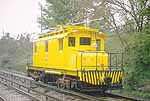
buena04.jpg (85k) A long consist of freight cars lines the East Track in Buena Yard on April 30, 1973, looking south. These would be the final freight cars handled by the "L", as freight service on the CTA was over the following day. The weather that day was damp and rainy. (Photo by Lou Gerard) |
|
ctaS-104.jpg (153k) |
|
ctaS-104b.jpg (80k) |
|
ctaS-105.jpg (160k) |
 |
ctaS-105b.jpg (143k) |
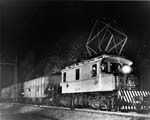 |
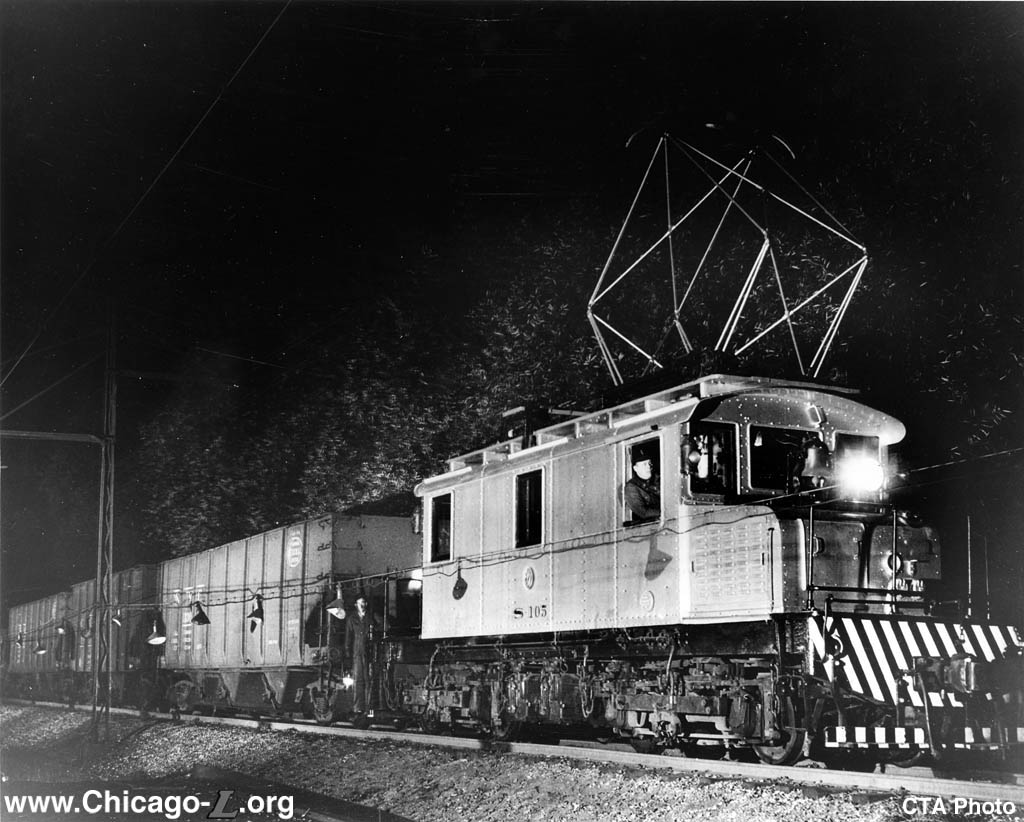
ctaS-105c.jpg (147k) Freight locomotive S-105 pulls a consist of loaded hoppers up the incline from Buena Yard to the elevated freight lead connecting to the North Side elevated on a fall night in 1949. Most freight operations were performed at night, since the absence of scheduled service on Track 1 allowed it to be vacated for bidirectional freight moves. The disused piggyback loading ramp for the North Shore Line's Merchandise Despatch service, discontinued in 1947, is visible in the left foreground. (CTA Photo) |
 |
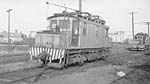
ctaS-104a.jpg (222k) The S-104, in its weathered silver paint scheme, sits in Buena Yard between trips on a sunny day circa the early 1950s. Staged behind it, barely visible, it is twin, S-105. Note behind the locomotives are a train of Baldie 4000s still in their CRT orange and brown paint and the Wilson Shops building in the background up on the elevated, while down below are the incline up from Buena Yard to the elevated structure and the out-of-service Merchandise Despatch ferry truck loading ramps and lead tracks. (Photo by George Krambles, courtesy of the Krambles-Peterson Archive) |
 |
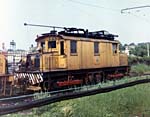
ctaS-105d.jpg (163k) After spending about five years in an aluminum-colored silver paint scheme that wore poorly, in September 1953 the CTA repainted the two electric freight locomotives in the first version of the yellow scheme, which had become the CTA's standard color for work equipment. Locomotive S-105 is newly repainted in its yellow paint scheme in this 1953 photo taken of the unit positioned on a Skokie Shops yard lead. (CTA Photo) |
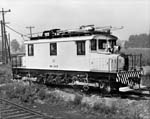 |
ctaS-105e.jpg (171k) S-105 was photographed on its first yellow scheme at Skokie Shops in 1953, shortly after receiving the new livery. In September 1953, the two electric freight locomotives were repainted yellow, which became the CTA's standard color for work equipment. The carbody was yellow, while the various handles and grab irons, end railings, and other components were black. Under the side center windows was a green CTA herald and a black car number. The locomotives retained one variation or another of this paint scheme for the rest of their CTA service lives. (CTA Photo) |
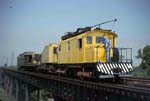 |
ctaS-105f.jpg (134k) |
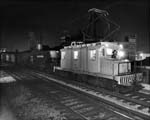 |
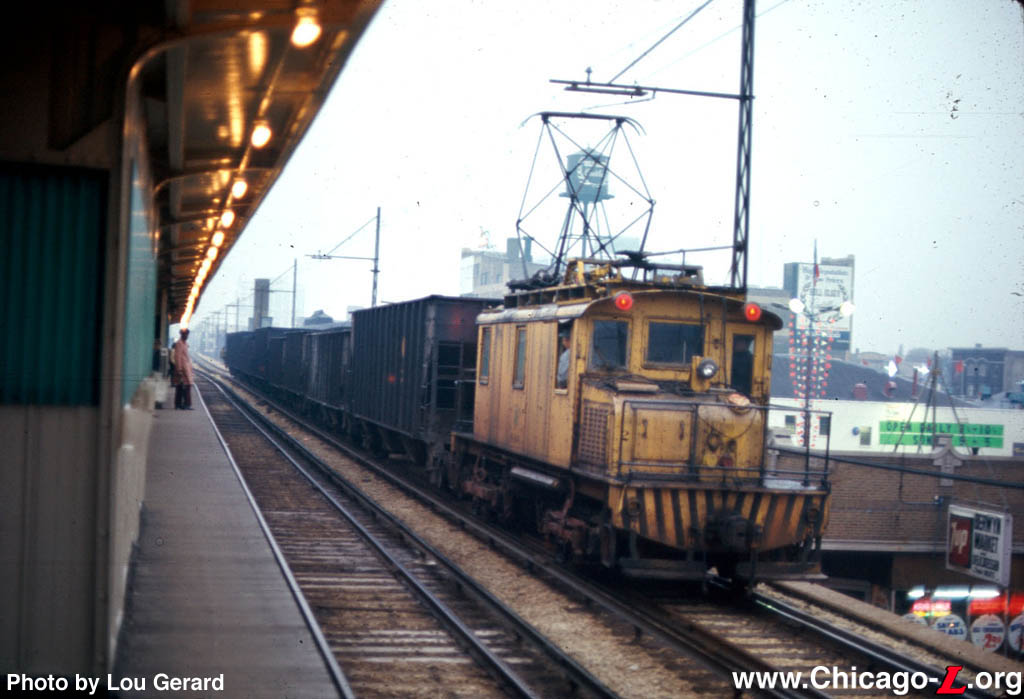
ctaS-104c.jpg (133k) S-104 pulls a freight consist, including several hopper cars belongs to the Nickel Plate Road, on the night of November 2, 1965, looking southwest from Berwyn station. The scene is typical of the freight service in the CTA era, as almost all freight moves were made at night, when Track 1 had no scheduled service and could be dedicated to bidirectional moves by the freight locomotives. A series of photos were taken by CTA staff photographers in late 1965 for a feature article in the company's employee magazine, Transit News. (CTA Photo) |
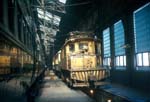 |
ctaS-104d.jpg (136k) Electric freight locomotive S-104 is seen inside Wilson Shop in February 1973, surrounded by 6000-series cars on the adjacent track and 4000s behind it on the same track. The unit is parked on Track 8, the easternmost track in the shop, during an inspection, probably one of the last it would undergo before the end of freight service a few months later. (Photo by Lou Gerard) |
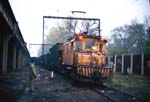 |
ctaS-104h.jpg (133k) Having returned to Buena Yard with the last shipment of empty hopper cars, CTA electric freight locomotive S-104 is spotting the cars to be picked up by the Milwaukee Road and returned to their home rails. The rainy, gloomy weather in this April 30, 1973 view looking south in the yard is befitting the end of a 53-year era in "L" history. (Photo by Lou Gerard) |
|
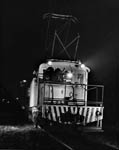
ctaS-104i.jpg (108k) In this dramatic night shot, locomotive S-104 is in Buena Yard, about to department from the yard and make the trip north against traffic on Track 1 to deliver a load to the Lill Coal Company, opposite Berwyn station, on December 14, 1965. (CTA Photo) |
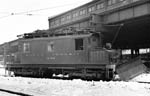 |
ctaS-104j.jpg (123k) Due to their substantial weight -- about 100,000 pounds -- electric locomotive S-104 and its twin, S-105, were well-suited to snow clearance duty during the winter months when not needed for freight service. Here, S-104 is seen in Lower Wilson Yard with a snowplow attached to its front on February 1, 1939. The four-track North Side Main Line and the elevated Wilson Shops are visible in the background. (Photo by George Krambles, from the Krambles-Peterson Archive) |
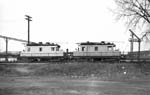 |
ctaS-104_S-105.jpg (127k) Locomotives S-104 (right) and S-105 are parked in their usual storage spot during the later years of their service lives, on the inclined spur track leading to Hines Lumber along the west property line of Howard Yard. The two Westinghouse locomotives are seen in profile parked on the spur in March 1964. (Photo by Lou Gerard) |
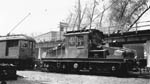 |
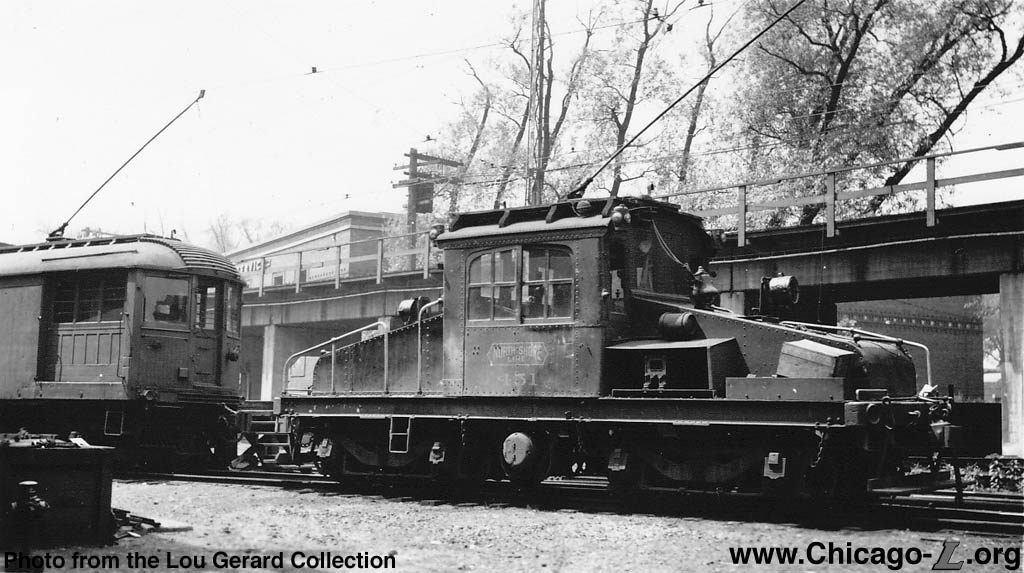
cnsm451.jpg (131k) Locomotive 451 was one of two 36-1/2 ton steeple cabs built by General Electric for the North Shore Line in 1907. Seen with a merchandise despatch car near the Montrose freight house in Lower Wilson Yard, 451 and its twin, 450, handled all sorts of freight and work duties between 1907 and 1948. (Photo from the Lou Gerard Collection) |
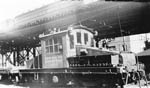 |
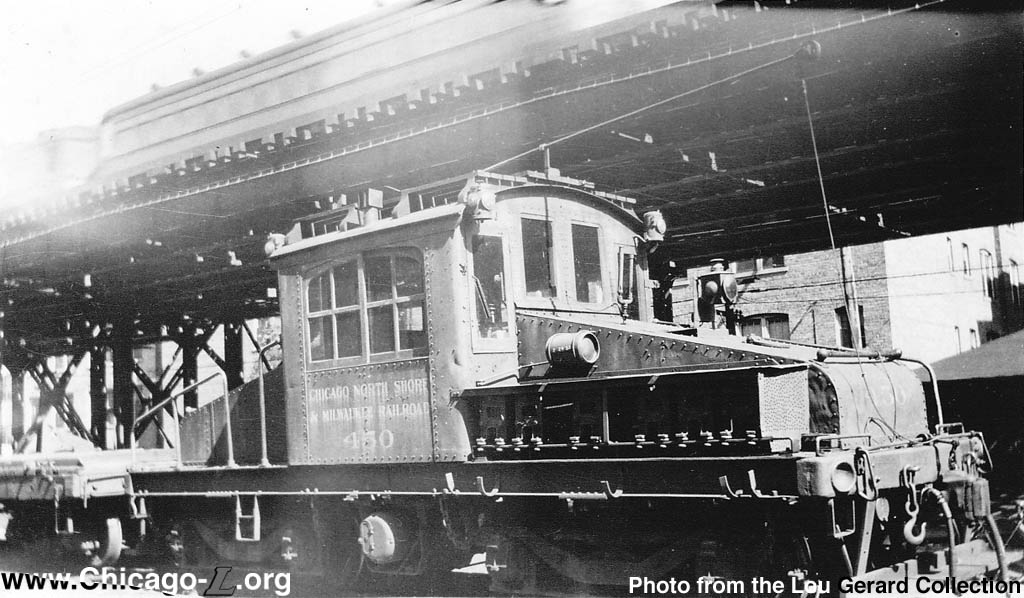
cnsm450.jpg (135k) Electric freight locomotive 450 is on the ferry truck loading ramp south of Montrose in Buena Yard, with the flatcars for the "piggyback" containers coupled to the locomotive on the left. The unit still has the carrier lettered on its side, rather than the North Shore Line herald it would later have. Locomotive 450 would be sold to the Commonwealth Edison Company in 1948, a year after merchandise despatch service ended. (Photo from the Lou Gerard Collection) |
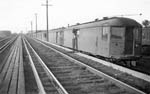 |
cnsm227.jpg (109k) With the success of the North Shore Line's express package service, additional cars were needed. Bought between 1922-24 from the Cincinnati Car Co., in a change from the previous 203-class express cars, the 215-class cars had a single freight door located in the center of the car instead of two doors at each end. Merchandise despatch car 227 is seen in Lower 63rd Yard with the ramp up to the Jackson Park branch elevated on the left. (Photo from the Lou Gerard Collection) |
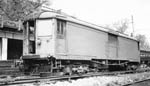 |
cnsm_MDcar01.jpg (122k) A single 215-series merchandise despatch car is seen in Lower Wilson Yard. After less-than-carload freight service ceased in 1947, many MD cars were put in work service performing various utility chores for the interurban. The concrete structure of the lead connecting Buena Yard to the elevated is seen in the background. (Photo from the Lou Gerard Collection) |
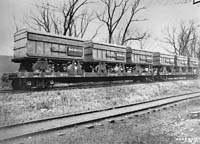 |
cnsm1513.jpg (219k) North Shore Line flatcar 1513 is shown loaded with piggyback containers on the incline from the Buena Yard to the elevated on November 28, 1927. Car 1513 was one of 10 flats purchased in 1927 to accommodate the interurban's growing ferry truck freight service, joining 10 shorter flat cars bought the previous year for the same purpose. The cars were specifically designed to hold the truck-trailer containers, which were transferred from the trucks to the trains at the Montrose ramp in Buena Yard. (Photo from the Lou Gerard Collection) |
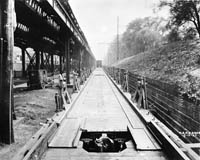 |
MontrosePiggybackRamp01.jpg (222k) This view looking south shows a long row of piggyback container-equipped flatcars backed up to the Montrose ramp on September 2, 1927. The coupler of the last flatcar is visible on the bottom. The metal uprights on the sides of the flatcars are the armatures that the containers were secured to. A container is seen in the distance, secured to a flatcar several cars down in the consist. The incline up to the elevated from the yard is seen on the right, while the North Side Main Line "L" structure is on the left. (Photo from the Lou Gerard Collection) |
|
cae1004.jpg (165k) |
|
cae2001.jpg (153k) |
|
cae2001-2002.jpg (208k) |

|
|
|
Sources: