|
|
|
|
|
|
|
As in many professions and industries, a special language and vocabulary evolves over the years. An argot forms -- words and expressions that fit the job, verbal shortcuts that say what's needed in a precise lingo that might be alien to outsiders. Chicago transit is no different, where a colorful patios has evolved from the men and women who have worked the city's streetcars, trolleys, buses and elevated trains. Below is a sampling, with those words in quotes being verbal slang that would not be found in any CTA book or manual.
A-car: The odd numbered car of a 2-car unit that shares mechanical and electrical equipment with another car (the B-car); together, the A- and B-car form a semi-permanently coupled married pair.
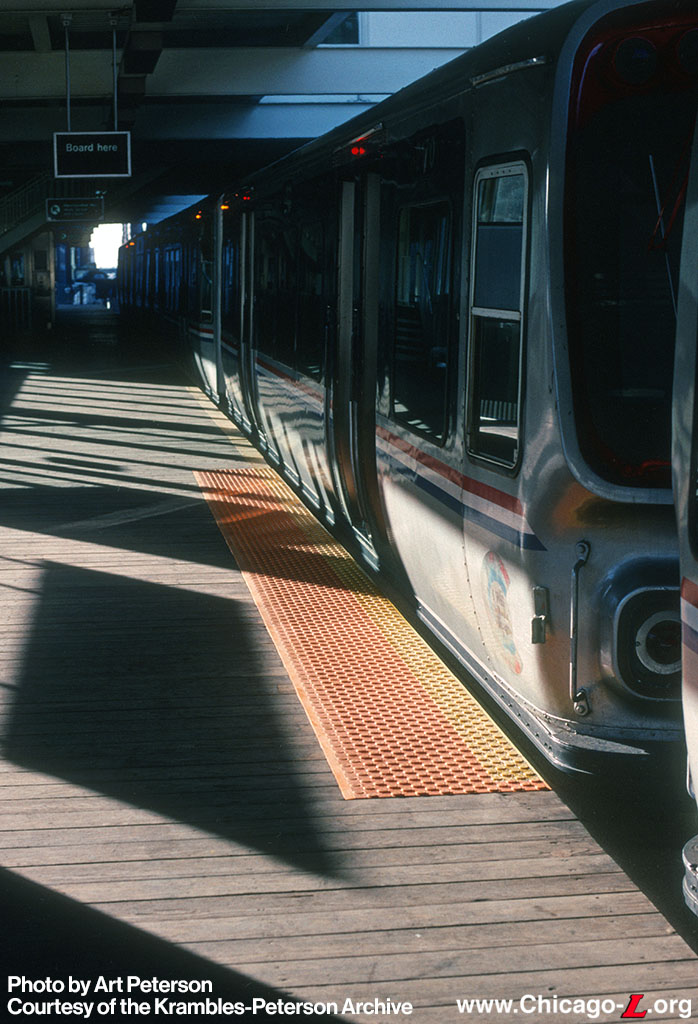
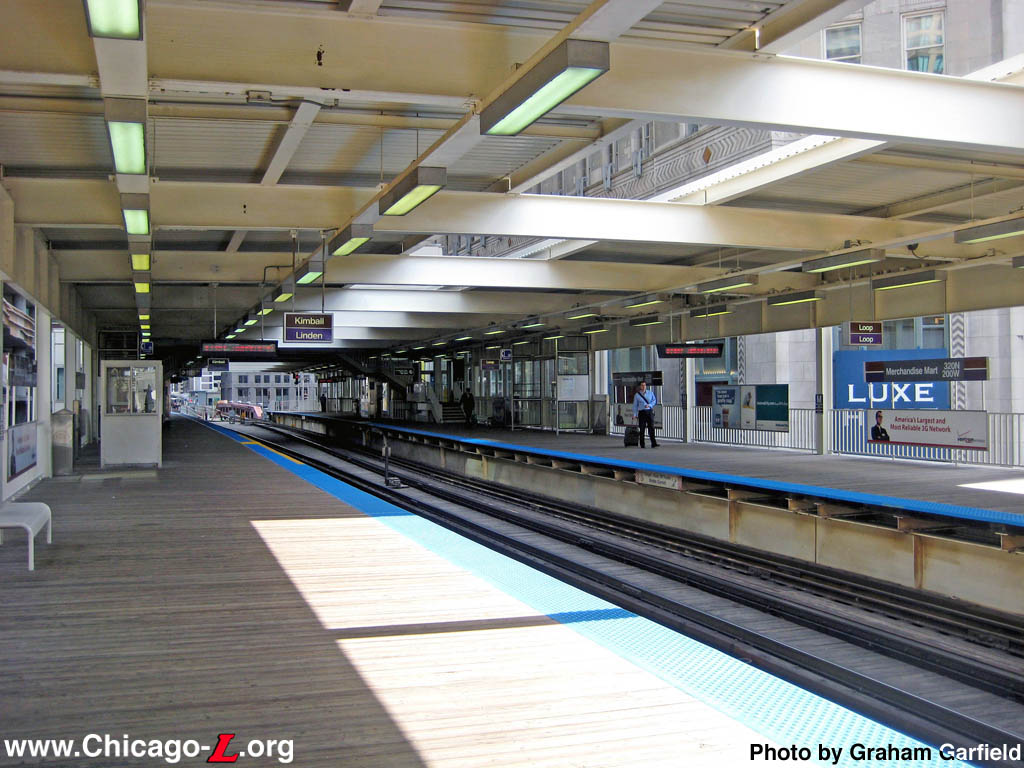
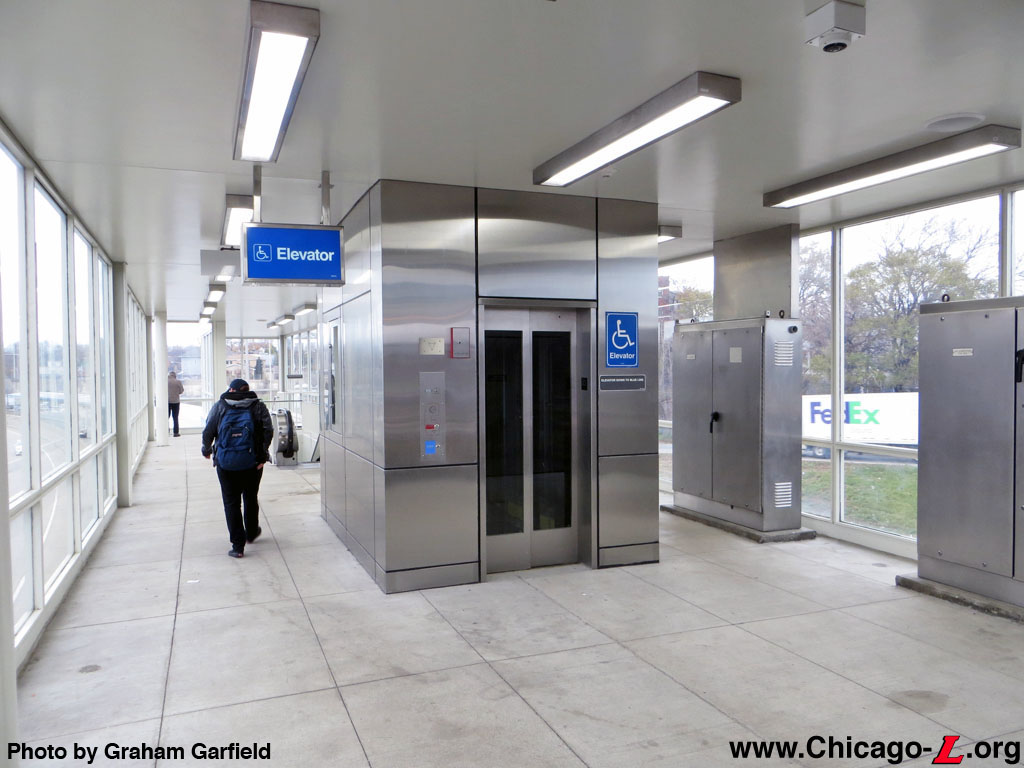
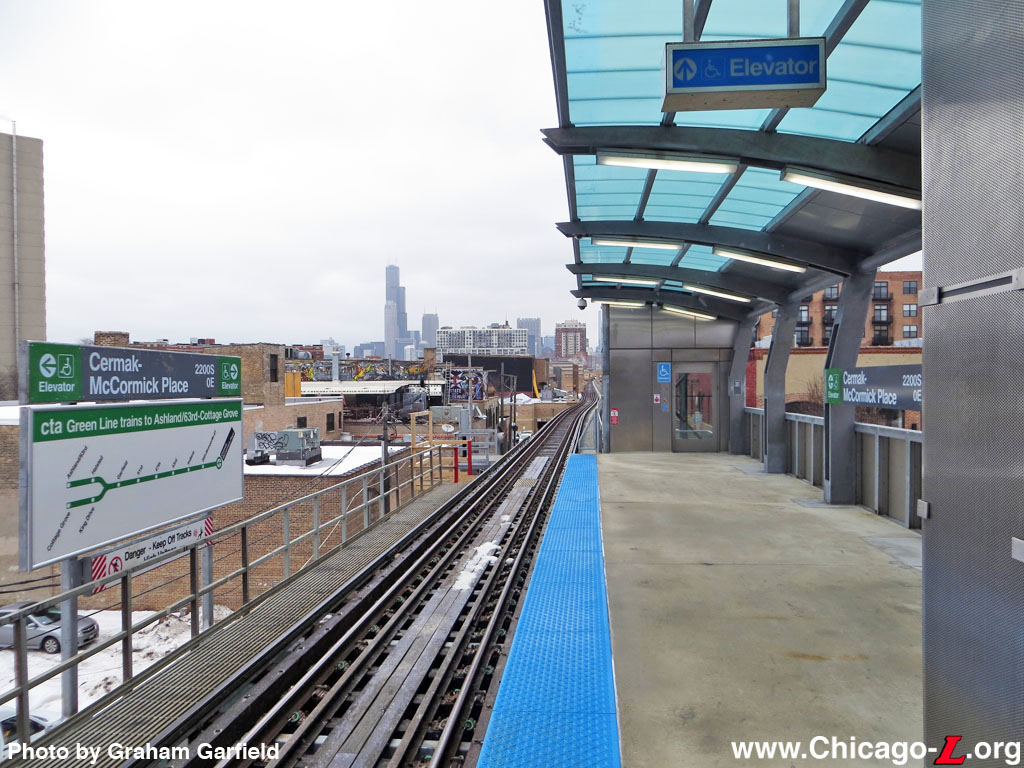
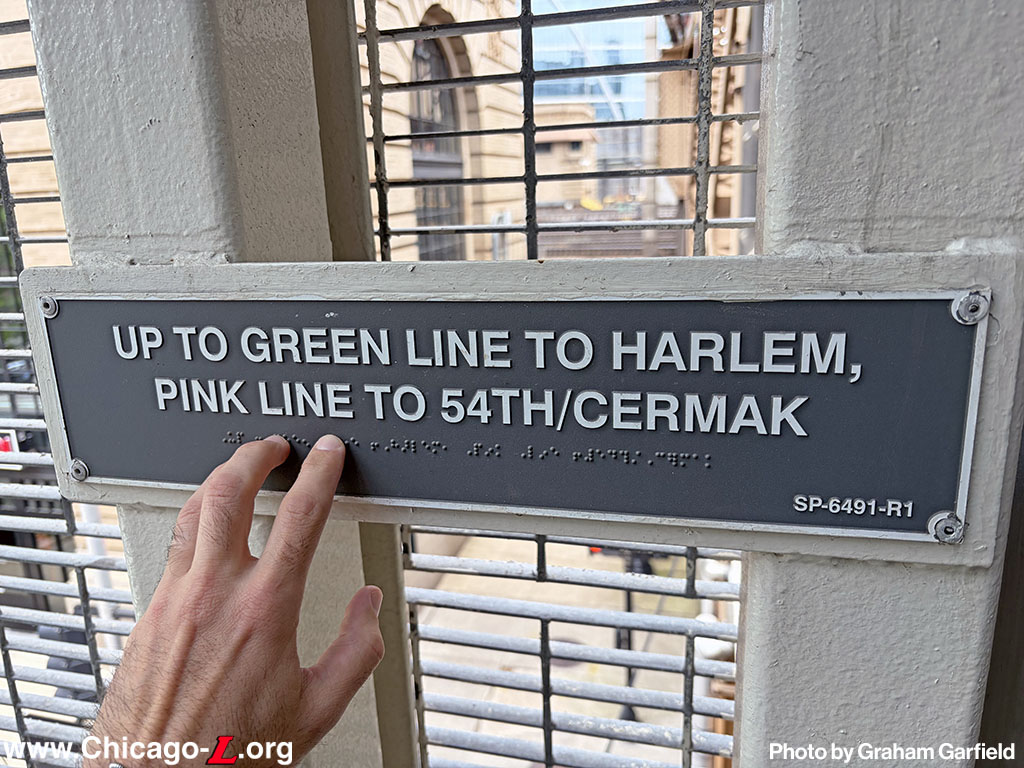
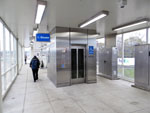
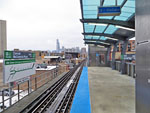
ADA: The Americans with Disabilities Act of 1990. This federal act requires various accommodations and design requirements to ensure that people with disabilities have access to jobs, public accommodations, telecommunications, and public services, including public transit. Examples of these changes includes mandating that all new and renovated stations and rail lines be accessible to persons with mobility challenges including use of a wheelchair, and that alternative transportation be provided to customers unable to access the transit system (what is called "Paratransit"). However, while the general public often focuses largely on wheelchair and mobility accommodation when thinking about ADA-accessiblity, compliance with the ADA involves consideration and accommodation for a wider range of disability, including low-vision and blindness through the use the Braille tactile signs, tactile panels along platform edges, and proper character size and spacing and background/character contrast on signage.
 |
 |
 |
 |
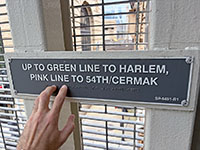 |
Some features of ADA compliance in CTA stations: |
||||
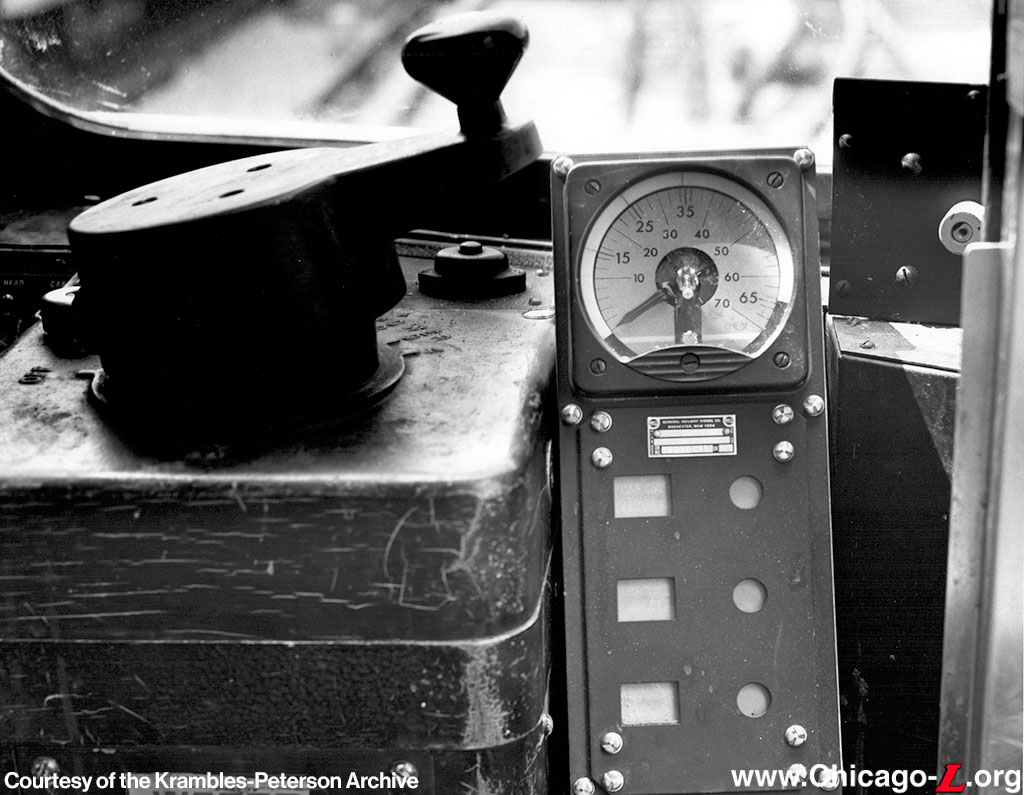
ADU: Aspect Display Unit. An indication panel in the motorcab of a train that displays allowable and actual speeds, as well as illuminated green, yellow and red signal aspects. All ADUs also have a white indicator light labeled "Rule R6.4" that, when flashing, signifies that the operator must operate according to Rule R6.4.
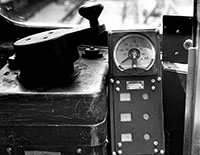 |
The initial implementation of Automatic Train Control (ATC, see also) was on the Lake Street "L", where 140 2000-series cars assigned to the service were equipped with a General Railway Signal (GRC) cab signal/ATC package; this included an Aspect Display Unit (ADU) in each motorcab displaying actual and allowable speed and signal information. A GRS ADU is seen here in the cab of a 2000-series car in 1967. For a larger view, click here. (Photo courtesy of the Krambles-Peterson Archive) |
add: Cars to be coupled to a train.
AFC: Automated Fare Collection system. Refers to the electronic fare system CTA currently uses, which began with magnetic stripe farecards introduced in the mid/late 1990s, and now is based around contactless tickets, farecards, and other payment mediums using near-field communication (NFC) technology, all provided to CTA through a contract with Cubic Transportation Systems. See Fares section for more information.
"air it out": To run with all end doors of a train open, common on "flat door sixes" (see also).
allowable speed (cab signal): The maximum speed allowed by the ATC system (see also). Failure to bring train speed to or below the allowable speed in the prescribed period of time results in a penalty brake application and stop.
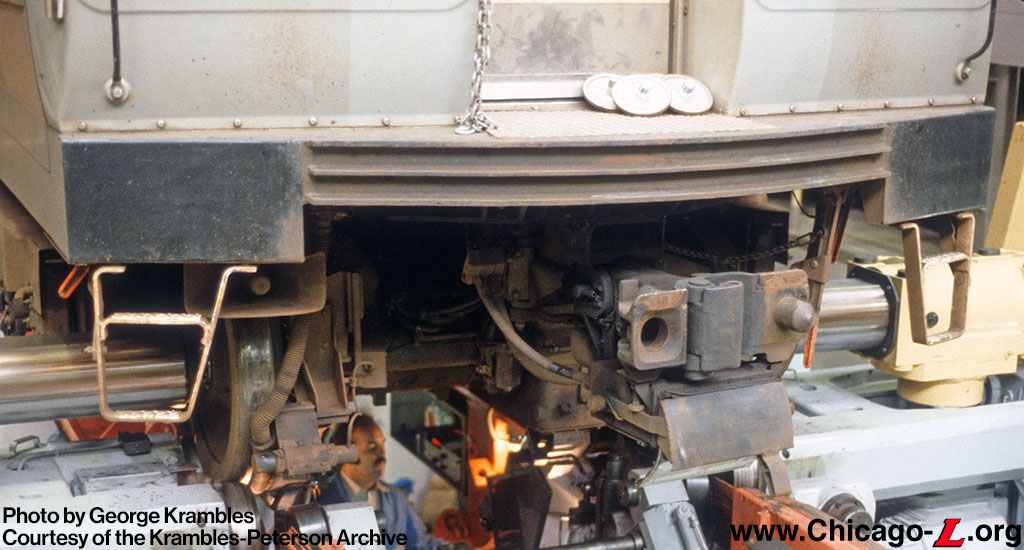
anti-climber: The ridges on the front of an "L" car at the end sill, above the coupler and just below floor level, that prevents a car from riding up and into another car in case of an end-to-end collision with another vehicle.
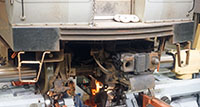 |
The front, or "number 1 end", of a relatively new 2400-series car displays its anticlimber along the end sill of the carriage's frame, its horizontal ridges designed to lock railcars colliding head-on from riding up and through each other. Other front-end elements visible include the stirrups at each corner for a train personnel to use to climb up onto the car from track level, and the coupler. The car was captured while on the Hegenscheidt wheel lathe at Skokie Shop on April 28, 1979. For a larger view, click here. (Photo by George Krambles, courtesy of the Krambles-Peterson Archive) |
approach signal: A fixed wayside signal used to govern the track leading to a home signal.
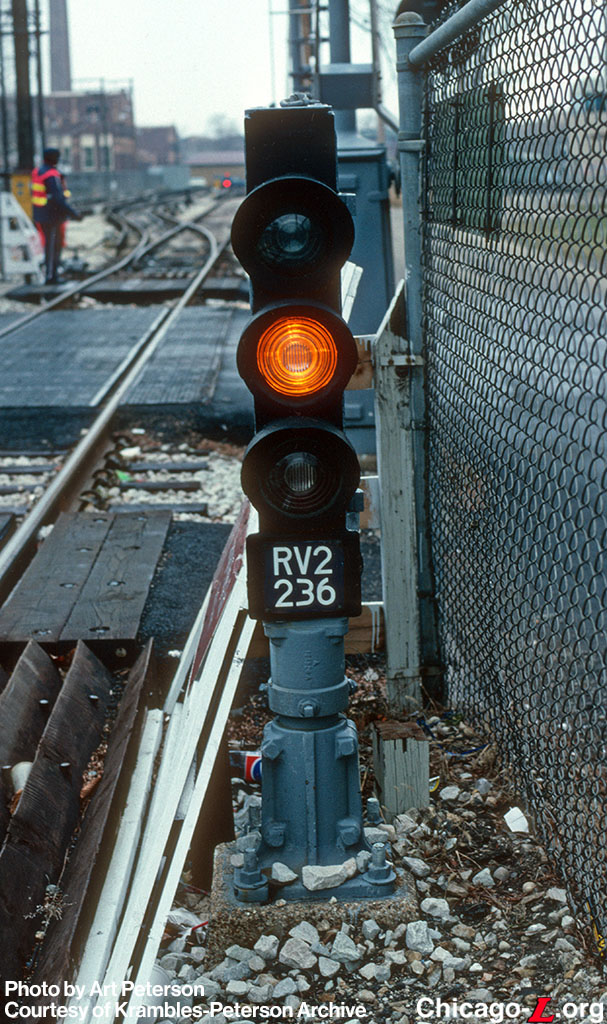
automatic block signals (ABS): A wayside block signal or ATC cab signal designed to protect from rear collisions. Although there were some limited installations of block signals by the early "L" companies, the first extensive use of an automatic block signal system on the "L" came when all five double-track miles of the State Street Subway were equipped with them in 1943. A typical wayside ABS consists of a three-aspect color-light signal, paired with a left-side mounted track trip to engage a spring-loaded carborne trip valve on any train attempting to pass a restrictive indication (see also track trip). The wayside ABS signal lights are as follows:
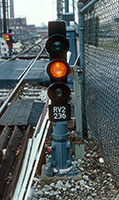 |
A typical wayside automatic block signal is seen at Spaulding on the Ravenswood branch on November 14, 1991. It has three aspects (light): red, amber (illuminated) and green. The signal number on the number plate, "RV2-236", indicates it is block signal 236 on Ravenswood track 2. For a larger view, click here. (Photo by Art Peterson, courtesy of the Krambles-Peterson Archive) |
automatic train control (ATC): Wayside equipment that detects the presence of trains or other speed-limiting conditions through track circuits powered by auto-frequency currents and send them through the rails commands which determine the maximum speed at which a following train may be safely operated. Equipment in the train cab compares this command with the actual speedometer reading and provides visible and audible displays to alert the motorman. If actual speed exceeds the recommended speed, the motorman must reduce speed within a short time or the equipment will engage in an emergency full stop. ATC is continuously in communication with trains, not just at a fixed point, as with ABS systems.
B-car: The even numbered car of a 2-car unit that shares mechanical and electrical equipment with another car (the A-car); together, the A- and B-car form a semi-permanently coupled married pair.
bad order: See "B.O."
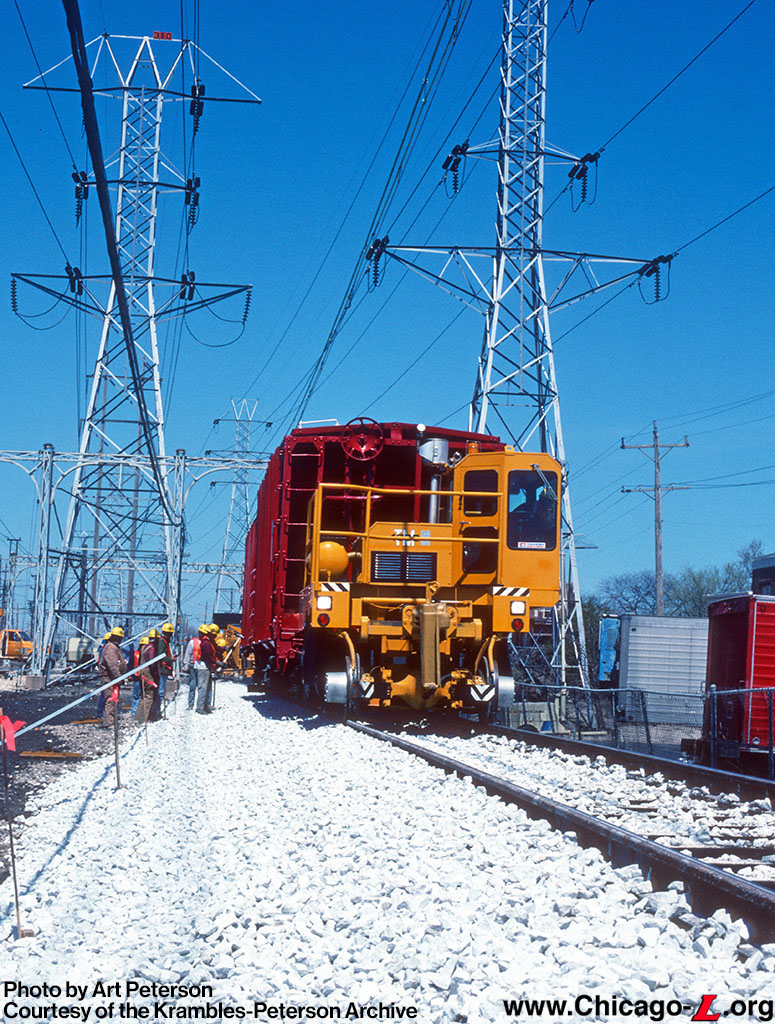
ballast: Gravel or broken stone laid in a railroad bed to give stability to the tracks and ties, also serves to dampen the sound of the trains.
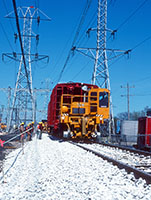 |
During a period of extensive rehabilitation of the tracks and right-of-way, freshly-laid ballast can be seen on the Skokie Swift line near Main Street on on April 21, 1991, with the contractor's train in the background. For a larger view, click here. (Photo by Art Peterson, courtesy of the Krambles-Peterson Archive) |
berthing allowance: The distance beyond the berth marker within which the operator must stop the front corner posts of the head car.
berthing area: The zone along a station platform in which a train must berth (stop to board and alight passengers). Berthing the train at the correct location along the platform assures that all side doors are on the platform; the designated location may also have been chosen to allow proper line-of-sight for the operator to check the side of their train before closing the doors, and/or to position the train in a way that is a desired location relative to access points like stairs or elevators. The proper location along the platforms may differ depending on the number of cars in the train consist (see also); berth marker signs (10" x 10" signs with a large number on them) indicate the stopping point for a train having a designated number of cars.
block runs: Runs that are scheduled between Monday and Friday. These runs consist of a ten-hour shift at straight pay. Overtime is not a factor.
"blue light": see FAQ #4.8.
"blue light special": A car having one or more blue lights. See "blue light".
B.O.: Bad Order car. A railcar that has a mechanical or electric defect that precludes its proper and correct operation. Often, bad order cars are taken out of service and laid up in a yard so that they can be inspected and repaired.
"breeze": To bypass a station on the rail system, or to bypass standing passengers at a bus stop. Typically, this type of operation is ordered by supervisory or Control personnel to allow an off-schedule run to make up lost time.
buffer train: A nonrevenue train made up of cars with fully functioning motors and friction brakes that immediately follows a transfer of coach unit(s) (see also).
"the bugs": see "doodlebugs".
cab signal: A signal in the motorcab with colored lights, a speedometer and other indicators. See also automatic train control.
catenary: A particular type of overhead system for the provision of traction power to transit vehicles, typical of interurban railways, modern light rail systems, or electrified main line railroads. As opposed to the "direct suspension" system in which the wire a rail car receives power from is attached directly to the overhead support (whether it be a crosswire, metal arm, bracket, or other support), a catenary system consists of a "messenger wire" suspended loosely between the overhead supports. The "contact wire" -- which is what the trolley pole or pantograph touches and supplies traction power to the car -- is then hung below the messenger wire, with short vertical drop wires connecting the two at a consistent height. Because only the contact wire needs to be taut and the messenger tends to be more slack, the messenger hangs a bit between supports, naturally forming what mathematicians call a "catenary" curve, thus giving this type of suspension its name. There are a few different types of catenary systems and the type the North Shore (and subsequently the Yellow Line) used was called a "compound catenary" system, which used two messenger wires rather than just one.
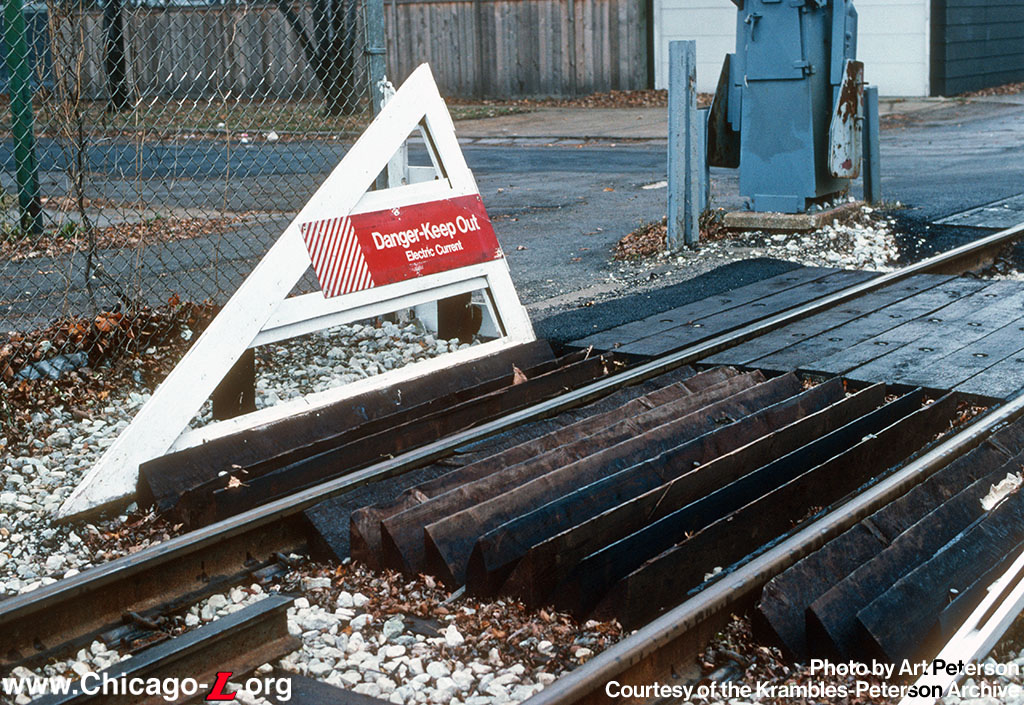
"cattle guard": A device comprised of diagonal cut lumber installed in a saw-tooth arrangement between and on either side of ground-level "L" tracks, usually at crossings, used to discourage trespass on the right-of-way. hey are commonly found on the grade sections of the Douglas, Ravenswood, Skokie and Evanston branches.
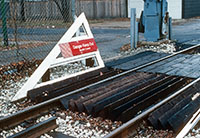 |
A recently-installed "cattle guard" is seen at the Sacramento Avenue grade crossing on the Ravenswood branch of the Brown Line on November 14, 1991. For a larger view, click here. (Photo by Art Peterson, courtesy of the Krambles-Peterson Archive) |
center track: A parallel track running for a short distance situated between revenue service tracks which is accessed via manually operated track switches. See also middle track.
CER: Chicago Elevated Railways Collateral Trust
"cheater": (a.k.a. "dummy") A term used for the homemade or modified brake handles or controller/reverser keys commonly used by yard switchmen and shopmen. The term was also used on the North Shore Line. See also "cheater key" and "slip key."
"cheater key": A Cineston controller key that's had the nubs ground off on either face, so it's a lot easier to insert/remove. See also "slip key".
"the cherry": The red ball-shaped lever used to activate emergency features on a railcar. There are actually two types of "cherry", though the devices look identical: Ones located above the side doors of all cars are formally called "emergency door release" levers, and when pulled release the side doors so they can be pushed open; when pulled, it also cuts the motors on the train so that it will slowly decelerate to a stop. One located at the #2 (non-motorcab) end of a car are emergency brake levers.
coach: A trailer or un-motorized car. See also "sinker".
consist: The number of cars that make up a train.
consist box: A single-digit display unit manually set by the operator located in the motorcab of 2600- and 3200-series cars used to help remind operators of the number cars in the train's consist.
crossover: Switches arranged to provide a route from one track to another.
CRT: Chicago Rapid Transit Company
CSL: Chicago Surface Lines
CTA: Chicago Transit Authority
CTC: Centralized Traffic Control. This is a system of track control where a rail traffic controller remotely controls the signals and switches along the track. The O'Hare Extension, from Jefferson Park to O'Hare, originally had this as-built, but it has since been removed.
cut: Cars to be uncoupled from a train.
cut gap: A minimum six-foot physical gap in the third rail typically located in a station platform area to allow for the safe coupling and uncoupling of cars, since then there is no third rail where switch workers would be working between cars at track level performing the coupling or uncoupling. A cut gap can be bridged by the trolley shoes of a single rail car.
"deadheading": When referring to train equipment, is the movement of a nonrevenue train from the end of the line to the yard (when the yard is located mid-line) -- typical deadheading movements are from O'Hare station to the Rosemont Yard and from Cottage Grove to the Ashland Yard. When referring to personnel, is when an operator rides as a passenger from one terminal to another as part of their their run because there are more crews at one end of the line than are needed, to balance out staffing. (see also "run lite")
dead man feature: Also called the "dead man switch." A feature of "L" cars that stops the train should the motorman or operator have an emergency, be injured or become incapacitated (hence the name). It is a switch that is automatically activated when the master controller handle is released; therefore, while operating the train, the operator must always have the controller handle pressed down, whether in power, coast, or brake positions (unless the train is at a full stop). Opening the dead man switch while the train is moving simply cuts out the motors on older "L" cars with air brakes; on newer cars with all-electric brakes (from the 1947-built 5000-series cars onward), opening the dead man switch results in a full service brake application.
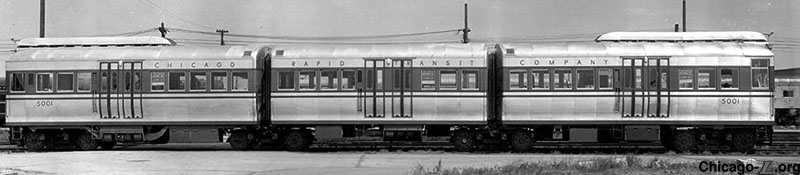
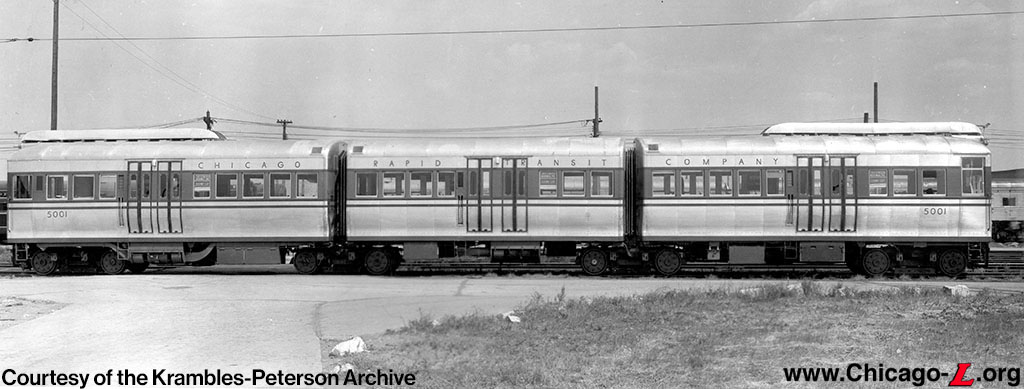
"doodlebugs": Affectionate slang term for the 5000-series cars, probably derived from the articulated cars' bug-like or caterpillar-like appearance. It also may have further origin on mainline railroads, where gas-electric diesels were also called "doodlebugs" or "puddlejumpers". See also "jitterbugs".
The long, segmented design of the 5000-series cars, with their short compartments linked by articulation joints, earned the cars the nickname "doodlebugs", thanks to their similarity to a long, segmented insect. For a larger view, click here. (Photo courtesy of the Krambles-Peterson Archive) |
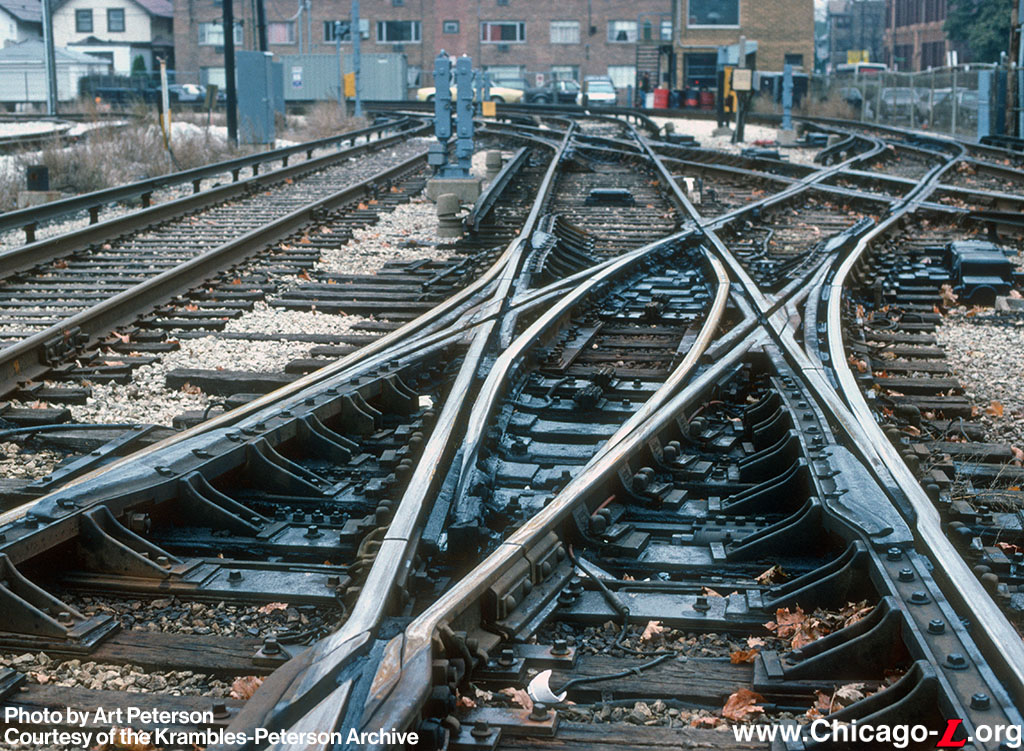
double slip switch (DSS): A rigid switch joining two tracks at a narrow angle made up of eight (8) movable switch points that give the possibility of setting four (4) distinct paths of travel.
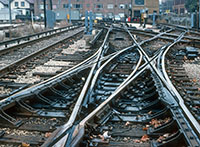 |
A double slip switch is seen within the interlocking at the Kimball terminal on the Brown Line on November 14, 1991. For a larger view, click here. (Photo by Art Peterson, courtesy of the Krambles-Peterson Archive) |
"drag" (eight car drag/ten car drag): A nonscheduled movement of trains to balance equipment. Often, though not always, it is an unusually long train of derelict cars being transferred, or run to a shop (out of service). An example of a type of drag was a "hospital train" (see also).
dynamic braking: The use of an electric traction motor as a generator that is the train's primary of source braking.
expansion gap: A physical gap in the third rail typically four (4) feet long within the limits of a single power section that allows for the expansion and contraction of the rail. An expansion gap can be bridged by the trolley shoes of a single rail car.
express: A term with multiple and somewhat flexible meanings:
extra train: Any train not in the schedule.
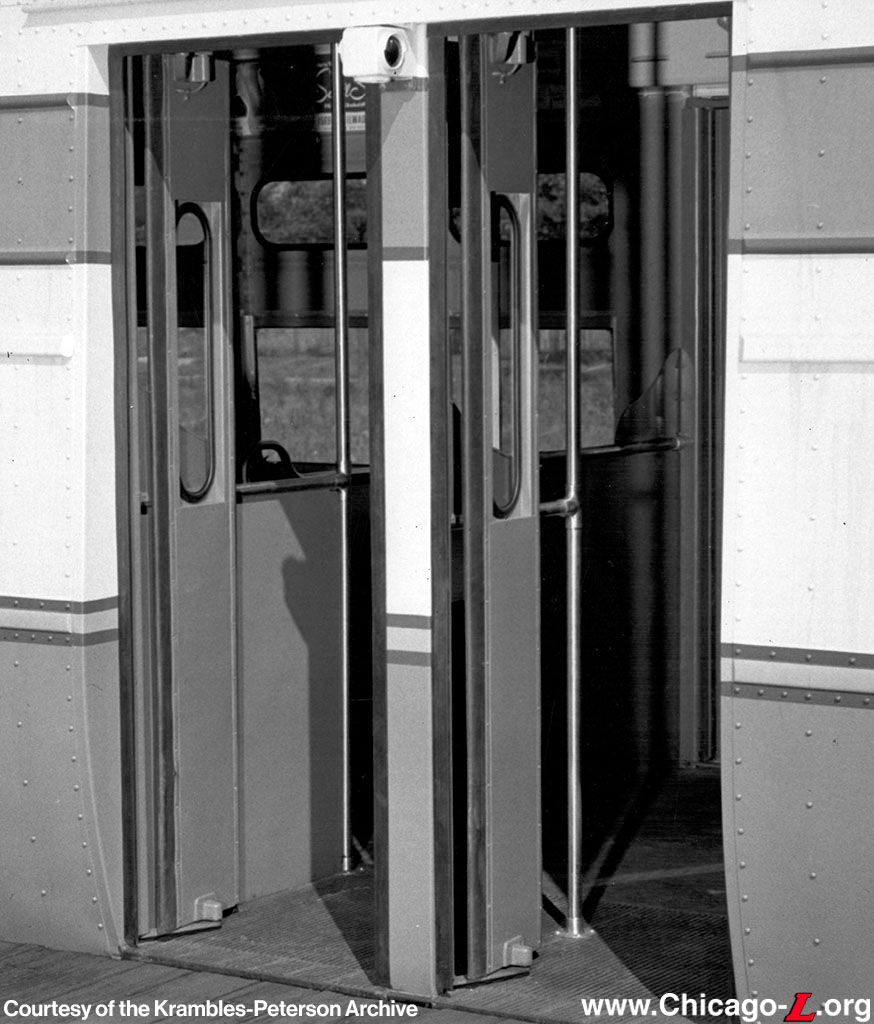
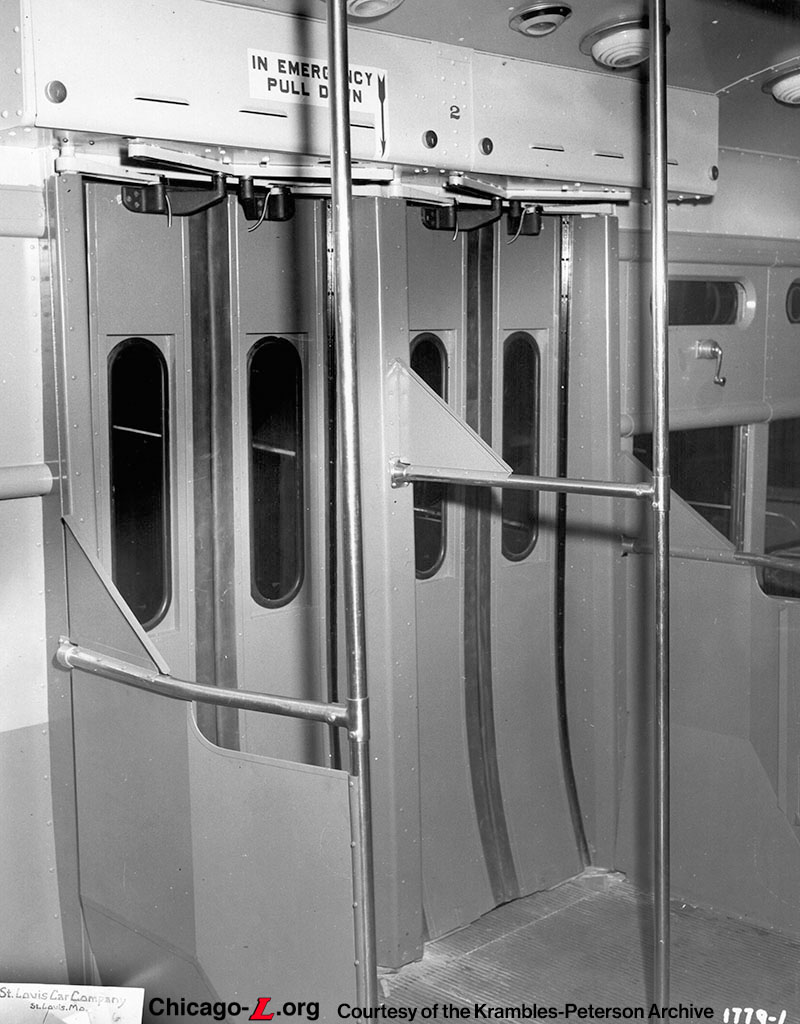
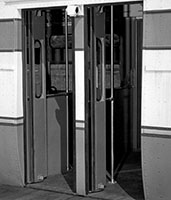
"flat door six": The first 200 cars of the 6000-series delivered to CTA from St. Louis Car Company had flat blinker style doors; the last 520 had curved doors that match the cars' curved sides.
 |
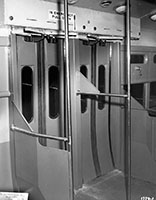 |
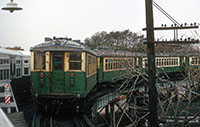
Far left: A set of sidedoors on a "flat door six" -- in this case, the first cars of the series, 6001-6002 -- are seen at Logan Square in August 1950. Although the sides of the carbody are curved (more precisely, they have a "fishbelly" profile), the door panels are flat, requiring a jamb be to designed into the recessed doorway to properly frame the doors. (Also note the original door open/cut-out indicator light location, as a projecting module between the doorsets, which was later superseded by the carside-mounted indicator.) This door design was only used on the first 200 6000-series cars. For a larger
view, click here. (Photo courtesy of the Krambles-Peterson Archive) |
follower: The train immediately behind a given train.
"fool catcher": A small cantilevered platform with a railing, adjacent to the elevated tracks and sometimes hanging over the street, that provides workers on the tracks an escape from an oncoming train.
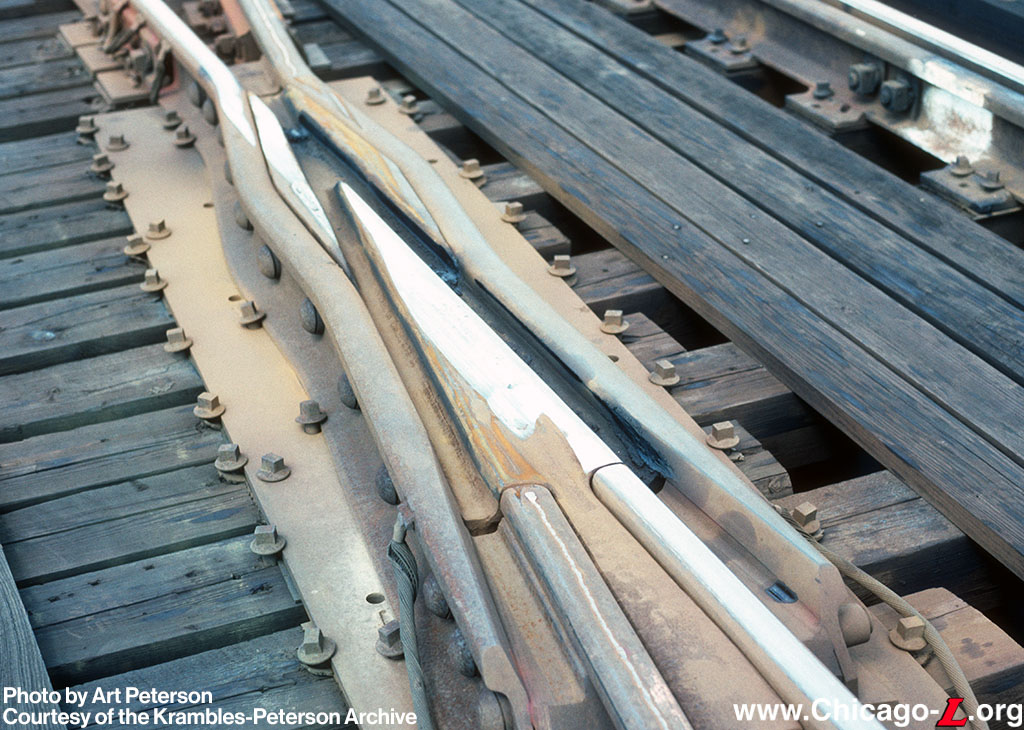
frog: The static or movable crossing point of two (2) rails; the wheel flange guide in the crossing point of two (2) rails.
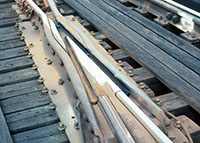 |
The frog on one of the switches in the center track at Western on the Brown Line was photographed on August 20, 1991. The solid V-shaped piece is called the frog's "nose" or "point"; the solid pieces on either side are called the "guard rails". The guard rails, combined with the point, ensure that the wheels of the train follow the appropriate flangeway (recessed path) through the switch frog and that the train does not derail. For a larger view, click here. (Photo by Art Peterson, courtesy of the Krambles-Peterson Archive) |
gang plank: A wood plank -- one side smooth, one side textured, and painted white -- used to evacuate a train in certain situations, specifically when a train is outside of a station and there is another train along side the train being evacuated. The gang plank is stored in a bracket on the right side of the end door at the #2 (non-cab) end of all current "L" cars. See FAQ #4.13 for more on this topic.
"give 'er nine": To use full power and attain maximum speed. The term is derived from the fact that the power pedals on "trackless trolleys" (trolley buses) had nine points of power.
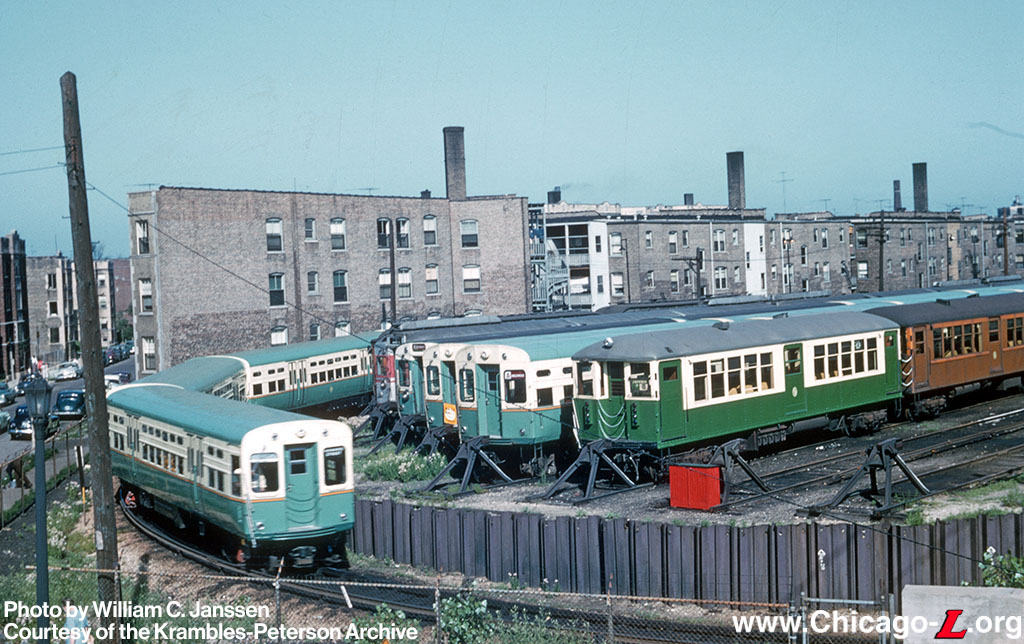
"going around the horn": The large swing through via the loop track around the Howard Yard taken by northbound Red Line trains before heading back south.
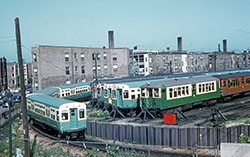 |
A train of 6000-series cars is "going around the horn" in Howard Yard to turn around on July 4, 1954, passing a wide variety of passenger rolling stock laid up on the storage tracks, including (from left to right) a 5000-series car in its original paint scheme, various 6000-series cars of both the 6001-type and 6200-type configurations, and a train of 4000-series cars in both the then-new everglade green and cream livery and CRT-era orange and brown paint. For a larger view, click here. (Photo by William C. Janssen, courtesy of the Krambles-Peterson Archive) |
"going into the hole": Entering the subway system from the "L" tracks via one the portals (some of these are located at Armitage/Sheffield, 13th/State, 18th/Clark, Halsted/Eisenhower and Evergreen/Milwaukee)
governing signal: A cab signal, wayside signal, or hand, flag or lantern signal, which ever is most restrictive.
hand jumper: See stinger.
headway: The time span between service vehicles (bus or rail) on specified routes. Sometimes called frequency.
home signal: The last signal to be passed approaching any point in an interlocking where conflicting or alternative routings of trains must be controlled. Signal identification for home signals included the letter "X".
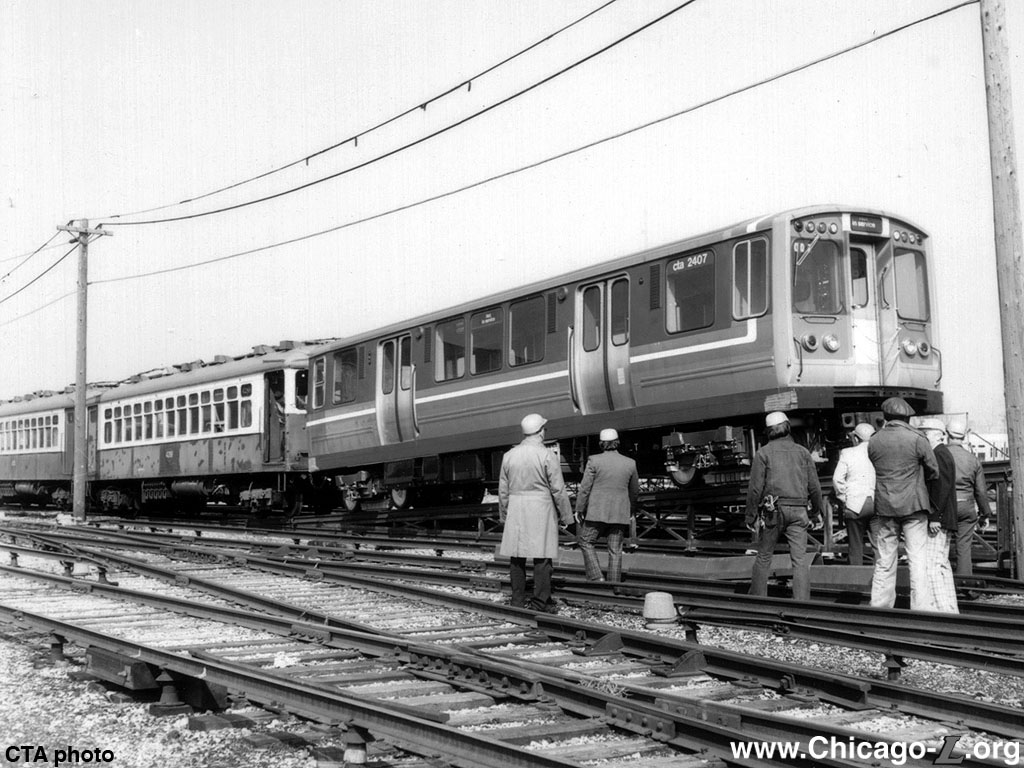
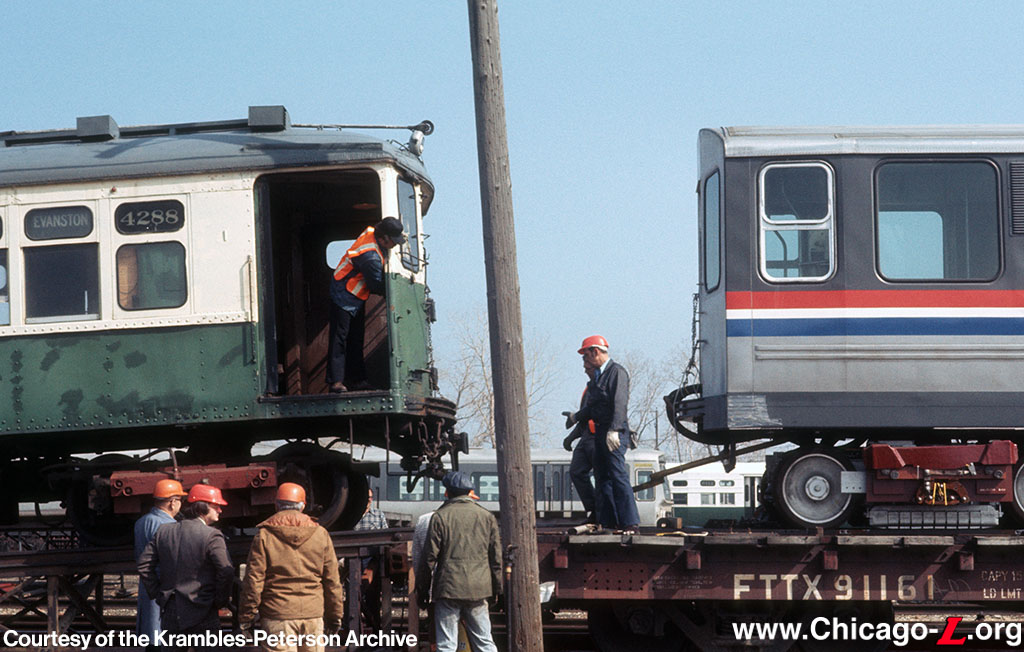
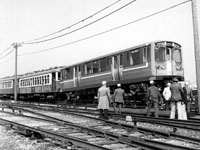
horse: A train made up of cars with fully functioning motors and brakes that are coupled to cars that either cannot brake on their own or are situated or to be placed on dead tracks. A horse is typically used to move other railcars around a yard or in/out of a maintenance shop.
 |
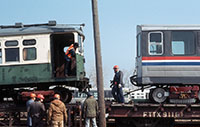 |
During the era when new cars were delivered to CTA via the mainline interchange rail network, one of the duties of the Skokie 'horse' was to pull the new railcars off the delivery flatcars onto CTA rails for the first time. Multiple generations of CTA rolling stock served as 'horses' at Skokie over the years. In these images, 4000-series car 4288 is acting as a 'horse', closing in on newly-delivered 2400-series car 2407 on March 14, 1977, to pull the new car off the flat. |
"hospital train": A train of bad order (see also) equipment (cars with mechanical or electric failures) that was moved, or "dragged", from an inspection shop to a repair facility for attention. An example of a common scenario in which a hospital train was ran was after the PM rush when the accumulated bad orders from Foster Shop/Jeff Park would be run from the north end of the West-Northwest Route to Desplaines Shop for repair -- this move frequently stood out, as it could be an 8- or 10-car train, depending on how many bad orders had accumulated at the small Foster Shop in the course of the day. The "hospital train" term likely came from the main line railroads and probably from employees that made that migration from a railroad job to the rapid transit.
identra coil: An abbreviated term for a Train Identification Coil, an electronic device carried by the lead car of a train for automatic operation at an interlocked junction, to detect the type (route) of train approaching and set the switches automatically, negating the need to staff a tower at that location to sort trains. As a train approached the junction, a carborne electronic device (e.g. the coil) passed in front of a trackside electronic device (a receiver) which automatically set the proper switches for the train depending whether a coil (and what type) was detected. First used at Paulina Junction in 1954 when Douglas trains were rerouted to the Loop via the Lake Street elevated while the Eisenhower Expressway and Congress Line were under construction, with only Douglas trains carrying a coil (if no coil was detected on an outbound train, the default routing was for Lake Street trains). Once the Congress Line opened in 1958 and Douglas trains were routed to downtown via the new line, Loomis Junction on the Congress Line used identra coils to detect and sort outbound Congress and Douglas trains at the junction. See also "john seat".
 |
First-generation 6000-series car 6021 is assigned to the Douglas-Loop service in this August 25, 1954 view at Paulina Junction, and is displaying a Train Identification Coil on the front corner of the train under the motorcab. The background to the left of the train was "opaqued" (removed by covering it after the photo was taken) to help make the hoop-shaped coil attached to the train more visible, the intended purpose of the photo when it was taken in 1954. For a larger view, click here. (Photo courtesy of the Krambles-Peterson Archive) |
interlocking: A group of switches, track trips and signals, with locks so arranged as to permit train movements without conflict; usually locked at track switches and crossings. The oldest interlockings were purely mechanical; newer interlockings are electronic.
"the Island": An abbreviated name for Stony Island/Jackson Park station.
"Jeff": Jefferson Park station, terminal or (formerly) yard, or anything to do with Jefferson Park.
"jitterbugs": A nickname for the 5000-series cars, whose long, articulated bodies gave them a caterpillar-like appearance.
"john seat": Slang term for a Train Identification Coil -(see identra coil), because the ring/hoop-shaped device resembled a toilet seat.
"knucklebuster" : Also sometimes called a "knucklecracker", this term referred to the C-36 controller used on some Northwestern Elevated 1100-1259 and 1260-1269 series cars, as well as the control trailers of the original Baldie 4000-series order (cars 4001-4066). The design of the C-36 controller was such that, when mounted on the inside dash of a cramped cab, the motorman didn't have a lot of clearance for his hand when operating it. Also the variety (type C-36C or 36-C) used by the "L" was generally awkward to operate, especially if wound it up fast.
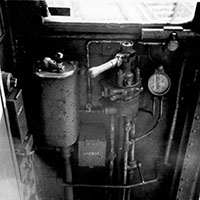 |
This view inside the motorcab of a 4001-4066-type control trailer shows the "knucklebuster" C-36 controller used on all the Baldie 4000-series cars (4001-4250) is seen on the left. With the handle's small size, mounted on the inside dash of a cramped motorcab, the motorman didn't have a lot of clearance for their hand when operating it side to side, resulting in hitting their knuckles on the surrounding equipment. The photo is undated, but visible elements suggest it is sometime in the Chicago Rapid Transit Co. era. For a larger view, click here. (Photo courtesy of the Krambles-Peterson Archive) |
"lay up": This phrase can have two related meanings, depending if it is used as a noun or a verb.
leader: The train ahead of (or, leading) another train.
livery: A car's paint scheme or the manner in which equipment is painted (for instance, the car's particular colors and design and layout of various stripes, logos, and graphics). See the Livery section for more information and history.
local: A scheduled train that stops at all stations on a route.
"Lower Yard": Common reference to the ground-level yard at 63rd & Calumet. There was also a lower yard at Wilson at one time. "Lower" refers to the yard being on the ground rather than elevated, but is typically only used when there is an adjacent elevated yard as well to differentiate the two (i.e. other "L" yards that entirely and only are located at ground-level with no elevated section or annex are not referred to with "lower" appended to the name).
"the Met": Nickname for the Metropolitan West Side Elevated Railroad, and refers to that former private "L" company and/or its facilitates specifically; was also an old timer's term in the CTA era for the Milwaukee/Congress/Douglas route, which was made up of former Met company lines.
middle track: A parallel track running for a short distance situated between revenue service tracks that is accessed via interlocking switches and signals. See also center track.
MU: Multiple Unit. Electrical and/or pneumatic connections between cars that allow the operation of more than one unit from a single cab. Electric cars operated in multiple are controlled by one person in the lead car, and their operation of the master controller in the lead car controls the motors in all cars of the train. Multiple unit control was invented by Frank Julian Sprague and was first prototyped on Chicago's South Side Elevated in 1897. The term "MU" can be used as both a noun ("This is an MU car.") or a verb ("This train is being MUed.").
MUDC: Multiple unit door control -- a system by which all doors on a train can be controlled from a single position (typically a door control box), as opposed to the doors in each car being operated independently, as was the case on the "L" before MUDC.
NITA: Northern Illinois Transit Authority. The new (as of 2026) regional agency created by Illinois legislation signed in December 2025 (SB 2111) to oversee, unify, and fund Chicago-area transit, replacing the Regional Transportation Authority (RTA).
OCI: Operator Control Interface. A graphic user interface that replicates the functions of the OCU (see also) to set announcements and train information on 5000- and 7000-series cars.
OCU: Operator Control Unit. A small box in the motorcabs of 2600- and 3200-series cars with buttons and a small screen that, by logging in with their run number and a prefix that chooses a specific sequence of announcements (for instance, during rush hour when service or transfers might differ from during base, night or weekend periods), sets up the sequence of prerecorded announcements for the operator to play; it also has a menu to choose "special" announcements such as for delays or disruptions to service.
"open it up": To run as fast as the equipment will go.
operating employee (Trainman): The term "operating employee" includes any employee working as a flagman (flagger), conductor, motorman, operator (RTO), towerman (tower worker), switchman (switch worker), yard foreman, platform man/person, or collector.
OSL: Outside signal light. Colored lights on the sides of railcars next to the side doors which convey information to the train crew when lit or not lit about the operation and functionality of the railcar or unit. See FAQ #4.8 for more details.
"over the top": A slang term for when a train that is normally scheduled to operate via the subway is rerouted via the Loop Elevated, usually because the subway has been closed for maintenance or an emergency. The term refers to the Loop route being above the subway route.
Owl Service: Service that is provided continuously between midnight and 5am. On the "L", owl Service is provided only on routes that run 24-hour service. Although the phrase "Owl Service" for late night/early morning service is not unique to Chicago (San Francisco MUNI also uses the term, for instance), it is one of several terms that is often associated with Chicago transit.
PCC: President's Conference Commission. A type of all-electric traction that was developed by leading streetcar companies in the 1930s in a last-ditch effort to save the streetcar industry through modernization and standardization. PCC technology was first applied to the "L" in the 5000-series cars, but was given its largest application in the 770 6000- and 1-50 series cars, 570 of which were actually made from recycled PCC streetcars.
peak: Rush hour time periods, typically defined as 6:00am through 9:00am and 3:00pm through 6:00pm, Monday through Friday.
permitted speed: The permitted speed is the maximum speed at which a train may be operated at any point and is the lowest of the following:
platform time: The period of time in which a transit vehicle is in operation. Platform time contains time that buses are in revenue service and time required to support revenue service, for example time from a garage to the beginning of a route.
"porter": Rail janitor with extra assigned duties, such as collecting signboards or trainphones.
power section: A length of contact rail defined on each end by a minimum of forty (40)-foot section gap that normally receives its power from two (2) sources. Each power section is assigned a unique number that may be followed by a suffix. Power sections that do not end with a suffix cannot be bridged by the trolley shoes on a single rail car. Power sections may be opened (cutting power) or closed (energizing power) either locally (on site or at the nearest substation) or remotely by Power Controller at the Control Center. Having the power distribution system divided into sections allows power to be easily removed to an area in an emergency (or planned) without cutting power to more of a line than necessary.
"pull my poles": To be passed by another vehicle. The term harks back to the days of the trackless trolley (trolley buses), which was connected by poles to overhead electrical wire. When the driver of a trolley bus wanted to pass one in front of him, he would signal to the other driver, who would yell "pull my poles!" The other driver would get out, grab a rope pulling the poles off the wire, and pass the first vehicle.
"put out": A train ordered to leave the yard and go into service.
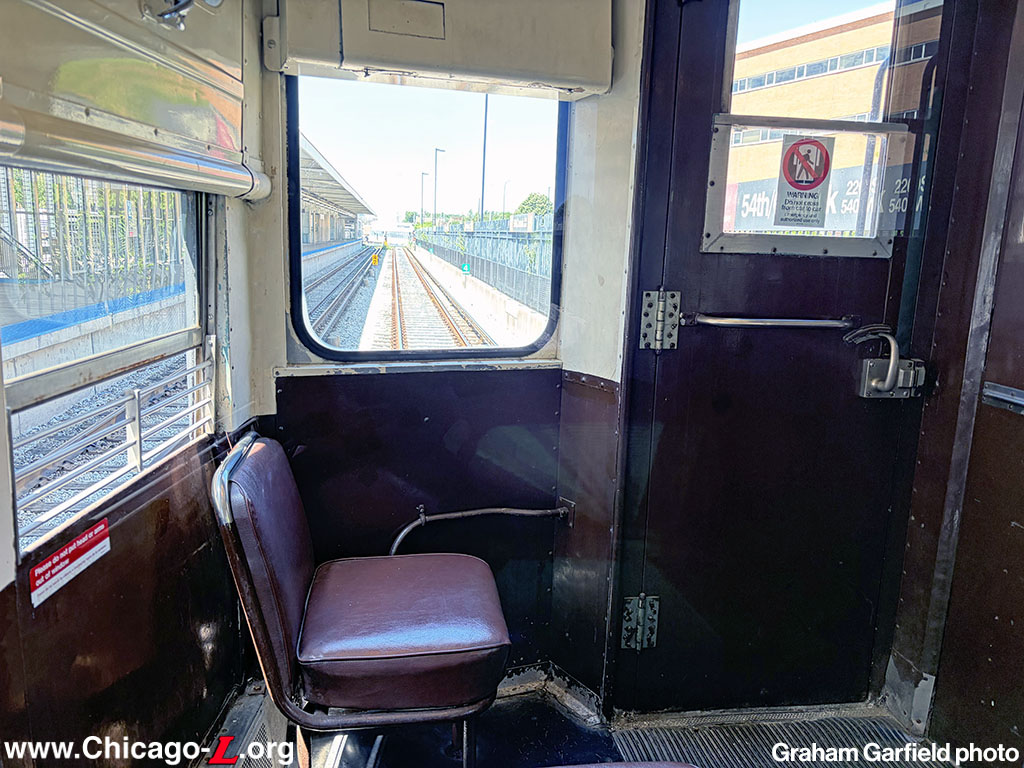
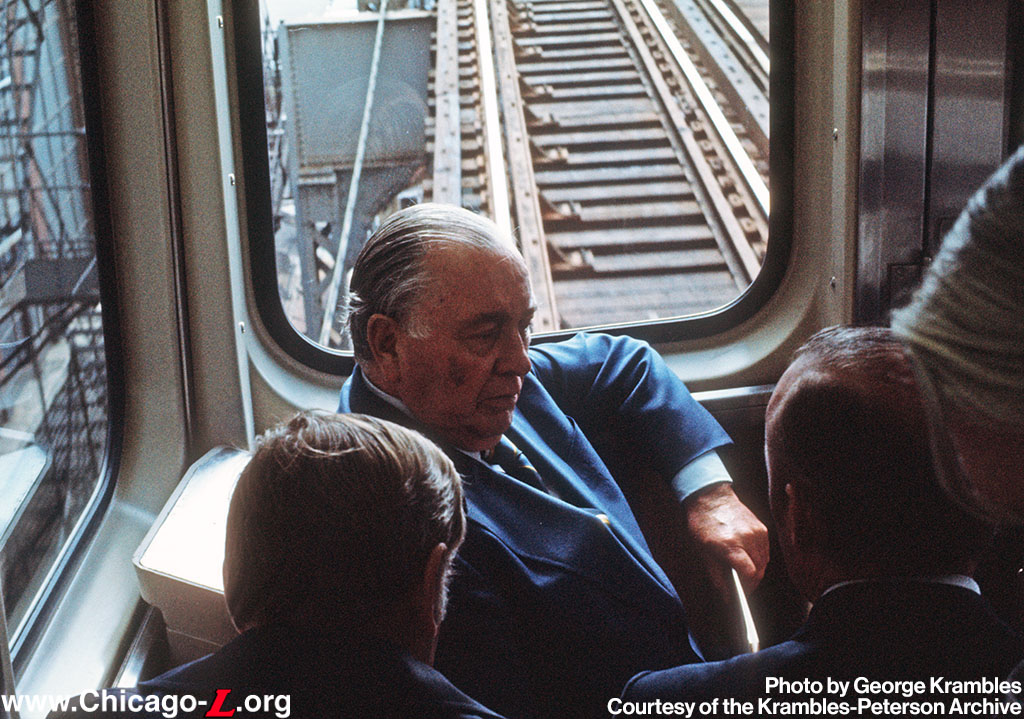
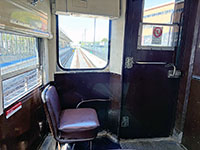
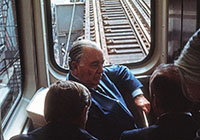
"railfan's seat": The single seat at the front of the car on the left of the motorman's cab, so called because railfans like sitting there to look out the front window. This seat first came into being with the 5000-series cars in 1947 (the design of previous, earlier car series precluded such a seat being provided due to the side doors being at the very end of the car body, placing a vestibule between the forward-most seat and the front end of the carbody), and was included in all subsequent car series until the 3200-series cars, which were delivered with full-width cabs. The railfan's seat was subsequently eliminated in the rehabbed 2600-series cars upon their re-delivery, and when the 2200- and 2400-series cars were converted to full-width cabs around the same time. All subsequent car series, all of which have full-width motorcabs, did not include a railfan's seat, and currently no modern "L" cars in regular service have one. While the first seat behind the cab wall (on the side opposite the controls) offers a view out the front window through the back window of the full-width cab, these are not considered true railfan seats.
 |
 |
Far left: The railfan seat in 6000-series CTA Heritage Fleet car 6711 is seen on June 16, 2026, while the train is on layover at 54th/Cermak. For a larger
view, click here. (Photo by Graham Garfield) Left: Perhaps one of the most prominent persons to every occupy the railfan's seat of an "L" car, Chicago Mayor Richard J. Daley is sitting in the 'best seat in the house' while chatting with CTA Chairman McDonough and Board Member Brabec during the 2400-series inaugural trip on October 6, 1976. Mayor Daley passed away about two and a half months later. For a larger view, click here. (Photo by George Krambles, courtesy of the Krambles-Peterson Archive) |
"the Rave": An abbreviated term for the Ravenswood branch, or more generally the Ravenswood Line in its entirety (now the Brown Line).
"Ravenston": Originally, a run that unofficially began at Kimball and at the Merchandise Mart turned into an Evanston Express. Currently, due to increased demand at southern Brown Line stations but insufficient room at Kimball Yard to store additional cars, "Ravenston" trains now are Purple Line equipment dispatched from Howard Yard that operate as Brown Line trains once they reach Belmont southbound.
reduced speed: Fifteen (15) miles per hour or less.
regular train: A train authorized by schedule.
repeater signal: A wayside signal which duplicates the aspects of a regular signal, and which is usually located on the left side of the track near the regular signal, so that its aspects can be seen earlier. The repeater signal number plate bears the letters "REP".
restricted speed: Six (6) miles per hour or less.
reverse movement signal: A signal which governs movements against the normal direction of traffic.
rigid switch: A track switch which must be lined for either facing or trailing move. Such switch stands are painted black.
"road train": A train in regular revenue passenger service.
rolling stock: The equipment available for transportation, such as automotive vehicles or railroad cars, owned by a particular company or carrier.
route selector: A wayside lever or pushbutton which, when activated, establishes a route, typically positioned for and used by motorman/operators to choose a route at a junction or interlocking that is unstaffed.
RTA: Regional Transportation Authority, the CTA's regional coordination and oversight agency from 1974 to 2026, superseded by NITA (see also).
RTO: Rapid transit operator.
"run": A term referring a late train running express between stations to make up time. For example, at Washington/State, the crew on train 612 (using old CTA run numbers, see also) is given a "run" to Fullerton station. The train 'runs' to Fullerton nonstop. The jargon is to avoid use of the word "express", as it was widely used to identify these operations up until the '90s. However, many Rail Controllers use the terms "run" and "express" interchangeably. And sometimes, they don't say anything. For instance, commonly on the Blue Line, if you a train leaves O'Hare six minutes late, the Controller might say "Control to [run]101, I want you to go from Rosemont to Jeff." or they might say "Operator 210, announce an Express run, Jeff to Logan, you have an immediate follower". (see also "Jeff" and "follower")
"run lite": A scheduled train that runs out-of-service to balance equipment. For instance, on the Green Line the first run of the day to report, run 601, runs lite from Racine Yard to Cottage Grove-East 63rd to begin revenue service because the motorman must get his train from the yard. Similarly, at the end of the day, the last two crews must run lite from Cottage Grove to Racine Yard and lay-up their train at Racine because Cottage Grove isn't a "terminal". (see also "drag")
run number: A three-digit number that designates the collection of trips which forms the day's work for an operator. A run will usually include several round trips in a 24 hour period. The run number is displayed in the run number box, a group of three small roller curtain signs in a box in the front cab window. It designates a scheduled trip between terminals and are assigned in 100-number blocks based on the terminal where the operator reports. The current system of run numbers are as follows:
"scrub": A left over, short piece of work that didn't fit into a regular trick of 8 hours. A scrub shift may, but is not necessarily, include work at more than one location. For instance, back in the era of ticket agents, staffing the #3 agent's booth at Chicago/State station was a scrub because it was only needed in the afternoon rush hour. It worked for 4 hours only in the PM and reported and turned in to the #1 agent booth.
section gap: A physical and electrical gap where no third rail exists for a minimum of 40 feet between power sections (see also) and cannot be bridged by the trolley shoes on a single rail car.
sectionalizing power: The creation of a 40-foot gap to electrically isolate portions of the contact rail for maintenance or emergencies that cannot be bridged by a trolley shoe on a single rail car.
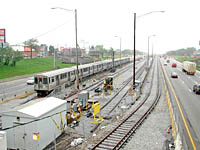
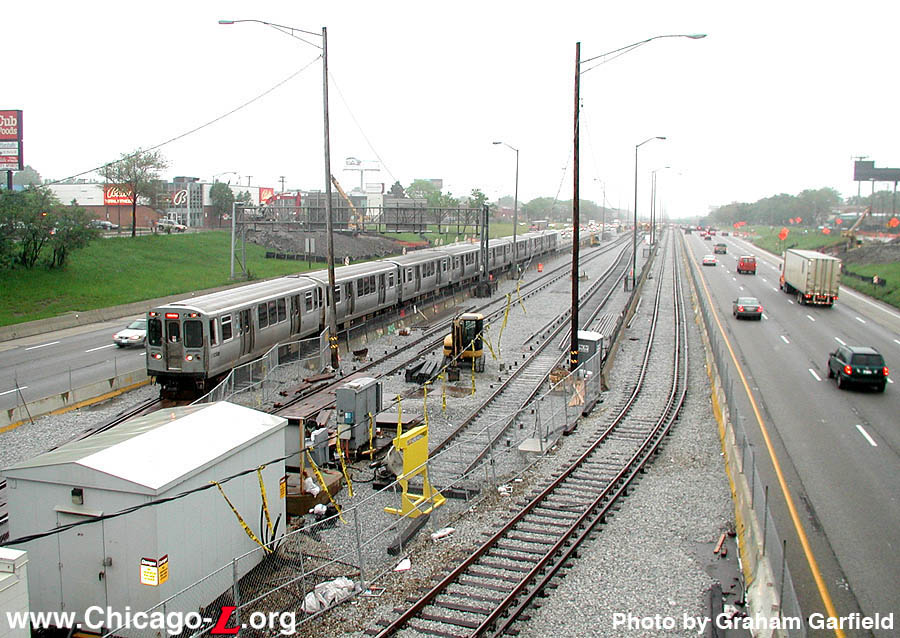
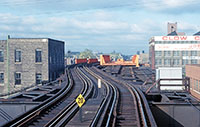
shoofly: A temporary track to bypass an obstacle. On main line railroads, these are sometimes constructed around a derailment or damaged section of track. They are not common on the "L", but were built for instance during the Dan Ryan rehabilitation project in 2004 to allow trains to run around interlockings and sections of track that were being replaced. Sometimes also called "runaround tracks".
 |
|
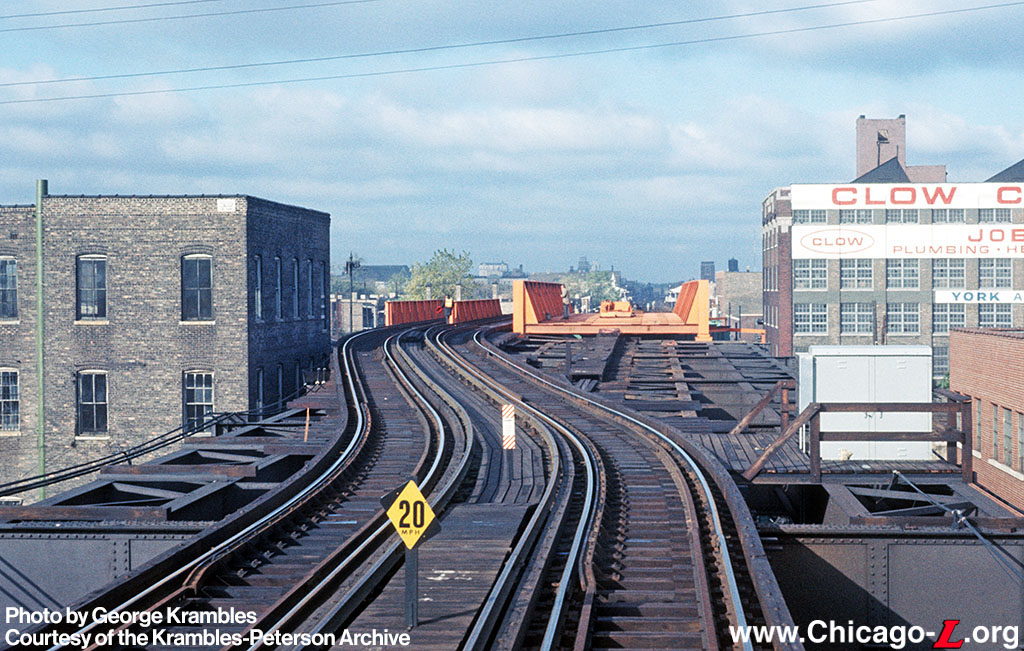
Two examples of shooflies on the "L": Far left: The Lake "L" tracks near Rockwell have been rerouted over a temporary shoofly over the Pennsylvania Railroad tracks to accommodate the construction of a new permanent bridge, seen on October 10, 1967. For a larger view, click here. (Photo by George Krambles, courtesy of the Krambles-Peterson Archive) Left: A shoofly was in operation at 87th Interlocking on May 14, 2004, rerouting trains to allow workers to replace the interlocking and do other work within the right-of-way more quickly without the need to accommodate revenue trains on the tracks being worked on. For a larger view, click here. (Photo by Graham Garfield) |
side track: A track adjacent to a main or a secondary track, for meeting, passing, or storing trains or rail mounted maintenance equipment. Unlike a center track or middle track (see also), a side track typically only connects to the main line track at one end, with the other end terminating in a bumping post.
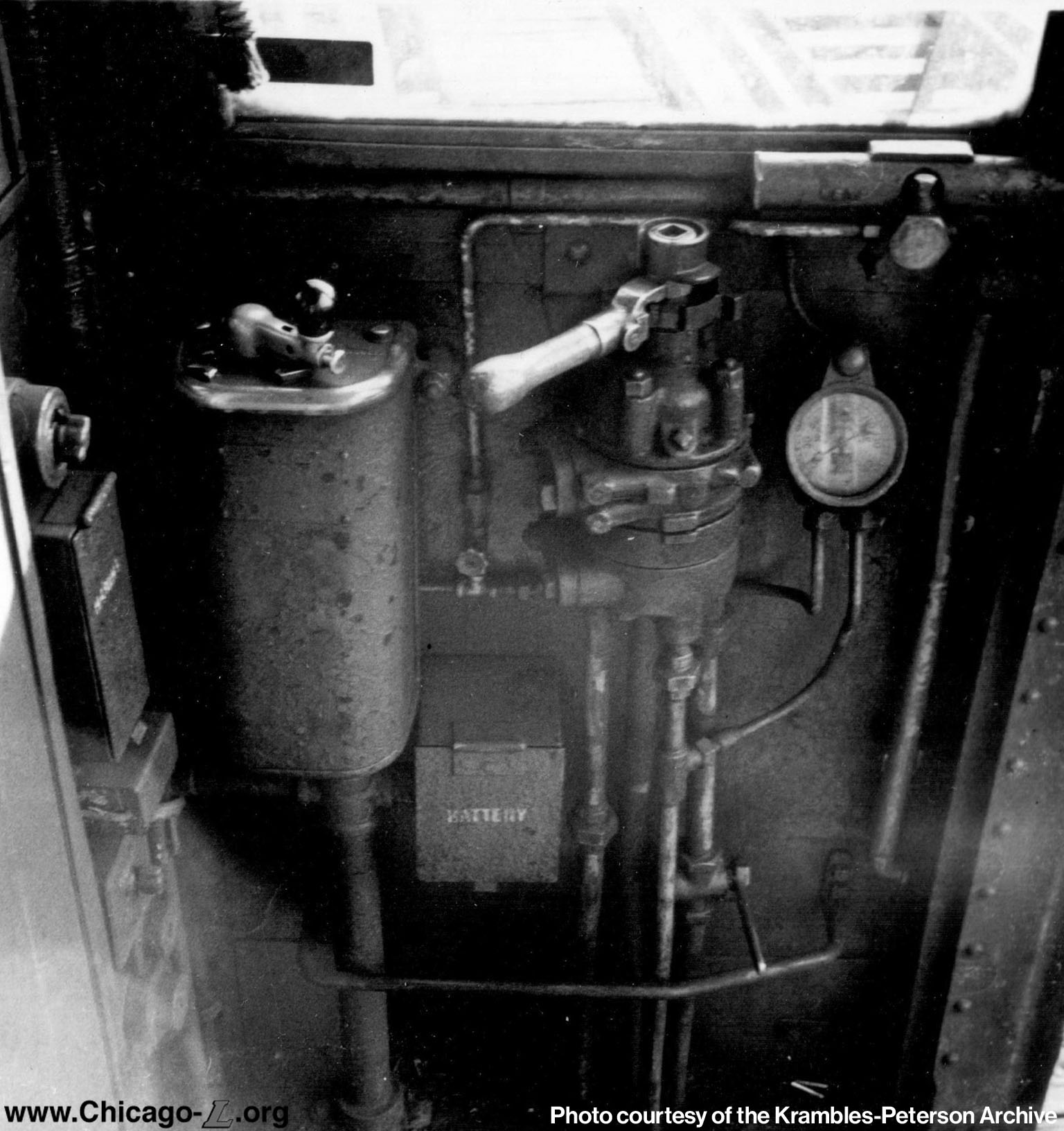
"sidewinder": A term for the Westinghouse-11 controllers used on all Metropolitan Elevated control trailer cars. The W-11 controller was mounted against the front dash and the motorman had to push the operating handle sideways to operate it. Also referred to as "elevator controllers".
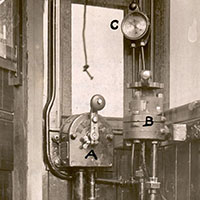 |
An example of a Westinhouse-11 multiple-unit controller is seen here on Metropolitan West Side Elevated car 262 after it was rebuilt in 1907. This is an excerpt of the full photo, which shows the entire motorcab with several elements lettered for identification; this view shows item A, the WH-11 master controller; item B, the engineer's brake valve; and item C, the duplex gauge. This type of controller was called a "sidewinder" due to its vertical mounting rather than the more typical horizontal mounting for a controller, resulting in the motorman rotating the controller handle side-to-side to operate it. For a larger view, see Wood Cars Gallery 9. (Photo courtesy of the Krambles-Peterson Archive) |
Side Trip Emergency Mechanism: See STEM.
signal: Any device conveying information affecting movement of a train. These may include cab signals and wayside signals, both electronic and semaphores.
signal aspect: The position, form or color of a signal.
signal indication: The information conveyed by a signal aspect (e.g. "stop and stay", "proceed on diverging route", etc.)
signal number plate: A plate containing the letters and numbers distinctive for each signal, attached to that signal or signal board.
single slip switch (SSS): A rigid switch made up of four (4) movable switch points that give the possibility of setting three (3) distinct paths of travel.
"sinker": Any railcar without a working motor; either a trailer or a disabled motorcar. See also coach.
 |
As the last day for revenue operation of the 4251-class cars approached some maintenance shortcuts were taken. Car 4443 became a trailer, as indicated by the 'T' on either side of its anticlimber. This car might also have been called a "sinker". CRT/CTA was not alone in having a nickname for its trailers -- the Pacific Electric called their trailer cars 'sleds.' For a larger view, click here. (Photo by Art Peterson, courtesy of the Krambles-Peterson Archive) |
"slip key": A Cineston key issued to shop personnel that is designed to be removed from the controller when motor car is in operation.
slow zone: Sections of track, marked with warning signs and lights, where trains must reduce speed in order to safely operate rail service. For more on Slow Zones, see FAQ #3.14.
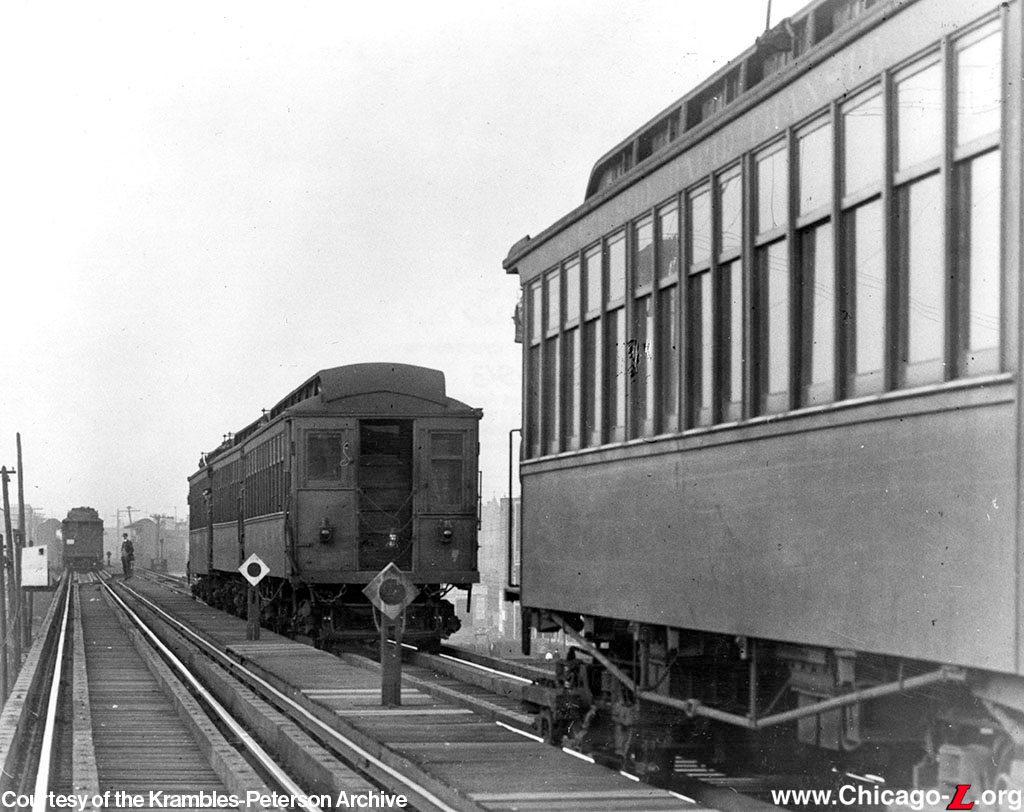
spacing boards: Diamond-shaped pieces of wood usually spaced about 600 feet apart and mounted on short posts adjacent to the tracks. In the days before electronic signaling, they served as a warning to the motorman to slow down if he couldn't see them because of an obstacle or inclement weather.
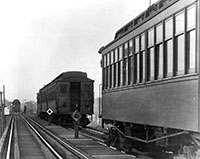 |
Spacing boards installed on the center footwalk are seen on the South Side elevated at 52nd Street keeping two trains of wood-bodied "L" cars safely distanced in 1913. For a larger view, click here. (Photo courtesy of the Krambles-Peterson Archive) |
"spam cans": A nickname for the 6000-series cars. Some claimed that the name simply originated from the shape of the cars. However, many also link the name to, in addition to the shape, their lightweight metal construction and apparently weak structural fortitude in a collision. This latter source may have originated with the November 1956 collision at Wilson station where car 6288 hit a standing North Shore Line interurban train of heavier construction and the 6000-series car's front end was completely crushed.
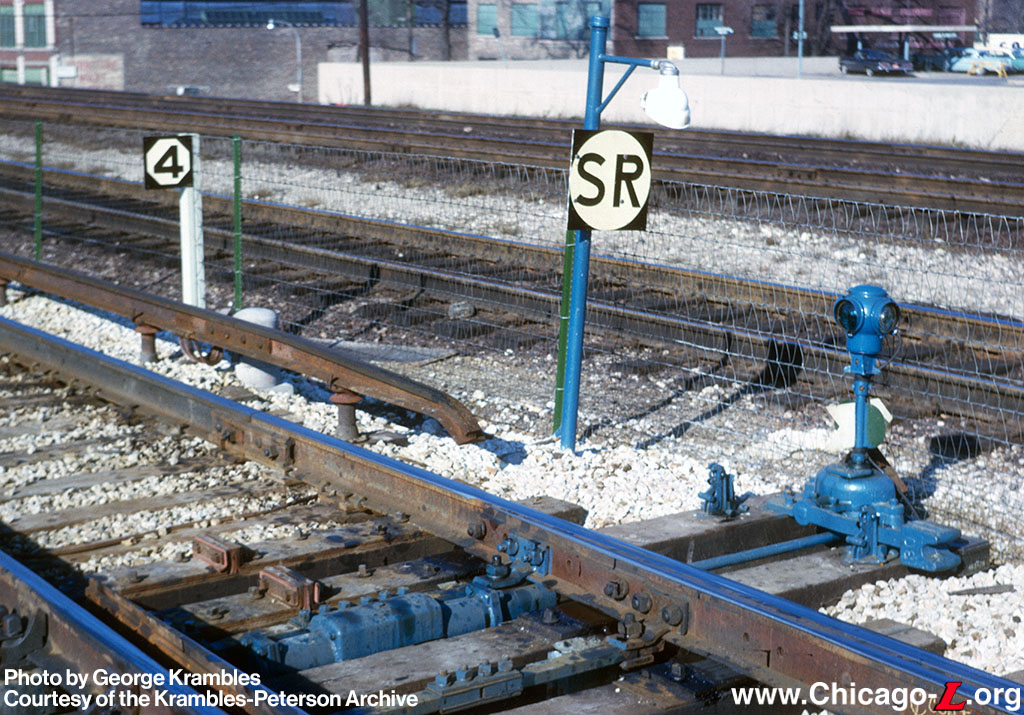
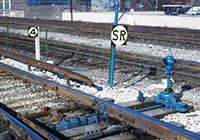
spring-and-return switch: A track switch which does not have to be lined for a training move but will spring to the desired route, if necessary, to allow the wheels to trail through its points, and then will return to the original position. Such switch stands are identified by a sign reading "SR" and are painted blue.
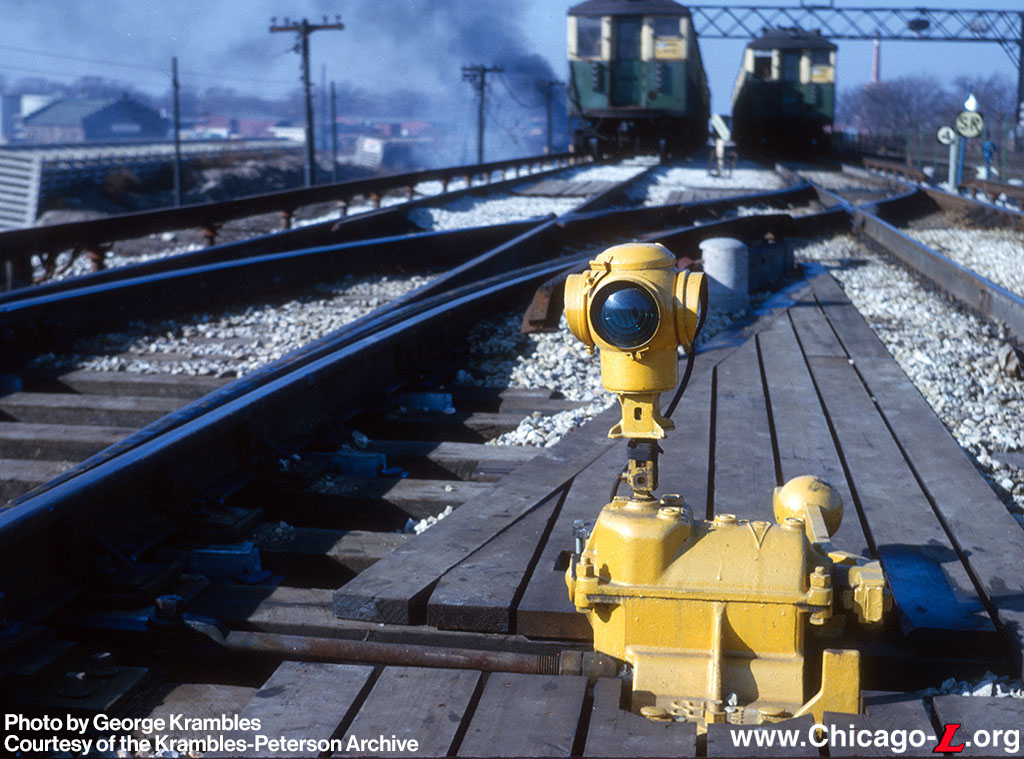
spring-and-stay switch: A track switch which does not have to be lined for a training move but will spring to the desired route, if necessary, to allow the wheels to trail through its points, and then will stay in the new position. Such switch stands are painted yellow.
 |
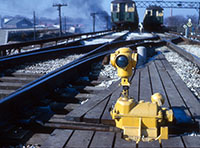 |
Far left: A spring-and-return switch is seen in the recently-opened Harlem Yard on November 3, 1962. The blue-painted switch stand and "SR" sign that identify such switches are both present. For a larger
view, click here. (Photo by George Krambles, courtesy of the Krambles-Peterson Archive) Left: A spring-and-stay switch, with its identifying yellow switch stand, is also seen in Harlem Yard on November 3, 1962. For a larger view, click here. (Photo by George Krambles, courtesy of the Krambles-Peterson Archive) |
SPTO: Part-time STO personnel that are restricted to weekend work, at a lower pay rate, and who do not receive fringe benefits.
station employee: The term "station employee" includes any employee working as a clerk, ticket agent, or foot collector.
STEM: Side trip emergency mechanism -- a device on the underside of a railcar located on the front truck (non-motorcab side) which projects downward that is activated when a car contacts debris or the track trip is set in the tripping position (due to a wayside signal displaying a "stop" aspect). Activating the STEM will engage the train's full service dynamic and friction brakes, enforcing the stop indication of the signal or trip. For an image of a STEM, see also track trip.
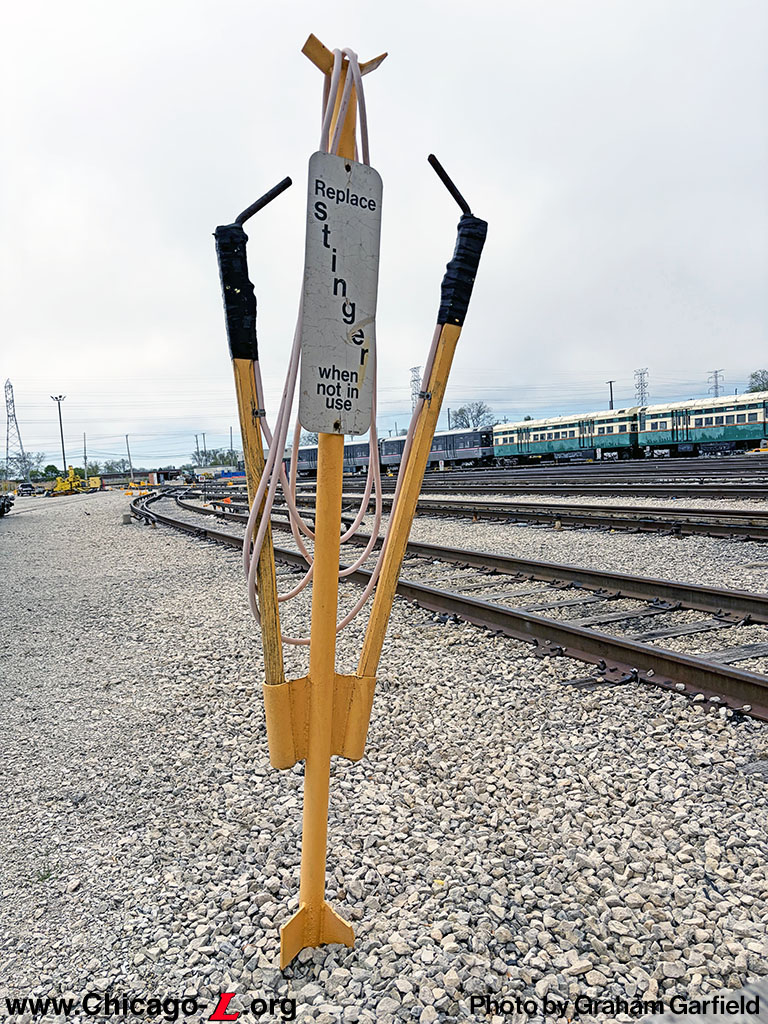
stinger: Stingers, also known as "hand jumpers", are two four-foot long wooden handles, each having an eight-inch long metal contact rod attached and connected by a heavy-duty electrical cable. They are used when an "L" train gets stranded in a spot where none of the third rail shoes are touching the third rail and thus the train has no power to move; by touching the metal rod at one end to one of the third rail shoes of the "dead" train and the rod at the other end to the nearest third rail, the current is passed from the third rail through the stinger to the train, giving it a "jump" and enough power to get back onto live rail. This is most common with short trains (two cars) at switches or grade crossings, but it happens elsewhere on occasion. (See FAQ question 3.3 for more information on stingers.)
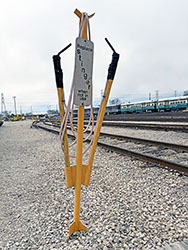 |
A stinger, properly stored in its holder so that it is kept in good repair and is easily found when needed, is seen at Skokie Yard on April 25, 2026. For a larger view, click here. (Photo by Graham Garfield) |
STO: The portion of labor that represents Scheduled Transit Operations. This classification includes bus operators, rail operators, and customer assistants.
stub terminal: A terminal station whose tracks simply dead-end at the platform, with no yard or additional trackage beyond. In the days before the Loop, all "L" lines ended in stub terminals; in later years, they were used to handle overflow traffic. They were Old Congress [South Side], Wells Terminal [Metropolitan], Market Terminal [Lake] and North Water Street [Northwestern].
stub track: A train track that leads into a dead-end spur, but is typically longer than a side track (see also); in many cases, may have a station on it, sometimes referred to as a "stub terminal" (see also), used as a secondary/overflow station for additional capacity.
"sweat box": Non-air conditioned railcars or buses.
switch: A mechanical installation enabling rail mounted equipment to be guided from one track to another.
"swinging load": A full load of passengers. The term comes from the days when "L" trains and buses had overhead straps for standing passengers to grip; a vehicles with a "swinging load" was packed with riders.
tamping: A process by which more ballast (see also) is added to the rail bed. The new ballast will not do any good unless it is placed next to and under the wood or concrete ties that support the steel rails. Most railroads, like the CTA, have a machine called a "ballast tamper" to help them perform this work quickly. This machine pulls the existing railroad track out of the dirt and "tamps" fresh ballast rock underneath and around the ties preventing the track structure from sinking into the ground. They can also use a machine called a "Ballast Regulator" to evenly distribute the ballast along the rail corridor. The process is necessary because, over time, the ballast sinks into the ground, allowing the smaller particles of dirt and silt to come up to the surface, creating an unstable bed for the railroad.
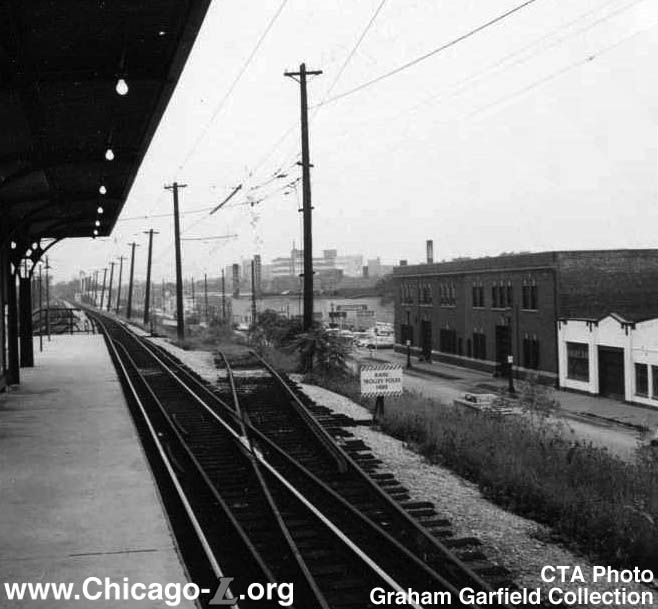
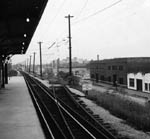
team track: A rail siding for general usage by freight shippers where freight cars can be spotted so they can be loaded or unloaded by an industry or shipper. They are named for the teams of horses that once pulled the wagons to move the freight to and from the trains.
 |
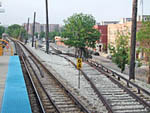 |
Left: This view looking north from the South Blvd. platform on September 10, 1963 shows the South Boulevard team track branching off from the main line. The team track was a rail siding for general usage by freight shippers where freight cars could be spotted and loaded or unloaded by an industry or shipper. The small sign to the right of the switch reads, "RAISE TROLLEY POLES HERE". About two months earlier, on July 6, 1963, trolley wire was replaced with third rail on the Evanston Line between Howard and South Blvd. However, the line north of South Blvd. to Isabella and the team track still used overhead trolley wire to power trains, requiring trolley poles on the cars to the raised and lowered here. For a
larger view, click here. (CTA photo, Graham Garfield Collection) |
|
"throw it into the big hole": An order from a motorman to come to an emergency stop.
time-controlled signal: A signal displaying a restrictive aspect, which may change to a less restrictive aspect only when a train approaches at or below the permitted speed.
time release: A device to delay the movement of a switch or switch lock to assure that possible conflicting train movements are accommodated, and then to operate the switch or switch lock.
timing device: A mechanism installed in an electric circuit to delay the functioning of the circuit.
"toilet seat": Slang term for a Train Identification Coil -- see also identra coil.
Top Operator Rate: The top hourly rate paid to Bus Operators and Rail Operators, based on employee seniority within the job, as specified by the union contract.
TOTS: Train Operator Touch Screen. A display screen found on 5000- and 7000-series railcars which displays video, interactive text, indicators and controls used by the operator in the operation and monitoring of the train.
track circuit: A length of track which forms a path for an electrical current used to detect the presence of a train. See also automatic train control.
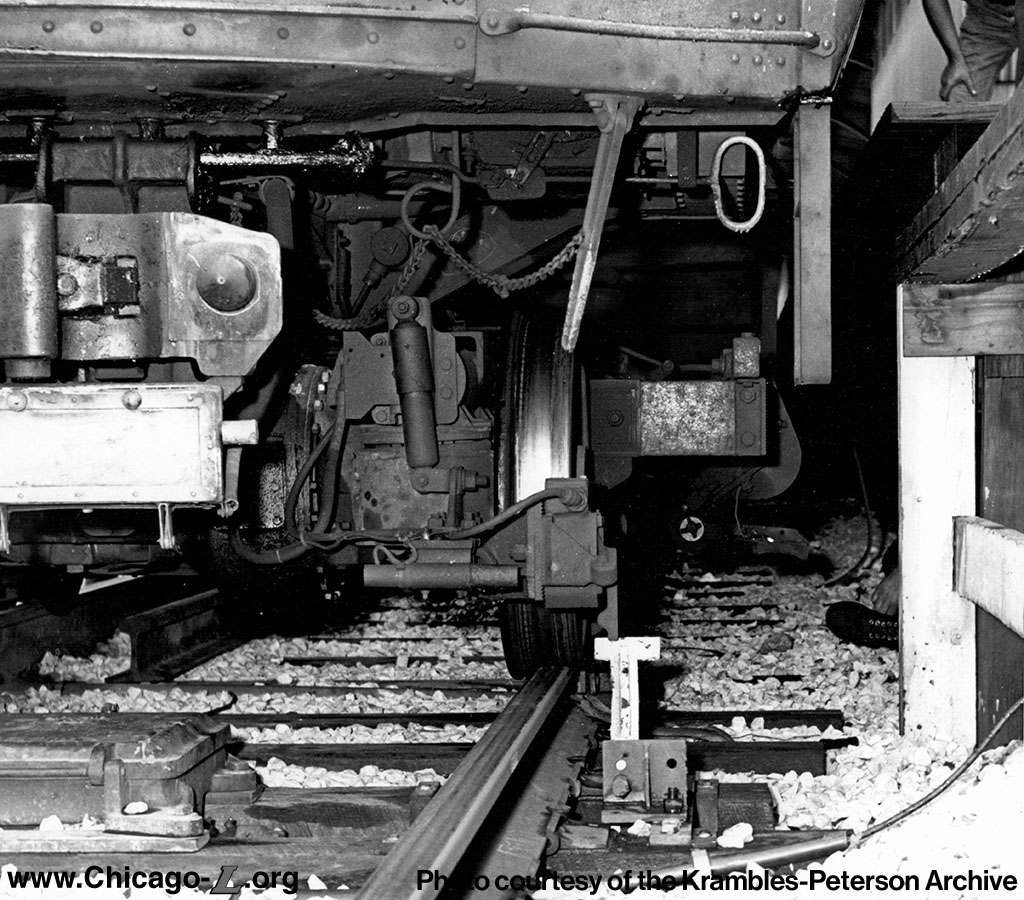
track trip: A device at track level that will stop a train if it should pass a wayside signal indicating "stop", enforcing the restrictive signal. The trip is a T-shaped object (currently painted white) located next to the and outside of the running rail on the non-motorcab side of the tracks in the direction of traffic of the signal it is associated with. The trip is able to move up and down -- when raised, the trip strikes the railcar's side trip emergency mechanism (STEM), which projects downward from the underside of the car in the same plane as the raised trip; when the STEM is pushed back by the trip, the train's brake will engage to enforce the stop signal. When a signal displays a "proceed" aspect, the trip is lowered and the STEM passes over the lowered trip without touching. See also automatic block signals and STEM.
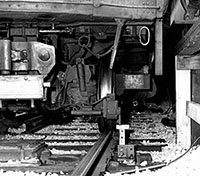 |
This front-end under-carriage view of a 6000-series railcar circa 1972 shows what a modern track trip (the white T-shaped object next to the running rail) looks like, and how, when raised, it stops a train if it should pass a signal indicating "stop" -- the trip strikes the side trip emergency mechanism (STEM), which projects downward from the underside of the car in the same plane as the raised trip, as seen here. For a larger view, click here. (Photo courtesy of the Krambles-Peterson Archive) |
track trip manual release: A lever on a wayside signal used to lower the track trip.
train berth: See berthing area.
train consist: See consist.
"trim a cab": To open a cab to passengers when not in use. This term has somewhat different meanings depending on the type of equipment being referred to. The 6000- (1950-1959), 2000- (1964) and 2200-series (1969-70) cars all had motorcab doors whose hinges allowed them to swing inward and close off the controls and switches on the front side of the motorcab, leaving the sensitive equipment secured when not in use but the cab space and seat otherwise open and available for passengers; when referring to these series cars' motorcabs, "trimming the cab" referred to configuring the motorcab for passenger use in this way. In addition, the 6201-6470 group of 6000-series cars delivered in 1954-55 had the conductor's position located in a purpose-built cab at the #2 end of each car, diagonally opposite the motorcab; when not required by the conductor, this cab area could be made available for passenger use by folding the door against the end bulkhead. So when referring to these cars, "trimming the cab" could also mean making the conductor's cab available for passenger use. The 2400- and 2600-series cars, as delivered, made the motorcab dedicated crew space, so this term did not apply to them. The 3200-series cars (1991-94) and all subsequent car series (as well as the 2600s, post-midlife rehab) were built with full-width motorcabs--the main operating compartment was still in the front right corner of the car as in earlier series, but the back wall extended to the other side of the car interior. Thus, when the door in the back wall of the motorcab was closed across the aisle it enclosed the entire width of the front end of the car as dedicated crew space, which facilitated the operator working the doors on both sides of the train under one-person train operation. However, when not in use as an active motorcab at the front of a train, the cab door was to be closed to secure only the right corner of the car where the controls were located, leaving the aisle to the end door and the other side of the cab open for passenger use---configuring the cab in this way on newer cars is also referred to as "trimming the cab". This is necessary to do not only to make more room for passengers, but to provide access to the end door of the car for emergency evacuation purposes.
tripper service (or a "tripper"): A revenue train operation that is not part of a full run. A full run (as in, when a train is operating as Run 908 or such) consists of several trips. For instance, run 514 (a PM Evanston Express run) might start at about 2pm, end around 10pm or so, and include two Loop round trips and three or so shuttle round-trips. All those trips (we will define a "trip" as being from one point to another) are part of a single run. A "tripper" will often operate in rush hour or another heavy-traffic time, when extra trains are needed between certain places for a relatively short period of time. A couple extra trips might be added to get people downtown, then those trains are taken out of service. They didn't complete a full run (of several trips), so they operated in "tripper service".
trolley shoe: A current collecting device that glides on top of the third rail to carry electricity from the third rail to the rail cars. See the Third Rail and Trolley Shoes section of the Traction Power page for more information.
unit: Two cars, the A-car and B-car (see also), coupled together mechanically and electrically via a semi-permanent coupling.
"washout": A manual signal for a train to stop because of oncoming traffic or danger. The signal is given by a lantern or flashlight waved horizontally across the track. An old railroad term, it was used to warn trains of washed-out bridges.
wayside signal: Any signal of fixed location outside the train along side the track.
"wrap it up": To go fast, at top speed
|
|
|
Sources:
- Keegan, Anne. "Chicago Speak." Chicago Tribune. 24 February
1995.
- Krambles, George and Arthur Peterson, CTA at 45, Oak Park,
IL: George Krambles Scholarship Fund, 1993.
- Chicago Transit Authority Rail System Rule Book, issued
March 17, 1985.
- Vince "The Wolfman" Dawson, CTA
Badge #7699
- Peterson, Art