.
|
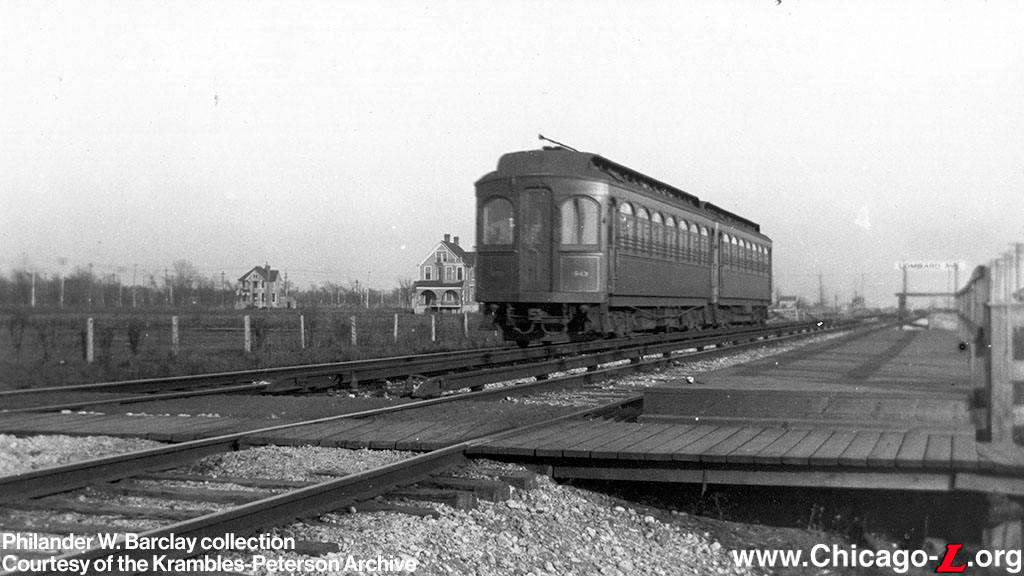
This circa 1903 view looking east as AE&C car 40 approaches Lombard station (two years before the "L" started serving the stop) shows the simple amenities of the early station facility and how sparse settlement was in south Oak Park at the time. For a larger view, click here. (Philander W. Barclay collection, courtesy of the Krambles-Peterson Archive)
|
Lombard
(200W/900S)
Lombard Avenue and
Harrison Street, Village of Oak Park
Service
Notes:

|
Garfield
Line
|
Quick Facts:
Address: TDB
Established: |
Late summer/fall 1902 (AE&C interurban service
inaugurated) |
March 11, 1905 ("L" service
inaugurated) |
Original Line: |
Aurora, Elgin & Chicago Railway (interurban service) |
Metropolitan West Side Elevated,
Garfield
Park branch ("L" service) |
Previous Names: none
|
Skip-Stop
Type:
|

|
Station
|
Rebuilt: n/a
Status: Demolished
History:
The Aurora
Elgin & Chicago (AE&C) interurban began service from Aurora and
Wheaton to a connection with the "L" at 52nd
Avenue (Laramie) on August 25, 1902. On opening day, not every station was ready; in the Maywood and Oak Park areas, the stations in service on the first day were Maywood (5th Avenue), Harlem (referring to the Village of Harlem, not the Avenue, so this was Desplaines Avenue), Oak Park (Avenue), Austin Avenue, and 52nd Avenue. However, early photos and records indicate that other stations were soon added.1 A map in an October 1902 Street Railway Journal article lists all the stations planned on this section of line, suggesting that the remaining stations, including one at Hannah Avenue one block west of Harlem Avenue, opened between August and October 1902.
As with many smaller, local AE&C stops, the Lombard Avenue station consisted of little more than a pair of ground-level side platforms with a walkway leading between the street and the boarding areas. As was the case at many local stops in this area, the platforms were split on different sides of the street--the outbound platform on the west side of Lombard Avenue, while the inbound platform was on the east side of the street.
A photo of Lombard station dated circa 1903 looking east from the street shows the inbound platform consisting of a wood deck raised a few inches above the wooden sidewalk along the street. The platform has a simple wooden back railing, and a sign reading "LOMBARD AVE" in dark type on a light background perpendicular to the tracks, raised above the railing on tall posts. Although spare in amenities, the provision of a wooden platform provided a better facility than many other early local AE&C stops, which consisted of little more than a graded area covered in gravel and/or cinders.
The Metropolitan
"L" assumed local service between 52nd
Avenue and Desplaines Avenue on
March 11, 1905, relieving the AE&C of this unwanted chore. The
extension of Garfield
Park service to Desplaines and the
Met's servicing of the local stations between was part of the
reciprocal trackage agreement that allowed the AE&C to extend to
downtown Chicago and the Fifth Avenue
Terminal over the Metropolitan Elevated.
A 1908 Sanborn Fire Insurance Map shows that the station still consisted of simple short, low platforms split on either side of the street, though the inbound side had gained a small wooden waiting shelter toward the east end of the platform.
Aerial photos show that by 1938 both platforms were located on the west side of Lombard Avenue. It is also likely that by this time, the station consisted of wooden dual side platforms with a station house located at the entry to the inbound platform from the street. The station house design was likely
typical of other small wood frame ground-level Met station houses.
The headhouse was positioned between the street and the boarding
platform, requiring passage through the station house before reaching
the platform.
During the 1950s, the City of Chicago and Cook County undertook
construction of the Congress Superhighway [Eisenhower
Expressway] along the general alignment of the Garfield
Park "L" line. Part of the project also included the new new
Congress "L" Line to
replace the Garfield
Park. Lombard closed on September 20, 1953. Lombard was not yet
in the way of the construction project but was closed due to its low
patronage to speed up service on the Garfield
Line, which had slowed due to a temporary grade-level trackage
along Van Buren between Sacramento and Aberdeen with multiple street
crossings.
A replacement station entrance -- the Lombard entrance to
Austin station -- was opened on
the Congress Line on
December 27, 1960.
Notes:
1. Plachno, Larry. Sunset Lines: The Story of the Chicago Aurora and Elgin Railroad - 2: History. Transportation Trails, 1990.