|
|



|
|
|


Miscellaneous "L" Accidents
Pre-CTA Era: 1924-1947
|
|
|
|
|
Miscellaneous "L" Accidents
Pre-CTA Era: 1924-1947
The following are less serious incidents that have occasionally occurred on the "L" between the merging of the "L" companies into the CRT in 1924 and the formation of the Chicago Transit Authority in 1947. These may include situations in which there was very little damage or injury and incidents that caused little or no disruption of service. Also included here are those incidents which may indeed be of a serious nature, but of which we have too little specific information to create an individual page for that particular incident.
This is not an exhaustive list of accidents and mishaps that have occurred on the "L" over the last hundred years. There are, indeed, a good handful of incidents that are not listed on the site. Mostly, incidents that are omitted aren't listed because we do not know about them or have too little information to discuss them accurately and authoritatively, and in the interest of fairness we will not list incidents for which there is not corroborated information. At a later date this page will be updated as more research can be undertaken on additional incidents. If you believe you know of an incident that is not listed below, feel free to contact us and we will add it to our roster of information to be investigated at a later date.
1927*: Accident at Wabash and Madison
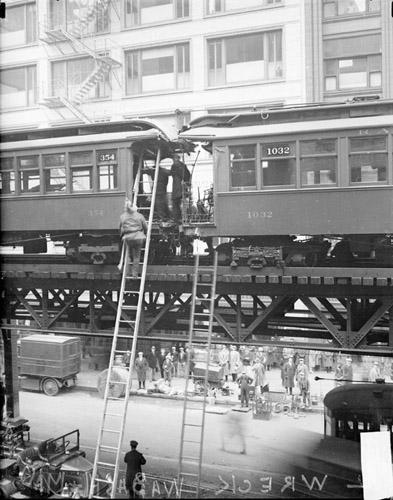
An accident of unknown details, likely a rear-end collision, occurred between two trains on the Loop elevated near Madison and Wabash. The ends of the wood "L" cars involved in the accident were smashed and madly damaged. Emergency workers used ladders from street level propped against the elevated structure and trains to reach the incident trains and passengers.
|
Fireman climb on a ladder leaning against an elevated train track on Wabash Avenue in the Loop, after an accident. A crowd is visible standing on the ground below.. For a larger view, click here. (DN-0084232, Chicago Daily News photo, CHM Collection) |
November 24, 1936: Granville Rear-End Collision
A severe rear-end collision involving a North Shore Line interurban hitting the rear of an "L" train near the Granville station on the North Side destroyed the trailing wooden car. For more information, click here.
January 30, 1939: Severe Snow Storm Results in Three "L" Accidents Around System
A severe snow storm, which started at 11:30pm, Sunday, January 29 and ended around 2pm, Monday, January 30, created the most intense snowfall on record in the city up to that time. The storm, which spread over 13 states, paralyzed activity in Chicago. During the 14-1/2 hour period of the storm, 14.8 inches of snow fell, with another tenth of an inch added by 6pm Monday.
At least 6,400 men and hundreds of trucks, snowplows and sweepers were put to work by public agencies and transportation companies to clear streets and tracks. The elevated lines, bus company, and surface lines put 2,500 men to work. The surface lines had 150 plows and as many trucks working all night. The Motor Coach company employed 250 men and 70 plows on the boulevards.
Amidst this hardship, multiple accidents occurred on the elevated lines, which were swamped with passengers due to the impassibility of many roads. There were three crashes, causing injuries to 36 persons, six of them seriously hurt.
The first "L" accident occurred at 7:45am, during the morning rush hour, when an eastbound Douglas Park train smashed into the rear of another train at California station on the Douglas branch. Two cars were telescoped in the collision. Sixteen people were hurt; three, pinned in the wrecked car, were extracted by firemen.
The crash was described by passenger George Novak of Berwyn, who was riding in the 4-car second train, to the Chicago Daily Times:
"The front train was so crowded they were letting people enter the last car on the rear platform. They were all piling in when our train came right up behind and folded the rear platform under them like matchwood. There must have been at least 20 people on that platform. They fell all over. Women screamed and yelled. Men knocked women down trying to get out. People inside smashed windows to get out. We all worked like horses to pick up the injured. Many of them were lying around with broken legs. The snow was coming down so hard we hardly could see what we were doing. Several people went to telephone but they had so much trouble getting Central the fire department didn't get there until a half hour after the wreck."
William Levy, a witness who had just stepped off a westbound train on the opposite platform, said it took firemen 20 minutes to extricated two men pinned in the wreckage. Loop-bound traffic on the Douglas Park line was tied up for three hours after the accident.
Four hours later, an 8-car eastbound Englewood Express rammed the rear of another train at Damen station on the Ravenswood branch. Seventeen people were injured, the most serious injury being to Motorman Frank J. Boehm.
The third crash occurred when a Garfield Park "L" train struck the rear of a Chicago, Aurora and Elgin interurban train at Kedvale Avenue. One person was slightly hurt.
In addition to these collisions, a fire in a southbound "L" train just beyond Wilson station added to the blizzard confusion. The fire started from a lighted cigarette which fell between the seats of the car crowded with about 175 persons. A woman screamed, alerting others to the fire; the emergency brake cord was pulled, stopping the train. The motorman came to the car and extinguished the fire with a fire extinguisher, and all passengers remained in the car. "L" traffic was delayed for almost an hour.
May 12, 1941: Train Derails, Hangs Off Market Stub Structure
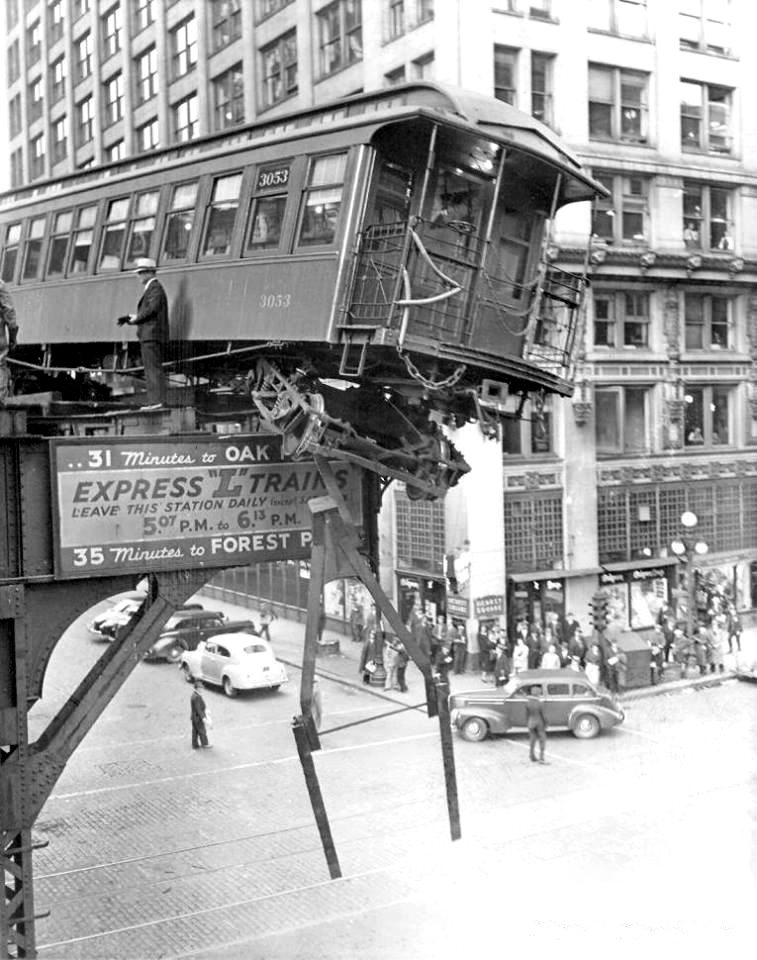
A two-car Lake Street elevated train, led by car 3053, crashed through the bumper at the end of the Market Street Stub at Madison and Market (Wacker) and came to a halt with the first truck and forward half of the train hanging off the end of the elevated structure. Although the accident occurred during rush hour, there were no passengers onboard. The train was pulling into the station when the accident occurred.
According to motorman James Vito, the brakes failed to hold as he tried to bring the train to a stop at the terminal station platform. The Chicago Daily News reported that the brakes failed because a fuse blew out. Glass, splintered pieces of wood, and metal track spikes showered the street below, cutting a traffic police officer below.
|
The front of Lake Street elevated car 3053 dangles over the intersection of Madison and Wacker after a mishap in which the motorman could not stop the train before hitting the bumping post at the end of the track. There were no passengers onboard. For a larger view, click here. |
May 13, 1942: Split Switch Smashes Train Into Tower 12
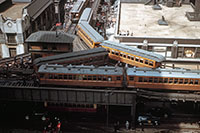
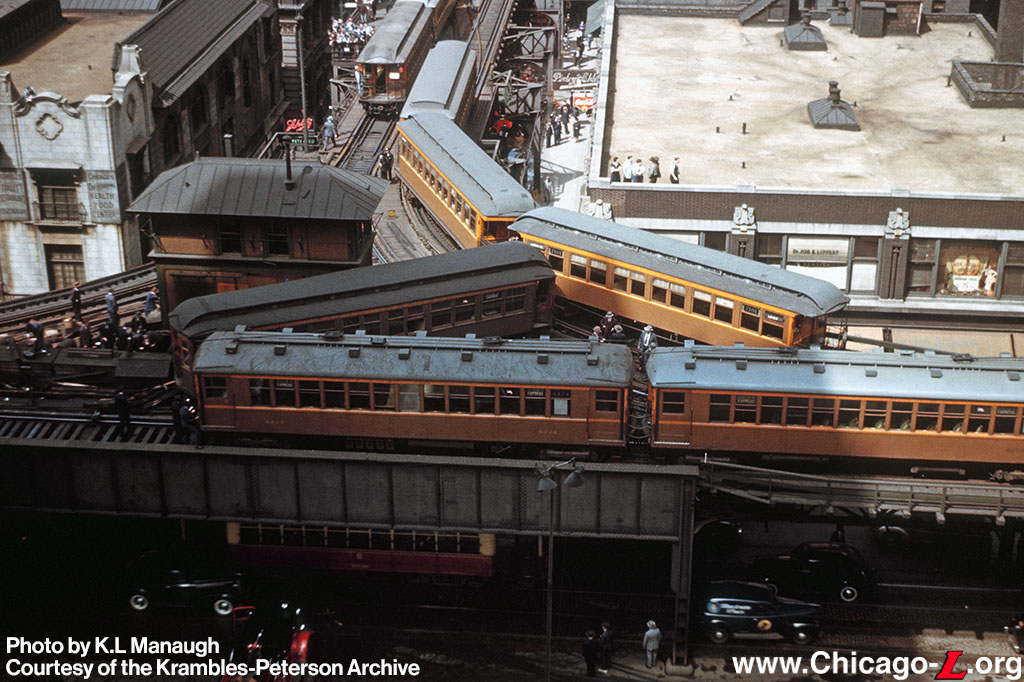
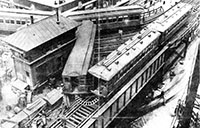
This aerial view taken by a member of the CRT Transportation Dept. of the accident at Tower 12 provides a good overview of the aftermath of the split switch, with the front of the wooden lead car taking the curve around the loop and the rest of the train continuing ahead -- pushed forward by the heavier steel cars behind the wood unit -- resulting in the train jackknifing and the lead car being slammed against the tower in the middle of the junction. For a larger view, click here. (Photo by K.L Manaugh, courtesy of the Krambles-Peterson Archive) |
This dramatic accident, in which a train derailed and struck Tower 12, was indirectly caused by a large building fire next to the Loop elevated.
A 4-11 fire which began in the Fred Potthast Restaurant at State and Van Buren streets, next to the "L" station, caused large-scale damage and a number of injuries on its own -- six firemen and a woman on-looker were hurt and street traffic was paralyzed for hours. The fire at the restaurant at 4 W. Van Buren St. originated in the explosion of an oil burner in the basement of the six-story building. Following the burner explosion, the fire burst ammonia pipes in the restaurant's refrigerator system, releasing fumes causing further injuries and hindering fire fighting and rescue.
While street and pedestrian traffic was detoured and streetcars were rerouted, "L" trains continued to operate past the fire, despite firefighters operating firefighting equipment along the elevated structure. The thick smoke from the fire restricted visibility, and "L" employees dispatched trains through the smoke by hand signals.
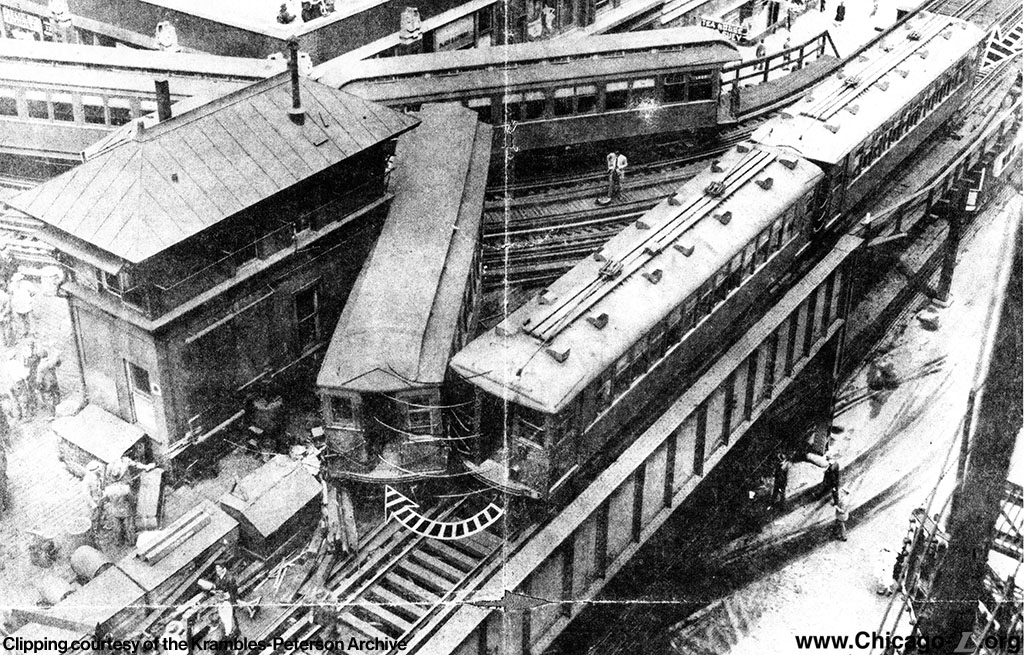
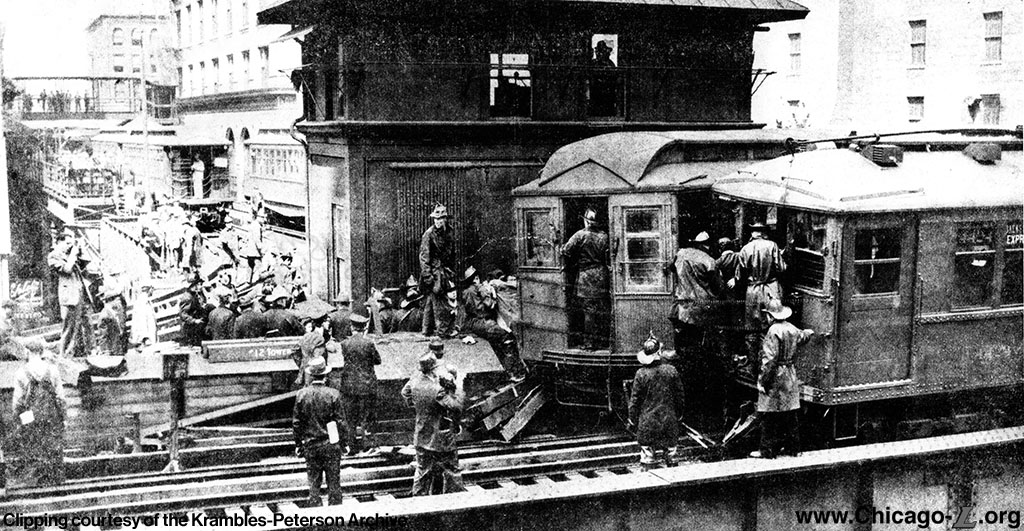
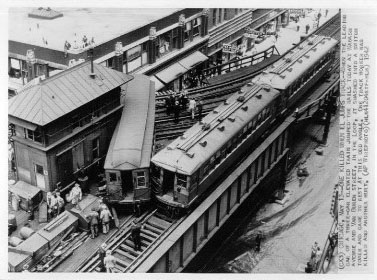
Amidst this situation, a Jackson Park Express train split a switch at Tower 12 at Wabash and Van Buren, one block east of the fire, and derailed. The 3-car train, led by a wood car followed by two 4000-series cars, was apparently traveling southbound on the Outer Loop on Wabash. This in itself would be unusual, as the Loop was operated uni-directionally at the time with trains on both tracks running counterclockwise, so while north-south trains did use the Outer Loop they normally would have been running in the other direction on this track, suggesting trains were being rerouted, adding an additional element of anomaly to the situation. The Daily Times reported that the train was "switched over to avoid firemen on the tracks." The press also reported that the switch that derailed the train was being hand-operated, which is also unusual since the junction was interlocked and controlled by Tower 12, located in the middle of the junction. The train was described as having split a switch; it appears the front truck of the lead car took the diverging route at the junction and began to turn west around the tower to continue around the Loop. However, the rest of the train continued south, routing the cars past the other side of the tower. As a result, the lead car, with each end traveling in diverging directions, was slammed sideways into Tower 12. Unfortunately, an "L" trackman foreman, Thomas Fitzgerald, was standing at track level near the tower at that moment and was crushed by the impact of the car, killing him. Four passengers onboard the train were also injured.
There was also a lot of confusion among passengers and employees regarding alternate service during the disruption. The Chicago Daily Times reported that northbound passengers from the South Side were discharged at Roosevelt and Wabash and given transfers. "The slips, they were told, would be honored by street cars on which they were asked to continue their journey. But surface lines conductors would not accept the transfers, and crowds of puzzled commuters returned to the elevated station for rebates, which agents refused. However, they did receive delay checks which are equal in value to a 10-cent fare on the elevated. Explanation by Chicago Surface Lines officials was that they could not violate provisions of the executive order of the Illinois Commerce commission, which they said, does not permit them to issue or receive inter-company transfers in the area bounded on the north by Grand, on the west by Halsted, and on the south by Roosevelt."
|
An aerial view looking northwest, showing how the lead wood car got pushed hard against the corner of Tower 12. Note the very stretched safety springs between the wood car and the 4000-series car in the foreground. The arrow drawn over the photo by the newspaper illustrates the movement the lead car took as its two ends when different ways through the switch. For a larger view, click here. (Clipping courtesy of the Krambles-Peterson Archive) |
 |
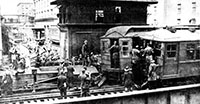
A nearly-identical photo to the one above, but actually taken at a slightly different time -- note that the Logan Square train on the "Inner Loop around" track in the background above is not there; the people at track level are also different. For a larger view, click here. (AP photo) |
 |
A view looking west at the accident site shows numerous firemen and other rescue workers accessing the cars, as well as several officials on the tracks. For a larger view, click here. (Clipping courtesy of the Krambles-Peterson Archive) |
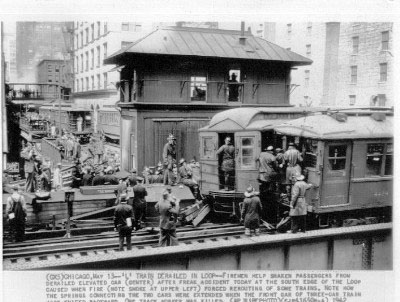 |
The same photo as above, uncropped but lower resolution. For a larger view, click here. (AP photo) |
November 18, 1942: North Shore and "L" Collision at Montrose
At 8am, a 6-car North Shore Line extra picked up 300 sailors on leave from Adams/Wabash and began its trip north to Great Lakes Naval Training Station.
There was a thick fog that limited visibility to just a few feet. At Wilson, a Howard train and a Wilson Local were standing at the south end of the yard, at Montrose Interlocking, the latter engaged in a switching operation to go into the Lower Wilson station. The towerman did not realize that the North Shore train had left Sheridan and was approaching Wilson and failed to set the manual block to protect the Wilson Local. The North Shore interurban approached Buena station (just south of Wilson Yard) at just under 10 mph and after passing the station, the motorman, Merrill Miller, saw the Wilson Local emerge from the dense fog. Despite an emergency application of air and sand, the interurban hit the rear of the "L" local.
The first six feet of the open platform wooden car on the rear of the local were smashed in, while the impact derailed the local and pushed it into the rear of the standing Howard Express in front of it. The North Shore train was comparatively undamaged. Miller was taken to the hospital, where it was discovered he lost part of a toe. Michael McNamara, the conductor on a 2-car Wilson Avenue Local which was telescoped by the northbound North Shore train, was severely injured. McNamara, who was changing the signs in the rear car when the train was hit, suffered head and internal injuries.
Thirty-five were hurt in the north side accident, according to the Chicago Tribune. Thirty-three passengers on the Howard Express were taken to the hospital for various injuries. By 9:45am, the track had been cleared a regular rush-hour service resumed.
November 18, 1942: Collision at 43rd Street
At almost the exact same time as the previous accident, an 8-car Ravenswood-Englewood train hit the rear of a 2-car Stock Yards local on the South Side main line. Dense fog, which reduced visibility to an eighth of a mile, was cited by Rapid Transit officials as the cause of this accident as well.
An 8-car Loop-bound Ravenswood train rammed the rear of a 2-car Stock Yards train which had stopped at the 43rd station for a block signal. (It was likely being held by 43rd Tower just north of the station, which controlled the location where the two-track line to the south becomes three tracks to the north.) Passengers estimated the Ravenswood train was traveling at about 15 miles an hour because of the dense fog. (Some accounts give the location as 41st and Calumet approaching the Indiana station, which would be about a block north of the aforementioned location.) The collision started a brief fire.
The accident caused minor injuries to 53 persons. Eighty-eight persons were injured in the two crashes -- this one, and the one above at Montrose Interlocking -- combined.
The Stock Yards train was comprised of A.C.F. 1905-vintage wooden motors and the rear car, 365, was retired the next year as a result of its damages.
July 3, 1944: Fire at Marengo Avenue, Forest Park
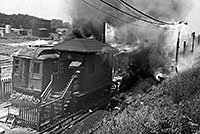
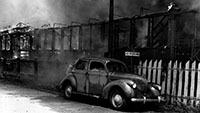
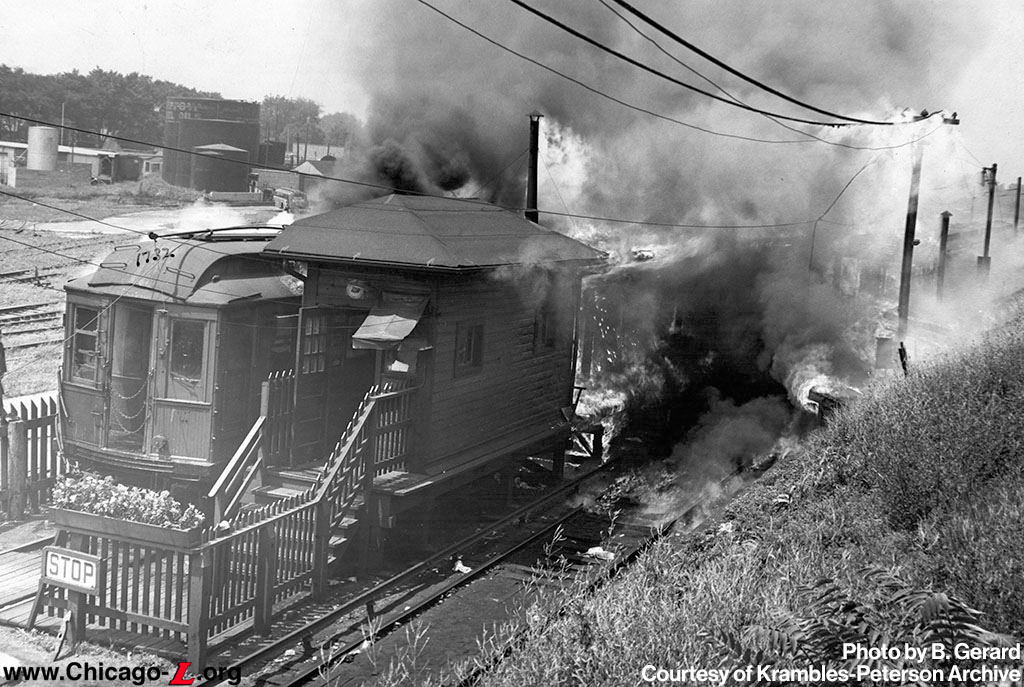
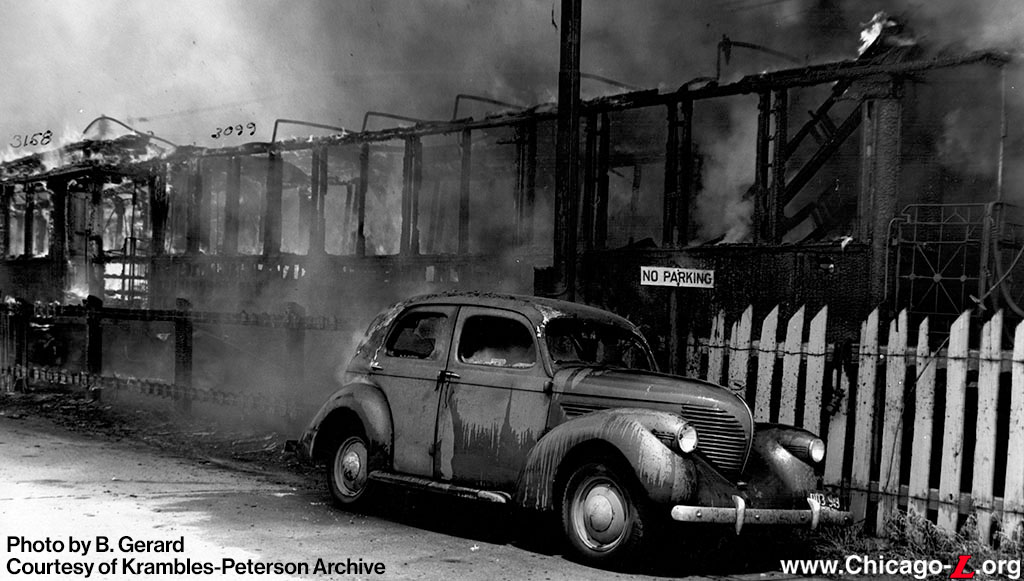
A large fire at the Forest Park terminal station on the Lake Street "L" at Marengo Avenue caused severe damage to the station and engulfed four cars, lightly damaging a fifth.
The fire was reported to have started on a train that had just come into the station from the Loop, and spread to the station platform and canopy and then to another train on the opposite side of the platform. The fire was discovered by an engineer on the Chicago & North Western railroad, whose tracks parallel the Lake Street "L" at that point. The C&NW engineer blew a series of blasts on his whistle to attract the attention of "L" yard workers. Two engines of the Forest Park fire department were aided by an engine from River Forest in fighting the fire. "L" service between Forest Park and Lombard station was suspended for an hour and 10 minutes while power was off to fight the fire.
The cause and cost of damage was reported variously in the press. Late the same day of the incident, the Chicago Daily Times reported that the fire was "apparently caused by a short circuit in an elevated car", and H.M. Lytel of the CRT public relations office put the estimated cost of the damage at $50,000. The next day, the Chicago Tribune reported that Forest Park fire chief Henry H. Lang conjectured that the fire was started by a cigarette under the wood platform and that the rapid transit company estimated losses at $40,000.
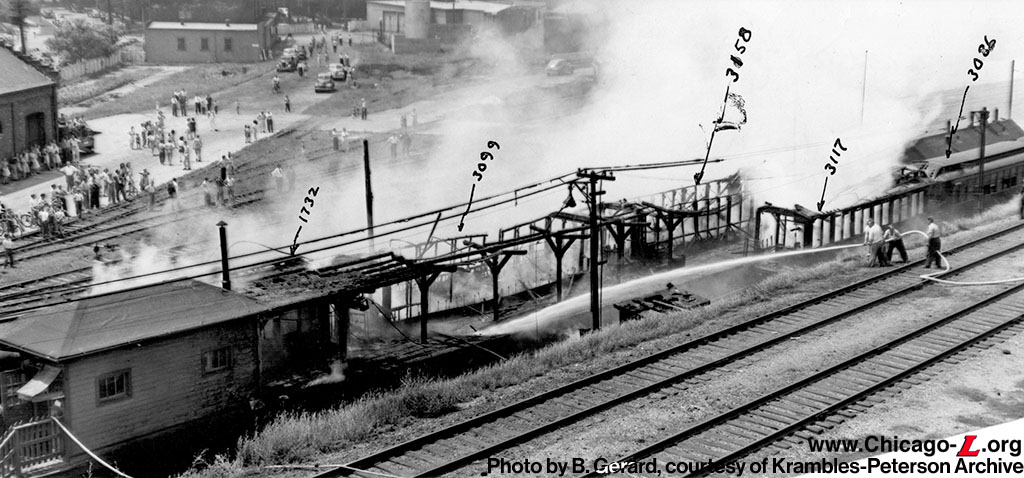
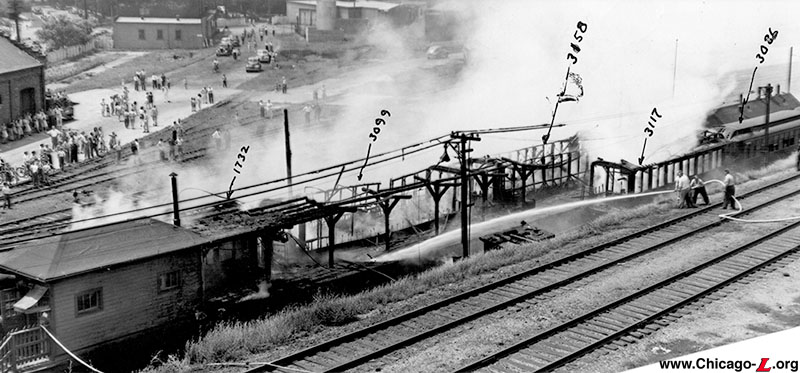
The fire destroyed an empty 3-car train on the south track, made up of (from east to west) cars 1732, 3099 and 3158. The fire also destroyed the rear car of a second train in the north pocket, car 3117, and caused some damaged to one end of the next car in that train, 3086. The station platform deck and canopy were severely damaged, with charred beams all that remained. The rear of the station house also suffered some burn and char damaged but was less severe. Officials stated after the fire that there would be no service to the end of the line for several days while damage was repaired; until the station was repaired, service terminated at the Marion Avenue station adjacent to the east.
The five affected cars had varied fates: Car 1732, despite about half the car suffering damage, was restored to service following the incident. Car 3086, having suffered lighter damage, was also restored to service. However, cars 3099, 3158 and 3117 were completely burned out and never restored to passenger service. Cars 3099 and 3117 were retired completed and scrapped. However, the frame and underbody of car 3158 were deemed salvageable and unit was converted to flatcar S-16 in 1945.
The station was repaired and reopened, but with some changes. The platform was rebuilt and restored, but the canopy was not entirely rebuilt -- most of the canopy was removed without replacement, with only one bay of the canopy beyond the station house repaired and kept. The station house also appears to have had its exterior cladding replaced and other minor cosmetic changes, based on photos taken in the years after the fire.
|
|
|
Top: The extent of the damage to the Forest Park station and five cars is well documented in this aerial view looking southwest on July 3, 1944; the photographer is likely looking down from the Wieboldts store that was just north of the station on Harlem between the C&NW tracks and Lake Street. The five affected cars are helpfully labeled in the photo, showing which were in the middle of the fire and which were on its fringes, getting less damage. The platform and canopy were totaled, however, and the station house rear a bit singed. In the background in the North Western's freight yard--the "L" station was sandwiched between the C&NW's main line tracks and this yard. For a larger view, click here. |
July 11, 1944: Collision at 58th Street
Fifteen persons were injured, three seriously, when two southbound Jackson Park trains collided at 58th Street. The first train was stopped at 58th station and was discharging passengers when the second train struck it from behind.
Among the critically injured was the motorman of the second train that struck the first, William Neuson. Neuson was pinned in the smashed motorcab of his train and was rescued after firemen worked for 20 minutes to free him. His legs were crushed, according to attendants at Provident Hospital where he was taken.
One of the passengers who helped extricate Motorman Neuson, Arthur Teichert, said the motorman mumbled, "I started to brake too late," as he awaited rescuers. Based on photos in the press, the headcar of the second train was a 4000-series car.
February 15, 1946: Trains Collide at Forest Park
Two trains collided head-on in the switching yard near Marengo Avenue at Forest Park station at the end of the Lake Street line. Both trains were out of service and were not carrying passengers, but members of both crews were injured.
The collision occurred when a three-car train just finishing its run switched to the eastbound tracks as a six-car train bound for the Loop came up on the same track. The impact was severe enough that the trains telescoped a few feet. Motorman James Howlette was trapped in the motorcab of the first train, the front of which ended up at an angle 15 feet above ground. Oak Park and Forest Park firemen had to cut Howlette out of the cab using acetylene torches, after which he was taken to Oak Park Hospital with arm, head and leg injuries.
Hal Lytle, vice president of the CRT, said the second train was slowing to a stop when the accident occurred. He cited the heavy fog as the principal factor in the accident. Louis J. Nesvig, motorman of the first train in the station, had released the brakes of his train when the collision occurred, preparing to depart the station, which lessened the impact when the second train hit.
George Patraitis, motorman of the second train which struck the first, had a good work record; he was the most seriously injured in the accident, suffering internal injuries, a compound fracture of his right ankle, and shock. Patraitis was crushed when the front of his car collapsed from the impact. The rear of the last car of the first train was also crushed.
October 23, 1946: Rear End Collision at 47th Street
A rear-end collision occurred at 47th Street at 7:10am, resulting in 311 injuries, 25 of them severe. Both trains were 7-car all-steel consists heading northbound, estimated to be carrying about 1,600 passengers altogether.
The first train was running about eight minutes late and was at the 47th station boarding and alighting passengers when the second train emerged from a heavy fog and collided with the standing train. The passenger loads in both trains were so heavy that most of the standing passengers did not fall down despite the impact due to a lack of room to do so. Firemen used ladders to facilitate rescue work, and police and fire department ambulances and police squad cars transported the injured to a dozen different hospitals.
February 8, 1947: Rear-end Collision Near Clinton Ave, Oak Park
A rear-end collision occurred on the ground-level portion of the Lake Street "L" between Clinton and Kenilworth avenues, between Oak Park and Marion stations, with four persons sustaining minor injuries.
Two 4-car eastbound trains collided when the first train was stopped near Kenilworth Avenue, and it was rammed by a second train following behind. Reportedly, a gateman (controlling the gates at a grade crossing) signaled the first train, which was deadheading back to Hamlin Yard, stop because the trolley pole on one of the cars had come off the wire and had swung sideways, in danger of striking obstructions alongside the tracks. While the train was standing, its follower hit the rear car. Witnesses said that smoke from a passing North Western steam train, which ran on an elevated embankment next to and above the Lake Street "L" tracks, settled down over the rapid transit tracks and obscured the right-of-way just before the accident occurred.
The rear of the first train and the front of the following train were crushed by the impact, and several windows were broken. Passengers in the second train said the motorman escaped serious injury by leaving his motorcab a moment before impact; he suffered minor cuts.
Lake Street Division wood car 3235 (which may have been the rear car of the first train) was severely damaged and subsequently retired.
May 14, 1947: Met/CA&E Collision on Laramie Avenue Loop
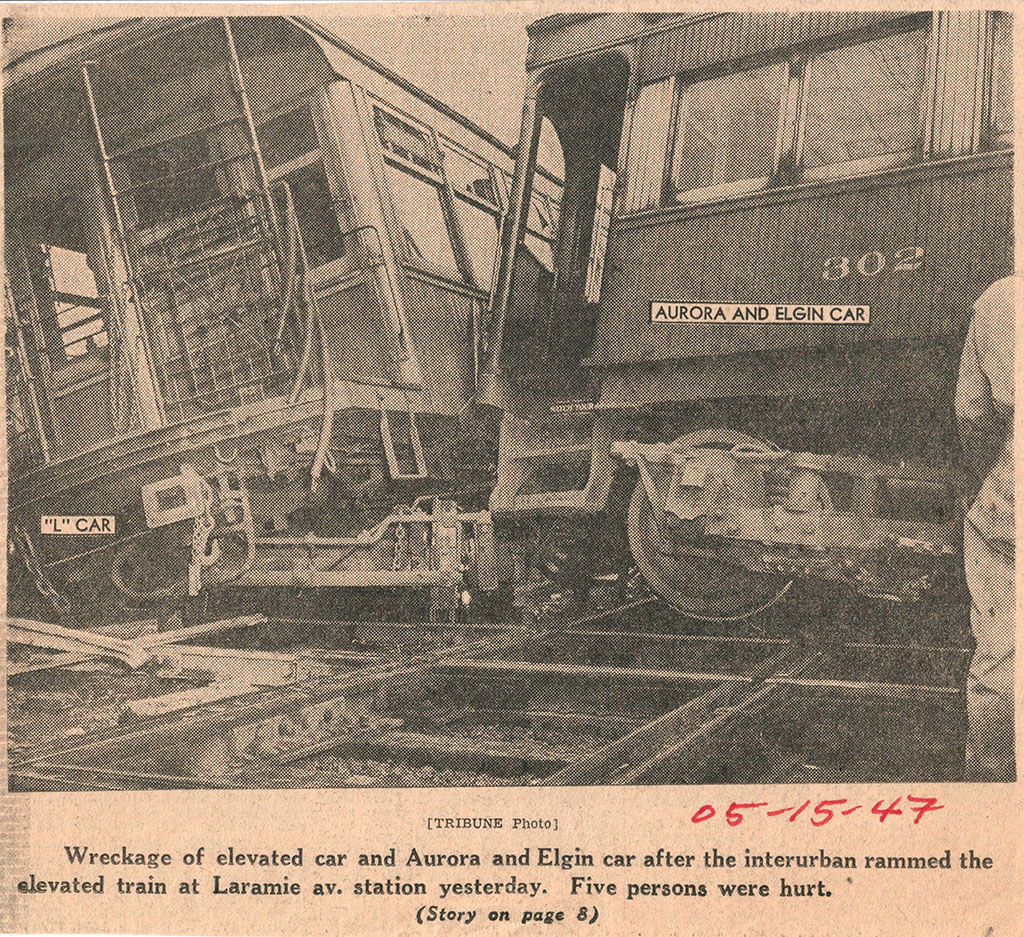
A 3-car Chicago Aurora & Elgin interurban train collided with a 3-car "L" train at Laramie on the Garfield Park branch, injuring five women. Leading the eastbound CA&E train, interurban car 302 struck Met wood "L" car 2293, which was at the rear of a train going around the turning loop at Laramie.
The motorman of the CA&E train, Chester Jantolak, said he was going about 20 mph when he got a "stop flag" about 50 feet down the tracks from the collision site and applied the brakes, but they did not hold. The accident occurred in an area in which trains were restricted to 6 mph.
The CA&E train carried about 60 passengers; the "L" train was empty, as it had terminated at Laramie, unloaded, and was turning on the loop to return to the city when the collision occurred.
"L" car 2293 was retired later that year as a result of its damages.
 |
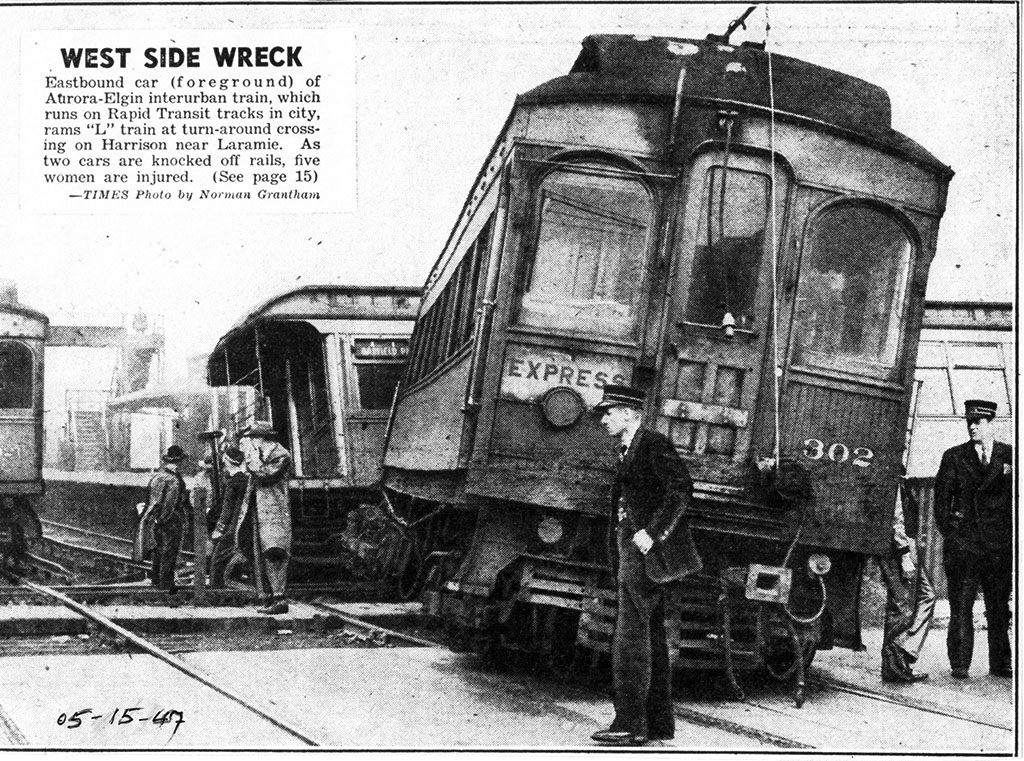 |
Far left: The collision point between CA&E car 302 and "L" car 2293 is vividly illustrated in this view, showing that the impact not only derailed both cars but knocked the rear of 2293 off its truck. For a larger view, click here. (Chicago Tribune photo, clipping courtesy of the Krambles-Peterson Archive) Left: This view from farther back better shows the context of the collision. The other two cars of the CA&E train have been separated from car 302. This view illustrated how the train car 2293 was trailing was going around a loop track that crossed the main line at a right angle, so when 302 hit it it was a direct impact. The Laramie station platform on the main line track can be seen in the background. For a larger view, click here. (Chicago Daily Times photo, clipping courtesy of the Krambles-Peterson Archive) |
June 5, 1947: Minor Collision at State/Van Buren
A 3-car Lake Street "L" train, stopped at the State/Van Buren station, was struck from the rear by a slow-moving 2-car Douglas train.
Neither train was damaged. Four passengers sustained cuts and bruises.
June 9, 1947: Wood Car Fire at Division St
Thirty persons escaped from burning wood coaches on a 2-car Kenwood local train south of Division station when a flash and explosion occurred in the rear control cab of one car.
June 18, 1947: Sideswipe Collision Near Belmont Station
A southbound Evanston Express sideswiped a southbound Wilson Local about 250 feet south of Belmont station. The local was about the switch to the express track when the accident occurred. Several trucks on both trains were derailed, and a portion of the third rail was torn up.
No one was injured. Passengers were led along a footwalk to the Belmont station.
Southbound trains were rerouted over northbound tracks around Belmont station while worked repaired the third rail and re-railed the derailed trucks.
September 1, 1947: Collision at Canal Station
An eastbound 2-car Douglas Park train struck the rear of a 2-car Logan Square train discharging passengers at the Canal station on the Met main line. The motorman of the Douglas Park train, Charles Engh, said he failed to see the other train in time to stop due to a curve in the track just west of the station.
Twenty-five persons were injured in the afternoon collision. All of the injured passengers were on the Douglas train, many of them knocked to the floor by the force of the impact.
After the injured passengers had been removed, the two trains were coupled together and pulled out of the station. Neither was returned to service, however, pending inspection for mechanical damage.
The Rapid Transit company conducted an inquiry into the accident the next day, September 2, to determine the cause of the crash.
* = Ed.: Further details are not known or exact date unknown.
|
|
|
Sources:
Campbell, George V., North Shore Line Memories, Northbrook, IL: Domus Books, 1980.
Cudahy, Brian J. , Destination Loop, Brattleboro, VR: The Stephan Greene Press, 1982.
Hanzell, Wesley. "Loop tragedy was second major crash in 13 months". Chicago Tribune 5 February 1977
Keevil, Walter R. and Norman Carlson (editors), Chicago's Rapid Transit Volume I: Rolling Stock/1892-1947 (CERA Bulletin 113), Chicago: Central Electric Railfans' Association, 1974.
Keevil, Walter R. and Norman Carlson (editors), Chicago's Rapid Transit Volume II: Rolling Stock/1947-1976 (CERA Bulletin 115), Chicago: Central Electric Railfans' Association, 1976.
Moffat, Bruce, The "L": The Development of Chicago's Rapid Transit System, 1888-1932 (CERA Bulletin 131), Chicago: Central Electric Railfans' Association, 1995.
Various newspaper articles and accounts