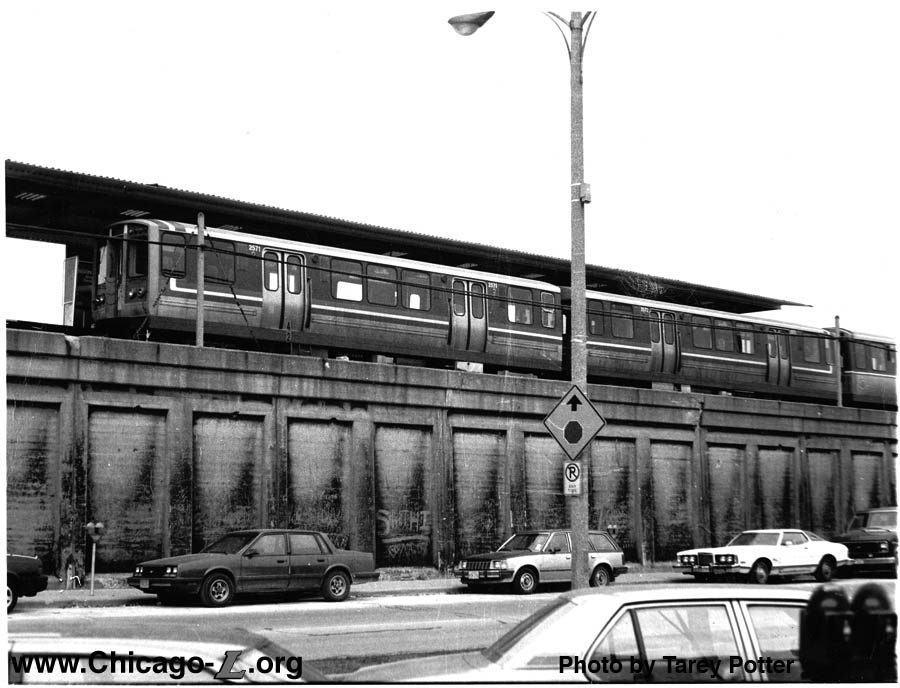
Original Ground-Level Station
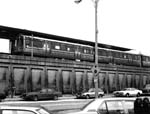
The first "L" station at Oak Park Avenue was built as part of the Lake Street Elevated's 1901 street-level extension along South Boulevard to Wisconsin (Marion) Avenue in Oak Park. The "L" was powered by overhead trolley wire along the extension for safety purposes due to the grade-level running. The tracks also paralleled the adjacent Chicago & North Western Railroad.
The modest stations on this portion consisted of island stations and platforms constructed of wood. The narrow station houses with their clapboard paneling and peaked roofs with overhanging eaves emptied out onto an island platform covered by a peaked canopy that was actually a continuation of the station house's roof. The tall steel poles that carried the "L"'s overhead wires occasionally poked through the canopy, interrupting the platform.
The "L"'s street-level operation began to result a number of crossing accidents, typically due to pedestrians and wagon drivers failing to take note of approaching trains. Neither the "L" nor the C&NW had any type of crossing protection originally. Manually-operated crossing gates and gatemen helped reduce accidents but did not eliminate them. The problem got worse as automobile traffic entered the picture and became more prevalent. The situation was further exacerbated when the parallel C&NW elevated their right-of-way circa 1908-09, creating a blind intersection due to the embankment preventing southbound traffic from seeing approaching "L" trains until they were on the crossing. The Chicago and Oak Park municipal governments tried for decades to get the "L" to elevated their tracks west of Laramie Avenue, to no avail.
Track Elevation
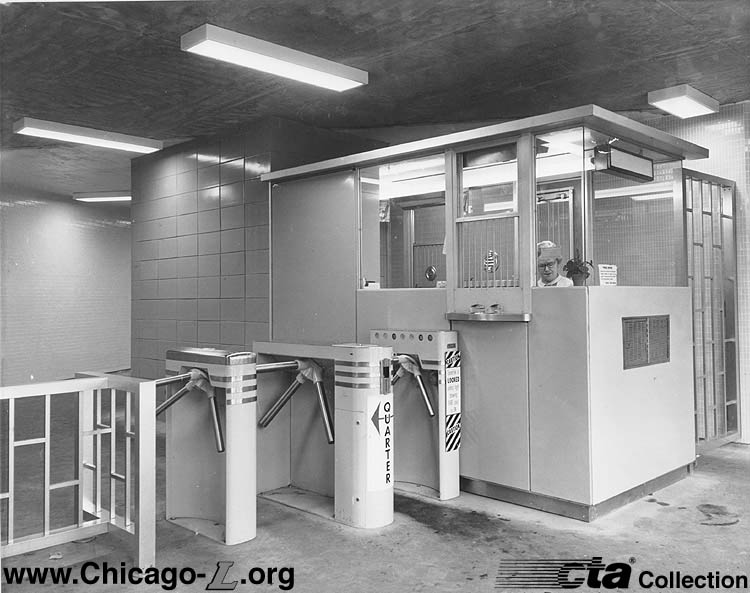
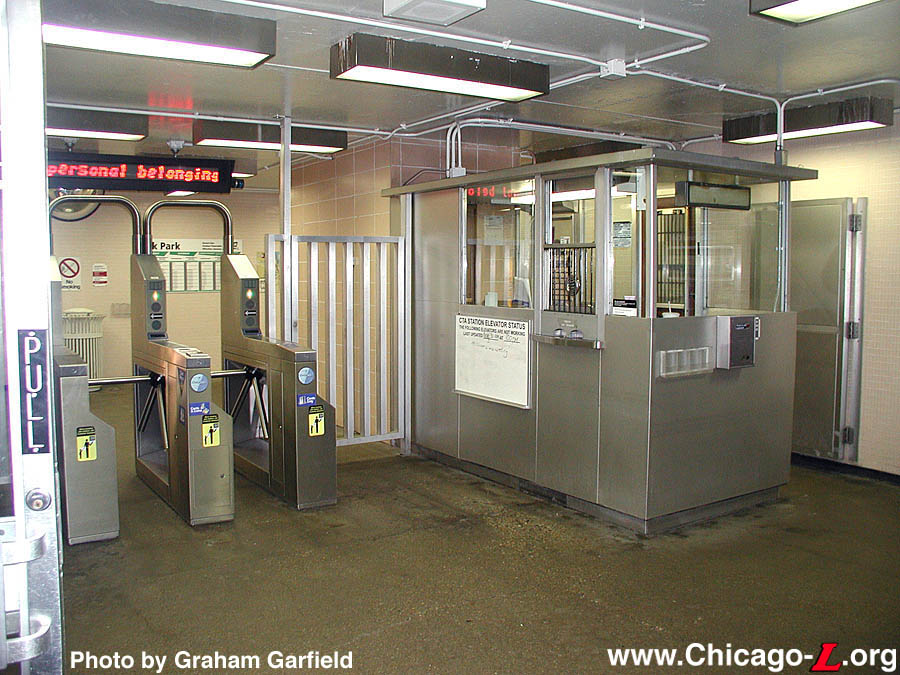
The Oak Park station house interior hasn't changed much between there views looking northeast from the unpaid area -- in 1963 about a year after opening above (for a larger view, click here) and on May 30, 2003 below (for a larger view, click here) -- save perhaps for new turnstiles and conduit on the ceiling. (Top photo from the CTA Collection; bottom photo by Graham Garfield)
|
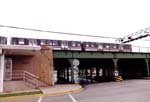
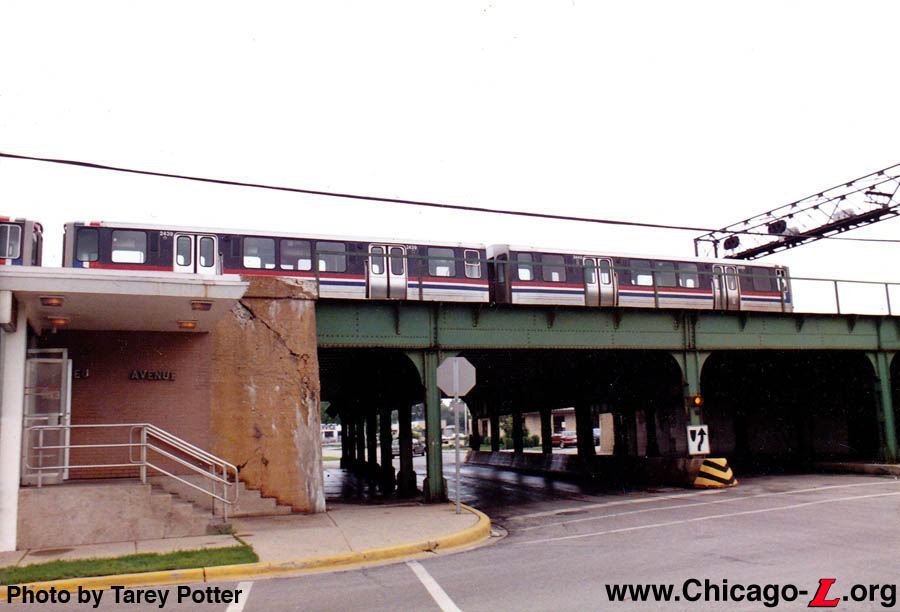
Finally, in 1961 construction began on a joint project to elevate the Lake Street "L" tracks. The $4 million project was jointed financed by the Chicago Transit Authority (who had assumed operation of the "L" in 1947), City of Chicago, Village of Oak Park, Cook County, State of Illinois, and US Bureau of Public Roads, and in cooperation with the Chicago & North Western Railroad. Rather than build a new elevated structure for the "L", the rapid transit tracks were relocated onto the C&NW's embankment, occupying the southern portion of the elevated right-of-way, which the railroad vacated. The elevation project eliminated 22 grade crossings between Laramie and Harlem avenues.
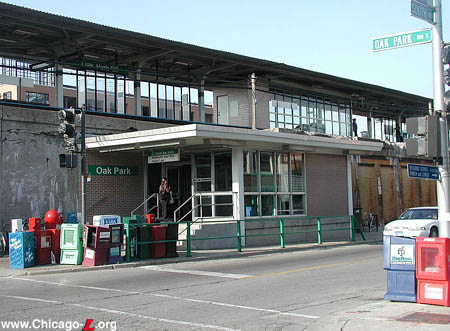
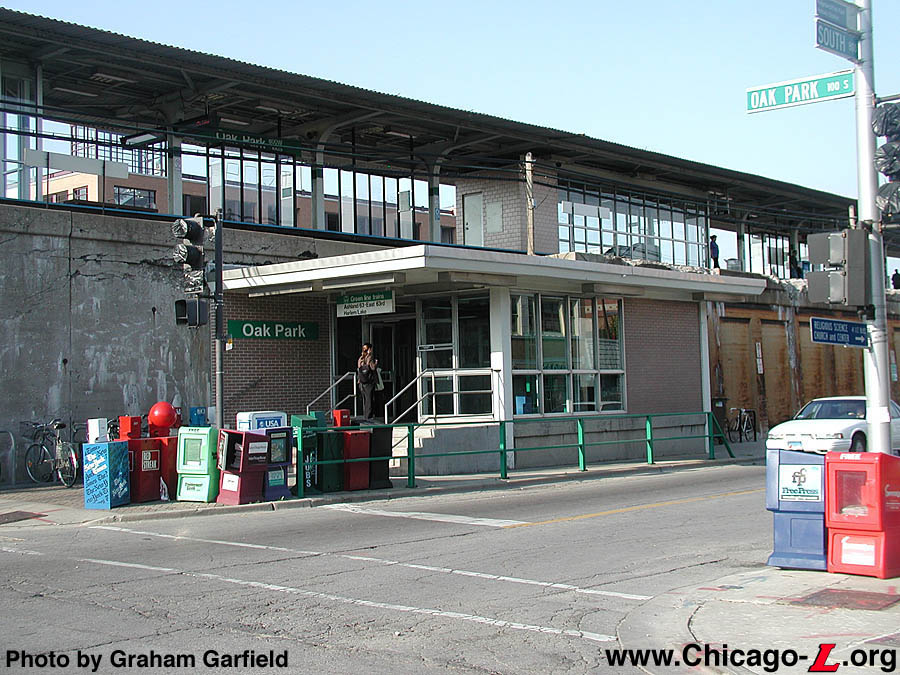
The elevation project included the construction of new stations and removal of the old wooden stations at street-level. The stations included new island platforms on the embankment and street-level station houses on the south side of the embankment. The stations were very modern for the time, and described thusly in a promotional brochure for the project:
Integrated with the south wall of the North Western embankment, the new stations incorporate many design features.
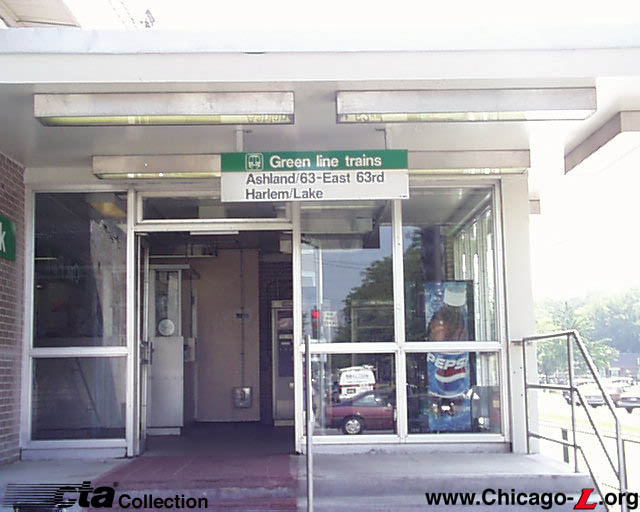
Large picture windows enhance a light and bright interior. External walls are of ceramic glazed brick in the color code for the respective station. The color is repeated in porcelain enamel panels of each station front, in the glazed ceramic tile of the interior walls, and in the porcelain enamel panels of the agents' booths.
Electric signs over the entrance of each station buildings are to identify the station and display the travel time between the station and Chicago's Loop.
Passenger control facilities include agent-controlled, illuminated fare indicator turnstiles, coin-operated turnstiles, and electrically-operated, remotely-controlled exit turnstiles.
In the metal platform canopies, which extend over the roofs of cars at train stops protecting boarding and alighting passengers from rain, sleet and snow, the station color code is repeated. Translucent fiberglass panels are interspersed with the metal panels of the canopies.
Platforms and stations are illuminated by fluorescent luminaires.
At the platforms, the lights are turned off ad on automatically by photo-electric cells. Lighting in the stations is controlled by the agents.
The "color code" for Oak Park station, used for various accents in the facility, was peach. The tiled wall outside the station entrances, on the embankment, featured pin-mounted metal letters spelling out the name of the station entrance.
The Oak Park station had two entrances, with one at Oak Park Avenue at the west end of the station and another at the east end of the station at Euclid Avenue. As a result, the station was sometimes referred to as "Oak Park-Euclid" in some promotional materials, though maps and signage simply referred to the station at "Oak Park".
The station entrances at Central, Austin and Oak Park were equipped with an escalator in addition to the stairs to access the platform. The escalators were of a reversible, dual-operation type. Typically, in rush hours the escalators operated in the peak direction (up in the morning, down in the evening) and in off-peak hours operated automatically. While in automatic mode, the escalator was activated by treadle steps, at the top and at the bottom. Once set in motion by a passenger, it operated in the proper direction until the passenger had alighted. Flashing signs warned patrons not to board an escalator operating in the wrong direction. Both the escalators and stairs were protected by glass-walled shelters at the platform level.
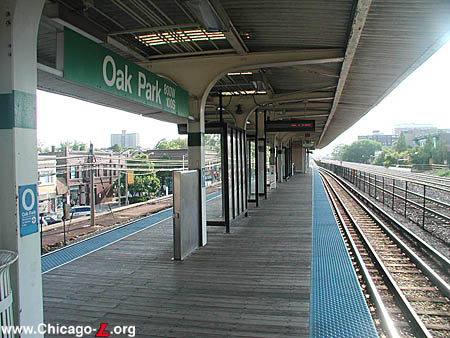
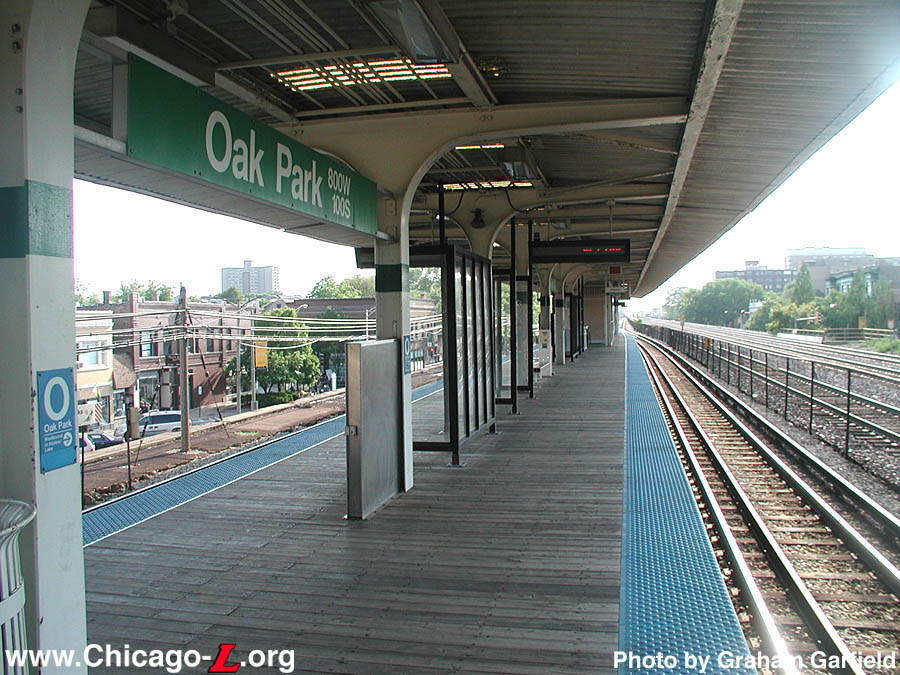
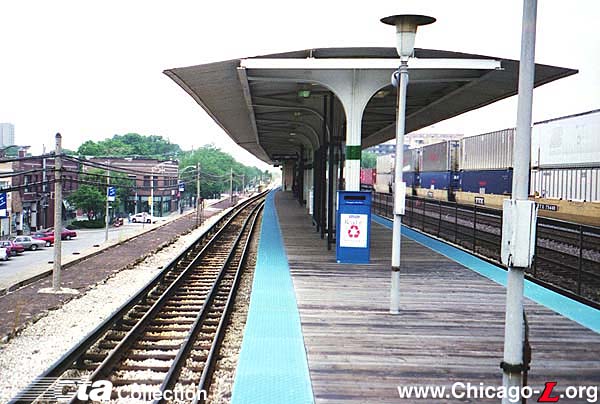
The platform features a wooden floor and a steel canopy supported by I-beams. The platform lights outside the canopy were unusual, found only in Oak Park suburban stations, with a thin pole and a conical head with a convex saucer as a cap.
Lake "L" trains began using the new elevated right-of-way on the C&NW embankment between Laramie and Harlem on Sunday, October 28, 1962. The ground-level stations closed and the elevated platforms opened, but the new permanent street-level station houses were not ready yet, due to the street-level tracks needing to be removed before they could be completed. Thus, on opening day, temporary fare control areas were used at Oak Park and Euclid.
Completion of the remaining amenities was not far off, however. The escalator at Oak Park went into service on Thursday, November 14, 1962. The first of the station's two permanent station houses went into service on Wednesday, January 9, 1963 when the control area at Euclid opened. This was followed by the opening of the permanent station house at Oak Park on Tuesday, March 5, 1963, which represented the completion of the track elevation project.
The station saw modest changes through the following years. On Sunday, September 2, 1973, in one of several rounds of cost-cutting that year that included multiple station closures and service reductions, the Euclid entrance to Oak Park station was closed, though it was retained as an exit. Euclid remained available as an exit as least as late as the 1980s, but has since been closed and boarded up.
However, unlike other stations that were rebuilt, few alterations were made to Oak Park station, as it was not originally budgeted to receive an overhaul. The existing station house, platform, and canopy remained. The station received new fare controls and some new signage, though some old signage remained. More significantly, Oak Park station, along with Austin and Ridgeland stations in Oak Park, reopened without modifications to make the stations handicapped-accessible. CTA officials contended they were not mandated by federal law to make all stations handicapped-accessible because they made only cosmetic changes to Oak Park and the two other suburban stations while carrying out the $350 million Green Line renovation. Eighteen of the line's 27 stations -- all stations except the three in Oak Park and some Loop stations shared with other routes -- were eventually made handicapped-accessible, including the Marion Street entrance to the Harlem/Lake terminal in downtown Oak Park. The other Oak Park stations, at Austin, Ridgeland and Oak Park, were not scheduled to be made accessible because the transit authority did not have the money, CTA Chairman Valerie Jarrett said in 1996. Oak Park residents with disabilities protested the lack of accessibility after the project, and Village President Lawrence Christmas agreed to seek funds to make all the Green Line stations in Oak Park handicapped-accessible but the three stations are still currently not ADA-compliant.
Oak Park station received some new signage at platform level in 2009, including new "board here" signs and new column signs that adhere to CTA's current signage standards (which, ironically, were first designed as part of the 1994-96 Green Line rehab), replacing some signs that dated from the 1980s A/B skip-stop era. The station name signs remain an odd variant, presumably installed in the 1994-96 rehab -- they have white letters on a green background, a style previously used for "B" stations in the skip-stop era (whereas Oak Park was an "AB" all-stop station under A/B service).