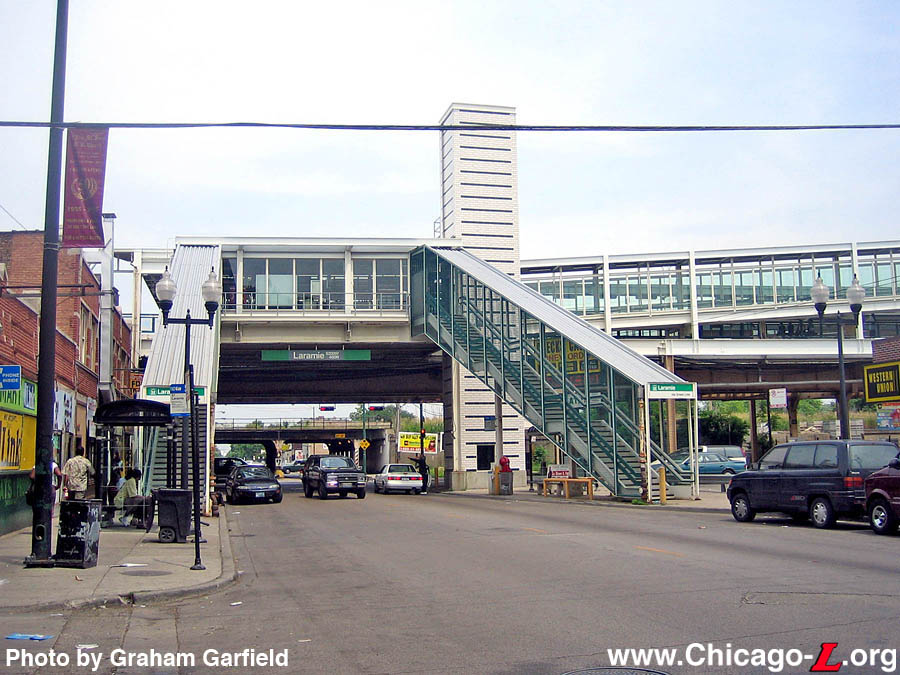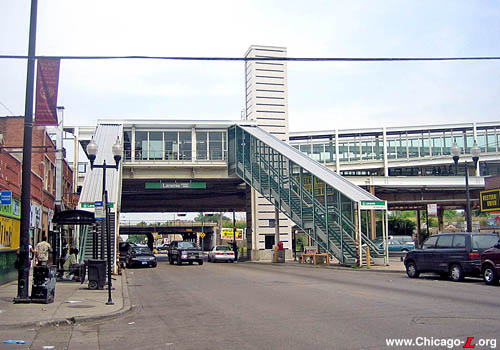
The Laramie/Lake station,
looking north on June 15, 2006. Unlike most Green Line
stations built in 1994-97, Laramie is equipped with only one
elevator, between the street and the track-level station
house. To get from the station house (on the inbound side)
to the outbound platform, long ADA-compliant ramps are
provided to access the overhead transfer bridge. For a
larger view, click here.
(Photo by Graham
Garfield)
|
Laramie
(5200W/400N)
Laramie Avenue and Lake
Street, Austin
Service
Notes:

|
Green Line:
Lake
|

|
Accessible
Station
|
Quick Facts:
|
Address:.
|
2743-45 W. Lake
Street.(original
station, in pre-1909 street numbering)
|
|
|
5148 W. Lake Street
(current
station)
|
Established: April 29, 1894
Original Line: Lake Street Elevated Railroad
Previous Names: 52nd Avenue
|
Skip-Stop Type:
|

|
Station
|
Rebuilt: 1899, 1996
Status: In Use
History:
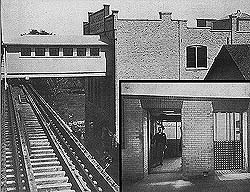
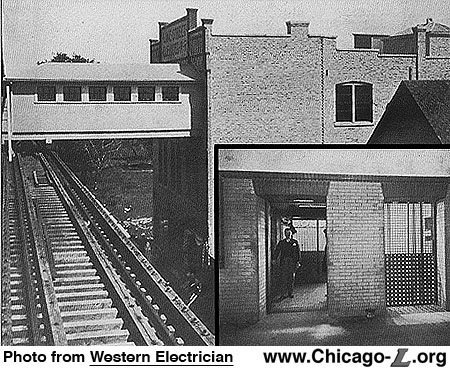
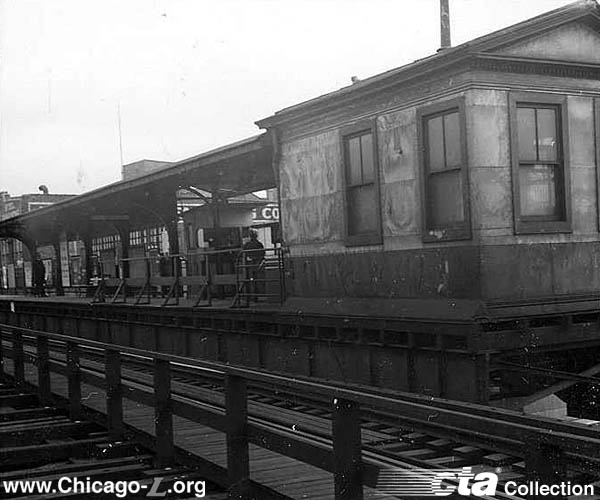
This view looks east down
Lake Street from the end of the tracks. The original
three-story Laramie station is on the right; the tile mosaic
on the top of the front says, "Lake Street
Elevated•R•R". The passageway from the building
blocked the south track and prevented its usage until its
removal. Inset: The very rare use of elevators in the
Laramie station, used to transfer streetcar passengers up to
the "L" platform. For a larger view, click here.
(Photo from Western
Electrician)
|
When regular passenger service began on the Lake Street "L" at 5am
on November 6, 1893, trains ran between California
and the Madison & Market terminal;
stations west were not yet finished. Service was not extended
westward until November 24, when trains continued to Homan.
Finally, on April 29, 1894, the structure west to 52nd Avenue was
rushed to completion and service was extended to the terminal there,
despite the fact that all of the elevated's facilities weren't yet
complete. The 52nd Avenue station was little more than an elevated
platform was service was extended there in 1894.
The Lake Street first ran with steam locomotives and trailers,
but, like the rest of the "L", eventually converted to electric third
rail traction. On May 9, 1896, the changeover was officially made.
Concurrent with the conversion process, a three-story brick station
was constructed at 52nd Avenue, completed in April of that year.
Located opposite the island platform that already served the station,
the station house had two elevators to bring passengers from the
street to the platform. While somewhat common today, a passenger
elevator was an unusual and extravagant feature for a rapid transit
station of the day, almost a century before their mandatory inclusion
for accessibility requirements. On the third floor, passengers
entered an enclosed walkway over the south track to the island
platform. The building also had additional space for offices and
stores.
This magnificent station, with "Lake Street Elevated R.R." written
in terra cotta on the building's front cornice, had a drawback: for
unknown reasons, the passageway between the headhouse and the
platform wasn't built high enough to clear trains beneath it on the
south track, necessitating that track's removal from service. Because
this meant the station then had only one track serving the platform,
the number of trains that could be handled was severely limited, an
especially problematic situation given that it was the line's
terminal.
On April 19, 1899, service was extended west to Austin
Avenue, with the tracks descending to ground-level shortly after
Laramie station and utilizing at-grade operation and powered from
overhead lines for safety reasons due to the excessive number of
grade crossings. Around this time, probably concurrent with the
introduction of through-service west of Laramie, the station was
rebuilt. No doubt the operationally-limiting overhead walkway from
the original three-story headhouse contributed to its closure, though
its still surprising that this facility seems to have only been in
use for three years before replacement. It is unclear if the
three-story brick station was demolished at this time or merely
converted to another use.
A New Station for Through Service
The new station, built circa 1899, had side platforms with
track-level station houses on each side. The design of this facility,
in both plan and detail, was somewhat unusual. In terms of its
layout, the fact that it had a track-level station house on each
platform wasn't out of character: the Lake Street's original stations
mostly had this design, as did the Loop
Elevated and the Jackson
Park branch over East 63rd Street. What was unusual was the
asymmetrical design of the station. On the inbound side, the station
house was at the southeast corner of Laramie and Lake and the
platform projected eastward from that point. On the outbound side,
the platform occupied roughly the same location -- from Laramie
Avenue eastward -- except that the station building was toward the
center of the platform, with a stairway projecting down on the west
side toward the street intersection.
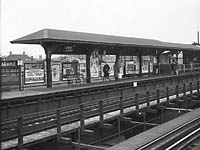
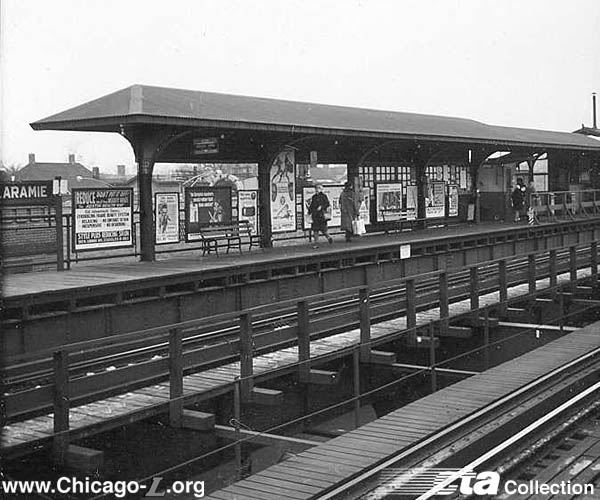
Looking southwest at the
inbound platform at Laramie on December 26, 1963, note the
similarities in the design of the canopy and railings to the
Northwestern's main line local stations. The station house
is visible at the end of the platform on the right. For a
larger view, click here. (Photo from the CTA
Collection) |
The station buildings were small
and had modest facilities. The station house on the inbound side had ticket agent and a small
waiting room. It is not clear if the outbound station building had any facilities for a ticket agent or a waiting room; it may have only had utility functions such as a shelter for platform personnel and a porter's closet.
The design of the station is somewhat interesting as well. Many
elements were similar or identical to designs on the Northwestern
Elevated. This similarity is not as surprising as one might imagine,
since both companies were under the common ownership of Charles
Yerkes by the time of the second Laramie's construction. The overall
design of the canopies, railings, and railing grilles are nearly
identical to those on the local stations of the Northwestern's
original main line. While the plan and layout of the headhouses are
unique, the style, ornamentation, and details bear a striking
resemblance to Kinzie Street station on the Northwestern Elevated,
which was designed by the Northwestern's station architect William
Gibb, and has some similarities to South
Park [King Drive] and
University stations on the Jackson
Park branch of the South Side Elevated, also thought to be Gibb's
work. The drawings for Laramie bear only the mark of the Lake Street
Elevated's Chief Engineer's Office, however, indicating that Gibb
either had a silent hand in the design or the staff engineers were
merely copying his work.
The structure and tracks themselves were not significantly altered
in the 1899 rebuild. The side platforms seem to have been built
alongside the existing tracks and the space formerly occupied by the
island platform allowed for the eventual installation of a center
track through and adjacent to the station for storage and lay-ups.
The south, inbound station house seems to have been built immediately
around 1899, while there are some indications that the outbound
station house on the north side of the right-of-way may have been
added a couple years later.
This station served for the majority of the 20th century, although
by the postwar period it was subject to the piecemeal modifications
and additions of most of the Lake
Line's stations.
Changes in the CTA Era
Historically, the outer portion of the Lake branch that ran at ground-level used overhead wire rather than third rail for traction power for safety reasons. For years, Laramie, the last elevated station before the line descended to street level, was the location where trains switched between trolley poles and third rail shoes for power.
In the pre-CTA era, when each car needed a conductor or guard to open and close the doors at each station, these crew members raised and lowered the poles on each car at Laramie. During the 1950s, wood cars were replaced with 4000-series cars on Lake Street, and the 4000s were upgraded with multiple-unit door control (MUDC), among other improvements, which reduced the crew to just the motorman and conductor. During periods of shorter train operation, the conductor was responsible for raising or lowering the poles. However, during some periods, including rush hours, trains were as long as six cars (and unlike on other lines, the Lake-assigned 4000s were not jumpered into pairs, so each car's pole has to be raised and lowered), which would have been a time-consuming (and delay-inducing) job for one person. So during these periods, platform personnel were assigned to Laramie to assist with the poles, both on the outbound side to raise them and on the inbound side to lower them.1
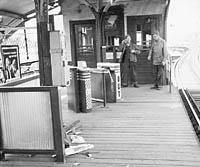
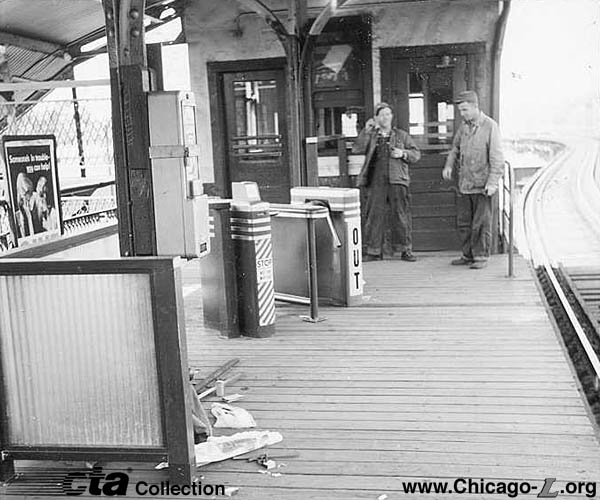
On May 19, 1961, two workmen
take a break from their task of installing turnstiles and
partitions on the inbound platform at Laramie. As part of a
change over from trolley wire to third rail operation from
Laramie to Central three days later, the ticket agent booths
and fare controls at Laramie were also rearranged. For a
larger view, click here. (Photo from the CTA
Collection) |
It is unclear if there was ever a ticket agent's booth or other fare collection facility on the outbound platform at Laramie, but certainly by the 1950s there was not. When shorter trains operated, the conductor collected any fares of passengers boarding outbound at Laramie. During periods when longer trains ran, the platform men collected any fares.2
On May 22, 1961, a series of changes took place at Laramie. The first was that the overhead wire between Laramie and Central, the first ground-level station, was replaced with third rail. The change was made as one of several modifications in preparation for the track elevation project work west of Laramie. This resulted in the location of the raising and lowering of trolley poles moving from Laramie to Central. As such, the pole men that had been assigned to Laramie were moved to Central, and no longer available to collect fares.
This necessitated the second set of changes effective that date: the rearrangement of fare controls at Laramie. On the inbound side, the ticket agent's position in the old platform-level station house was closed, and a new booth was installed on the platform east of the stairs from the street. Two standalone turnstiles were also installed -- one an exact-fare coin entry turnstile, the other an exit-only turnstile -- as well as barriers for separating the paid and unpaid zones. On the outbound side, a portion of the west end of the platform-level building (described in one document as the "trolleymen's shelter house"), at the top of the stairs from the street, was converted into a ticket agent booth. The agent position was tiny -- basically just room for a chair. A ticket agent was assigned to the outbound side Monday-Saturday in 1961 (the Saturday daytime coverage was dropped in 1973). The agents' booths on both sides had no turnstiles, only fare registers.
In the 1970s,
metal drum barriers were installed at all Lake
Street platforms to restrict boarding to the westernmost car
(where the conductor was) to permit on-train fare collection on 4-car
trains.
On January 30, 1987, Laramie was converted to inbound boarding
only. Although the station had largely inbound boarding and modest
overall ridership -- as early as 1972, a recommendation was made to
convert Laramie westbound to exit-only due to low entering traffic,
as well as due to complaints from conductors which indicate that
Laramie westbound was the worst Lake
Street station in regard to fare evasion -- the real catalyst for
the change actually seems to have been the decision to
begin periodically turning cars 180 degrees on the Lake-Dan
Ryan service to even out wheel-wear. (The West-South
Route had no turning loops at either end and a disproportionate
number of curves in each direction, so the wheels wore unevenly going
back and forth on the line.) This required the drum barriers at each
station to be moved so that the conductor's position, whose berthing
location would change when the cars were flipped, would still land
between the barriers during pay-on-train hours.
The dimensions of
Laramie's westbound platform apparently did not allow simple
relocation of the drum barriers and assigning a ticket agent, an
alternative used at other Lake
Street stations with similar problems, was not feasible at
Laramie westbound because there was not room for the addition of the
agent-controlled Visifare turnstile. The passage in front of the agent's position on the outbound side at Laramie was relatively narrow, and was not wide enough for both an agent-controlled Visifare turnstile and an exit-only turnstile. The space in front of agent was, in essence, too wide for the Visifare arms to span, yet too narrow for a second separate exit lane. Having only one turnstile for both directions of traffic would have been an unacceptable circulation choke point per CTA fare control standards, even at such a low-use location. (Some CTA documentation suggests it was determined in advance that an agent-controlled turnstile was not workable at this location, but other sources indicate that, circa 1980, the housing for a Visifare turnstile was, in fact, installed at Laramie outbound, but the arms were never put in once it was realized the setup wasn't workable and the Visifare was never activated.)3
The conversion to exit-only for
the westbound platform was regarded as only temporary by
CTA staff, as a planned column
relocation project on the elevated over the Laramie/Lake intersection
that was to be performed by the city in summer/early fall 1987 would
have provided replacement of the platforms on this section in-kind.
The new wider platforms at the west end, where the structure was
being rebuilt, would've allowed for the installation of twin drum
barriers or both the barriers and an agent's booth, if desired. A
complete station reconstruction would likely have followed, so major
changes such as a new agent's booth were not deemed practical in the
short term. Unfortunately, this project did not immediately come to
pass and the station remained exit-only outbound until its closure in
1994 for the Green Line
rehabilitation project.
Green Line Reconstruction
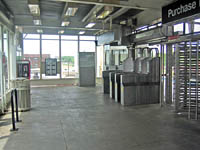
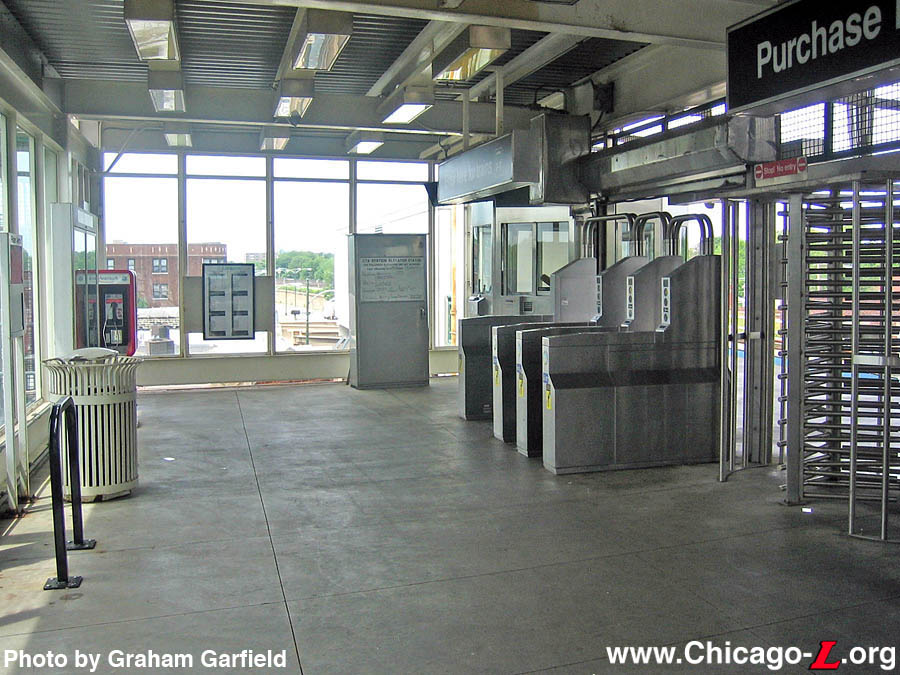
The Laramie station fare
control area is seen looking west in the unpaid area on June
15, 2006. For a larger view, click here.
(Photo by Graham
Garfield)
|
When the Lake Street "L" and the rest of the Green
Line closed in 1994 for a two year refurbishment, the
CTA intended to include
Laramie as one of the stations to remain permanently closed as part
of service cuts necessitated by limited funds to rebuild new
stations. After a public outcry, the
CTA finally agreed to add a
new Laramie station. Then-CTA President Belcaster stated that he planned to cover the cost by
economizing at other stations to finance construction. Funding,
however, was not secured until early 1996 and its delayed
construction caused it to open nearly half a year after the rest of
the Green Line.
Laramie's new design was developed by Skidmore,
Owings & Merrill (SOM), who had been selected in 1993 as a
lead architecture/engineering firm for the renovation of the stations
along the Green Line.
The new station was executed, at a basic level, following the "open
plan" design. The new station house, located at track level, is
constructed of white steel, large glass windows and green accents.
Unlike the previous incarnations of the station, only one fare
control area was provided for the both directions, located at
track-level on the south (inbound) side. An elevator on the southeast
corner of Lake and Laramie, decorated in white tile with green
stripes, brings passengers to the station house. Rather than utilize
stairs and dual elevators to bring passengers from the inbound
platform to the outside side, the designers opted instead to
construct two unusually long ramps along the sides of the platforms
to ascend to a bridge over the tracks. This no doubt was a
cost-saving measure, saving the cost of construction and maintenance
on two elevators. The canopy extends the entire width of the
platforms, but unlike the horizontally flat canopies of many new "L"
stations of the preceding decades, this one has a peaked roof with
postmodern, unusual angled latticework in the center section.
Because the station was added late to the roster of new facilities
in the Green Line rehab,
it did not open when the rest of the Green
Line came back into service in May 1996. The new Laramie station
was placed in service at 1000 hours on February 2, 1997. In an odd
twist of history repeating itself, the outbound platform initially
opened as exit-only, though this time it was merely because some
additional work was necessary on the connection to the inbound
platform where the fare controls are located. The station was also
limited to 6-car operations when it first opened, also a result of
unfinished work, and had limited ticket agent hours and a temporary
agent's booth. In June 1997, the full 8-car length of the platforms
came into service. It was also at this time that westbound boarding
was added following the completion of the accessible ramps and
overhead transfer bridge and the permanent customer assistant's booth
came into use.
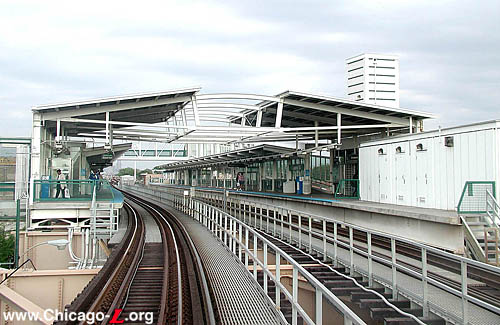
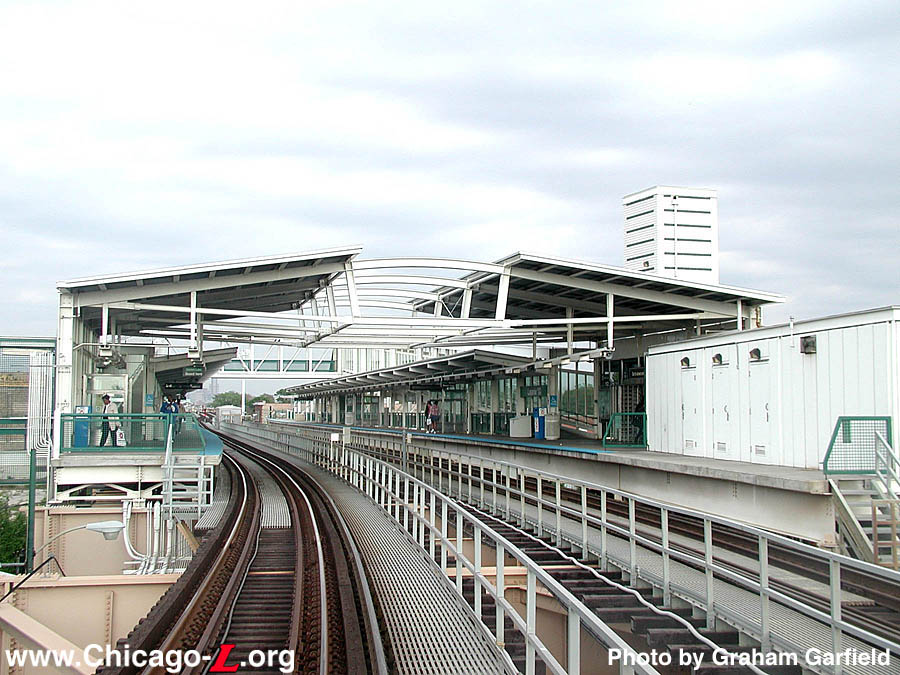
Looking east from the curve
just west of Laramie station that brings the Lake Elevated
from the steel structure to the Union Pacific embankment,
the station's canopy stands front and center. Like most
modern "L" stations, it is a full-width canopy but unlike
the horizontally flat canopies other new stations from
preceding decades, this one has a peaked roof with
postmodern, unusual angled latticework in the center
section. For a larger view, click here.
(Photo by Graham
Garfield)
|

|
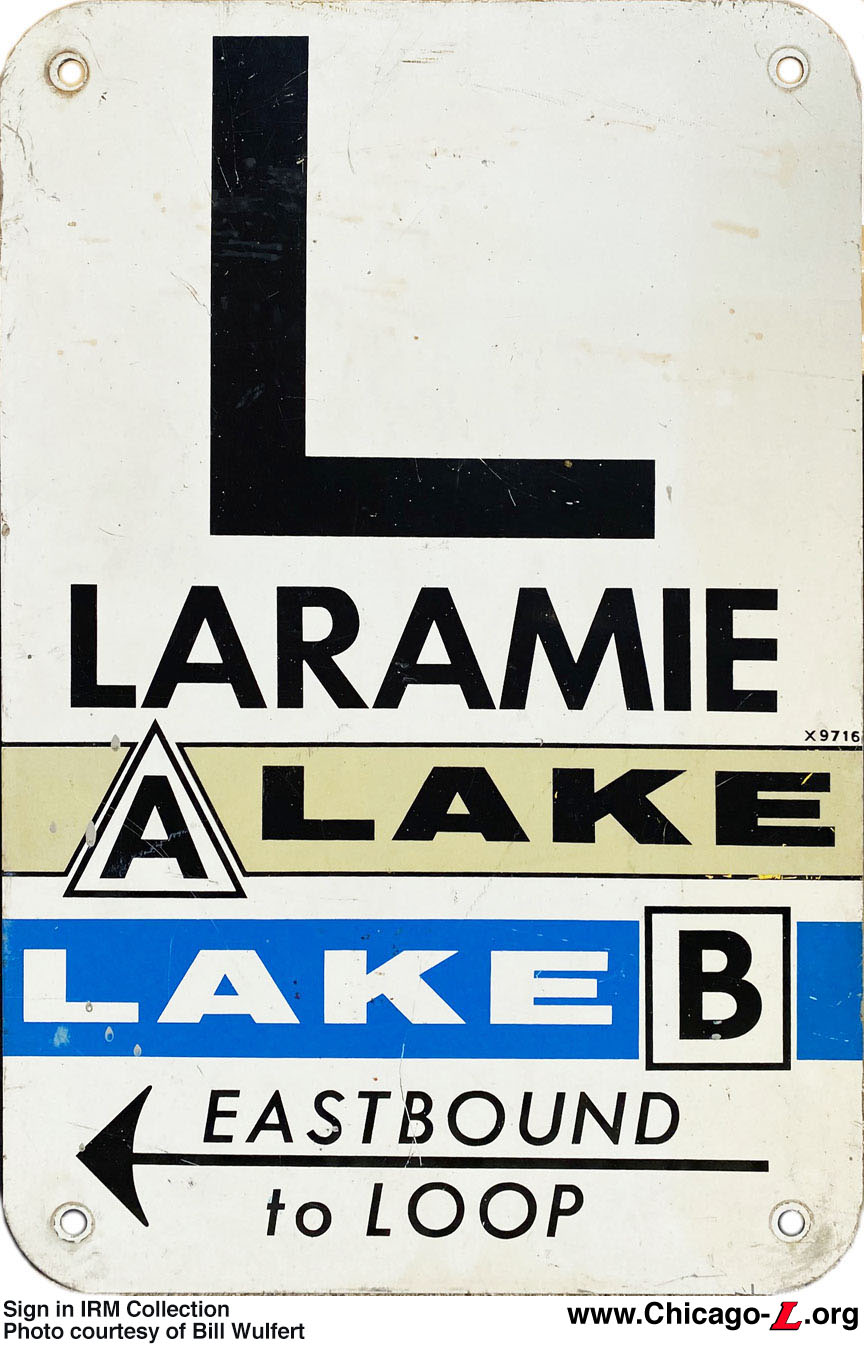
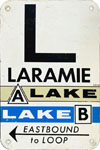
laramie-lake-P-8_50sSignEB.jpg (224k)
This "symbol sign", as CTA calls them, from the Laramie inbound platform is of a type implemented beginning in the mid-1950s. The artwork for this sign from the CTA Staff Engineer's Office is dated November 7, 1962; the signs were likely fabricated and installed not long after. The design of this sign is typical of this type: large first letter of the station name with the full name under it; the skip-stop letters on color-coded bands (yellow was used for 'A' stations and blue used for 'B' stations on services that terminated around the Loop; at A/B stations, the word "STATION" in the band was replaced with the name of the route/service) in the middle; and the destination at the bottom accompanied by an arrow pointing in the direction of travel. (Sign in IRM Collection, photo courtesy of Bill Wulfert) |
|
laramie-lake08.jpg
(71k)
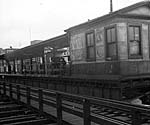
Looking east at the inbound Laramie platform on
December 17, 1965, the small station house is seen on the
right anchoring the west end of the platform over the
intersection of Lake and Laramie. By this time, the building
was rather worn and no longer open for passenger use, with
fare paid at the booth visible on the platform. The space
between the tracks, seen on the left, was originally filled
by the station's original island platform.
(Photo from the Chicago Transit Authority
Collection)
|
|
laramie-lake01.jpg
(182k)
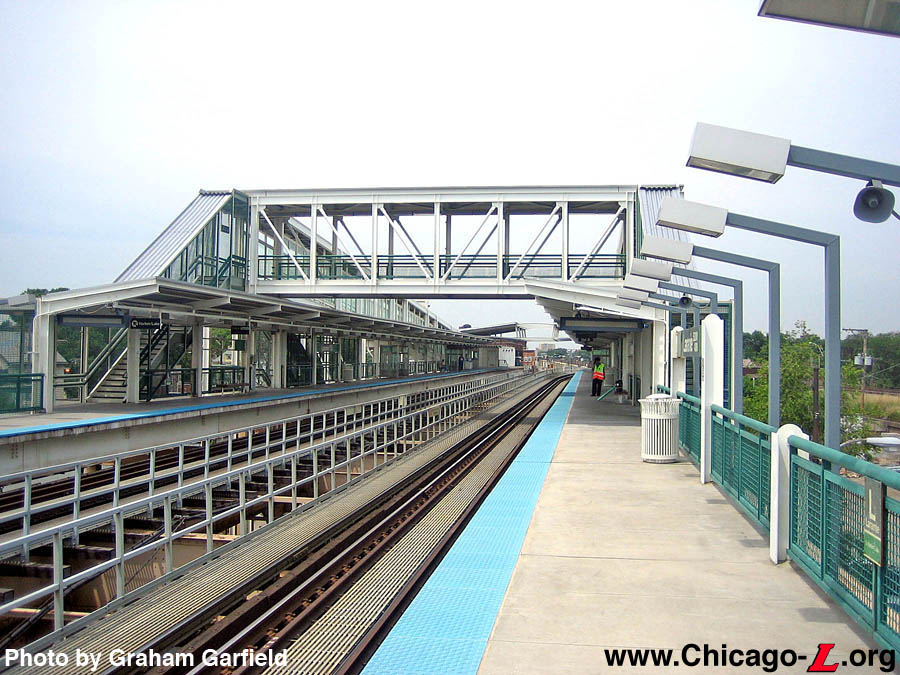
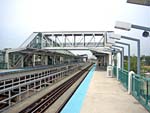
This view from the east end of the outbound Laramie
platform on June 15, 2006 shows the lights, railings, and
other appointments standard to the SOM-designed Green Line
stations and its transfer bridge with the long access ramps
for accessibility between platforms. (Photo
by Graham Garfield)
|
|
laramie-lake09.jpg
(199k)
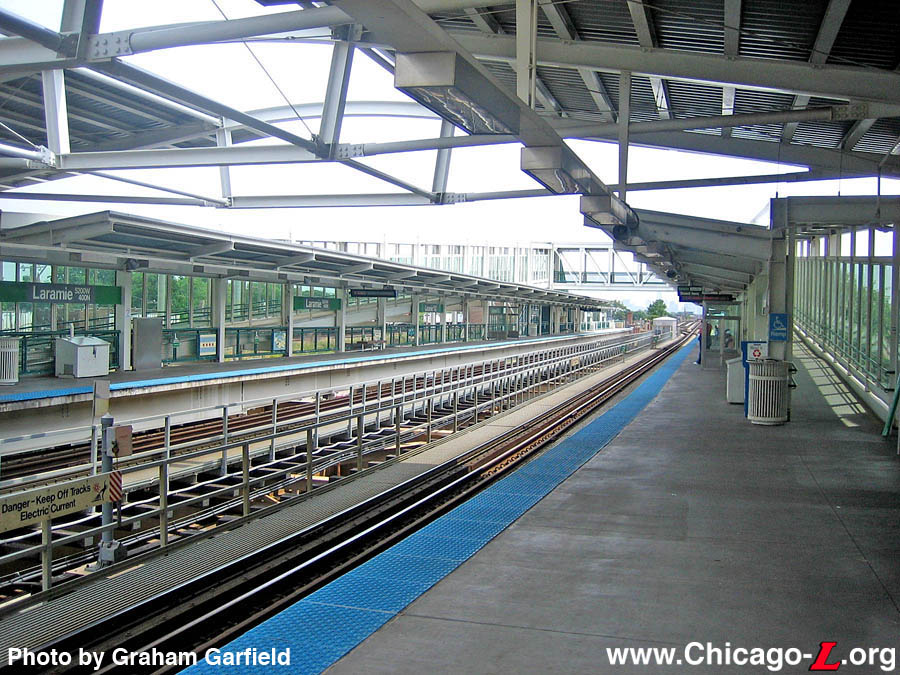
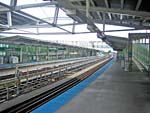
The Laramie station platforms are seen looking east on the
inbound platform near the fare controls on June 15, 2006.
The ramps up to the overhead transfer bridge are seen on the
left and right and the canopy truss typical of the stations
Skidmore
designed for the Lake
Street branch stations is seen overhead.
(Photo by Graham Garfield)
|
|
laramie-lake10.jpg
(194k)
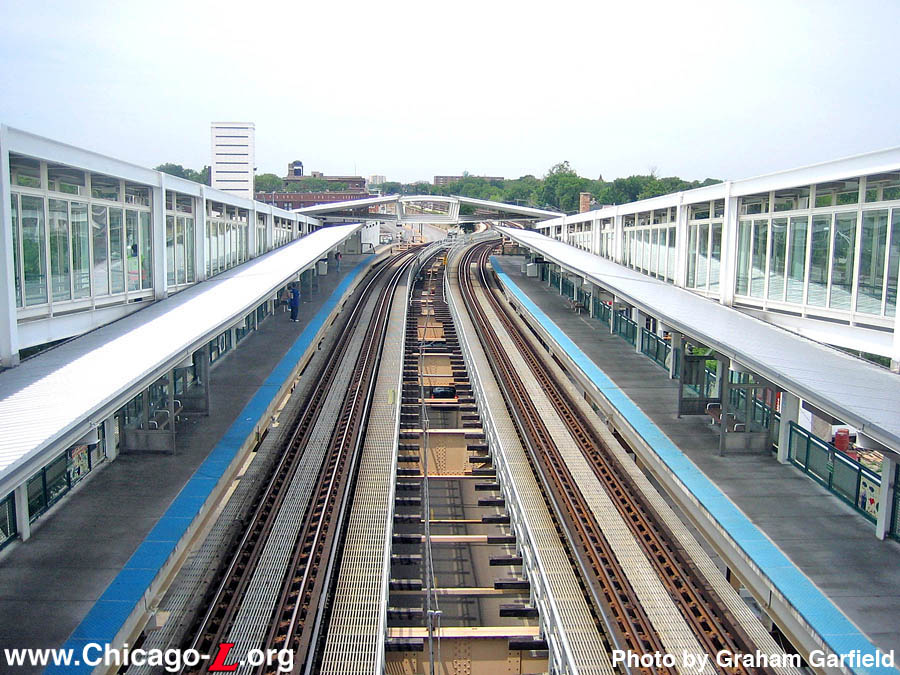
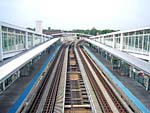
The long ramps that lead to the overhead transfer bridge and
connect the two platforms (and provide the only access to
the outbound platform) are seen looking west from the bridge
on June 15, 2006. In the distance, the tracks turn to the
north to move from over Lake Street to the old Chicago &
North Western (now Metra-Union Pacific) embankment.
Previously, they descended to street level there.
(Photo by Graham Garfield)
|
|
laramie-lake11.jpg
(194k)
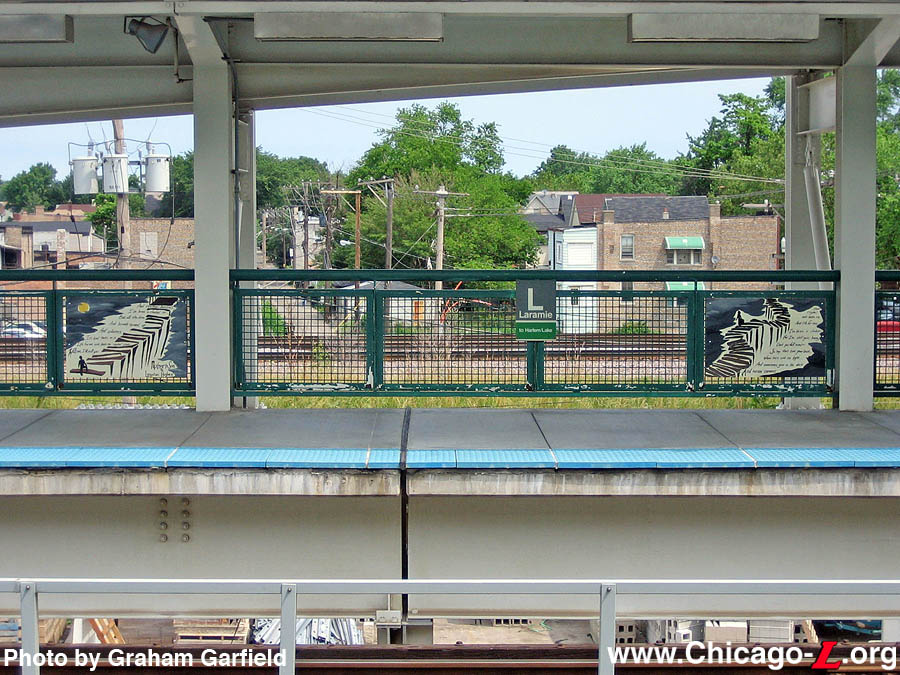
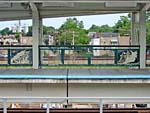
Two examples of the artwork that decorate the Laramie/Lake
station platforms are seen in this view looking north at the
outbound platform on June 23, 2006. The art panels were
decorated by local students and were produced and installed
in cooperation with the city's City
Year volunteer program. (Photo by Graham
Garfield)
|
 |
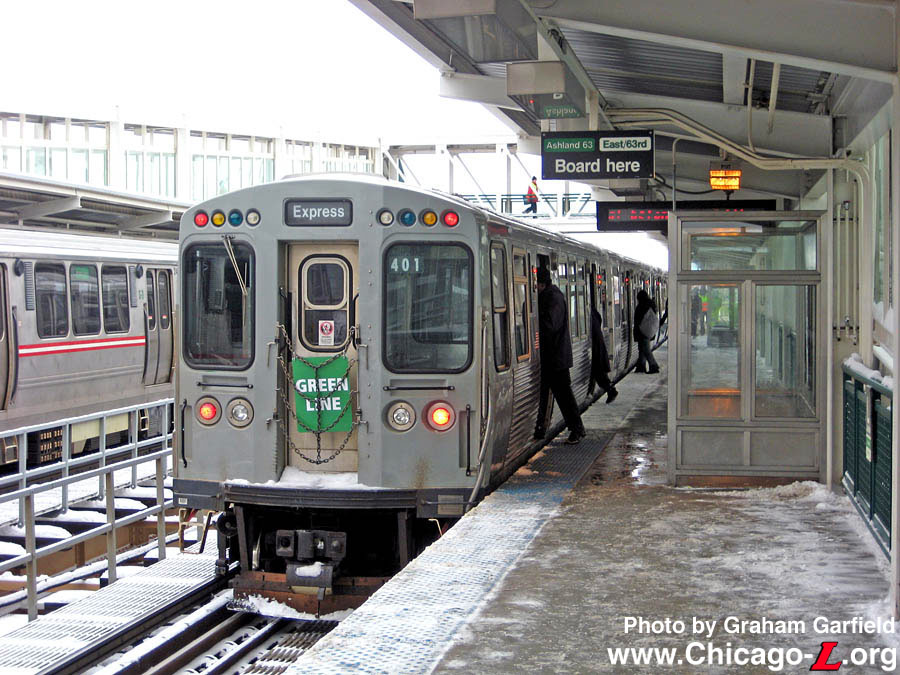
cta3200s-Green.jpg (194k)
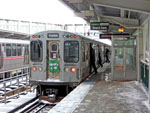
A train of 3200-series cars stops at Laramie on the Green Line on a snowy February 1, 2008. Note the "Express" destination sign and the sign on the chains identifying the train as a Green Line. The train is most likely, in fact, not running express, but using that setting because the cars did not have destination sign roller curtains with Green Line readings and "Express" was the only "generic" reading available (other than "Not in service"). The chain sign was provided for additional identification assistance. During increment weather, when more trains than usual might be out for maintenance due to snow- or cold-related defects, it is not uncommon for cars to be transferred between lines to help cover service. Unfortunately, if they do not have the right roller curtains, this can cause issues with setting destination signs. (Photo Photo by Graham
Garfield) |

Notes:
1. Per Chicago transit historian Andre Kristopans, who worked as a porter at the Lake Street "L" stations during this period.
2. Ibid.
3. Ibid.