|
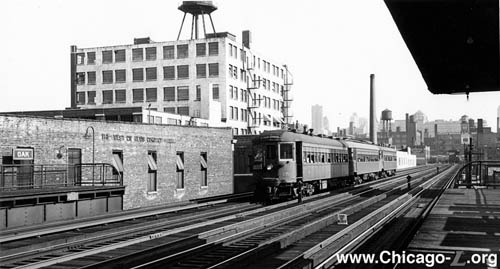
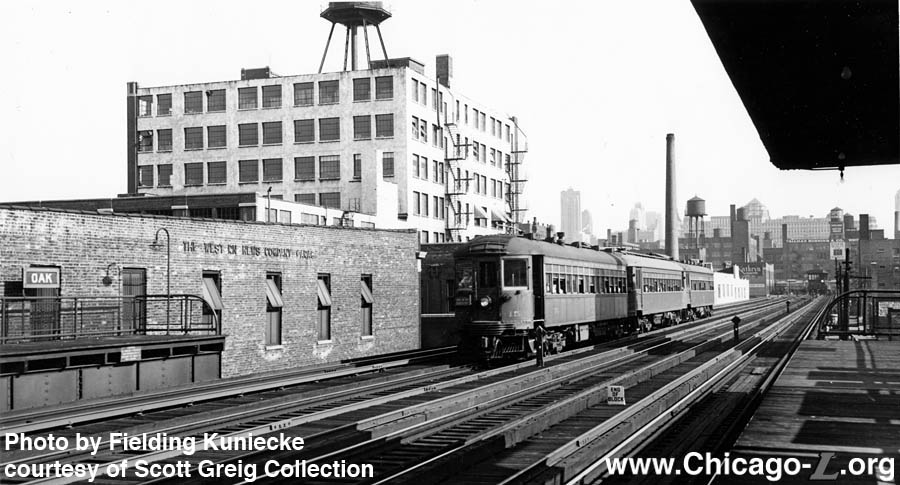
A northbound three-car North Shore Line interurban train, led by a 1915-built Brill coach, is seen in this view looking south circa 1949 as it approaches Oak station on the inner express track. The Oak platforms, despite being built six years later and contemporaneously with the Ravenswood branch, featured railings typical of the original Northwestern Elevated facilities. For a larger view, click here. (Photo by Fielding Kuniecke, from the Scott Greig Collection)
|
Oak
(1000N/400W)
Oak Street and Orleans
Street, Near North Side
Service
Notes:

|
North Side
Division
|
Quick Facts:
Address: 319? W. Oak Street
Established: 1906
Original Line: Northwestern Elevated Railroad
Previous Names: none
Skip-Stop Type: n/a
Rebuilt: n/a
Status: Demolished
History:
Like Willow to the north, Oak station was not part of the original plan of the Northwestern Elevated Railroad as built in 1896-1900. The addition of a station at Oak Street was included in the franchise provided by the city to build the Northwestern Elevated's Ravenswood branch, as was the addition of a stop at Willow Street. Although these stations were not located on the new branch, the city used the Northwestern's desire for permission to build and operate the new spur as leverage to force the "L" company make the otherwise unrelated improvements.
Oak station opened in 1906. The station house was located on the south side of Oak Street, underneath the elevated track structure. It is uncertain what the station house looked like, although its footprint suggests it either resembled Willow's small Craftsman-style building or the masonry station houses built for the elevated portion of the Ravenswood branch, all of which were built at approximately the same time and mandated by the same franchise.
Oak featured dual side platforms, constructed of a wood deck on a steel frame. The platforms featured canopies covering most of the platforms, beginning at the north ends of both platforms and extending about three-quarters of the length southward. Despite being built six years later and contemporaneously with the Ravenswood branch (which had a different design), Oak featured railings typical of the original Northwestern Elevated facilities, with tubular frames and posts with
panels of decorative, vaguely diamond shaped metalwork inside.
The station had an unremarkable history for the next several decades, serving mostly local walk-in traffic from the surrounding apartment houses.
Oak briefly survived the CTA's 1947 takeover, but was one of 23 stations closed in their North-South Route service revision August 1, 1949, which included the closing of several other stops on this line including Division, Larrabee, Schiller, Halsted, Webster, Wrightwood and more. The concept of "local" stations, of which Oak's low usage was only suited, was not a part of the A/B skip stop concept and the station was closed.
Some have
conjectured that Oak and other stations in the Near North area may
have been closed because of or to discourage patronage by public
housing denizens. This theory, however, is almost certainly untrue, if for no other
reason than pure chronology: the only Cabrini housing there in 1949
were the Frances Cabrini Rowhouses, built in 1942. Known at the time
as "Little Sicily," this development served as a stronghold for the
city's Italian-American community and, under Elizabeth Wood's
leadership (1937-1954), the Chicago Housing Authority's developments
were relatively safe, well-maintained places, making them unlikely
sources for crime or disturbances. The high rise towers, formally
known as the William-Green Homes, and the CHA policies and issues
of the high-rise era didn't come to Cabrini until many years after the
stations closed. So it seems unlikely that the public housing was the
reason that Oak and other surrounding stations closed.
However, it is acknowledged that the neighborhood around Cabrini and Oak station
was quite rough by the 1940s, sometimes called "Little Hell" and
consisting of much rundown tenement-style housing (indeed, making it
the very reason why public housing was being located there to begin
with, to provide new, better housing stock). The state of the
neighborhood no doubt made the area unappealing to riders and
Rapid Transit employees alike. But low ridership and the desire to streamline the
North-South Route were the real, primary reason for the stations'
closures.
Today, the entire station is gone and nothing of it remains.
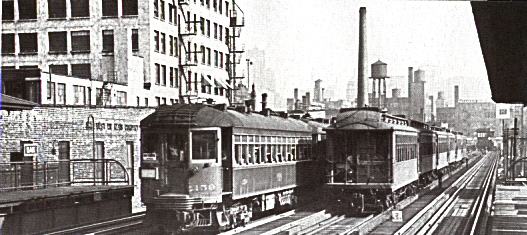
A North Shore Line train overtakes a wooden "L" train at Oak, just a month before its closing, on June 29, 1949. (Photo from the Krambles-Peterson Archive) |