North Water Tower, controlling the switches connecting the North Side Main Line with the short branch to North
Water Terminal, as well as the Wells Street Bridge, is seen looking north.
The overhead transfer bridge connects the station platforms
with the Merchandise Mart building and the North
Water Street station. (Photo from the
CTA Collection) |
North Water
Tower
North Water Street
(Carroll Avenue) and Wells Street, Near North Side
Service
Notes:
|
Services:
|

|
North Side Main
Line
|
Quick Facts:
Established: 1908
Original Line: Northwestern Elevated Railroad
Rebuilt: n/a
Status: Demolished
Profile:
North Water Tower was installed as part of the construction of the North Water Stub branch and station, which was completed and opened on November 17, 1908. The tower, located on the south side of the double-track turnout from the North Side Main Line to the North Water Stub and, after 1930, immediately south of Merchandise Mart station, controlled the junction, as well as the "L"'s switches and signals associated with the Wells Street Bridge.
On July 31, 1949, the CTA instituted its North-South
Route service revision, which included discontinuance of scheduled service out of the North Water Terminal. The stub was retained for emergencies and other non-revenue purposes, however.
The signal and the interlocking machine in the tower were system uniques on the CTA. The interlocking machine was a General Railway Signal Co. (GRS) Model 5 electric machine -- possibly the only one of this manufacturer anywhere on the "L" system -- controlled the North Water Junction and the crossovers in front of the North Water Terminal station. This plant was fully electric, as opposed to electro-pneumatic (powered by compressed air). The North Water machine was equipped with 23 levers, eight of them having detector bars. A detector bar was a mechanical device used to keep a switch locked in position while a train was on the switch. This technology was superseded by detector locking, where track circuits were used to lock the switch. The plant also included 15 signals and seven trip stops. The use of a GRS machine at North Water Tower was unusual at a time when the rest of the system pretty much exclusively used US&S equipment until the Congress Line opened. The Congress Line, which opened in 1958 (two years after North Water Tower was removed from service), was the first broad use of electrically-powered interlocking switches on the "L".1
By the 1950s, there were two different interlocking machines in the tower. A second machine controlling the Wells Street Bridge was a United Switch & Signal (US&S) Model 14 electro-pneumatic machine, of generally the same type as used at many locations throughout the "L".
North Water Tower was closed on August 10, 1956, with the operating controls for the Wells Street Bridge being transferred to Tower 18. Hand-throw switch stands were installed at the switches leading into North Water Terminal. The tower was demolished in early 1957.2
North Water Stub was closed on June 21, 1963 and the switches were removed.

|
NorthWater_19500714.jpg (215k)
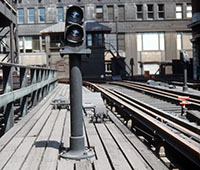
Looking west out of the North Water Stub towards the tower and the Merchandise Mart forming the backdrop on July 14, 1950, this home signal (on the south track of the stub) was a two-aspect signal (mirroring what was then common on many of the "L" semaphores), showing only "stop" or "proceed" indications. Here, it is displaying a "stop" signal, though that's barely visible. Note the "rooster tail" type center trip to the right, which is in the "trip" (up) position. As was common with these trips, the side that would potentially be hit by a train was painted red-orange. The other side of the trip (when down) would have been painted white. (Photo by Barney L. Stone, courtesy of the Krambles-Peterson Archive) |
Notes:
1. Correspondence with Kendrick Bisset, former CTA Director, Power and Way Engineering, 2011 April 29-30.
2.
"Tower Take Out." CTA Transit News, March 1957.