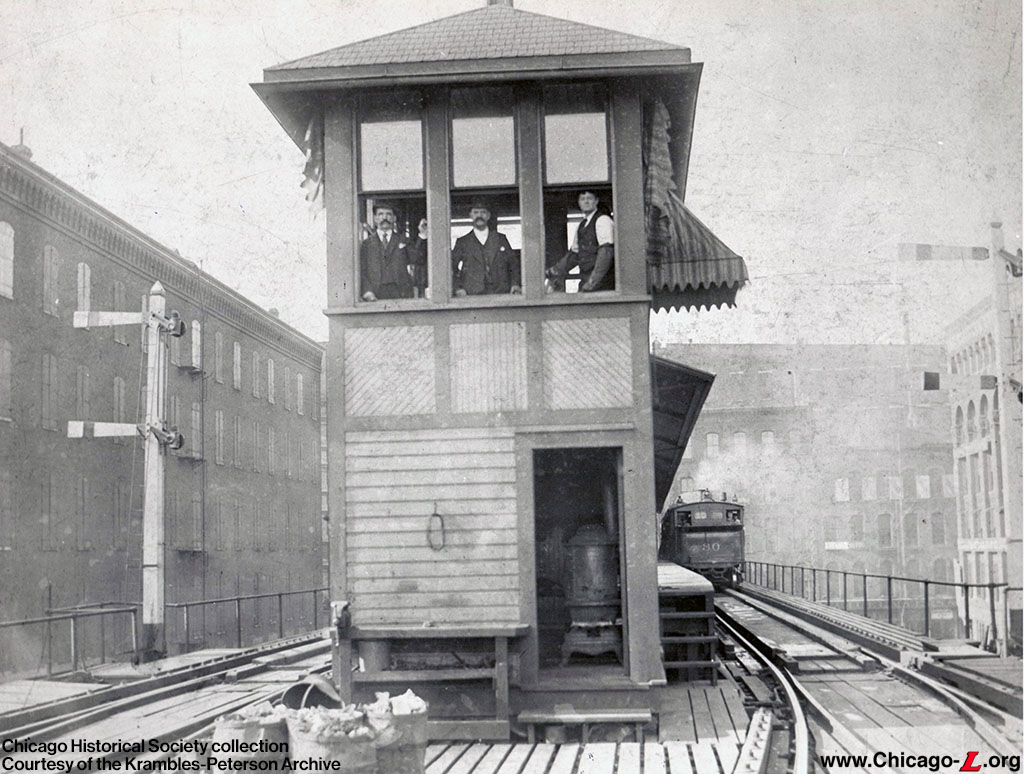
The Market & Madison Tower is seen looking south from the interlocking circa 1895. The tower was located at the north end of the Market Street terminal (the station canopy is visible behind, peaking out on the right side of the tower) and would remain there until operation of the stub closed in 1948. Note Lake Street steam locomotive no. 30 on the west terminal track, on the right. With the tower windows open and one man working in shirtsleeves, this view could not have been taken before 1895 when most trains were diverted to the new extension into the Loop and the Market Stub saw much less traffic. Note the tall semaphore signals; nearly all the later installations used so-called "dwarf" signals, much lower and narrower. For
a larger view, click here. (Photo from the CHS Collection, courtesy of the Krambles-Peterson Archive) |
Market & Madison Tower
Market Street and Madison Street, Loop
Service
Notes:
|
Services:
|

|
Lake Line, Market St Stub
|
Quick Facts:
Established: November 4, 1893
Original Line: Lake Street Elevated Railroad
Rebuilt: n/a
Status: Demolished
Profile:
|
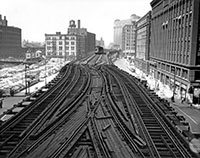
The interlocking at the Market Street Stub terminal is seen looking north from the Madison & Market station. While the stub is already closed and track level demolition has begun in this 1948 view, the track and switch arrangement of the interlocking and center track extending to Randolph station (seen in the distance) is evident. For a larger view, click here. (Photo from the CTA Collection) |
When the Lake Street Elevated first opened, the line began at Madison Street and Market Street (now Wacker Drive), ran north over Market, then turned west on Lake Street to head out to the West Side. The terminal at Market & Madison was a 2-track island platform station. Between the Market Terminal and the next station, Market & Randolph, was a center track that extended the entire 1-1/2 block distance; at the south end of the center track was a set of left- and right-hand crossovers between each main line track and the center track between them, allowing trains to access either terminal track from the inbound main line track and crossover to the outbound main line track when departing. The center track extended for about a block between the interlocking and the Randolph station, likely originally to relay steam locomotives and later motor cars from one end of the train the other in the days before multiple-unit electric traction for the Lake Street "L".
Controlling this interlocking was the Market & Madison Tower, located at the north end of the terminal station platform.
A 1945 inventory of interlockings shows that Market tower was then equipped with a Johnson Signal-designed interlocking. Johnson had been an independent company between 1888 and 1892, when it was sold to Hall Signal. In 1895, Hall was sold to National and ended up in the US&S fold from 1898. US&S sold machines pursuant to these patents until at least 1909. The machine at Market was equipped with 16 levers and controlled seven signals. This was the only machine then in use on the Chicago Rapid Transit which conformed to the Johnson Signal interlocking machine design.
The Market terminal interlocking was interesting in that, at least when it first opened, it featured tall semaphore signals; nearly all the later installations used so-called "dwarf" signals, much lower and narrower. It is unclear how long the tall semaphores lasted, but they were been replaced by lower signals at some point, as later photos show.
On April 4, 1948, the CTA revised Lake "L" service, operating all trains between Forest Park and the Loop and discontinuing service into Market Street Terminal. The tower and interlocking at Market/Madison was removed from service and subsequently demolished when the Market Street Stub was torn down shortly after closure.