|

|

|
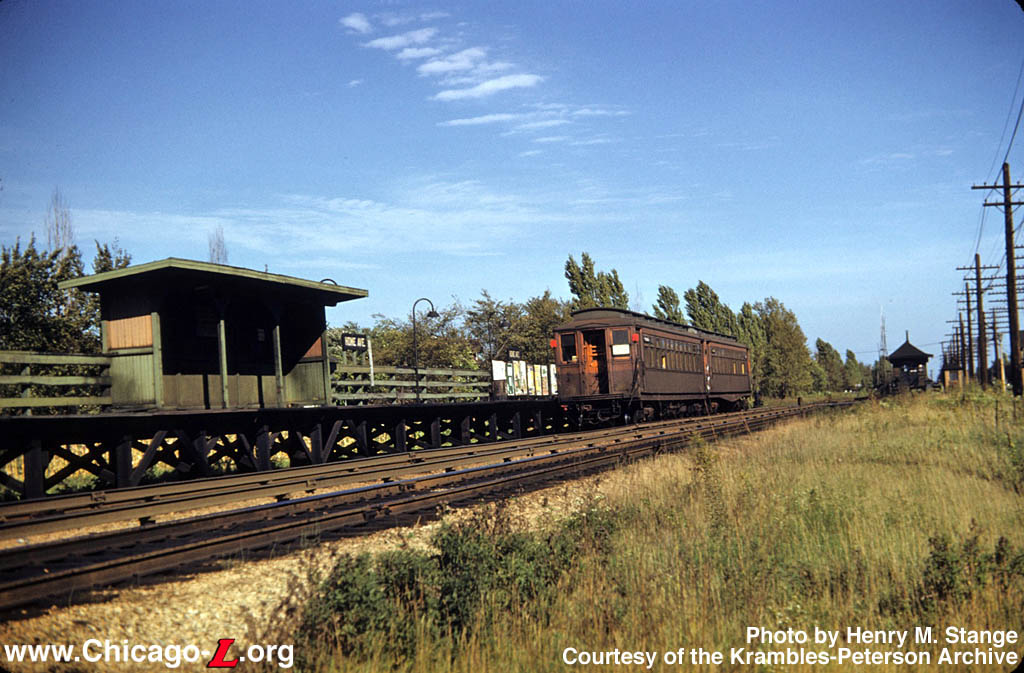
A two-car Garfield Park train of wood motor cars heads west, pulling into Home station on September 23, 1951. Home station had an unusual arrangement, with the platforms on different sides of Home Avenue: the outbound platform (seen in the foreground) was on the west side of the street, while the station house and inbound platform (visible in the distance) was on the east side of the street. The outbound platform had no fare controls, so any collection of fares had to be performed onboard trains by conductors. However, in practice, there was little outbound boarding at Home. The station is painted in hues of green and yellow/cream, reflecting the railcar livery of the 1920s. This was common in the Rapid Transit Co. era, to paint stations in the same scheme as the rolling stock, but the fact that the station still bears this paint scheme in the 1950s when the trains haven't for over a decade explains the station's shabby, well-worn appearance. For a larger view, click here. (Photo by Henry M. Stange, courtesy of the Krambles-Peterson Archive)
|
Home
(1000W/900S)
Home Avenue and Harrison
Street, Village of Oak Park
Service
Notes:

|
Garfield
Line
|
Quick Facts:
Address: TDB
Established: 19101
Original Line: Metropolitan West Side Elevated, Garfield
Park branch
Previous Names: none
|
Skip-Stop
Type:
|

|
Station
|
Rebuilt: n/a
Status: Demolished
History:
The Aurora
Elgin & Chicago interurban began service from Aurora and
Wheaton to a connection with the "L" at 52nd
Avenue (Laramie) on August 25, 1902. However, a station at Home Avenue was not originally included on the AE&C's
main line; the interurban instead had a station at Wisconsin Avenue, one block west of Home.
AE&C service to stations on
this segment of their main line was short-lived, as the Metropolitan
"L" assumed local service between 52nd
Avenue and Desplaines Avenue on
March 11, 1905, relieving the AE&C of this unwanted chore. The
extension of Garfield
Park service to Desplaines and the
Met's servicing of the local stations between was part of the
reciprocal trackage agreement that allowed the AE&C to extend to
downtown Chicago and the Fifth Avenue
Terminal over the Metropolitan Elevated.
The Met "L" continued to serve the existing stations at Wisconsin Avenue (with the station later referred to as Maple Avenue) following their 1905 assumption of local service. However, "L" service to the Maple Avenue station was short-lived. Maple station appears to have been closed in 1910,1 replaced by new stations on either side of it -- to the west at Harlem Avenue, and to the east at Home Avenue.
The Home station consisted of a pair of high-level wooden side platforms split on different sides of the street--the outbound platform on the west side of Home Avenue, while the inbound platform was on the east side of the street. Eventually, a station house was located at the entry to the inbound platform from the street. The design was
typical of other small wood frame ground-level Met station houses.
The headhouse was positioned between the street and the boarding
platform, requiring passage through the station house before reaching
the platform. The exterior used clapboard siding and a peaked roof
with eaves that extended out about a foot. The front featured one set
of double doors, while the sides are broken up by double-hung
sash windows. The rear opened out onto the inbound platform. The
interior was most likely floor-to-ceiling tongue-in-groove paneling,
wood floors and paneled ceilings with a small ticket booth near the
entrance, benches along the walls, a boiler stove for heat and
incandescent lights for illumination.
During the 1950s, the City of Chicago and Cook County undertook
construction of the Congress Superhighway [Eisenhower
Expressway] along the general alignment of the Garfield
Park "L" line. Part of the project also included the new new
Congress "L" Line to
replace the Garfield
Park. Home closed on September 20, 1953. Home was not yet in the
way of the construction project but was closed due to its low
patronage to speed up service on the Garfield
Line, which had slowed due to a temporary grade-level trackage
along Van Buren between Sacramento and Aberdeen with multiple street
crossings.