|
|



|
|
|


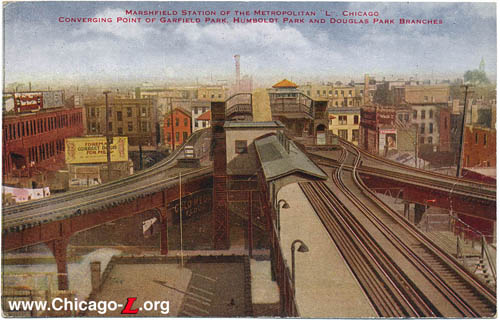
This pre-World War I postcard looks east from Marshfield Junction. For a larger view, click here. (Postcard from the Graham Garfield Collection) |
|
|
|
|
|
|
This pre-World War I postcard looks east from Marshfield Junction. For a larger view, click here. (Postcard from the Graham Garfield Collection) |
Marshfield
Junction
Marshfield Avenue, between
Van Buren and Congress streets, Near West Side
Service Notes:
Services:
Logan Square/Garfield Park/Douglas Lines
Quick Facts:
Established: May 6, 1895
Original Line: Metropolitan West Side Elevated Railroad
Rebuilt: n/a
Status: Demolished
Profile:
Marshfield Junction was the location where the Metropolitan West Side Elevated's main line divided into three separate branches: the Northwest branch, Garfield Park branch, and Douglas Park branch. A station was located immediately east of the junction, serving as the last chance to transfer between the various services before they diverged north, west, and south, respectively.
The Marshfield Junction was a complicated place indeed. East of Marshfield station, the two inbound and two outbound tracks become two paralleling double-tracks. Garfield Park and Douglas Park trains used the south set of tracks; Logan Square and Humboldt Park trains used the north pair. This arrangement carried over to Marshfield's dual island platforms, where those bound for the northwest branches used the north platform while those going to points west and southwest used the south platform. Immediately west of the station, the tracks forked into a Y with three two-track lines (cutting the roof of the Dreamland Dance Hall below into three slices) going north (Humboldt Park and Logan Square), west (Garfield Park) and south (Douglas Park). An interlocking tower was located at the east end of the south platform to control this junction.
The relatively short island Marshfield station platforms were also lengthened over the years, eventually enveloping the first floor of the interlocking tower in the case of the south platform.
In 1951, trains to and from Logan Square were rerouted from their Milwaukee-Paulina alignment through Marshfield Junction into the Milwaukee-Dearborn Subway, which continued under Milwaukee, under Lake Street, then under Dearborn (later connecting to the Congress-Douglas trains under Congress Street upon that alignment's completion in 1958). Garfield Park and Douglas Park trains to and from the Loop, however, continued to operate over the old Met main line and through Marshfield Junction for the time being.
In 1953, the Garfield Line was rerouted via temporary grade-level trackage along Van Buren due to expressway construction, vacating the elevated and discontinued using Marshfield Junction. At this point, only Douglas trains passed through Marshfield, which technically was no longer a junction since no other routes diverged at this point. But this was short-lived. Marshfield Junction was closed on April 4, 1954 when the Douglas Line was temporarily rerouted to the Loop via the Lake Street "L" and Paulina Connector (former Northwest branch). A new section of track was built immediately west of Marshfield Junction to provide a straight connection between the Douglas branch and Paulina Connector, bypassing Marshfield Junction entirely.
|
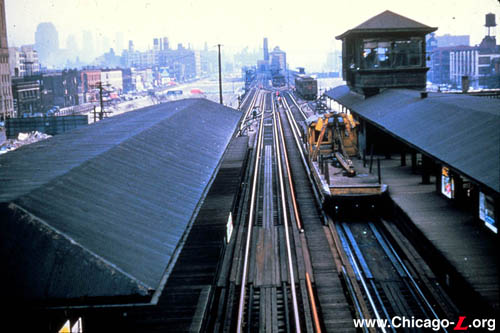
Marshfield is seen looking east from the overhead transfer bridge in the early 1950s as a work train sits in the station on the outbound Garfield/Douglas track. In the background, just beyond the inbound two-car wooden "L" train, the crossover where two inbound and two outbound tracks become two paralleling double-tracks is visible. The interlocking tower looms over the south platform. For a larger view, click here. (Photo from the Graham Garfield Collection) |
.

 |
ROW@VanBuren01.jpg
(204k) |
 |
ROW@VanBuren02.jpg
(221k) |
|
|
|